Kāliya-ghāṭa
कालिय-घाट Hindi name proposed
Also called Kāliyā-hrada, Kali-Daha Ghāṭa

- What it is
- Kāliya-ghāṭa is the bathing place on the old bank of the Yamunā in Vṛndāvana that marks Kāliya's lake, the Kāliya-hrada of the scriptures, today called Kāliya-daha.
- Visiting
- The Color Guide to Vṛndāvana (2000) says that the Yamunā reaches the ghāṭa only in the rainy-season floods.
- Places here
- Bilvamaṅgala's place of bhajana, Kadamba tree at Kāliya-ghāṭa
In short
Kāliya-ghāṭa is the bathing place on the old bank of the Yamunā in Vṛndāvana that marks Kāliya's lake, the Kāliya-hrada of the scriptures, today called Kāliya-daha. Śrīla Prabhupāda identifies the two: Kāliya-hrada, he writes, is the bathing place known as Kāliya-ghāṭa.[1 +7] Śrīmad-Bhāgavatam tells how Kṛṣṇa jumped from a tall kadamba tree into the poisoned lake, danced on the heads of the serpent Kāliya and sent him away, and how Kṛṣṇa Himself said that bathing here frees one from sin.[9 +8] Śrī Caitanya Mahāprabhu bathed here, according to the Caitanya-caritāmṛta. A guidebook of 2000 says that the river reaches the ghāṭa only in the rainy-season floods.[3 +8]
Key facts
| Kind | ghāṭa |
|---|---|
| Region · area | Vṛndāvana |
| Also part of | Yamunā |
| Ācāryas | Śrī Caitanya Mahāprabhu, Śrīla Prabodhānanda Sarasvatī, Śrīla Bilvamaṅgala Ṭhākura, Śrīla Sanātana Gosvāmī |
Why it is glorified
When Kāliya had gone, Kṛṣṇa called the lake "this place of My pastimes" and gave it a blessing: whoever bathes in it, offers its …
When Kāliya had gone, Kṛṣṇa called the lake "this place of My pastimes" and gave it a blessing: whoever bathes in it, offers its water to the demigods and others, fasts, and worships and remembers Him is freed from all sins.[15 +2]
yo 'smin snātvā mad-ākrīḍe devādīṃs tarpayej jalaiḥ / upoṣya māṃ smarann arcet sarva-pāpaiḥ pramucyate
If one bathes in this place of My pastimes and offers the water of this lake to the demigods and other worshipable personalities, or if one observes a fast and duly worships and remembers Me, he is sure to become free from all sinful reactions.
Translation: Śrīla Prabhupāda's disciples (BBT)Śrīla Sanātana Gosvāmī explains (summarised here, not translated) that Kṛṣṇa gave this blessing to purify the lake, which had become as if spoiled by the serpents who lived in it, and he calls it a great tīrtha, a holy bathing place. Śrīla Jīva Gosvāmī takes the fast here as the fast kept at a tīrtha.[21 +3]
The Padma Purāṇa describes Vṛndāvana as a lotus with eight petals. It places Kālī-hrada on the sixth petal, in the north-west, and calls that petal the best of the best; Dvādaśāditya is on the fifth.[25]
द्वादशादित्यमत्रैव दलं च कर्णिकासमम् । वायव्यां तु दलं षष्ठं तत्र कालीह्रदः स्मृतः ॥ … दलोत्तमोत्तमं चैव प्रधानं स्थानमुच्यते ।
dvādaśādityamatraiva dalaṁ ca karṇikāsamam
vāyavyāṁ tu dalaṁ ṣaṣṭhaṁ tatra kālīhradaḥ smṛtaḥ
… dalottamottamaṁ caiva pradhānaṁ sthānamucyate |
The Nārada Purāṇa counts the place where the subduing of Kāliya was shown to the cowherds among the holy tīrthas of Vṛndāvana, one that removes sin.[26] Śrīla Rūpa Gosvāmī's Mathurā-māhātmya gives Kāliya's lake a section of its own. In the verses it quotes from the Varāha Purāṇa, the Lord calls the lake holy, His supreme secret, where He plays forever in the pure water of the Yamunā; in a verse from the Saura Purāṇa, whoever bathes at this Kāliya-tīrtha, where the Lord as a boy danced on Kāliya's head, and worships Vāsudeva reaches union with Kṛṣṇa (summarised here, not translated).[27 +2] Śrīla Raghunātha dāsa Gosvāmī's Vraja-vilāsa-stava worships the lake where Hari, dancing, crushed with His soles the Kāliya who had offended His dear ones and friends.[30]
Divine pastimes
The poisoned lake
Śrīmad-Bhāgavatam (10.15–10.17) tells that once Kṛṣṇa went to the Yamunā with His friends but without Balarāma. The cows and boys drank the poisoned water and fell lifeless at the water's edge, and Kṛṣṇa brought them back to life with His glance.[31 +2] Within the river was a lake where the serpent Kāliya lived. His poison boiled its water; birds flying over it fell in, and every plant and creature on its shore died.[34 +5]
śrī-śuka uvāca kālindyāṃ kāliyasyāsīd hradaḥ kaścid viṣāgninā / śrapyamāṇa-payā yasmin patanty upari-gāḥ khagāḥ
Śrī Śukadeva Gosvāmī said: Within the river Kālindī [Yamunā] was a lake inhabited by the serpent Kāliya, whose fiery poison constantly heated and boiled its waters. Indeed, the vapors thus created were so poisonous that birds flying over the contaminated lake would fall down into it.
Translation: Śrīla Prabhupāda's disciples (BBT)Śrīla Prabhupāda's Kṛṣṇa book says the same in his own words: the whole river that ran before Vṛndāvana had become deadly.[40] The commentators on the Bhāgavatam place the lake without naming a ghāṭa (summarised here, not translated). Śrīla Sanātana Gosvāmī, Śrīla Jīva Gosvāmī, Śrīla Viśvanātha Cakravartī Ṭhākura and Śrīla Baladeva Vidyābhūṣaṇa say that it lay on the southern side of the Yamunā, apart from her current; otherwise the poison would have reached Mathurā. Śrīla Sanātana Gosvāmī and Śrīla Jīva Gosvāmī say that it was within Śrī Vṛndāvana.[24 +5] They tell different things about the day and why Balarāma stayed at home.[45] Read more: How Kṛṣṇa subdued the serpent Kāliya →
The kadamba tree
Kṛṣṇa climbed a very tall kadamba tree on the bank, tightened His belt, slapped His arms and jumped into the poisoned lake. The Garga-saṁhitā adds that He tied His yellow cloth at His waist.[46 +4]
taṃ caṇḍa-vega-viṣa-vīryam avekṣya tena
duṣṭāṃ nadīṃ ca khala-saṃyamanāvatāraḥ … kṛṣṇaḥ kadambam adhiruhya tato 'ti-tuṅgam
āsphoṭya gāḍha-raśano nyapatad viṣode
Lord Kṛṣṇa saw how the Kāliya serpent had polluted the Yamunā River with his terribly powerful poison. Since Kṛṣṇa had descended from the spiritual world specifically to subdue envious demons, the Lord immediately climbed to the top of a very high kadamba tree and prepared Himself for battle. He tightened His belt, slapped His arms and then jumped into the poisonous water.
Translation: Śrīla Prabhupāda's disciples (BBT)Why that one tree had not died is explained in more than one way. Śrīla Prabhupāda writes that some commentators say the touch of Kṛṣṇa's lotus feet revived it, and that some Purāṇas say Garuḍa had put nectar on it. Śrīla Śrīdhara Svāmī gives both reasons, and Śrīla Jīva Gosvāmī says that it was Kṛṣṇa's own tree, kept by Him for His pastime.[16 +1] Śrīla Rūpa Gosvāmī, Śrīla Jīva Gosvāmī and the Bhakti-ratnākara quote, as from the Varāha Purāṇa, a verse on a great kadamba east of Kāliya-hrada, with a hundred branches, that blossoms in all twelve months; the Bhakti-ratnākara applies it to the tree from which Kṛṣṇa jumped.[17 +3] Śrīla Jīva Gosvāmī quotes it to show that the divine trees of Vṛndāvana are seen even now by great devotees.[17 +2] The guidebooks show a kadamba tree at the ghāṭa today.[7 +4]
In the serpent's coils
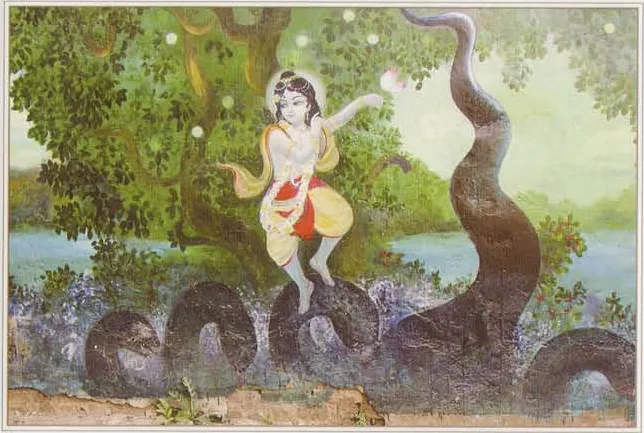
Kāliya bit Kṛṣṇa and wrapped Him in his coils. Balarāma, who knew His brother's power, stopped Nanda and the other cowherd men from entering the lake. After a short time Kṛṣṇa saw that His people were in great distress on His account, rose from the coils, mounted Kāliya's heads and danced on them, crushing each head that would not bow, until Kāliya, his hoods broken, took shelter of Him within his mind.[9 +5]
Having severely depleted the serpent’s strength with His relentless circling, Śrī Kṛṣṇa, the origin of everything, pushed down Kāliya’s raised shoulders and mounted his broad serpentine heads. Thus Lord Śrī Kṛṣṇa, the original master of all fine arts, began to dance, His lotus feet deeply reddened by the touch of the numerous jewels upon the serpent’s heads.
Translation: Śrīla Prabhupāda's disciples (BBT)The commentators see these events in the light of devotion (summarised here, not translated). Śrīla Sanātana Gosvāmī says that Kāliya surrendered only in his mind because he could not even say "I am Yours".[56 +5] Śrīla Viśvanātha Cakravartī Ṭhākura says that Kāliya's wives, seeing him surrender, saw that he had become a Vaiṣṇava and tried to save him; Śrīla Jīva Gosvāmī names their company, and his living in the Yamunā within Vṛndāvana, as the cause of his good fortune.[7 +3] The wives prayed that they did not know how Kāliya had earned the touch of the dust of Kṛṣṇa's feet, for which the goddess of fortune had performed austerities.[66 +2] According to Śrīla Rūpa Gosvāmī, Kṛṣṇa's Kaustubha gem was presented to Him by the hands of Kāliya's wives, and Śrīla Viśvanātha Cakravartī Ṭhākura explains that the gem had entered the serpent's treasury unseen (summarised here, not translated).[69]
Why Kāliya lived here
Kāliya had fled to this lake from Ramaṇaka island because Garuḍa could not come here.[39 +4] The Bhāgavatam, the Garga-saṁhitā and the Brahma-vaivarta Purāṇa tell that the sage Saubhari, meditating in the lake, had cursed Garuḍa when he came to take its fish; they differ on the details.[74 +5]
Names this place“Kāliya, who is also known as Kadrusuta, son of Kadru, immediately fled to the lake known as Kāliya-hrada, which lay within the Yamunā River and which Garuḍa could not approach.”
Śrīla Prabhupāda, Kṛṣṇa, the Supreme Personality of Godhead, Chapter 17 (Extinguishing the Forest Fire) · vedabase.io
Kṛṣṇa sent Kāliya with his family back to Ramaṇaka in the ocean, marked with His footprints so that Garuḍa would not harm him, and the Yamunā became free of poison.[39 +4]
On the bank
Kṛṣṇa came out of the lake wearing divine garlands and jewels.[80 +4] At the brāhmaṇas' request Nanda gave them cows and gold for His safety.[39 +1] That night the Vrajavāsīs, too tired to go home, slept near the bank of the Yamunā; a forest fire surrounded them, and Kṛṣṇa swallowed it.[39 +3] Śrīla Sanātana Gosvāmī says that they stayed where they had met Kṛṣṇa, a little away from the lake's water for fear of the poison.[88 +2] The guidebook Śrī Vraja-maṇḍala Parikramā (2007) sets the night and the fire at Dāvānala-kuṇḍa, a little to the east.[39 +3] Read more: Kṛṣṇa swallows the forest fire on the night after Kāliya →
Traditional accounts
In Śrīla Jīva Gosvāmī's Gopāla-campū the young gopīs, in a time of great distress, come to Kāliya-hrada early one morning; a …
Other pastimes at the lake
In Śrīla Jīva Gosvāmī's Gopāla-campū the young gopīs, in a time of great distress, come to Kāliya-hrada early one morning; a voice from the sky and the Yamunā protect them, and Paurṇamāsī consoles them (summarised here, not translated).[91] Śrīla Rūpa Gosvāmī's drama Vidagdha-mādhava also sets a scene of Śrī Rādhā's pastimes at Kāliya-hrada and the nearby Dvādaśāditya-tīrtha.[92] The same drama describes Nanda's settlement as stretching from the slope of Govardhana to Kāliya-hrada, and the Canto 10 commentators also use the lake as the landmark of the settlement.[93 +1]
In Śrīla Rūpa Gosvāmī's Haṁsadūta Lalitā tells the swan messenger to drink the water of Kāliya-hrada, tinted by jewels that fell from the serpent's hoods during the dance and fragrant with kadamba pollen.[95] In his Bhakti-rasāmṛta-sindhu a speaker whom the verse does not name, in despair when Kṛṣṇa had gone into the lake, asks his wife to offer themselves with him into its poison; Śrīla Prabhupāda's The Nectar of Devotion tells it as Nanda speaking to Yaśodā.[96]
Bathing here
According to the Bhakti-ratnākara, whoever bathes here is freed from all sins without effort, and whoever leaves the body here goes to the world of Viṣṇu.[17 +1] The same book says that bathing at the Kāliya-tīrtha brings success in many undertakings; Śrīla Prabhupāda quotes the couplet:[17 +2]
Names this placeKālīya-hrada is mentioned in the Bhakti-ratnākara … “When one takes a bath in Kālīya-hrada, he is freed from all sinful reactions. One can also be successful in business by bathing in Kālīya-hrada.”
Śrīla Prabhupāda, Śrī Caitanya-caritāmṛta, Madhya-līlā 18.71, purport · vedabase.io
Śrīla Nārāyaṇa Bhaṭṭa Gosvāmī's Vraja-bhakti-vilāsa gives pilgrims a mantra to say at Kāliya-hrada while bathing, sipping water and praying, addressed to Gopāla who danced the tāṇḍava and was pleased by the prayers of the serpent's wives.[100]
The merchant's boats
The Color Guide to Vṛndāvana (2000) tells that the boats of salt of a merchant from Multan stuck on a sandbank at Kāliya-ghāṭa until Śrīla Sanātana Gosvāmī sent him to pray to Madana-mohana, and that, freed, he built the Madana-mohana temple; this local tradition is not certain. The Bhakti-ratnākara tells of the merchant without any stranding, and other guidebooks set the place differently.[101 +1]
Accounts differ Who the merchant was who built Madana-mohana's temple, and whether and where his boat stuck before he came to Śrīla Sanātana Gosvāmī.
- The Color Guide to Vṛndāvana (2000); the undated parikramā notes VṛndāvanaThe Multan merchant Rāmdāsa Kapoor's boats of salt (the undated parikramā notes Vṛndāvana: one boat) stuck on a sandbank at Kāliyā-ghāṭa; a cowherd boy (The Color Guide to Vṛndāvana (2000): Madana-mohana) sent him to Sanātana on Dvādaśāditya hill; when he prayed to Madana-mohana the boats were freed (The Color Guide to Vṛndāvana (2000): by a storm and heavy rain), and he later built the temple.
- Śrī Vraja-maṇḍala Parikramā (2007)Kṛṣṇadāsa Kapūra, a rich merchant from the Multāna province, travelling on the Yamunā with valuable goods in large boats; the boats stuck in the sand as they approached Śrīla Sanātana Gosvāmī's bhajana-kuṭī; he came ashore, saw Madana-mohana, vowed a temple, and the boats came free by themselves.
- Vṛndāvana, the Playground of God (2010)A boat of salt bound for Agra stuck in the sand immediately beneath Dvādaśāditya-ṭīlā; the merchant Kṛṣṇadāsa Kapoor asked Sanātana for help and was told to ask Madana-mohana; the boat came free and he vowed the temple, opened in 1581.
- Bhakti-ratnākara, Second Wave (1912 ed. pp. 93-94)Kṛṣṇadāsa, a very rich Kapūra kṣatriya from Multan, came down from a boat to Śrīla Sanātana Gosvāmī, fell at his feet, was dedicated by him to Madana-mohana and began the temple that same day; no stranding, salt or place on the river is mentioned.
The Gosvāmīs and ācāryas
According to the Caitanya-caritāmṛta (Madhya 18), while staying at Akrūra-tīrtha, Śrī Caitanya Mahāprabhu went to Vṛndāvana and …
Śrī Caitanya Mahāprabhu
According to the Caitanya-caritāmṛta (Madhya 18), while staying at Akrūra-tīrtha, Śrī Caitanya Mahāprabhu went to Vṛndāvana and bathed at Kāliya-hrada and Praskandana.[18 +5]
আর দিন আইলা প্রভু দেখিতে ‘বৃন্দাবন’ ।
‘কালীয়-হ্রদে’ স্নান কৈলা আর প্রস্কন্দন ॥ ৭১ ॥
āra dina āilā prabhu dekhite ‘vṛndāvana’
‘kālīya-hrade’ snāna kailā āra praskandana
The next day, Śrī Caitanya Mahāprabhu went to Vṛndāvana and took His bath at Kālīya Lake and Praskandana.
Translation: Śrīla A.C. Bhaktivedanta Swami PrabhupādaAccording to the same chapter, during His stay crowds went at night to Kāliya-daha, sure that Kṛṣṇa had appeared again and was dancing on Kāliya's hoods. It was a fisherman with a torch in his boat.[19 +3] Śrīla Prabhupāda draws the lesson:[19 +3]
Names this place“The puzzled people who visited Śrī Caitanya Mahāprabhu were actually seeing Lord Kṛṣṇa, but they were mistaken in thinking that Lord Kṛṣṇa had come to Kālīya Lake. … This incident at Kālīya-daha is very instructive for those eager to advance in Kṛṣṇa consciousness.”
Śrīla Prabhupāda, Śrī Caitanya-caritāmṛta, Madhya-līlā 18.99, purport · vedabase.io
Two other lives of Śrī Caitanya, Śrīla Murāri Gupta's Kṛṣṇa-caitanya-caritāmṛta and Śrīla Locana dāsa Ṭhākura's Caitanya-maṅgala, tell that His guide showed Him the lake where Kāliya was subdued, the ghāṭa where Kṛṣṇa came out of the water, and an image of Kāliya's subduer there.[108 +2]
Śrīla Prabodhānanda Sarasvatī
The guidebooks place the samādhi of Śrīla Prabodhānanda Sarasvatī beside Kāliya-ghāṭa, about twenty metres away, behind the great kadamba tree.[55 +6] According to the Bengali Bhaktamāla of Kṛṣṇadāsa Bābājī (1905), the author of the Caitanya-candrāmṛta and the Vṛndāvana-śataka has his samādhi here, at Kāliya-hrada, where he relishes the pastime of the subduing of Kāliya.[117]
Other ācāryas
Śrīla Bilvamaṅgala Ṭhākura's place of bhajana
One guidebook, Śrī Vraja-maṇḍala Parikramā (2007), names a place where Śrīla Bilvamaṅgala Ṭhākura did his bhajana (his chanting and prayer) on the bank of Kāliya-daha, the pool of the serpent Kāliya, near Kāliya-ghāṭa in Kāliya-damanavana; it describes no shrine or marker there, and the other guidebooks, which describe the ghāṭa and the places near it, do not mention it.[7 +4] No older text mentions it. Śrīla Prabhupāda and the other guidebooks place his long stay in Vṛndāvana at Brahma-kuṇḍa instead, so the sources differ (see below).[120]
The 2007 guidebook tells Śrīla Bilvamaṅgala Ṭhākura's life here, and Śrīla Prabhupāda tells the same story. Attached to Cintāmaṇi, he went to her on the day of his father's funeral rites, crossed the flooded river holding a dead body that he took for a log, and climbed her wall by a snake that he took for a rope. Her words, that such attraction should be given to Kṛṣṇa, turned him to Kṛṣṇa.[55 +2] On the way to Vṛndāvana he was again attracted to a woman, asked her for her hairpins and blinded himself:[55 +2]
General teaching (does not name the place)When Bilvamaṅgala Ṭhākura was going to Vṛndāvana, he was still attracted to women. … “Mother, please give me the pins out of your hair. I am very mad after the beauty of women. So let me pluck out my eyes.” … Although he could not see, in Vṛndāvana he was supplied milk by Kṛṣṇa Himself.
Śrīla Prabhupāda, Teachings of Lord Kapila, Chapter 14 (Bhakti as Ultimate Liberation), text 32, purport · vedabase.io
According to Śrīla Prabhupāda, Kṛṣṇa came to the blind saint in Vṛndāvana as a cowherd boy and brought him milk; the sources that tell this name no spot in Vṛndāvana.[120 +2] The guidebook says that he came from a village on the Kṛṣṇa-veṇvā river in South India, and Śrīla Prabhupāda writes that it is said he lived on the banks of the Kṛṣṇa-veṇvā, a branch of the Kṛṣṇā.[55 +2]
Śrīla Prabhupāda
In the Caitanya-caritāmṛta (Madhya 5.14) the pilgrims of the Sākṣi-gopāla story bathe at Keśī-ghāṭa and Kāliya-ghāṭa, and Śrīla …
In the Caitanya-caritāmṛta (Madhya 5.14) the pilgrims of the Sākṣi-gopāla story bathe at Keśī-ghāṭa and Kāliya-ghāṭa, and Śrīla Prabhupāda explains the name of the text:[1 +1]
Names this place“kālīya-hrada — the bathing place on the bank of the Yamunā known as Kāliya-ghāṭa”
Śrīla Prabhupāda, Śrī Caitanya-caritāmṛta, Madhya-līlā 5.14, synonyms and translation · vedabase.io
He tells Kṛṣṇa's blessing on the lake in his Kṛṣṇa book:[15 +2]
Names this placeThe Lord also declared, “If one takes a bath in the Kāliya lake, where My cowherd boyfriends and I have bathed, or if one fasts for a day and offers oblations to the forefathers from the water of this lake, he will be relieved from all kinds of sinful reactions.”
Śrīla Prabhupāda, Kṛṣṇa, the Supreme Personality of Godhead, Chapter 16 (Subduing Kāliya) · vedabase.io
In his life of Śrī Caitanya, Śrīla Prabhupāda names Kāliya-hrada among the places of Vṛndāvana that the Lord visited.[20]
Visiting today
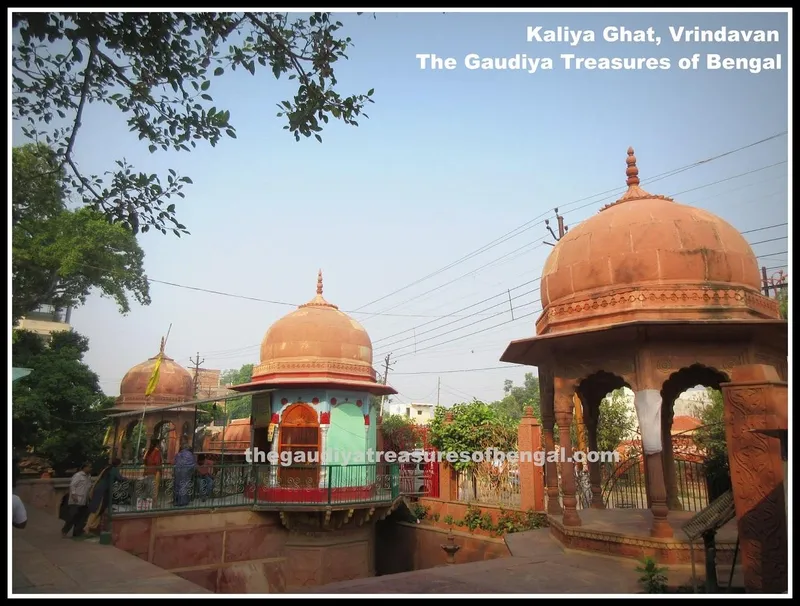
The Color Guide to Vṛndāvana (2000) says that the Yamunā reaches the ghāṭa only in the rainy-season floods. Vṛndāvana, the Playground of God (2010) says that in Kṛṣṇa's time the river flowed right past the ghāṭa and speaks of "what used to be the Kāliya Lake". Śrī Vraja-maṇḍala Parikramā (2007) puts the ghāṭa on the old bank about half a mile north of Varāha-ghāṭa.[3 +5]
Near the ghāṭa the guidebooks show the kadamba tree, Śrīla Prabodhānanda Sarasvatī's samādhi, the Kāliya-mardana Mandira, and Dvādaśāditya-ṭīlā with the old Madana-mohana temple. Śrī Vraja-maṇḍala Parikramā puts Sonaraka, Saubhari's hermitage, about a mile to the west.[7 +4]
Location
| Where it is | on the Yamunā; map key 1 (west of town)[133] old bank, about half a mile north of Varāha-ghāṭa; map label[134] |
|---|
Places at Kāliya-ghāṭa
3 places
Nearby places
Varāha-ghāṭa · Sonaraka · Dvādaśāditya-ṭīlā · Prabodhānanda Sarasvatī's samādhi
Pictures
4 pictures
History
The historian A. W. Entwistle (1987) reports that an inscription on the steps of the ghāṭa names "Holkar Rao" as their builder, which he dates to the early nineteenth century, and that it appears to have replaced an older ghāṭa of Bīr Singh Deo of Orchhā.[103 +1] The Bengali Vṛndāvana-kathā (1920) and The Color Guide to Vṛndāvana (2000) also name Holkar Rāo as the builder; the book of 1920 adds that when these ghāṭas were built cannot be told exactly.[8 +1]
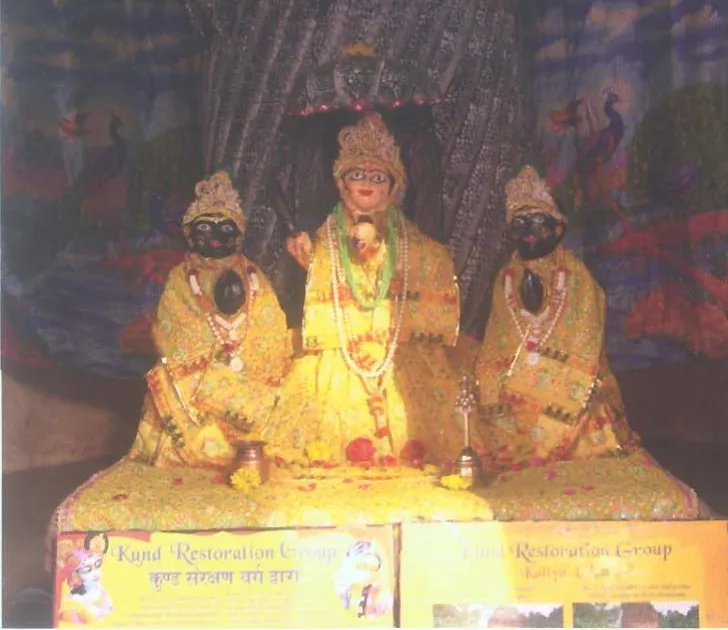
Entwistle also reports that Lakṣmīdhara's digest of the early twelfth century already names a Kāliyahrada, and adds that there is no sign whether it is the place known today.[106] In his account of 1987 one of the kiosks on the ghāṭa had been made into a small shrine with a modern image of Kṛṣṇa dancing on Kāliya. He does not say whether an older image he mentions is the Deity of the nearby Kāliya-mardana Mandira.[103]
Where the sources differ
Whether Kāliya was subdued at Kāliya's lake or at Dvādaśāditya, and how the two places relate.
Whether Kāliya was subdued at Kāliya's lake or at Dvādaśāditya, and how the two places relate.
Accounts differ Where Kāliya was subdued, in relation to Dvādaśāditya.
- Śrīmad-Bhāgavatam 10.16.4 and 10.16.29, with Śrīla Sanātana GosvāmīIn a lake (hrada) of the serpent Kāliya within the river Kālindī (Yamunā); Śrīla Sanātana Gosvāmī: 'within Śrī Vṛndāvana, in the lake of the Śrī Yamunā'. No tīrtha called Dvādaśāditya is named.
- Varāha Purāṇa 156.14–15At the sun-tīrtha called Dvādaśāditya, where Kāliya sported in the Kālindī's water: there Kāliya was subdued, and the Ādityas were established by Me.
- Padma Purāṇa, Pātāla-khaṇḍa 69.30–31In the thousand-petalled lotus called Gokula (69.23), Dvādaśāditya is the fifth petal (north) and Kālī-hrada the sixth (north-west): two different petals.
- Śrīla Rūpa Gosvāmī, Mathurā-māhātmya v.387–396Separate sections for Kāliya-hrada (v.387–393) and Dvādaśāditya (v.394–396); the bathing verse that the Varāha text has in its Dvādaśāditya passage (156.17) is quoted under Kāliya-hrada, where it speaks of going to Kāliya's lake.
The wording of these accounts is our summary of the sources, not a published translation.
Accounts differ On what day Kṛṣṇa went to Kāliya's lake without Balarāma.
- Śrīmad-Bhāgavatam 10.15.47–48'once' Kṛṣṇa went to the Kālindī with His friends but without Balarāma; the cows and boys were distressed by the summer sun
- Kṛṣṇa book ch. 15 (Śrīla Prabhupāda)Kṛṣṇa sometimes went to the Yamunā with His friends and Balarāma and sometimes with His friends alone; 'one day' in the summer season the boys and cows drank the poisoned water (no special reason for Balarāma's absence)
- Śrīla Viśvanātha Cakravartī and Śrīla Baladeva Vidyābhūṣaṇa on ŚB 10.15.47a day in the hot season after the Kārttika Gopāṣṭamī of the same year; Balarāma had been kept at home because it was the day of His birth-star (Viśvanātha: by the two mothers, for its propitiatory bath; Baladeva: by His mother)
- Śrīla Sanātana Gosvāmī on ŚB 10.15.47at the end of Kṛṣṇa's sixth year, in the hot season; Kṛṣṇa went without Balarāma because otherwise all the people of Vraja would have come to harm by entering Kāliya's lake, as will become clear later (on 10.16.22 he calls Balarāma the one the Lord had kept at home for the protection of Vraja)
The wording of these accounts is our summary of the sources, not a published translation.
Why the kadamba survived the poison: the Purāṇas, the guidebooks and the commentators give different reasons, set side by side on the page of the kadamba tree at Kāliya-ghāṭa.[16 +1]
Accounts differ How far Kāliya's lake lay from Nanda's settlement (vraja), and why and where the Vrajavāsīs spent the night after the pastime (the night of the forest fire).
- Śrīmad-Bhāgavatam 10.17.20weak from hunger, thirst and fatigue, the Vrajavāsīs and the cows spent that night there (tatra), near the bank of the Kālindī; no distance given
- Kṛṣṇa book ch. 17 (Śrīla Prabhupāda)since it was almost night and all were very tired, they decided to take their rest on the riverbank
- Śrīla Sanātana Gosvāmī on ŚB 10.17.20 (Śrīla Jīva Gosvāmī in part the same)they stayed where they had met Kṛṣṇa because the vraja was then near Nandīśvara, too far to reach at night; they kept a little away from the water of that lake, at the edge of the Yamunā's bank, for fear of the poison
- Śrīla Viśvanātha Cakravartī and Śrīla Baladeva Vidyābhūṣaṇa on ŚB 10.17.20they chose not to go home, so as to keep looking at Kṛṣṇa all night and to drive Kāliya off if he returned, and kept away from the lake's bank for fear of the poison
Accounts differ Who gave charity after Kṛṣṇa came out of Kāliya's lake, and where.
- Śrīmad-Bhāgavatam 10.17.17-18; Kṛṣṇa book ch. 17Nanda, at the brāhmaṇas' request, gave cows and gold; no separate place named (the scene is the bank of the lake).
- Garga-saṁhitā Vṛndāvana-khaṇḍa 12.27Yaśodā gave charity to the brāhmaṇas for her son's welfare.
- Śrī Vraja-maṇḍala Parikramā (2007)Mahārāja Nanda donated many cows at Kālīya-damana-ghāṭa.
- Śrī Vraja-maṇḍala Parikramā (2007)After the Kāliya pastime Nanda donated a vast number of cows in Gopālavana (temple of Nanda and Yaśodā).
Where Śrīla Bilvamaṅgala Ṭhākura did his bhajana and left this world: one guidebook places his place of bhajana near Kāliya-ghāṭa, the other sources at Brahma-kuṇḍa. Śrī Vraja-maṇḍala Parikramā says that, after a stay at Govardhana, he may have lived by Kāliya-daha near the keli-kadamba, done his bhajana there and left the world here.[55 +1] Vṛndāvana, the Playground of God (2010) shows his samādhi in the Gopīnātha Bazaar instead.[55 +4] Śrīla Prabhupāda writes that he lived seven hundred years near Brahma-kuṇḍa, as the other guidebooks also say, and two Bengali books of 1905 and 1920 set his meeting with Kṛṣṇa at Brahma-kuṇḍa.[120 +5]
Accounts differ Where Bilvamaṅgala did bhajana and left the world.
- Śrī Vraja-maṇḍala Parikramā (2007)He resided and did bhajana near Kālīya-daha and performed his disappearance pastime there.
- The Color Guide to Vṛndāvana (2000); the undated parikramā notes VṛndāvanaHe is said to have lived about 700 years doing bhajana at Brahma-kuṇḍa; his samādhi is listed separately.
- Vṛndāvana, the Playground of God (2010)He lived mainly at nearby Brahma-kuṇḍa for 700 years; his samādhi is in the Gopīnātha Bazaar, just before the Amiya Nimāi temple.
- Śrīla Prabhupāda, CC Ādi 1.57 purportHe 'lived at Vṛndāvana for seven hundred years in the vicinity of Brahma-kuṇḍa, a still-existing bathing tank in Vṛndāvana'.
The same question was recorded once more for the place of bhajana itself; that record adds only that The Color Guide's entry for his samādhi also speaks of seven hundred years of bhajana at Brahma-kuṇḍa.[120 +5]
More on this place
How Kṛṣṇa subdued the serpent Kāliya · Kṛṣṇa swallows the forest fire on the night after Kāliya
References
134 references
- Śrīla Kṛṣṇadāsa Kavirāja Gosvāmī, Śrī Caitanya-caritāmṛta, Madhya-līlā 5.14, online edition · vedabase.io
- Śrīla Prabhupāda, Śrī Caitanya-caritāmṛta, Madhya-līlā 5.14, synonyms and translation · vedabase.io
- The Color Guide to Vṛndāvana (2000), Written and Photographed by Rājaśekhara dāsa Brahmacārī, PDF p. 54
- Vṛndāvana, the Playground of God (2010), Bhakti Caitanya Svāmī, PDF p. 124
- Vṛndāvana, the Playground of God (2010), Bhakti Caitanya Svāmī, PDF p. 18
- Śrī Vraja-maṇḍala Parikramā (2007), PDF p. 342
- Śrī Vraja-maṇḍala Parikramā (2007), PDF p. 299
- Pulinbihārī Datta, chapter 23 ('upasaṁhāra'), printed p. 274
- Śrīmad-Bhāgavatam 10.16.9, Bhagavata Vidya Pith edition, ed. Bhagavata Rishi and Krishna Shankar Shastri, 1996
- Śrīmad-Bhāgavatam 10.16.22, GRETIL
- Śrīmad-Bhāgavatam 10.16.23, Bhagavata Vidya Pith edition, ed. Bhagavata Rishi and Krishna Shankar Shastri, 1996
- Śrīmad-Bhāgavatam 10.16.26, Bhagavata Vidya Pith edition, ed. Bhagavata Rishi and Krishna Shankar Shastri, 1996
- Śrīmad-Bhāgavatam 10.16.28, Bhagavata Vidya Pith edition, ed. Bhagavata Rishi and Krishna Shankar Shastri, 1996
- Śrīmad-Bhāgavatam 10.16.30, GRETIL
- Śrīmad-Bhāgavatam 10.16.62, GRETIL
- Śrīla Prabhupāda, Kṛṣṇa, the Supreme Personality of Godhead, Chapter 16 (Subduing Kāliya) · vedabase.io
- Śrīla Narahari Cakravartī, Bhakti-ratnākara, Fifth Wave (pañcama taraṅga), 1912 ed. p. 302, 2nd ed., 1912
- Śrīla Kṛṣṇadāsa Kavirāja Gosvāmī, Śrī Caitanya-caritāmṛta, Madhya-līlā 18.71, online edition · vedabase.io
- Śrīla Prabhupāda, Śrī Caitanya-caritāmṛta, Madhya-līlā, Chapter 18, chapter summary · vedabase.io
- Śrīla Prabhupāda, Śrīmad-Bhāgavatam, Canto 1, Introduction, Introduction (life of Śrī Caitanya Mahāprabhu) · vedabase.io
Show all 134 references
- Śrīla Sanātana Gosvāmī: commentary on ŚB 10.16.60, Bhagavata Vidya Pith edition, ed. Bhagavata Rishi and Krishna Shankar Shastri, 1996
- Śrīmad-Bhāgavatam 10.16.60, GRETIL
- Śrīla Sanātana Gosvāmī: commentary on ŚB 10.16.62, Bhagavata Vidya Pith edition, ed. Bhagavata Rishi and Krishna Shankar Shastri, 1996
- Śrīla Sanātana Gosvāmī: commentary on ŚB 10.16.29, Bhagavata Vidya Pith edition, ed. Bhagavata Rishi and Krishna Shankar Shastri, 1996
- Padma Purāṇa, Pātāla-khaṇḍa 69.31-32, Sanskrit Wikisource
- Nārada Purāṇa, Uttara-bhāga 80.63-64
- Śrīla Rūpa Gosvāmī, Mathurā-māhātmya, v.387
- Śrīla Rūpa Gosvāmī, Mathurā-māhātmya, v.388–389
- Śrīla Rūpa Gosvāmī, Mathurā-māhātmya, v.392–393
- Śrīla Raghunātha dāsa Gosvāmī, Vraja-vilāsa-stava v.81 (hymn (9) of the Grantha Mandira Stavāvalī)
- Śrīmad-Bhāgavatam 10.15.47, GRETIL
- Śrīmad-Bhāgavatam 10.15.49-50, GRETIL
- Garga-saṁhitā, Vṛndāvana-khaṇḍa 12.1, Sanskrit Wikisource
- Śrīmad-Bhāgavatam 10.16.4, GRETIL
- Śrīmad-Bhāgavatam 10.16.5, GRETIL
- Harivaṁśa, 55.40-41, GRETIL
- Harivaṁśa, 55.45-46, GRETIL
- Viṣṇu Purāṇa, 5.7.3-4, GRETIL
- Śrīla Prabhupāda, Kṛṣṇa, the Supreme Personality of Godhead, Chapter 17 (Extinguishing the Forest Fire) · vedabase.io
- Śrīla Prabhupāda, Kṛṣṇa, the Supreme Personality of Godhead (Kṛṣṇa book), Chapter 16 (Subduing Kāliya) · vedabase.io
- Śrīla Sanātana Gosvāmī: commentary on ŚB 10.16.4, Bhagavata Vidya Pith edition, ed. Bhagavata Rishi and Krishna Shankar Shastri, 1996
- Śrīla Sanātana Gosvāmī: commentary on ŚB 10.16.19, Bhagavata Vidya Pith edition, ed. Bhagavata Rishi and Krishna Shankar Shastri, 1996
- Śrīla Jīva Gosvāmī: commentary on ŚB 10.16.36, Bhagavata Vidya Pith edition, ed. Bhagavata Rishi and Krishna Shankar Shastri, 1996
- Śrīla Viśvanātha Cakravartī Ṭhākura: commentary on ŚB 10.16.32, Bhagavata Vidya Pith edition, ed. Bhagavata Rishi and Krishna Shankar Shastri, 1996
- Śrīla Viśvanātha Cakravartī Ṭhākura: commentary on ŚB 10.15.47, Bhagavata Vidya Pith edition, ed. Bhagavata Rishi and Krishna Shankar Shastri, 1996
- Śrīmad-Bhāgavatam 10.16.6, GRETIL
- Garga-saṁhitā, Vṛndāvana-khaṇḍa 12.4, Sanskrit Wikisource
- Harivaṁśa, 55.57 and 56.1 (constituted text), with the star passage that the text prints between them (lines marked '|', in segment HV_56.1), GRETIL
- Viṣṇu Purāṇa, 5.7.10-11, GRETIL
- Brahma-vaivarta Purāṇa, Śrī-kṛṣṇa-janma-khaṇḍa 19.8-9, Sanskrit Wikisource
- Śrīdhara Svāmī: commentary on ŚB 10.16.6, Bhagavata Vidya Pith edition, ed. Bhagavata Rishi and Krishna Shankar Shastri, 1996
- Śrīla Jīva Gosvāmī, Kṛṣṇa-sandarbha, anuccheda 106, GRETIL
- Śrīla Jīva Gosvāmī, Gopāla-campū, Uttara-campū, pūraṇa 29, prose 88, GRETIL
- Śrīla Rūpa Gosvāmī, Mathurā-māhātmya, v.390–391
- Śrī Vraja-maṇḍala Parikramā (2007), PDF p. 341
- Vṛndāvana, the Playground of God (2010), Bhakti Caitanya Svāmī, PDF p. 126
- The Color Guide to Vṛndāvana (2000), Written and Photographed by Rājaśekhara dāsa Brahmacārī, PDF p. 55
- The Color Guide to Vṛndāvana (2000), Written and Photographed by Rājaśekhara dāsa Brahmacārī, PDF p. 56
- Śrīmad-Bhāgavatam 10.16.26, Bhagavata Vidya Pith edition, ed. Bhagavata Rishi and Krishna Shankar Shastri, 1996
- Śrīla Sanātana Gosvāmī: commentary on ŚB 10.16.9, Bhagavata Vidya Pith edition, ed. Bhagavata Rishi and Krishna Shankar Shastri, 1996
- Śrīla Viśvanātha Cakravartī Ṭhākura: commentary on ŚB 10.16.10, Bhagavata Vidya Pith edition, ed. Bhagavata Rishi and Krishna Shankar Shastri, 1996
- Śrīla Viśvanātha Cakravartī Ṭhākura: commentary on ŚB 10.16.16, Bhagavata Vidya Pith edition, ed. Bhagavata Rishi and Krishna Shankar Shastri, 1996
- Śrīla Sanātana Gosvāmī: commentary on ŚB 10.16.30, Bhagavata Vidya Pith edition, ed. Bhagavata Rishi and Krishna Shankar Shastri, 1996
- Vṛndāvana, the Playground of God (2010), Bhakti Caitanya Svāmī, PDF p. 125
- Śrīla Viśvanātha Cakravartī Ṭhākura: commentary on ŚB 10.16.31, Bhagavata Vidya Pith edition, ed. Bhagavata Rishi and Krishna Shankar Shastri, 1996
- Śrī Vraja-maṇḍala Parikramā (2007), PDF p. 300
- Śrīmad-Bhāgavatam 10.16.36, GRETIL
- Śrī Vraja-maṇḍala Parikramā (2007), PDF p. 346
- Rūpa Gosvāmī, part 2, v.131; quoted by Viśvanātha Cakravartī and Vaṁśīdhara on ŚB 10.16.65
- Śrīmad-Bhāgavatam 10.16.63, GRETIL
- Śrīmad-Bhāgavatam 10.17.8, GRETIL
- Śrīmad-Bhāgavatam 10.17.12, GRETIL
- Garga-saṁhitā, Vṛndāvana-khaṇḍa 12.23, Sanskrit Wikisource
- Śrīmad-Bhāgavatam 10.17.9, GRETIL
- Śrīmad-Bhāgavatam 10.17.10, GRETIL
- Śrīmad-Bhāgavatam ŚB 10.17.11, GRETIL
- Garga-saṁhitā, Vṛndāvana-khaṇḍa (2) 14.27, Sanskrit Wikisource
- Garga-saṁhitā, Vṛndāvana-khaṇḍa (2) 14.28, Sanskrit Wikisource
- Garga-saṁhitā, Vṛndāvana-khaṇḍa (2) 14.29, Sanskrit Wikisource
- Śrīmad-Bhāgavatam 10.16.7, Bhagavata Vidya Pith edition, ed. Bhagavata Rishi and Krishna Shankar Shastri, 1996
- Śrīmad-Bhāgavatam 10.16.8, Bhagavata Vidya Pith edition, ed. Bhagavata Rishi and Krishna Shankar Shastri, 1996
- Śrīmad-Bhāgavatam 10.16.19, Bhagavata Vidya Pith edition, ed. Bhagavata Rishi and Krishna Shankar Shastri, 1996
- Śrīmad-Bhāgavatam 10.17.13 (vedabase: Texts 13–14), GRETIL
- Śrīla Prabhupāda, Kṛṣṇa, the Supreme Personality of Godhead (Kṛṣṇa book), Chapter 17 (Extinguishing the Forest Fire) · vedabase.io
- Śrīmad-Bhāgavatam 10.17.18, GRETIL
- Śrīmad-Bhāgavatam 10.17.20, Bhagavata Vidya Pith edition, ed. Bhagavata Rishi and Krishna Shankar Shastri, 1996
- Śrīmad-Bhāgavatam 10.17.25, GRETIL
- Śrīla Sanātana Gosvāmī: commentary on ŚB 10.17.17, Bhagavata Vidya Pith edition, ed. Bhagavata Rishi and Krishna Shankar Shastri, 1996
- Śrīla Sanātana Gosvāmī: commentary on ŚB 10.17.20, Bhagavata Vidya Pith edition, ed. Bhagavata Rishi and Krishna Shankar Shastri, 1996
- Śrīla Nārāyaṇa Bhaṭṭa: commentary on ŚB 10.30.22
- Śrīla Jīva Gosvāmī, Gopāla-campū, Pūrva-campū 15 (pūraṇa 15, 'apūrvānurāga-caryā-jāgaryā'), prose 114-117, GRETIL
- Śrīla Rūpa Gosvāmī, Vidagdha-mādhava, Act 2 (dvitīyo 'ṅkaḥ, 'Manmatha-lekhā'), Rādhā's words after v.42 … after v.42'; the text follows the verse numbers of the Chowkhamba edition, 1970)
- Śrīla Rūpa Gosvāmī, Vidagdha-mādhava, Act 1 (veṇu-nāda-vilāsa), v.19
- Śrīla Sanātana Gosvāmī: commentary on ŚB 10.11.35, Bhagavata Vidya Pith edition, ed. Bhagavata Rishi and Krishna Shankar Shastri, 1996
- Śrīla Rūpa Gosvāmī, Haṁsadūta 29-30, GRETIL
- Śrīla Rūpa Gosvāmī, Bhakti-rasāmṛta-sindhu, 2.4.8 (Dakṣiṇa-vibhāga, Laharī 4: nirveda caused by great distress), GRETIL
- Śrīla Narahari Cakravartī, Bhakti-ratnākara, Fifth Wave (pañcama taraṅga), 1912 ed. p. 301, 2nd ed., 1912
- Śrīla Prabhupāda, Śrī Caitanya-caritāmṛta, Madhya-līlā 18.71, purport · vedabase.io
- Vṛndāvana-Dhāma Ki Jaya! (c. 1986), by Dhruva Mahārāja dāsa, PDF p. 62
- Śrīla Nārāyaṇa Bhaṭṭa, Vraja-bhakti-vilāsa, printed p. 227, prayer no. 71, 1st ed., publ. Bābā Kṛṣṇadāsa, Kusuma-sarovara, Saṁvat 2008
- The Color Guide to Vṛndāvana (2000), Written and Photographed by Rājaśekhara dāsa Brahmacārī, PDF p. 60
- the undated parikramā notes Vṛndāvana, ¶70
- A. W. Entwistle, ch. 8 §66.1 'Kalidah Ghat', printed p. 401, Egbert Forsten, Groningen, 1987
- Mathurá (1883), F. S. Growse, B.C.S., M.A. Oxon., C.I.E. (as the title page gives him, p. 270
- The Color Guide to Vṛndāvana (2000), Written and Photographed by Rājaśekhara dāsa Brahmacārī, PDF p. 31
- A. W. Entwistle, on Lakṣmīdhara's Mathurāmāhātmya, printed p. 230, Egbert Forsten, Groningen, 1987
- Śrīla Kṛṣṇadāsa Kavirāja Gosvāmī, Śrī Caitanya-caritāmṛta, Madhya-līlā 18.94, online edition · vedabase.io
- Kṛṣṇa-caitanya-caritāmṛta, prakrama 4, sarga 7, verse 8
- Kṛṣṇa-caitanya-caritāmṛta, prakrama 4, sarga 7, verses 9–10 (4.7.9–10), PDF page 569
- Śrīla Kṛṣṇadāsa Kavirāja Gosvāmī, Śrī Caitanya-caritāmṛta, CC Madhya-līlā 18.104, online edition · vedabase.io
- Śrīla Prabhupāda, Śrī Caitanya-caritāmṛta, Madhya-līlā 18.99, purport · vedabase.io
- Śrīla Locana dāsa Ṭhākura, Caitanya-maṅgala, Śeṣa-khaṇḍa, 1903 ed. p. 173: left column, last line; right column, lines 1–6
- the undated parikramā notes Vṛndāvana, ¶43
- Śrī Vraja-maṇḍala Parikramā (2007), PDF p. 345
- Vṛndāvana-Dhāma Ki Jaya! (c. 1986), by Dhruva Mahārāja dāsa, PDF p. 63
- Śrī Vraja-maṇḍala Parikramā (2007), PDF p. 157
- Śrī Śrī Bhaktamāla grantha, 26th mālā, printed p. 348, left column
- Śrīla Jīva Gosvāmī, Gopāla-campū, Pūrva-campū 13 (pūraṇa 13), prose 7-8, GRETIL
- Śrīla Jīva Gosvāmī, Gopāla-campū, Pūrva-campū 13, prose 19-20, GRETIL
- Śrīla Prabhupāda, Śrī Caitanya-caritāmṛta, Ādi-līlā 1.57, purport · vedabase.io
- Śrīla Prabhupāda, Room Conversation with Allen Ginsberg, Columbus, 13 May 1969 · vedabase.io
- Śrīla Prabhupāda, Śrīmad-Bhāgavatam, 1.11.19, purport · vedabase.io
- Śrīla Prabhupāda, Teachings of Lord Kapila, Chapter 14 (Bhakti as Ultimate Liberation), text 32, purport · vedabase.io
- Śrīla Prabhupāda, Śrī Caitanya-caritāmṛta, Madhya-līlā 9.304, purport · vedabase.io
- Vṛndāvana, the Playground of God (2010), Bhakti Caitanya Svāmī, PDF p. 189
- Vṛndāvana, the Playground of God (2010), Bhakti Caitanya Svāmī, PDF p. 191
- The Color Guide to Vṛndāvana (2000), Written and Photographed by Rājaśekhara dāsa Brahmacārī, PDF p. 124
- The Color Guide to Vṛndāvana (2000), Written and Photographed by Rājaśekhara dāsa Brahmacārī, PDF p. 125
- Vṛndāvana, the Playground of God (2010), Bhakti Caitanya Svāmī, PDF p. 190
- Vṛndāvana, the Playground of God (2010), Bhakti Caitanya Svāmī, PDF p. 198
- The Color Guide to Vṛndāvana (2000), Written and Photographed by Rājaśekhara dāsa Brahmacārī, PDF p. 135
- Vṛndāvana-Dhāma Ki Jaya! (c. 1986), by Dhruva Mahārāja dāsa, PDF p. 79
- Śrī Vraja-maṇḍala Parikramā (2007), p. 572-573
- Śrī Vraja-maṇḍala Parikramā (2007), p. 658-659