Gaṅgānārāyaṇa Cakravarti's samādhi
गंगानारायण चक्रवर्ती की समाधि Hindi name proposed
- What it is
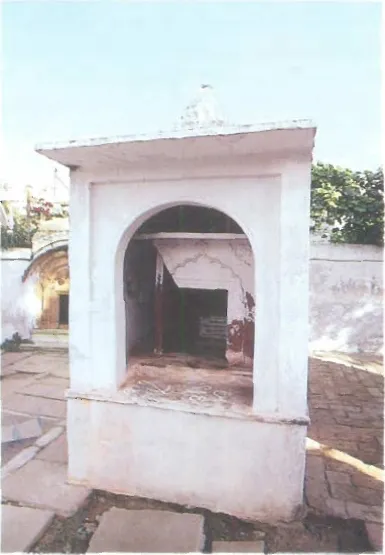
- This small shrine in the samādhi garden of the Rādhā-Gokulānanda Mandira in Vṛndāvana is the samādhi of Śrī Gaṅgānārāyaṇa Cakravartī; the guidebooks place it next to the samādhi of Śrīla Narottama …
- Visiting
- The Color Guide to Vṛndāvana (2000) and the undated parikramā notes Vṛndāvana place the samādhi next to that of his guru in the Rādhā-Gokulānanda courtyard, and Vṛndāvana, the Playground of God …
In short
This small shrine in the samādhi garden of the Rādhā-Gokulānanda Mandira in Vṛndāvana is the samādhi of Śrī Gaṅgānārāyaṇa Cakravartī; the guidebooks place it next to the samādhi of Śrīla Narottama dāsa Ṭhākura, his guru.[1 +6] The Bhakti-ratnākara and Śrīla Prabhupāda name him as Śrīla Narottama dāsa Ṭhākura's disciple, and Śrīla Prabhupāda gives him as an example of a man born a brāhmaṇa who accepted a guru not born in a brāhmaṇa family.[1 +6] His home was in Bengal; no source says why his samādhi is in Vṛndāvana, what it holds or when it was made.[1 +5]
Key facts
| Kind | samādhi |
|---|---|
| Region · area | Vṛndāvana · Samādhi Garden (Rādhā-Gokulānanda) |
| Ācāryas | Śrī Gaṅgānārāyaṇa Cakravartī, Śrīla Narottama dāsa Ṭhākura, Śrīla Viśvanātha Cakravartī Ṭhākura |
The Gosvāmīs and ācāryas
Disciple of Śrīla Narottama dāsa Ṭhākura
According to the Bhakti-ratnākara, Śrī Gaṅgānārāyaṇa Cakravartī, the disciple of Śrīla Narottama dāsa Ṭhākura, was very learned. He refuted the doctrines of unbelievers to reveal bhakti and was absorbed day and night in saṅkīrtana, and a song of the author calls the Deity of Śrī Govinda his life and soul (summarised here, not translated).[6] Śrīla Prabhupāda writes:[1 +6]
General teaching (does not name the place)“Similarly, another great ācārya, Śrī Rasikānanda, accepted Śrī Śyāmānanda as his spiritual master, although Śyāmānanda was not born in a brāhmaṇa family. So also did Gaṅgānārāyaṇa Cakravartī accept Narottama dāsa Ṭhākura as his spiritual master.”
Śrīla Prabhupāda, Teachings of Lord Caitanya, Chapter 31 · vedabase.io
The Narottama-vilāsa tells (summarised here, not translated) that Śrīla Narottama dāsa Ṭhākura appeared to him in a dream, called him his servant, and promised that he would see him the next day at his bath in the Gaṅgā; the meeting took place at Gāmbhīlā. Vṛndāvana, the Playground of God (2010) retells the dream and adds that he was drawn to Śrīla Narottama dāsa Ṭhākura after hearing two of his disciples defeat caste brāhmaṇas.[3 +2] The Prema-vilāsa gives his home as the village of Gāmbhīlā on the bank of the Gaṅgā, which its editor (c. 1913) places near Bāluchar in Murshidabad.[11 +2]
The debate at Kheturi
The older Bengali books and the guidebooks tell how he and Śrīla Rāmacandra Kavirāja, disguised as sellers of betel and pots, defeated in Sanskrit the scholars who had come to challenge Śrīla Narottama dāsa Ṭhākura. They differ in the details:
Accounts differ Details of the Kheturi debate in which Gaṅgānārāyaṇa defeated the scholars who came to challenge Narottama.
- Vṛndāvana, the Playground of God (2010) pp. 91-93King Nṛsiṁha came with caste brāhmaṇas led by the scholar Rūpanārāyaṇa; Rāmacandra and Gaṅgānārāyaṇa posed as betel-nut shopkeepers, and Gaṅgānārāyaṇa defeated first a disciple and then Rūpanārāyaṇa in Sanskrit; that night the goddess Bhagavatī scolded Rūpanārāyaṇa in a dream, and next morning he, his followers and the king surrendered to Narottama.
- The Color Guide to Vṛndāvana (2000) pp. 102-103Smārta paṇḍitas brought an unnamed king; Gaṅgānārāyaṇa and Śrīla Rāmacandra Kavirāja posed as a clay-pot seller and a betel-nut seller near the camp; the paṇḍitas left Kheturi to save their reputations, and that night the king and the Digvijayī paṇḍita dreamt that they should take initiation from Narottama, which they did.
- Narottama-vilāsa, 10th vilāsa (c. 1907 edition), pp. 97-98Rāmacandra and Gaṅgānārāyaṇa, as a betel-seller and a potter, set up a shop at Kumarapura, answer a student in Sanskrit and defeat him and then the teachers who came with King Narasiṁha and Rūpanārāyaṇa; Rūpanārāyaṇa advises surrender; that night the Devī rebukes the proudest teacher in a dream, and next morning the king and the teachers go to Kheturi.
- Prema-vilāsa, 19th vilāsa (c. 1913 edition), p. 194Six devotees (Rāmacandra, Govinda, Gaṅgānārāyaṇa, Harihara, Rāmakṛṣṇa, Jagannātha) pose as an oilman, a liquor-seller, a betel-seller and a potter and set up a market; students and then paṇḍitas are defeated; at the end of the night the paṇḍitas see Bhagavatī in a dream rebuking them for blaspheming Narottama.
His fame in Vṛndāvana
In a hymn of eight verses to Śrī Gaṅgānārāyaṇa Cakravartī, Śrīla Viśvanātha Cakravartī Ṭhākura says that Śrīla Narottama dāsa Ṭhākura gladly placed his own bhakti in him, that his fame is well known in Vṛndāvana and still sung in the assemblies of saintly persons, and that he upheld the śruti that declares Śrī Govindadeva two-armed (summarised here, not translated). The hymn does not mention a samādhi.[15 +1]
नरोत्तमो भक्त्यवतार एव यस्मिन् स्वभक्तिं निदधौ मुदैव । श्रीचक्रवर्ती दयतां स गङ्गा नारायणः प्रेमरसाम्बुधिर्माम् ॥ २॥ वृन्दावने यस्य यशः प्रसिद्धं अद्यापि गीयते सतां सदःसु । श्रीचक्रवर्ती दयतां स गङ्गा नारायणः प्रेमरसाम्बुधिर्माम् ॥ ३॥ श्रीगोविन्ददेवद्विभुजत्वशंसि श्रुतिं वदन् सद्विपदं निरास्थत् । श्रीचक्रवर्ती दयतां स गङ्गा नारायणः प्रेमरसाम्बुधिर्माम् ॥ ४॥ … इति श्रीमद्विश्वनाथचक्रवर्तिविरचितं श्रीश्रीगङ्गानारायणदेवाष्टकं सम्पूर्णम् ॥
narottamo bhaktyavatāra eva yasmin svabhaktiṁ nidadhau mudaiva
śrīcakravartī dayatāṁ sa gaṅgā nārāyaṇaḥ premarasāmbudhirmām
2|| vṛndāvane yasya yaśaḥ prasiddhaṁ adyāpi gīyate satāṁ sadaḥsu
śrīcakravartī dayatāṁ sa gaṅgā nārāyaṇaḥ premarasāmbudhirmām
3|| śrīgovindadevadvibhujatvaśaṁsi śrutiṁ vadan sadvipadaṁ nirāsthat
śrīcakravartī dayatāṁ sa gaṅgā nārāyaṇaḥ premarasāmbudhirmām
4|| … iti śrīmadviśvanāthacakravartiviracitaṁ śrīśrīgaṅgānārāyaṇadevāṣṭakaṁ sampūrṇam ||
The editor of the Prema-vilāsa (c. 1913) adds, without giving a source, that he gained special distinction in Vṛndāvana by his bhajana and that he had no descendants; this is not certain. Neither text says that he lived or died in Vṛndāvana.[12]
Visiting today
The Color Guide to Vṛndāvana (2000) and the undated parikramā notes Vṛndāvana place the samādhi next to that of his guru in the Rādhā-Gokulānanda courtyard, and Vṛndāvana, the Playground of God (2010) counts it as one of the four tombs of the garden. Śrī Vraja-maṇḍala Parikramā (2007) and Vṛndāvana-Dhāma Ki Jaya! (c. 1986) name only three tombs there, leaving out this one.[1 +7]
Location
| Where it is | Rādhā-Gokulānanda samādhī garden (6c)[20] next to his guru in the Rādhā Gokulānanda courtyard[21] |
|---|
Nearby places
Narottama dāsa Ṭhākura's puṣpa-samādhi
Where the sources differ
What the guidebooks say of Śrīla Narottama dāsa Ṭhākura's birth, in their accounts of his brāhmaṇa disciple.
Accounts differ Narottama's birth, as the Gaṅgānārāyaṇa accounts state it (a brāhmaṇa accepting a guru not born a brāhmaṇa).
- Śrīla Prabhupāda, Teachings of Lord Caitanya 16; CC Madhya 24.330 purportNarottama and Śyāmānanda 'were not born in brāhmaṇa families' (no caste named).
- The Color Guide to Vṛndāvana (2000) pp. 98, 102'Narottama was born in a sūdra family'; 'his father was a great king even though by caste they were kayasthas (sudra)'.
- Vṛndāvana, the Playground of God (2010) pp. 87, 91His father Kṛṣṇānanda Datta was 'the king of the Kheturi area'; the caste brāhmaṇas complained that 'Narottama, although a kṣatriya, was initiating brāhmaṇas'.
References
21 references
- The Color Guide to Vṛndāvana (2000), Written and Photographed by Rājaśekhara dāsa Brahmacārī, PDF p. 116
- the undated parikramā notes Vṛndāvana, ¶219
- Vṛndāvana, the Playground of God (2010), Bhakti Caitanya Svāmī, PDF p. 90
- The Color Guide to Vṛndāvana (2000), Written and Photographed by Rājaśekhara dāsa Brahmacārī, PDF p. 166
- the undated parikramā notes Vṛndāvana, ¶127
- Śrīla Narahari Cakravartī, Bhakti-ratnākara, taraṅga 15, 2nd ed., 1912
- Śrīla Prabhupāda, Teachings of Lord Caitanya, Chapter 31 · vedabase.io
- Śrīla Prabhupāda, Śrī Caitanya-caritāmṛta, Madhya-līlā 24.330, purport · vedabase.io
- The Color Guide to Vṛndāvana (2000), Written and Photographed by Rājaśekhara dāsa Brahmacārī, PDF p. 113
- Śrīla Prabhupāda, Teachings of Lord Caitanya, Chapter 16 · vedabase.io
- Prema-vilāsa, twentieth vilāsa (list of Narottama's branches), printed p. 207, left-hand column, first lines, Kolkata, 1913
- Prema-vilāsa, twentieth vilāsa, footnote (১), printed p. 207, right-hand column, Kolkata, 1913
- Śrīla Narahari Cakravartī, Narottama-vilāsa, tenth vilāsa, vv. 89-92, printed p. 94, left-hand column, 1st ed., Baṅgābda 1314
- Vṛndāvana, the Playground of God (2010), Bhakti Caitanya Svāmī, PDF p. 91
- Śrīla Viśvanātha Cakravartī Ṭhākura, Stavāmṛta-laharī no. 4 (as numbered on the page), Śrī Gaṅgānārāyaṇa-devāṣṭaka, verses 2-4 and colophon
- Vṛndāvana, the Playground of God (2010), Bhakti Caitanya Svāmī, PDF p. 93
- Vṛndāvana, the Playground of God (2010), Bhakti Caitanya Svāmī, PDF p. 86
- the undated parikramā notes Vṛndāvana, ¶127
- Śrī Vraja-maṇḍala Parikramā (2007), PDF p. 333
- Vṛndāvana, the Playground of God (2010), Bhakti Caitanya Svāmī, p. 90
- The Color Guide to Vṛndāvana (2000), Written and Photographed by Rājaśekhara dāsa Brahmacārī, p. 102