Narottama dāsa Ṭhākura's puṣpa-samādhi
नरोत्तम दास ठाकुर की पुष्प-समाधि Hindi name proposed
Also called Narottama Das Puṣpa Samādhi, Narottama dāsa Ṭhākura's samādhi (Rādhā-Gokulānanda)
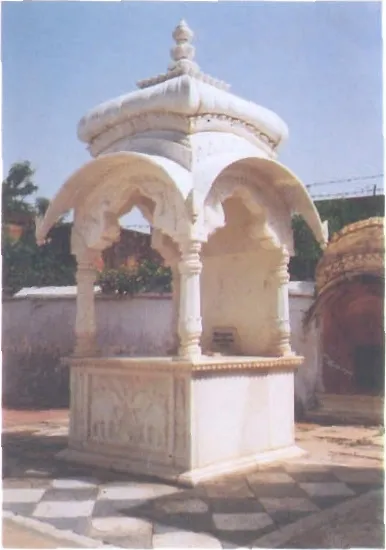
- What it is
- This shrine of Śrīla Narottama dāsa Ṭhākura stands in the samādhi garden of the Rādhā-Gokulānanda Mandira in Vṛndāvana, next to the tomb of his guru, Śrīla Lokanātha Gosvāmī.
- Visiting
- The guidebooks place the shrine in the samādhi garden, or courtyard, of the Rādhā-Gokulānanda temple, next to Śrīla Lokanātha Gosvāmī's samādhi.
In short
This shrine of Śrīla Narottama dāsa Ṭhākura stands in the samādhi garden of the Rādhā-Gokulānanda Mandira in Vṛndāvana, next to the tomb of his guru, Śrīla Lokanātha Gosvāmī.[1 +5] Śrīla Prabhupāda writes that Śrīla Narottama dāsa Ṭhākura chose Śrīla Lokanātha Gosvāmī as his spiritual master and was his only disciple.[4 +3] Three guidebooks call the shrine a puṣpa-samādhi, a memorial without the body, while two call it simply his samādhi.[1 +5] According to the Narottama-vilāsa, he passed away in Bengal, at Gāmbhīlā on the Gaṅgā.[10]
Key facts
| Kind | puṣpa-samādhi |
|---|---|
| Region · area | Vṛndāvana · Samādhi Garden (Rādhā-Gokulānanda) |
| Ācāryas | Śrīla Narottama dāsa Ṭhākura |
Traditional accounts
Three guidebooks call this a puṣpa-samādhi holding a garland, cloth, kaupīna (loincloth) and japa beads of Śrīla Narottama dāsa Ṭhākura; two others call it simply his samādhi. The sources differ:
Accounts differ Whether Narottama's shrine is a flower-samādhi (puṣpa-samādhi) or a samādhi (tomb).
- Vṛndāvana, the Playground of God (2010), p. 87; The Color Guide to Vṛndāvana (2000), p. 98; the undated parikramā notes Vṛndāvana, the undated parikramā notes VṛndāvanaA puṣpa-samādhi containing a garland, cloth, kaupīna and japa beads used by him.
- Vṛndāvana-Dhāma Ki Jaya! (c. 1986), p. 53 (caption) and p. 52'Narottama dāsa Ṭhākura's samādhi' (no mention of flowers or relics).
- Śrī Vraja-maṇḍala Parikramā (2007), pp. 640, 664'the samādhis of Śrī Lokanātha Gosvāmī, Śrī Narottama Ṭhākura and Śrī Viśvanātha Cakravartī Ṭhākura'; on p. 664 a samādhi is defined as the place 'where the body of a highly elevated devotee is placed'.
- The Color Guide to Vṛndāvana (2000), p. 99 (caption)'Narottam dāsa Thākura's Samādhi' (the heading on p. 98 says Puṣpa Samadhi).
The Gosvāmīs and ācāryas
Śrīla Prabhupāda writes in his summary of the disciplic succession …
Śrīla Narottama dāsa Ṭhākura
Śrīla Prabhupāda writes in his summary of the disciplic succession:[2 +2]
General teaching (does not name the place)“The direct disciple of Śrīla Kṛṣṇadāsa Kavirāja Gosvāmī was Śrīla Narottama dāsa Ṭhākura, who accepted Śrīla Viśvanātha Cakravartī as his servitor. Śrīla Viśvanātha Cakravartī Ṭhākura accepted Śrīla Jagannātha dāsa Bābājī,”
Śrīla Prabhupāda, Śrī Caitanya-caritāmṛta, Ādi-līlā, Chapter 1, introduction (summary of the disciplic succession) · vedabase.io
Śrīla Viśvanātha Cakravartī Ṭhākura, whose own samādhi stands in the same garden, names Śrīla Narottama dāsa Ṭhākura in the verse that opens his commentary on the rāsa chapters of the Tenth Canto, where he praises Śrī Gaurāṅga, the Lord of Śrīla Narottama (summarised here, not translated).[15]
His passing in Bengal
The Narottama-vilāsa tells (summarised here, not translated) that Śrīla Narottama dāsa Ṭhākura went from Budhari to Gāmbhīlā, bathed in the Gaṅgā and sat on its bank. He asked two disciples, Rāmakṛṣṇa and Śrī Gaṅgānārāyaṇa Cakravartī, to rub his body; as soon as they touched him, he mingled like milk with the water of the Gaṅgā and disappeared before their eyes. The book names no tomb or memorial.[10]
বুধরি হইতে শীঘ্র চলিলা গাম্ভীলে। গঙ্গাস্নাম করিয়া বসিলা গঙ্গাকুলে ॥৩৩৮ আজ্ঞা কৈলা রামকৃষ্ণ গঙ্গানারায়ণে। মোর অঙ্গ মার্জ্জন করহ দুইজনে ॥৩৩৯ দোঁহে কিবা মার্জ্জন করিব পরশিতে। দুগ্ধ প্রায় মিশাইয়া গঙ্গার জলেতে ॥৩৪০ দেখিতে দেখিতে শীঘ্র হৈলা অন্তর্দ্ধান। অত্যন্ত দুর্জ্ঞেয় ইহা বুঝিব কি আন ॥৩৪১ অকস্মাৎ গঙ্গার তরঙ্গ উথলিল। দেখিয়া লোকের মহা বিস্ময় হইল ॥৩৪২
budhari haite śīghra calilā gāmbhīle| gaṅgāsnāma kariẏā basilā gaṅgākule ||338 ājñā kailā rāmakṛṣṇa gaṅgānārāẏaṇe| mora aṅga mārjjana karaha duijane ||339 dom̐he kibā mārjjana kariba paraśite| dugdha prāẏa miśāiẏā gaṅgāra jalete ||340 dekhite dekhite śīghra hailā antarddhāna| atyanta durjñeẏa ihā bujhiba ki āna ||341 akasmāt gaṅgāra taraṅga uthalila| dekhiẏā lokera mahā bismaẏa haila ||342
Śrīla Prabhupāda
The Color Guide to Vṛndāvana (2000) and the undated parikramā notes Vṛndāvana say, in their entries on this shrine, that Śrīla …
The Color Guide to Vṛndāvana (2000) and the undated parikramā notes Vṛndāvana say, in their entries on this shrine, that Śrīla Prabhupāda loved to sing the songs of Śrīla Narottama dāsa Ṭhākura.[4 +2] Recordings of him singing and explaining these songs survive; after singing Nitāi-pada-kamala in 1969 he said:[17]
General teaching (does not name the place)“This is a song by Narottama dāsa Ṭhākura, a great ācārya of the Gauḍīya-vaiṣṇava-sampradāya. He has written many songs about the Vaiṣṇava philosophy, and they are approved as completely corresponding with Vedic instructions.”
Śrīla Prabhupāda, Lord Nityānanda Prabhu's Appearance Day Bhajan & Nitāi-Pada-Kamala Purport, Los Angeles, 31 January 1969 · vedabase.io
On a walk at the Rādhā-Dāmodara temple in 1972 he pointed out a "Narottama samādhi" there and explained what a puṣpa-samādhi is; which shrine he meant is not clear (see below).[18]
Visiting today
The guidebooks place the shrine in the samādhi garden, or courtyard, of the Rādhā-Gokulānanda temple, next to Śrīla Lokanātha Gosvāmī's samādhi.[1 +5]
Location
| Where it is | 'In the Samādhī Garden of Rādha-Gokulānanda'[19] in the Gokulānanda compound (plan)[20] |
|---|
Nearby places
Gaṅgānārāyaṇa Cakravarti's samādhi · Lokanātha Gosvāmī Samādhi (Rādhā-Gokulānanda) · Rādhā-Gokulānanda Mandira (Vṛndāvana)
History
The oldest mention found is in the Bengali Vṛndāvana-kathā (1920): it places the samāja (tombs) of Śrīla Lokanātha Gosvāmī and Śrīla Narottama dāsa Ṭhākura in the courtyard of the Gokulānanda temple, and says that his disappearance festival was held there every year on the fifth day of the dark fortnight of Kārttika. It does not say what the shrine holds.[6] The historians Prabhudayāl Mītal (1966) and A. W. Entwistle (1987) also name a samādhi of his at this temple, without saying whether it holds relics. No source says when or by whom the shrine was made.[11 +1]
Where the sources differ
Where a 'Narottama samādhi' is shown in Vṛndāvana.
Accounts differ Where a 'Narottama samādhi' is shown in Vṛndāvana.
- Vṛndāvana, the Playground of God (2010) p. 87, The Color Guide to Vṛndāvana (2000) p. 98, Vṛndāvana-Dhāma Ki Jaya! (c. 1986) p. 52, Śrī Vraja-maṇḍala Parikramā (2007) pp. 640, 664, the undated parikramā notes Vṛndāvana, the undated parikramā notes VṛndāvanaIn the samādhi garden (courtyard) of the Rādhā-Gokulānanda temple, next to Śrīla Lokanātha Gosvāmī's samādhi.
- Śrīla Prabhupāda, morning walk, Vṛndāvana, 15 October 1972Walking at the Rādhā-Dāmodara temple: 'this is Narottama samādhi' (not explained; possibly another shrine). On the same walk, at the same temple, he also says 'But that tomb is Lokanātha Gosvāmī', although the guidebooks place Lokanātha's samādhi, like Narottama's, in the Rādhā-Gokulānanda garden.
References
20 references
- Vṛndāvana, the Playground of God (2010), Bhakti Caitanya Svāmī, PDF p. 87
- Śrī Vraja-maṇḍala Parikramā (2007), PDF p. 345
- Vṛndāvana-Dhāma Ki Jaya! (c. 1986), by Dhruva Mahārāja dāsa, PDF p. 70
- The Color Guide to Vṛndāvana (2000), Written and Photographed by Rājaśekhara dāsa Brahmacārī, PDF p. 112
- the undated parikramā notes Vṛndāvana, ¶125
- Vṛndāvana-kathā, ch. 6 (Gokulānanda temple), printed p. 104
- Śrīla Prabhupāda, Śrī Caitanya-caritāmṛta, Madhya-līlā 18.49, purport · vedabase.io
- Vṛndāvana, the Playground of God (2010), Bhakti Caitanya Svāmī, PDF p. 88
- the undated parikramā notes Vṛndāvana, ¶213
- Śrīla Narahari Cakravartī, Narottama-vilāsa, 11th vilāsa (the running head of the page misprints 'দশম বিলাস'), vv.338-342, printed p. 115, 1st ed., Baṅgābda 1314
- Prabhudayāl Mītal, part 1 ('ब्रज-संस्कृति की भूमिका'), 'Braj-yātrā', Vṛndāvana: 'Śrī Rādhāvinoda jī tathā Śrī Gokulānanda jī', printed p. 137
- A. W. Entwistle, ch. 8 §66.32 'Radhavinod and Gokulanand', printed p. 413, Egbert Forsten, Groningen, 1987
- Śrīla Prabhupāda, Śrī Caitanya-caritāmṛta, Ādi-līlā, Chapter 1, introduction (summary of the disciplic succession) · vedabase.io
- the undated parikramā notes Vṛndāvana, ¶216
- Śrīla Viśvanātha Cakravartī Ṭhākura: commentary on ŚB 10.29.1, first opening verse of the rāsa chapters
- Śrīla Narahari Cakravartī, Narottama-vilāsa, 11th vilāsa (the running head of the page misprints 'দশম বিলাস'), vv.338-342, printed p. 115, 1st ed., Baṅgābda 1314
- Śrīla Prabhupāda, Lord Nityānanda Prabhu's Appearance Day Bhajan & Nitāi-Pada-Kamala Purport, Los Angeles, 31 January 1969 · vedabase.io
- Śrīla Prabhupāda, Morning Walk, Vṛndāvana, 15 October 1972 · vedabase.io
- Vṛndāvana, the Playground of God (2010), Bhakti Caitanya Svāmī, p. 87
- The Color Guide to Vṛndāvana (2000), Written and Photographed by Rājaśekhara dāsa Brahmacārī, p. 98