Hāū-bilāū
हाऊ-बिलाऊ Hindi name proposed
In short
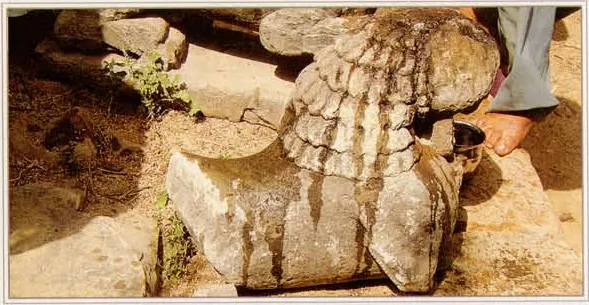
Hāū-bilāū is a spot with old stone figures on the western bank of Yaśodā-kuṇḍa at Nandagrāma. Śrīla Nārāyaṇa Bhaṭṭa Gosvāmī's Vraja-bhakti-vilāsa counts these stone figures, which it calls hāvas, among the holy places of Nandagrāma and gives a prayer to them.[1 +1] According to the guidebook Śrī Vraja-maṇḍala Parikramā (2007), here mother Yaśodā called Kṛṣṇa and Baladeva home from Their play, sometimes frightening Them with talk of a hāūa, a bogey, and the figures recall that pastime.[3] Śrīmad-Bhāgavatam tells the calling home at the riverside, before the cowherds left Mahāvana, and has no bogey.[4 +4]
Key facts
| Kind | pastime site |
|---|---|
| Region · area | Nandagrāma · Yaśodā-kuṇḍa (Nandagrāma) |
| Ācāryas | Śrīla Nārāyaṇa Bhaṭṭa Gosvāmī |
Divine pastimes
Called home from play
Śrīmad-Bhāgavatam (10.11.12–20) tells that after the uprooting of the yamala-arjuna trees, Rohiṇī went to call Kṛṣṇa and Balarāma, who were playing with the other boys at the riverside. When They did not come, she sent mother Yaśodā. Yaśodā called Them to drink her milk, to eat with Nanda, who was waiting, and to bathe and be dressed for Kṛṣṇa's birthday star; then she took Them home by the hand. The Bhāgavatam names no place but the riverside, and it tells the episode before the cowherds leave Mahāvana.[4 +4]
sarit-tīra-gataṃ kṛṣṇaṃ bhagnārjunam athāhvayat / rāmaṃ ca rohiṇī devī krīḍantaṃ bālakair bhṛśam
Once, after the uprooting of the yamala-arjuna trees, Rohiṇīdevī went to call Rāma and Kṛṣṇa, who had both gone to the riverside and were playing with the other boys with deep attention.
Translation: Śrīla A.C. Bhaktivedanta Swami PrabhupādaŚrīla Prabhupāda explains in his purport to the next verses:[8 +1]
General teaching (does not name the place)The word ajohavīt means “calling them again and again.” “Kṛṣṇa and Balarāma,” she called, “please come back. You are late for Your lunch. You have played sufficiently. Come back.”
Śrīla Prabhupāda, Śrīmad-Bhāgavatam, Canto 10, Chapter 11, Text 14, purport · vedabase.io
The commentators (summarised here, not translated) say that the riverside was the bank of the Yamunā and that Yaśodā herself had first sent Rohiṇī, because she was busy with the meal; Śrīla Sanātana Gosvāmī calls the episode one day of the care she gave her son every day. Śrīla Baladeva Vidyābhūṣaṇa places it at the ramaṇa-pulina, the boys' well-known sandbank, which he says was reached from the house by a side door.[10 +1] In the Kṛṣṇa book Śrīla Prabhupāda likewise has the boys playing on the bank of the Yamunā when Rohiṇī went to call Them.[8 +1]
Śrīla Jīva Gosvāmī retells the episode in his Gopāla-campū (summarised here, not translated). The boys had gone very far, to the bank of a deep river; Yaśodā, busy cooking and afraid of accidents, sent Rohiṇī, and when They did not come, Rohiṇī sent Yaśodā, whom Kṛṣṇa somewhat feared. Yaśodā did not go near Him suddenly, fearing that He would run away; she spoke of the bath for His birthday star as a pretext and brought the two home by the arms. He too sets the episode in Bṛhadvana, before the move, and has no bogey.[12 +1]
Traditional accounts
Śrīla Nārāyaṇa Bhaṭṭa Gosvāmī's Vraja-bhakti-vilāsa lists, right after Śrī Yaśodā-kuṇḍa, stone images of the hāvakas, which it …
The hāvas of the Vraja-bhakti-vilāsa
Śrīla Nārāyaṇa Bhaṭṭa Gosvāmī's Vraja-bhakti-vilāsa lists, right after Śrī Yaśodā-kuṇḍa, stone images of the hāvakas, which it describes as kṛṣṇa-darśakāḥ ("showing" or "seeing" Kṛṣṇa). Its pilgrims pray to them as gods in the form of stone, established by Yaśodā's blessing, who give the four goals of life; said six times, the prayer gives fearlessness (summarised here, not translated). It tells no story of Yaśodā frightening the boys.[1 +1]
ततो हावप्रार्थनमन्त्रः— नमः … धर्मकामार्थमोक्षिणः । पाषाणरूपिणो देवाः यशोदाशीषसंस्थिताः ॥ … अभयं पदमाप्नोति परशंकाविवर्जितः ॥
tato hāvaprārthanamantraḥ— namaḥ … dharmakāmārthamokṣiṇaḥ
pāṣāṇarūpiṇo devāḥ yaśodāśīṣasaṁsthitāḥ
… abhayaṁ padamāpnoti paraśaṁkāvivarjitaḥ ||
Yaśodā and the bogey
According to Śrī Vraja-maṇḍala Parikramā, Kṛṣṇa and Baladeva became so absorbed in play here that They forgot to come home to eat. Yaśodā first sent Rohiṇī, from whom They ran away; then she went herself, sometimes frightening Them with talk of a hāūa, and once Kṛṣṇa insisted on seeing the hāūa. The book quotes a Brajabhāṣā couplet on this, without naming its author, and says that the stone figures here are a reminder of the pastime.[3] The order of the callers agrees with the commentators and Śrīla Prabhupāda; the bogey and the place are found in later sources.[3 +2]
Location
| Where it is | on the western bank of Yaśodā-kuṇḍa (map: row along the south, west of 5)[22] |
|---|
Nearby places
Yaśodā-kuṇḍa (Nandagrāma)
History
The historian A. W. Entwistle (1987) dates the figures on the west side of Yaśodā-kuṇḍa: four grey-stone carvings of lion-like creatures from about the tenth or eleventh century, which probably once stood on the steps of a temple. Other surveys he cites counted six, two of them since stolen, or four.[1 +1] From these sculptures, a heap of architectural fragments beside them and carvings set into the walls of a nearby Sītalā shrine, he concludes that a fairly ornate temple once stood near the pond.[16]
Because Śrīla Nārāyaṇa Bhaṭṭa Gosvāmī names the hāvas in the sixteenth century, Entwistle holds that the figures have stood here at least since then; the Vraja-bhakti-vilāsa names both the pond and the stone figures, and the Bhakti-ratnākara names the pond.[1 +5] The historian Prabhudayāl Mītal (1966) records the local tradition that the image was set up in memory of Yaśodā frightening the child Kṛṣṇa with the hāū; he gives no date or founder, so this is not certain.[20]
According to Entwistle's source notes (1987), a pilgrim's account of 1849 by Sundarlāl calls the statues images of Narasiṁha, and a study of 1983 records a Hāū-līlā, a play of the bogey, performed here; neither work could be checked, so both reports are not certain.[19] According to Entwistle, whose report is not certain, the poet Nāgarīdāsa (1753) describes how at Gopāṣṭamī Kṛṣṇa and Balarāma, Deities or boys dressed as Them, were brought to Yaśodā-kuṇḍa and warned by the women not to wander far because of lions and tigers in the jungle.[21]
Where the sources differ
Where Rohiṇī and Yaśodā called Kṛṣṇa and Balarāma home from Their play, and whether a hāūa (bogey) was part of it.
Accounts differ Where Rohiṇī and Yaśodā called Kṛṣṇa and Balarāma home from Their play, and whether a hāūa (bogey) was part of it.
- Śrīmad-Bhāgavatam 10.11.12–20 (translation and purports by Śrīla Prabhupāda)After the yamala-arjuna episode the boys had gone to the riverside; Rohiṇī called Them, then Yaśodā called Them to eat, bathe and be dressed for Kṛṣṇa's birthday star, and took Them home. Told before the cowherds leave Mahāvana (10.11.21–36). …
- Śrīla Sanātana Gosvāmī on ŚB 10.11.12The riverside is the bank of the Śrī Yamunā; Rohiṇī had been sent by Yaśodā; the episode is one day of the care Yaśodā gave her son daily.
- Śrīla Baladeva Vidyābhūṣaṇa on ŚB 10.11.13The place was the ramaṇa-pulina (the delightful sandbank, or a sandbank of that name), the boys' well-known play place, reached from Nanda's house by a side door.
- Śrīla Jīva Gosvāmī, Gopāla-campū, Pūrva-campū 9The boys had gone very far, to the bank of a deep river, in Bṛhadvana; Yaśodā, busy cooking and afraid of accidents, sent Rohiṇī; Rohiṇī sent Yaśodā, somewhat feared by Him; Yaśodā approached slowly lest He run away, used a pretext (His birthday star) and brought the two home; the next morning the elders decide to leave Bṛhadvana. No hāūa.
The wording of these accounts is our summary of the sources, not a published translation.
Accounts differ What the stone figures on the west bank of Yaśodā-kuṇḍa are.
- Vraja-bhakti-vilāsa 2.44 and 4.15Stone images of the hāvakas (kṛṣṇa-darśakāḥ), worshipped with a prayer as 'gods in the form of stone, established by Yaśodā's blessing', which gives fearlessness.
- Śrī Vraja-maṇḍala Parikramā (2007)Stone figures of the hāūa (hobgoblin), a reminder of Yaśodā's frightening the boys.
- Mītal (1966), p. 124The image was installed in memory of Yaśodā's frightening the child Kṛṣṇa with the hāū; no date or founder.
- A. W. Entwistle (1987), a historianEntwistle describes four lion-like figures carved in grey stone, apparently of the tenth or eleventh century, which once stood on the steps of a temple and may be the lion or tiger mount of Durgā; Nārāyaṇa Bhaṭṭa calls them hāvas.
The wording of these accounts is our summary of the sources, not a published translation.
References
22 references
- Śrīla Nārāyaṇa Bhaṭṭa, Vraja-bhakti-vilāsa, ch. 2 v.44) v.44, 1st ed., publ. Bābā Kṛṣṇadāsa, Kusuma-sarovara, Saṁvat 2008
- Śrīla Nārāyaṇa Bhaṭṭa, Vraja-bhakti-vilāsa, ch. 4 v.15) v.15, 1st ed., publ. Bābā Kṛṣṇadāsa, Kusuma-sarovara, Saṁvat 2008
- Śrī Vraja-maṇḍala Parikramā (2007), PDF p. 199
- Śrīmad-Bhāgavatam ŚB 10.11.12, GRETIL
- Śrīmad-Bhāgavatam ŚB 10.11.13, GRETIL
- Śrīmad-Bhāgavatam ŚB 10.11.14, GRETIL
- Śrīmad-Bhāgavatam ŚB 10.11.20, GRETIL
- Śrīla Prabhupāda, Kṛṣṇa, the Supreme Personality of Godhead, Chapter 11 (Killing the Demons Vatsāsura and Bakāsura) · vedabase.io
- Śrīla Prabhupāda, Śrīmad-Bhāgavatam, Canto 10, Chapter 11, Text 12, purport · vedabase.io
- Śrīla Sanātana Gosvāmī: commentary v.10.11.12, sanātana-gosvāmī (bṛhad-vaiṣṇava-toṣaṇī), Bhagavata Vidya Pith edition, ed. Bhagavata Rishi and Krishna Shankar Shastri, 1996
- Baladeva Vidyābhūṣaṇa: commentary v.10.11.13, baladeva-vidyabhūṣaṇaḥ (vaiṣṇavānandinī), Bhagavata Vidya Pith edition, ed. Bhagavata Rishi and Krishna Shankar Shastri, 1996
- Jīva Gosvāmī, Pūrva-campū, (9) navamaṁ pūraṇam with v.3
- Jīva Gosvāmī, Pūrva-campū, (9) navamaṁ pūraṇam
- Śrīla Nārāyaṇa Bhaṭṭa, Vraja-bhakti-vilāsa, ch. 4 v.15) v.15, 1st ed., publ. Bābā Kṛṣṇadāsa, Kusuma-sarovara, Saṁvat 2008
- A. W. Entwistle, §40 Nandgaon, 5 'Tanks and ponds to the south-west and west of Nandgaon', printed pp. 381–382, Egbert Forsten, Groningen, 1987
- A. W. Entwistle, ch. 4 'Ancient and early medieval Braj', §17 'Finds in the north-western part of Mathura District' (pp. 130–131), printed p. 131, Egbert Forsten, Groningen, 1987
- Śrīla Nārāyaṇa Bhaṭṭa, Vraja-bhakti-vilāsa, ch. 4 v.14) v.14, 1st ed., publ. Bābā Kṛṣṇadāsa, Kusuma-sarovara, Saṁvat 2008
- Śrīla Narahari Cakravartī, Bhakti-ratnākara, Fifth Wave, 1912 ed. p. 224; Grantha Mandira, 2nd ed., 1912
- A. W. Entwistle, §40 Nandgaon, 5 'Tanks and ponds to the south-west and west of Nandgaon', source note, printed p. 381, Egbert Forsten, Groningen, 1987
- Prabhudayāl Mītal, 'Braj-yātrā', Nandagāṁv and its sights, entry 'Hāū-bilāū', printed p. 124
- A. W. Entwistle, §40 Nandgaon, 5 'Tanks and ponds to the south-west and west of Nandgaon', printed p. 382, Egbert Forsten, Groningen, 1987
- Śrī Vraja-maṇḍala Parikramā (2007), p. 372-373