Nandagrāma
नन्दग्राम
Also called Nandagaon
- What it is
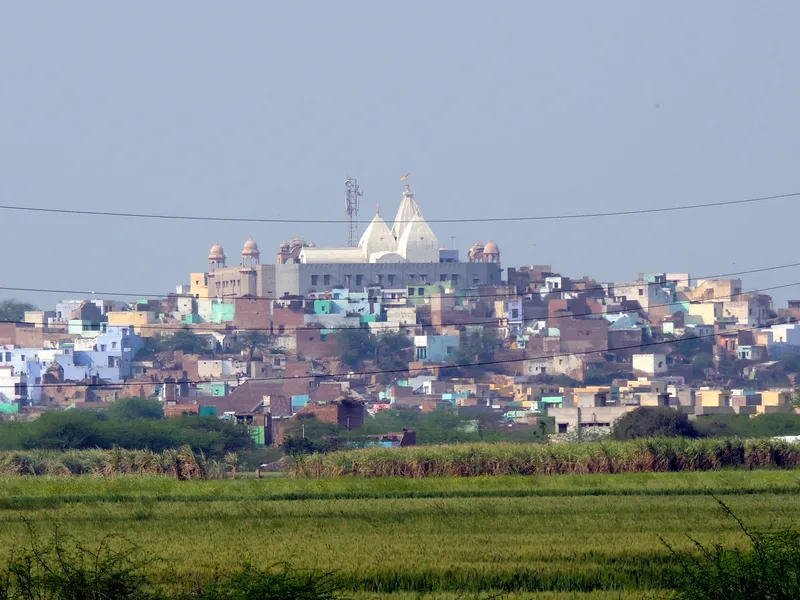
- Nandagrāma, today Nandagaon, is the village of Nanda Mahārāja, Kṛṣṇa's father in Vraja, on and around Nandīśvara Hill.
- Visiting
- In 2007 Śrī Vraja-maṇḍala Parikramā put Nandagaon sixteen miles north-west of Govardhana, eight miles south of Kosī and twenty-eight miles west of Vṛndāvana.
- Places here
- Pāvana-sarovara, Yaśodā-kuṇḍa, Motī-kuṇḍa, Kṛṣṇa-kuṇḍa, Vṛndā-kuṇḍa +40 more
In short
Nandagrāma, today Nandagaon, is the village of Nanda Mahārāja, Kṛṣṇa's father in Vraja, on and around Nandīśvara Hill. The Ādi-purāṇa and the Garga-saṁhitā name it as the home of the cowherds, and the Gosvāmīs place Nanda's palace and Kṛṣṇa's daily pastimes on its hill.[1 +12] Śrīmad-Bhāgavatam does not name the village, but it tells how Nanda's people left Mahāvana for Vṛndāvana, and Śrīla Prabhupāda speaks of this as the move from Gokula to Nanda-grāma.[14 +7] He writes that the Vṛndāvana forest stretches from the town of Vṛndāvana up to Nanda-grāma.[22 +1] Śrī Caitanya Mahāprabhu came here after Kāmyavana, overwhelmed with ecstatic love.[24]
Key facts
| Kind | village |
|---|---|
| Ācāryas | Śrīla Jīva Gosvāmī, Śrīla Narottama dāsa Ṭhākura, Śrīla Jāhnavā Mātā, Śrīla Vīracandra Prabhu, Śrīla Nārāyaṇa Bhaṭṭa Gosvāmī |
Why it is glorified
The Ādi-purāṇa says that in Vṛndāvana, where Hari always plays, the dwelling of the cowherds is called Nandagrāma, and that its …
The Ādi-purāṇa says that in Vṛndāvana, where Hari always plays, the dwelling of the cowherds is called Nandagrāma, and that its people, favoured by Kṛṣṇa, do not desire liberation. It names Nandagrāma again, with Govardhana and the Kālindī, among the places where the Lord plays forever with the gopīs (summarised here, not translated).[1 +1]
The Padma Purāṇa counts Nandīśvara among the groves of Vraja and calls the forest of Nandīśvara the place where Nanda's home is remembered.[25 +1] In the Garga-saṁhitā the cowherd boys, at their lunch by the Yamunā, say that their village, Nandagrāma, is far away.[3] In the Skanda Purāṇa's Bhāgavata-māhātmya the sage Śāṇḍilya tells Vajranābha, Kṛṣṇa's great-grandson, to set up his rule at Govardhana, Dīrghapura, Mathurā, Mahāvana, Nandigrāma and Bṛhatsānu. The verse says nothing more about this Nandigrāma; that it is Nandagrāma is a reading of the name only.[27 +1]
Śrīla Nārāyaṇa Bhaṭṭa Gosvāmī's Vraja-bhakti-vilāsa counts Nandagrāma among the adhivanas, the chief forests of Vraja. It explains the name with a verse that it gives from the Ādi-purāṇa: the place is called Nandagrāma because Nanda, Upananda, Pratinanda and Adhinanda made their happy home there. The verse has not been found in the available edition of the Ādi-purāṇa.[29 +5]
Divine pastimes
From Mahāvana to Nandagrāma
Śrīmad-Bhāgavatam (10.11) tells how the elder cowherds, troubled by demons in Mahāvana, followed Upananda's advice and moved with their carts and cows to the forest of Vṛndāvana, where they camped with the carts drawn up in a half-moon. The chapter names Vṛndāvana, Govardhana and the Yamunā; it does not name Nandagrāma or Nandīśvara.[14 +2]
vṛndāvanaṃ sampraviśya sarva-kāla-sukhāvaham / tatra cakrur vrajāvāsaṃ śakaṭair ardha-candravat
In this way they entered Vṛndāvana, where it is always pleasing to live in all seasons. They made a temporary place to inhabit by placing their bullock carts around them in the shape of a half moon.
Translation: Śrīla A.C. Bhaktivedanta Swami PrabhupādaIn his translation of Upananda's proposal Śrīla Prabhupāda places that Vṛndāvana between Nandeśvara and Mahāvana, and he writes that Nandīśvara is the house of Mahārāja Nanda.[14 +2] In his purport to the opening of the Tenth Canto and in talks of 1971, 1974 and 1976 he describes the move as one from Gokula to Nanda-grāma, the whole village carried by bullock carts; in 1971 he said that Kṛṣṇa was brought to Nanda-grāma when He was three or four years old.[17 +4]
Names this place“Just like Kṛṣṇa, when He was transferred from Gokula to Nandagrāma, so they took all the bullock carts, and within a few hours they transported them, the whole thing, their luggage, family member, everything.”
Śrīla Prabhupāda, Morning Walk, Rome, 27 May 1974 · vedabase.io
In Śrīla Murāri Gupta's and Śrīla Locana dāsa Ṭhākura's accounts of Śrī Caitanya Mahāprabhu's tour of Vraja, His guide says that Nanda, afraid of Kaṁsa, made his home on Nandīśvara Hill with all of Vraja (summarised here, not translated).[37 +3] According to the Bhakti-ratnākara, Nanda camped at Ḍerāvalī on his way to Nandīśvara.[41 +1]
When Nanda's people came to live at Nandīśvara, the commentators on the Bhāgavatam tell differently. Śrīla Jīva Gosvāmī, for one, places the first settlement in Vṛndāvana south-west of Kāliya's lake and says that Nanda's main residence around Nandīśvara came about later (summarised here, not translated). The accounts are set side by side on the page of Nandīśvara Hill.[43 +2] Read more: Nanda's family at Nandagrāma →
Long before, according to Śrīla Rūpa Gosvāmī, Kṛṣṇa's grandfather Parjanya lived at Nandīśvara and worshipped the husband of Lakṣmī there, on Nārada's order, for good sons; afraid of the demon Keśī, he later went with his family to Bṛhadvana (summarised here, not translated).[46 +2] Read more: Nanda's family at Nandagrāma →
Nanda's capital
The Gosvāmīs describe Nandīśvara Hill as the residence and capital of Nanda, the king of Vraja. Śrīla Rūpa Gosvāmī names the hill as Kṛṣṇa's home, with an assembly hall called Āmoda-vardhana, and Śrīla Viśvanātha Cakravartī Ṭhākura places Nanda's city on its ridge and gives the plan of the palace (summarised here, not translated).[4 +5] In the ācāryas' accounts of Kṛṣṇa's eight daily periods, He returns at the end of night from the groves to His house at Nandīśvara, and Nanda takes his meal there with Kṛṣṇa and Balarāma in the inner palace.[10 +3] The palace and its rooms are described on the page of Nanda-bhavana. Read more: The morning in Nanda's house at Nandīśvara →
Kṛṣṇa becomes a cowherd
Śrīmad-Bhāgavatam (10.15.1) tells that when Rāma and Kṛṣṇa reached the paugaṇḍa age, from six to ten, the cowherd men let Them tend the cows; it names no place. Śrīla Viśvanātha Cakravartī Ṭhākura gives the day as Gopāṣṭamī, the bright eighth of Kārttika, from a verse that he quotes from the Padma Purāṇa: from that day Kṛṣṇa, who had herded the calves, became a cowherd (summarised here, not translated).[49 +2] Śrī Vraja-maṇḍala Parikramā (2007) says that it was from Nandagrāma that Kṛṣṇa and Baladeva with Their friends first went out on Gopāṣṭamī with the calves, and some years later with the cows. The two accounts differ on what began that day (see below).[52]
Akrūra and Uddhava
Śrīmad-Bhāgavatam (10.38) tells that Akrūra, sent by Kaṁsa, reached Gokula at sunset and in the cowherd pasture saw Kṛṣṇa's footprints and rolled in their dust; it does not name Nandagrāma.[53 +2] Śrīla Sanātana Gosvāmī explains that the house of Nanda he reached was the one called Nandīśvara, thirteen krośas north-west of Mathurā, and Śrīla Viśvanātha Cakravartī Ṭhākura says that Kṛṣṇa in His human form was then only in Nandagrāma (both summarised here, not translated). Śrīla Prabhupāda writes that Akrūra saw the Lord's footprints on the dust of Nanda-grāma:[56 +2]
Names this place“When Akrūra came to Vṛndāvana in search of Kṛṣṇa, he saw the footprints of the Lord on the dust of Nanda-grāma and at once fell on them in ecstasy of transcendental love.”
Śrīla Prabhupāda, Śrīmad-Bhāgavatam, 3.1.32, purport · vedabase.io
The Bhakti-ratnākara shows a place of Akrūra at Nandīśvara, and Śrī Vraja-maṇḍala Parikramā (2007) sets his ecstasy at the footprints on Caraṇa-pahāḍī, west of the village.[59 +1] Read more: Akrūra in Vraja: his arrival at Nandagrāma and Kṛṣṇa's departure →
When Kṛṣṇa sent Uddhava from Mathurā, the Bhāgavatam says, he went to Nanda's Gokula and reached Nanda's pastures at sunset; the commentator Vaṁśīdhara explains Nanda's Gokula as Nandagrāma.[61 +2]
ity ukta uddhavo rājan sandeśaṃ bhartur ādṛtaḥ / ādāya ratham āruhya prayayau nanda-gokulam … prāpto nanda-vrajaṃ śrīmān nimlocati vibhāvasau / channa-yānaḥ praviśatāṃ paśūnāṃ khura-reṇubhiḥ
The fortunate Uddhava reached Nanda Mahārāja’s pastures just as the sun was setting, and since the returning cows and other animals were raising dust with their hooves, his chariot passed unnoticed.
Translation: Śrīla Prabhupāda's disciples (BBT)The Bhakti-ratnākara points out at Nandīśvara the place where Uddhava, seeing the gopīs' activities, thought himself blessed and consoled Nanda and the others, and the place where he stayed. It quotes Śrīla Raghunātha dāsa Gosvāmī's verse that Uddhava lived in Vraja for ten months, reviving it with talk of Kṛṣṇa.[59 +2] Where Uddhava met the gopīs the sources tell differently: the Garga-saṁhitā, for one, has them take him to a banana grove on the bank of the Yamunā. The accounts are set side by side on the page of Uddhava-kyārī.[66 +1] Read more: Uddhava brings Kṛṣṇa's message to the gopīs →
A later visit in the Garga-saṁhitā
Śrīla Prabhupāda explains Kṛṣṇa's return to Vraja in the Kṛṣṇa book (chapter 46); his explanation is given on the page of Pūñcharī. The Garga-saṁhitā tells, within the horse sacrifice narrated in its own Aśvamedha-khaṇḍa, of a later event. In chapter 40, verses 14–16, the Yādavas, following the sacrificial horse, came with Kṛṣṇa to Nanda's town in Vṛndāvana. Seeing Nandagrāma from His chariot, Kṛṣṇa went ahead of them all, and there He saw His father standing before Him with the cowherds, a decorated great elephant placed in front (summarised here, not translated). Śrīmad-Bhāgavatam does not tell this visit.[68]
The verses that follow tell the reunion. In verses 25–26 Kṛṣṇa jumps down from His chariot and falls at His father's feet, and Nanda Mahārāja raises Him, holds Him to his chest and bathes Him with his tears. In verses 40–42 Kṛṣṇa goes quickly to His mother's house; seeing Mother Yaśodā come weeping to the door, He bows to her, weeping too, and she embraces her son, dearer to her than her own life, and blesses Him in a voice choked with feeling. In verses 46–47 the Yādavas camp in the forest by the Yamunā, while Kṛṣṇa stays in Nanda's town (summarised here, not translated).[69 +2]
Śrī Caitanya Mahāprabhu at Nandīśvara
After Kāmyavana, the Caitanya-caritāmṛta tells, Śrī Caitanya Mahāprabhu went to Nandīśvara and was overwhelmed with ecstatic love. Śrīla Kṛṣṇadāsa Kavirāja Gosvāmī adds that He bathed in all the celebrated lakes there, beginning with Pāvana; he names no other pond.[24 +1] What Mahāprabhu saw on the hill is told on the page of Nandīśvara Hill. Read more: Śrīla Sanātana Gosvāmī at Nandagrāma →
Traditional accounts
Śrīla Nārāyaṇa Bhaṭṭa Gosvāmī lists the holy places of Nandagrāma in a passage that he gives from the Varāha Purāṇa …
The holy places in the Vraja-bhakti-vilāsa
Śrīla Nārāyaṇa Bhaṭṭa Gosvāmī lists the holy places of Nandagrāma in a passage that he gives from the Varāha Purāṇa: Madhusūdana-kuṇḍa in the west of the village; in front of the village the lake named Pāvana, with Yaśodā's well in its middle and the Kadamba-khaṇḍa forest beside it; inside the village the place where Yaśodā churned curd, with a great image of Rudra named Nandīśvara beside it; and on top of Rudra's hill the temple of Nanda-rāya, with Nanda, Yaśodā, Kṛṣṇa and Balarāma. The passage has not been found in the available text of the Varāha Purāṇa.[29 +3]
The same book tells that Nanda and the other cowherds milked their cows at Nandagrāma's Dohanī-kuṇḍa, which is named after the milking, and that a gift of cows there, or of a gold or silver milking pail to a brāhmaṇa, brings great merit; it gives the pond no position. Śrī Vraja-maṇḍala Parikramā (2007) names a Dohinī-kuṇḍa near Cauḍokhara; that the two are one pond rests on the name alone.[73 +2]
The Gosvāmīs and ācāryas
Śrīla Rūpa Gosvāmī says in the closing verse of his play Dāna-keli-kaumudī that he wrote it while living at Nandīśvara; the …
Śrīla Rūpa Gosvāmī says in the closing verse of his play Dāna-keli-kaumudī that he wrote it while living at Nandīśvara; the editor of a 1976 edition reads its date as śaka 1471 (1549).[76 +1]
In the Bhakti-ratnākara, Śrīla Rāghava Paṇḍita Gosvāmī of Govardhana shows Śrīla Śrīnivāsa Ācārya Nandīśvara, Nanda's home, with its cave, ponds and forests and the places of Parjanya, Akrūra and Uddhava, and brings him to the Pāvana lake and to the hut of Śrīla Sanātana Gosvāmī (his bhajana-kuṭī). Śrīla Narottama dāsa Ṭhākura travels with them, and the book tells that the two were overwhelmed with joy at Nandagrāma, Jāvaṭa, Varṣāṇā and other places.[59 +6]
According to the same book, Śrīla Jāhnavā Mātā's ecstasy on seeing Nandagrāma and other places was beyond description. Śrīla Vīracandra Prabhu came to Nandagrāma from Vṛṣabhānupura with his company, heard there of the great festival held on Kṛṣṇa's birthday, and bathed in Śrī Pāvana-sarovara.[83 +2]
Śrīla Prabhupāda
Śrīla Prabhupāda gives Nanda-grāma as the far end of the Vṛndāvana forest, one of the twelve forests of Vraja …
Śrīla Prabhupāda gives Nanda-grāma as the far end of the Vṛndāvana forest, one of the twelve forests of Vraja:[22 +1]
Names this place“Of these, the special forest known as Vṛndāvana is located from the present municipal city of Vṛndāvana to the village called Nanda-grāma. This distance is sixteen krośas (thirty-two miles).”
Śrīla Prabhupāda, Śrī Caitanya-caritāmṛta, Madhya-līlā 21.29, purport · vedabase.io
On 28 November 1971, on his parikramā of Vraja with his disciples, he walked up to a temple that Tamāla Kṛṣṇa's question names as Nandagrāma, and on the way said why Nanda had come here:[18 +3]
Names this place“Nanda, Nanda Mahārāja left Gokula and came here because the demons were disturbing Kṛṣṇa. They decided to change.”
Śrīla Prabhupāda, Parikramā on the Way to Gokula, Vṛndāvana, 28 November 1971 · vedabase.io
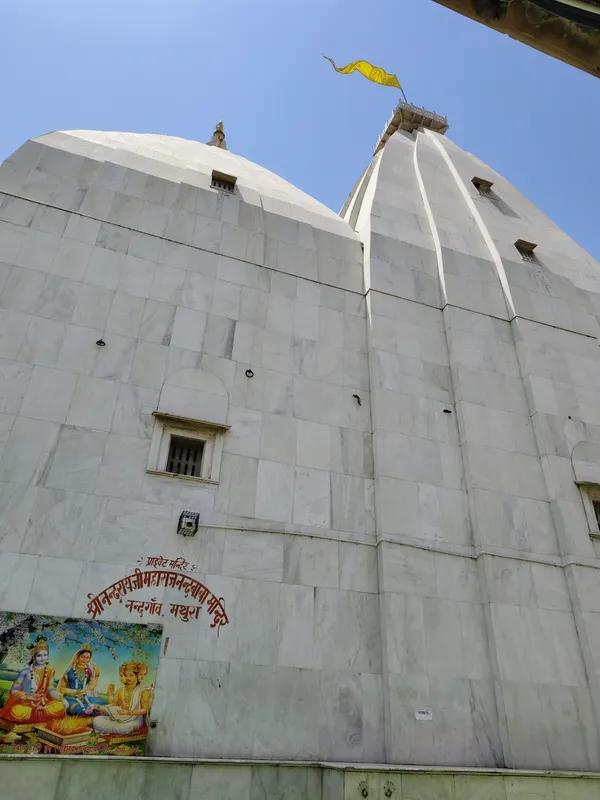
The Deities of that temple are described on the page of Nanda-bhavan Mandira. In 1974 he included it in a day's bus pilgrimage that he arranged for his disciples, and in October 1977, in his last weeks, he approved a plan for a parikramā that included it.[18 +3]
Visiting today
Coming to Nandagrāma
In 2007 Śrī Vraja-maṇḍala Parikramā put Nandagaon sixteen miles north-west of Govardhana, eight miles south of Kosī and twenty-eight miles west of Vṛndāvana. It gave the parikramā of the village as four miles, with fifty-six ponds of Kṛṣṇa's pastimes that take three or four days to see.[33] The same book says that on Gopāṣṭamī the Vrajavāsīs bring small boys dressed as Kṛṣṇa and Balarāma from Nandagrāma to Ṭer-kadamba, sing together there in a samāja, and worship and feed the cows.[89]
Smaller places described here
- The ancient cave near Yaśodā-kuṇḍa: according to Śrī Vraja-maṇḍala Parikramā (2007), the only source that names it, many great saints performed their sādhana in this secluded cave, though this is not certain. The book adds that in its time the cave still drew sādhakas free from material attachment to perform bhajana.[90]
- Kāroharo-kuṇḍa, which the same guidebook names near Yaśodā-kuṇḍa without a story. On its round of Nandīśvara the Bhakti-ratnākara shows, right after Yaśodā-kuṇḍa, a Karela-kuṇḍa in a forest of karīla bushes, where Kṛṣṇa stays and gazes at the beauty; the names are alike, but no source says that it is the same pond, so the link is not certain.[90 +1]
- Cauḍokhara, also called Caraṇa-kuṇḍa, on the east side of Vṛndā-kuṇḍa: Śrī Vraja-maṇḍala Parikramā names it with Rohiṇī-kuṇḍa, Mohinī-kuṇḍa, the posts for binding the cows, Nanda Bābā's cowshed and Dohinī-kuṇḍa near it, and tells nothing else about it.[75]
- Rohiṇī-kuṇḍa and Mohinī-kuṇḍa, which the same book places near Caraṇa-pahāḍī, west of Nandagaon, beside the field of the cow posts, without a story for either. Ponds of the same names in the older texts lie elsewhere, at Kāmyavana among other places.[60 +1]
- Nandīśvara Taḍāga: the same book uses this name only once, as the point from which Motī-kuṇḍa lies about a mile north, and does not say which pond it means.[92]
- Vilāsavaṭa, a banyan that Śrī Vraja-maṇḍala Parikramā (2007) gives only as a waypoint, some distance east of Phulvārī-kuṇḍa, with Sāhasī-kuṇḍa east of it. In 1966 the historian Prabhudayāl Mītal listed Vilāsavaṭa among the sights near Pāvana-sarovara. In 1987 A. W. Entwistle recorded a banyan of this name on the east side of Phulvārī-kuṇḍa with a baiṭhaka (sitting place) of Kṛṣṇa beneath it, and cited the name from Jagatānanda's itinerary of a circuit of Braj made by Śrī Viṭṭhalanātha.[93 +2]
- Śyāmapīparī-kuṇḍa, Vaṭa-kadamba and Kyārī Vaṭa-kuṇḍa, which the same guidebook names near Sāhasī-kuṇḍa among "numerous other ponds", with no story and without saying whether Vaṭa-kadamba is a tree, a grove or a pond. It adds that a grove (kyārī) of banyan trees used to stand there, but not which of these places the sentence explains, so where the grove stood is not certain.[93]
- Nārada-kuṇḍa and the place where Lalitā and Kṛṣṇa swung, near Lalitā-kuṇḍa: according to the local tradition recorded in Śrī Vraja-maṇḍala Parikramā (2007), Nārada reminded Kṛṣṇa here of His promise to let him see Him swing with Lalitā. No older source tells this pastime, so it is not certain.[96 +1]
- Chācha-kuṇḍa, a small pond a short distance north-west of Kṛṣṇa-kuṇḍa: according to the local tradition recorded in Śrī Vraja-maṇḍala Parikramā (2007), Kṛṣṇa and His friends, the sakhās, begged the gopīs here for buttermilk (chācha) and then quarrelled (jhagaḍanā) over who would have it first, and so the pond has two names, Chācha-kuṇḍa and Jhagaḍākī-kuṇḍa. This account is not certain: the pond and its pastime are probably known only from this guidebook, and the Bhāgavatam does not tell the story.[96]
- Jalvihāra-kuṇḍa, "the pond of water play", west of Āśīṣeśvara-kuṇḍa: according to the local tradition recorded in the same guidebook, probably the only source that names it, Kṛṣṇa and His friends played in the water here; this account is not certain.[98]
Of the ponds of Nandīśvara, the Caitanya-caritāmṛta names only Pāvana-sarovara, where Śrī Caitanya Mahāprabhu began His bath in all the kuṇḍas; it names none of the smaller ponds above.[72]
The Nṛsiṁha-Varāha Mandira
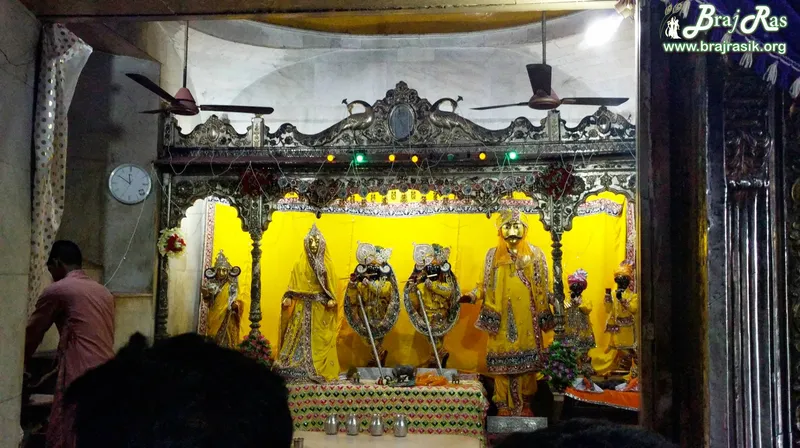
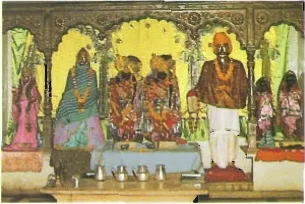
The Nṛsiṁha-Varāha Mandira is a small shrine in the village. According to the local tradition recorded in the pictorial guide Vṛndāvana-Dhāma Ki Jaya! (c. 1986), it keeps Nanda's own Deities of Nṛsiṁha and Varāha, and also his original Nārāyaṇa Deity, which is not on the altar; this is not certain. No other source describing the shrine has been found.[99] Two historians record a Narasiṁha temple at Nandagrāma: Growse (1883) lists one among the temples of the village, and Entwistle (1987) a small one on the north-west side of Madhusūdana-kuṇḍa. Neither says that it is this shrine or that it holds Nanda's Deities, so the two may or may not be the same.[100 +1]
The guide says that Nanda began to worship Nṛsiṁha on Garga Muni's advice; the Bhāgavatam tells Garga's advice differently. At the end of Garga Muni's visit, Śrīmad-Bhāgavatam has him tell Nanda that his son is as good as Nārāyaṇa and must be raised with great care.[102 +2]
tasmān nandātmajo 'yaṃ te nārāyaṇa-samo guṇaiḥ / śriyā kīrtyānubhāvena gopāyasva samāhitaḥ
In conclusion, therefore, O Nanda Mahārāja, this child of yours is as good as Nārāyaṇa. In His transcendental qualities, opulence, name, fame and influence, He is exactly like Nārāyaṇa. You should all raise this child very carefully and cautiously.
Translation: Śrīla A.C. Bhaktivedanta Swami PrabhupādaIn his purport Śrīla Prabhupāda explains that Nanda's worshipable Deity was Nārāyaṇa, and in the Kṛṣṇa book that Garga warned Nanda that demons would disturb the child. Neither the verse, the purport nor the Kṛṣṇa book speaks of Nṛsiṁha worship.[102 +2]
General teaching (does not name the place)“In other words, Garga Muni informed Nanda Mahārāja that because he was a great devotee of Lord Nārāyaṇa, the Lord had given him a son equal to Himsef. At the same time, Garga Muni indicated that this son would be disturbed by so many demons and that Nanda should therefore be careful and protect Him.”
Śrīla Prabhupāda, Kṛṣṇa, the Supreme Personality of Godhead, ch. 8 'Vision of the Universal Form' · vedabase.io
The Kṛṣṇa book also shows Nanda at his worship of Nārāyaṇa, asking the child Kṛṣṇa to bring his wooden slippers. It names no Deity of Nanda's that survives.[16]
Nṛsiṁha appears in other accounts of the child's protection, as a name invoked, not as a Deity. The Garga-saṁhitā tells that after Pūtanā's death Yaśodā, Rohiṇī and the gopīs protected the baby with a Kṛṣṇa-kavaca, a protective prayer that asks Nṛsiṁha to guard His eyes and Śveta-varāha His forehead. Durvāsā had given this prayer to Yaśodā in Nanda's house in Gokula.[105 +1]
नृसिंहो नेत्रयुग्मं च जिह्वां दशरथात्मजः । अधराववतां ते तु नरनाराणावृषी ॥ 16 ॥
nṛsiṁho netrayugmaṁ ca jihvāṁ daśarathātmajaḥ
adharāvavatāṁ te tu naranārāṇāvṛṣī || 16 ||
In the Gosvāmīs' accounts of the daily pastimes, Yaśodā protects Kṛṣṇa with Nṛsiṁha's names or seed-syllables each morning as He sets out for the forest. Śrīla Kṛṣṇadāsa Kavirāja Gosvāmī's Govinda-līlāmṛta, Śrīla Viśvanātha Cakravartī Ṭhākura's Kṛṣṇa-bhāvanāmṛta and Śrīla Raghunātha dāsa Gosvāmī's Abhīṣṭa-sūcana all tell it; none names a Deity or a shrine.[107 +2] Read more: How Nanda and Yaśodā prayed for Kṛṣṇa's protection →
Location
| Where it is | Saṅkeṭ lies between it and Varṣāṇā; the Vṛndāvana forest extends to it; map p. 98[110] Upper left on the map.[111] |
|---|
Places at Nandagrāma
61 places
Kuṇḍas
16 placesKuñjas of the sakhīs
2 placesPlaces of the ācāryas
5 placesTemples and shrines
5 placesOther places
17 placesAlso described on this page
- Nṛsiṁha-Varāha Mandira temple
Also listed here
- Ancient cave near Yaśodā-kuṇḍa cave
- Cauḍokhara kuṇḍa
- Chācha-kuṇḍa kuṇḍa
- Dohinī-kuṇḍa (Nandagrāma) kuṇḍa
- Jalvihāra-kuṇḍa (Nandagrāma) kuṇḍa
- Kyārī Vaṭa-kuṇḍa kuṇḍa
- Kāroharo-kuṇḍa kuṇḍa
- Mohinī-kuṇḍa (Nandagrāma) kuṇḍa
- Nandīśvara Taḍāga kuṇḍa
- Nārada-kuṇḍa (Nandagrāma) kuṇḍa
- Place where Lalitā and Kṛṣṇa swung (Nandagrāma) pastime site
- Rohiṇī-kuṇḍa (Nandagrāma) kuṇḍa
- Vaṭa-kadamba
- Vilāsavaṭa tree
- Śyāmapīparī-kuṇḍa kuṇḍa
Nearby places
Govardhana (town) · Kosī · Vṛndāvana · Jāvaṭa
Pictures
4 pictures
Where the sources differ
Accounts differ What began on Gopāṣṭamī: the herding of the calves or of the cows.
- Kārttika-māhātmya as quoted by Śrīla Viśvanātha Cakravartī (and Sanātana, Vaṁśīdhara) on ŚB 10.15.1From that day (the bright eighth of Kārttika) Vāsudeva became a cowherd (gopa), having earlier been a calf-herd (vatsapa); the commentaries name no place.
- Śrīmad-Bhāgavatam 10.15.1; Śrīla Prabhupāda, Kṛṣṇa book ch. 15At the paugaṇḍa age Rāma and Kṛṣṇa were allowed by the cowherd men to tend the cows (paśu-pāla-sammatau); no date or place.
- Śrī Vraja-maṇḍala Parikramā (2007)From Nandagaon, 'on Gopāṣṭamī day, Kṛṣṇa and Baladeva along with the sakhās first went out to graze the calves, and after some years the cows'.
The wording of these accounts is our summary of the sources, not a published translation.
Accounts differ Why Nanda's household turned to Nṛsiṁha for Kṛṣṇa's protection, and on whose advice.
- Vṛndāvana-Dhāma Ki Jaya! (c. 1986)Because demons were disturbing Vṛndāvana, Nanda took Garga Muni's advice and started the worship of Lord Nṛsiṁhadeva; his original Nṛsiṁha Deity (with Varāha) is in a small house in Nandagrāma.
- Śrīmad-Bhāgavatam 10.8.18–19; Śrīla Prabhupāda's purport and Kṛṣṇa book ch. 8Garga Muni tells Nanda that the child is as good as Nārāyaṇa and must be raised and protected very carefully; Nanda's worshipable Deity is Nārāyaṇa; no Nṛsiṁha worship is advised.
- Garga-saṁhitā 1.13.15–24After Pūtanā's death Yaśodā, Rohiṇī and the gopīs protect the baby with a Kṛṣṇa-kavaca in which Nṛsiṁha guards His eyes; the kavaca came from the Lord through Brahmā, Śiva and Durvāsā, who gave it to Yaśodā in Nanda's palace (in Gokula).
- Govinda-līlāmṛta 5.34–36; Kṛṣṇa-bhāvanāmṛta 7.50; Abhīṣṭa-sūcana 8In the daily pastimes Yaśodā (and Nanda) protect Kṛṣṇa with Nṛsiṁha's names or seed-syllables as He goes to the forest; no Garga, no Deity.
More on this place
Nanda's family at Nandagrāma · The morning in Nanda's house at Nandīśvara · Akrūra in Vraja: his arrival at Nandagrāma and Kṛṣṇa's departure · Uddhava brings Kṛṣṇa's message to the gopīs
- →Nanda's family at Nandagrāmaarticle›
- →The morning in Nanda's house at Nandīśvaraarticle›
- →Akrūra in Vraja: his arrival at Nandagrāma and Kṛṣṇa's departurearticle›
- →Uddhava brings Kṛṣṇa's message to the gopīsarticle›
- →Śrīla Sanātana Gosvāmī at Nandagrāmaarticle›
- →How Nanda and Yaśodā prayed for Kṛṣṇa's protectionarticle›
References
111 references
- Ādi-purāṇa (9) 11–12, Śrī Veṅkaṭeśvara Press, Mumbai, 1929
- Ādi-purāṇa (9) 44–45, Śrī Veṅkaṭeśvara Press, Mumbai, 1929
- Garga-saṁhitā, Vṛndāvana-khaṇḍa (2) 7.9, Sanskrit Wikisource
- Śrīla Rūpa Gosvāmī, Rādhā-Kṛṣṇa-gaṇoddeśa-dīpikā, part 2, vv.116–117 (sthāna-vivaraṇa)
- Śrīla Raghunātha dāsa Gosvāmī, Vraja-vilāsa-stava, Stavāvalī (9) Vraja-vilāsa-stava 8
- Śrīla Raghunātha dāsa Gosvāmī, Vraja-vilāsa-stava, Stavāvalī (9) Vraja-vilāsa-stava 62
- Śrīla Viśvanātha Cakravartī, Vraja-rīti-cintāmaṇi 1.15–16
- Śrīla Viśvanātha Cakravartī, Vraja-rīti-cintāmaṇi 1.19–22
- Śrīla Rūpa Gosvāmī, Stava-mālā, part 7 (Kṛṣṇa's names) v.15 with ṭīkā, after the edition of Bhakti Saranga Goswami and Purushottam Das, Vrindavan, 1959
- Govinda-līlāmṛta 1.4, ṭīkā
- Śrīla Viśvanātha Cakravartī, Kṛṣṇa-bhāvanāmṛta, sarga 18 (aṣṭādaśaḥ sargaḥ, prādoṣika-vilāsāsvādana; text section (18), which the index labels 'saptadaśaḥ sargaḥ') v.9, after the edition of Radhikanath Goswami, Vrindavan, 1906
- Śrīla Raghunātha dāsa Gosvāmī, Vraja-vilāsa-stava, Stavāvalī (9) Vraja-vilāsa-stava 33
- Śrīla Raghunātha dāsa Gosvāmī, Vilāpa-kusumāñjali, Stavāvalī (8) Vilāpa-kusumāñjali 61
- Śrīmad-Bhāgavatam 10.11.28, Bhagavata Vidya Pith edition, ed. Bhagavata Rishi and Krishna Shankar Shastri, 1996
- Śrīmad-Bhāgavatam 10.11.35, GRETIL
- Śrīla Prabhupāda, Kṛṣṇa, the Supreme Personality of Godhead, ch. 11 'Killing the Demons Vatsāsura and Bakāsura' · vedabase.io
- Śrīla Prabhupāda, Śrīmad-Bhāgavatam, Canto 10, chapter 1, verse 9, purport · vedabase.io
- Śrīla Prabhupāda, Parikramā on the Way to Gokula, Vṛndāvana, 28 November 1971 · vedabase.io
- Śrīla Prabhupāda, Parikramā on the Way to Gokula, Vṛndāvana, 28 November 1971 · vedabase.io
- Śrīla Prabhupāda, Morning Walk, Rome, 27 May 1974 · vedabase.io
Show all 111 references
- Śrīla Prabhupāda, Śrīmad-Bhāgavatam 5.5.10–13 lecture, Vṛndāvana, 1 November 1976 · vedabase.io
- Śrīla Prabhupāda, Śrī Caitanya-caritāmṛta, Madhya-līlā 5.12, purport · vedabase.io
- Śrīla Prabhupāda, Śrī Caitanya-caritāmṛta, Madhya-līlā 21.29, purport · vedabase.io
- Śrīla Kṛṣṇadāsa Kavirāja Gosvāmī, Śrī Caitanya-caritāmṛta, CC Madhya-līlā 18.57, online edition · vedabase.io
- Padma Purāṇa, Pātāla-khaṇḍa (5) 69.19, Sanskrit Wikisource
- Padma Purāṇa, Pātāla-khaṇḍa (5) 69.41–43, Sanskrit Wikisource
- Skanda Purāṇa, Bhāgavata-māhātmya (Skanda) 1.38 (Skanda 2.6.1.38), Sanskrit Wikisource
- Skanda Purāṇa, Bhāgavata-māhātmya (Skanda) 1.37–38 (Skanda 2.6.1.37–38), Sanskrit Wikisource
- Śrīla Nārāyaṇa Bhaṭṭa, Vraja-bhakti-vilāsa, ch. 2 v.44; printed p. 45, 1st ed., publ. Bābā Kṛṣṇadāsa, Kusuma-sarovara, Saṁvat 2008
- Śrīla Nārāyaṇa Bhaṭṭa, Vraja-bhakti-vilāsa, ch. 4 v.11; printed p. 87, 1st ed., publ. Bābā Kṛṣṇadāsa, Kusuma-sarovara, Saṁvat 2008
- Śrīla Nārāyaṇa Bhaṭṭa, Vraja-bhakti-vilāsa, ch. 4 vv.25–26; printed p. 91, 1st ed., publ. Bābā Kṛṣṇadāsa, Kusuma-sarovara, Saṁvat 2008
- Śrīla Nārāyaṇa Bhaṭṭa, Vraja-bhakti-vilāsa, the twelve adhivanas, vv.29–30, printed p. 3, 1st ed., publ. Bābā Kṛṣṇadāsa, Kusuma-sarovara, Saṁvat 2008
- Śrī Vraja-maṇḍala Parikramā (2007), PDF p. 191
- Śrī Vraja-maṇḍala Parikramā (2007), PDF p. 212
- Śrīla Prabhupāda, Śrī Caitanya-caritāmṛta, Madhya-līlā 18.57, purport · vedabase.io
- Śrīla Prabhupāda, Śrīmad-Bhāgavatam, Canto 10, chapter 11, verse 28, purport · vedabase.io
- Kṛṣṇa-caitanya-caritāmṛta of Śrīla Murāri Gupta, prakrama 4, sarga 8, v.1
- Kṛṣṇa-caitanya-caritāmṛta of Śrīla Murāri Gupta, prakrama 4, sarga 12, v.10
- Śrīla Locana dāsa Ṭhākura, Caitanya-maṅgala, Śeṣa-khaṇḍa, 1903 ed. p. 174, left column, lines 1-2
- Śrīla Locana dāsa Ṭhākura, Caitanya-maṅgala, Śeṣa-khaṇḍa, 1903 ed. p. 177, right column, lines 7-8
- Śrīla Narahari Cakravartī, Bhakti-ratnākara, Fifth Wave, 1912 ed. pp. 211-212, 2nd ed., 1912
- Śrī Vraja-maṇḍala Parikramā (2007), PDF p. 135
- Śrīla Jīva Gosvāmī: commentary on ŚB 10.11.35, Bhagavata Vidya Pith edition, ed. Bhagavata Rishi and Krishna Shankar Shastri, 1996
- Jīva Gosvāmī, Pūrva 32 ¶[9]
- Gopāla-campū, Pūrva-campū 33 ¶[321]
- Śrīla Rūpa Gosvāmī, Rādhā-Kṛṣṇa-gaṇoddeśa-dīpikā, part 1, vv.16–19
- Śrīla Rūpa Gosvāmī, Rādhā-Kṛṣṇa-gaṇoddeśa-dīpikā, part 1, vv.20–21
- Ānanda-vṛndāvana-campū, part 4, ṭīkā on v.4
- Śrīmad-Bhāgavatam 10.15.1, Bhagavata Vidya Pith edition, ed. Bhagavata Rishi and Krishna Shankar Shastri, 1996
- Śrīla Viśvanātha Cakravartī: commentary v.10.15.1, viśvanātha-cakravartī (sārārtha-darśiṇī), Bhagavata Vidya Pith edition, ed. Bhagavata Rishi and Krishna Shankar Shastri, 1996
- Śrīla Prabhupāda, Kṛṣṇa, the Supreme Personality of Godhead, ch. 15 'The Killing of Dhenukāsura' · vedabase.io
- Śrī Vraja-maṇḍala Parikramā (2007), PDF p. 194
- Śrīmad-Bhāgavatam 10.38.24, Bhagavata Vidya Pith edition, ed. Bhagavata Rishi and Krishna Shankar Shastri, 1996
- Śrīmad-Bhāgavatam 10.38.25, Bhagavata Vidya Pith edition, ed. Bhagavata Rishi and Krishna Shankar Shastri, 1996
- Śrīla Prabhupāda, Kṛṣṇa, the Supreme Personality of Godhead, ch. 38 'Akrūra's Arrival in Vṛndāvana' · vedabase.io
- Śrīla Sanātana Gosvāmī: commentary on ŚB 10.38.24, Bhagavata Vidya Pith edition, ed. Bhagavata Rishi and Krishna Shankar Shastri, 1996
- Śrīla Viśvanātha Cakravartī: commentary v.10.38.11, viśvanātha-cakravartī (sārārtha-darśiṇī), Bhagavata Vidya Pith edition, ed. Bhagavata Rishi and Krishna Shankar Shastri, 1996
- Śrīla Prabhupāda, Śrīmad-Bhāgavatam, 3.1.32, purport · vedabase.io
- Śrīla Narahari Cakravartī, Bhakti-ratnākara, Fifth Wave (pañcama taraṅga), printed p. 229 (1912 edition), 2nd ed., 1912
- Śrī Vraja-maṇḍala Parikramā (2007), PDF p. 200
- Śrīmad-Bhāgavatam ŚB 10.46.7–8, GRETIL
- Vaṁśīdhara: commentary on ŚB 10.46.7, Bhagavata Vidya Pith edition, ed. Bhagavata Rishi and Krishna Shankar Shastri, 1996
- Śrīla Prabhupāda, Kṛṣṇa, the Supreme Personality of Godhead, ch. 46 'Uddhava Visits Vṛndāvana' · vedabase.io
- Śrīla Narahari Cakravartī, Bhakti-ratnākara, Fifth Wave, 1912 ed. p. 230; Grantha Mandira text v.1041–1042, 2nd ed., 1912
- Śrīla Raghunātha dāsa Gosvāmī, Stavāvalī, Vraja-vilāsa-stava v.99 v.99)
- Garga-saṁhitā, Mathurā-khaṇḍa (5) 15.16, Sanskrit Wikisource
- Garga-saṁhitā, Mathurā-khaṇḍa (5) 15.17, Sanskrit Wikisource
- Garga-saṁhitā, Aśvamedha-khaṇḍa (10) 40.14–16, Sanskrit Wikisource
- Garga-saṁhitā, Aśvamedha-khaṇḍa (10) 40.25–26, Sanskrit Wikisource
- Garga-saṁhitā, Aśvamedha-khaṇḍa (10) 40.40–42, Sanskrit Wikisource
- Garga-saṁhitā, Aśvamedha-khaṇḍa (10) 40.46–47, Sanskrit Wikisource
- Śrīla Prabhupāda, Śrī Caitanya-caritāmṛta, Madhya-līlā 18.58, translation · vedabase.io
- Śrīla Nārāyaṇa Bhaṭṭa, Vraja-bhakti-vilāsa, ch. 4 v.18, first lines (Nandagrāma section of the forest pilgrimage), printed p. 88) v.18, 1st ed., publ. Bābā Kṛṣṇadāsa, Kusuma-sarovara, Saṁvat 2008
- Śrīla Nārāyaṇa Bhaṭṭa, Vraja-bhakti-vilāsa, ch. 4 v.18, continued, with the bathing prayer, printed p. 89) v.18, 1st ed., publ. Bābā Kṛṣṇadāsa, Kusuma-sarovara, Saṁvat 2008
- Śrī Vraja-maṇḍala Parikramā (2007), PDF p. 201
- Śrīla Rūpa Gosvāmī, Dāna-keli-kaumudī, closing verse (v.101), after the undated edition published by Krishna Das of Kusum Sarovar
- Śrīla Rūpa Gosvāmī, Dāna-keli-kaumudī, prologue (after v.2), after the undated edition published by Krishna Das of Kusum Sarovar
- Śrīla Narahari Cakravartī, Bhakti-ratnākara, Fifth Wave, 1912 ed. p. 221; Grantha Mandira text v.931–934, 2nd ed., 1912
- Śrīla Narahari Cakravartī, Bhakti-ratnākara, Fifth Wave, 1912 ed. p. 221; Grantha Mandira text v.935–938, 2nd ed., 1912
- Śrīla Narahari Cakravartī, Bhakti-ratnākara, Fifth Wave, 1912 ed. p. 222; Grantha Mandira text v.940–945, 2nd ed., 1912
- Śrīla Narahari Cakravartī, Bhakti-ratnākara, Fifth Wave, 1912 ed. pp. 222–223; Grantha Mandira text v.955–957, 2nd ed., 1912
- Śrīla Narahari Cakravartī, Bhakti-ratnākara, Sixth Wave, 1912 ed. p. 467; Grantha Mandira text v.211–212, 2nd ed., 1912
- Śrīla Narahari Cakravartī, Bhakti-ratnākara, Eleventh Wave, 1912 ed. p. 669, 2nd ed., 1912
- Śrīla Narahari Cakravartī, Bhakti-ratnākara, Thirteenth Wave, 1912 ed. p. 1023; Grantha Mandira text v.356–357, 2nd ed., 1912
- Śrīla Narahari Cakravartī, Bhakti-ratnākara, Thirteenth Wave, 1912 ed. p. 1025; Grantha Mandira text v.374–375, 2nd ed., 1912
- Śrīla Prabhupāda, Letter to Jayagovinda, Los Angeles, 4 July 1969 · vedabase.io
- Śrīla Prabhupāda, Letter to Gurudāsa, Honolulu, 17 January 1974 · vedabase.io
- Śrīla Prabhupāda, Room Conversation, Vṛndāvana, 26 October 1977 · vedabase.io
- Śrī Vraja-maṇḍala Parikramā (2007), PDF p. 205
- Śrī Vraja-maṇḍala Parikramā (2007), PDF p. 199
- Śrīla Narahari Cakravartī, Bhakti-ratnākara, Fifth Wave, 1912 ed. p. 228; Grantha Mandira, 2nd ed., 1912
- Śrī Vraja-maṇḍala Parikramā (2007), PDF p. 203
- Śrī Vraja-maṇḍala Parikramā (2007), PDF p. 204
- Prabhudayāl Mītal, printed p. 124, entry 'पावन सरोवर'
- A. W. Entwistle, §40 'Nandgaon', part 2b (source note and text), printed p. 380, Egbert Forsten, Groningen, 1987
- Śrī Vraja-maṇḍala Parikramā (2007), PDF p. 209
- Śrī Vraja-maṇḍala Parikramā (2007), PDF p. 210
- Śrī Vraja-maṇḍala Parikramā (2007), PDF p. 207
- Vṛndāvana-Dhāma Ki Jaya! (c. 1986), by Dhruva Mahārāja dāsa, PDF p. 53
- Mathurá (1883), F. S. Growse, B.C.S., M.A. Oxon., C.I.E. (as the title page gives him, p. 315
- A. W. Entwistle, §40 'Nandgaon', part 5, printed p. 381, Egbert Forsten, Groningen, 1987
- Śrīmad-Bhāgavatam ŚB 10.8.19, GRETIL
- Śrīla Prabhupāda, Śrīmad-Bhāgavatam, 10.8.19, purport · vedabase.io
- Śrīla Prabhupāda, Kṛṣṇa, the Supreme Personality of Godhead, ch. 8 'Vision of the Universal Form' · vedabase.io
- Garga-saṁhitā, Goloka-khaṇḍa (1) 13.16, Sanskrit Wikisource
- Garga-saṁhitā, Goloka-khaṇḍa (1) 13.23, Sanskrit Wikisource
- Śrīla Kṛṣṇadāsa Kavirāja Gosvāmī, Govinda-līlāmṛta 5.34 and 5.36, after the editions of Haridas Das and Haridas Shastri
- Śrīla Viśvanātha Cakravartī, Kṛṣṇa-bhāvanāmṛta, sarga 7 ('kānana-prayāṇānumodana', the setting out for the forest) v.50 (text section (7); the index locator labels it 'ṣaṣṭhaḥ sargaḥ'), after the edition of Radhikanath Goswami, Vrindavan, 1906
- Śrīla Raghunātha dāsa Gosvāmī, Abhīṣṭa-sūcana, Stavāvalī (30) Śrī Abhīṣṭa-sūcana 8
- Vṛndāvana-Dhāma Ki Jaya! (c. 1986), by Dhruva Mahārāja dāsa, p. 33
- The Colour Guide to Rādhā-kuṇḍa (1999), Rājaśekhara dāsa Brahmacārī, p. 6