Yaśodā-kuṇḍa (Nandagrāma)
यशोदा-कुण्ड (नन्दग्राम) Hindi name proposed
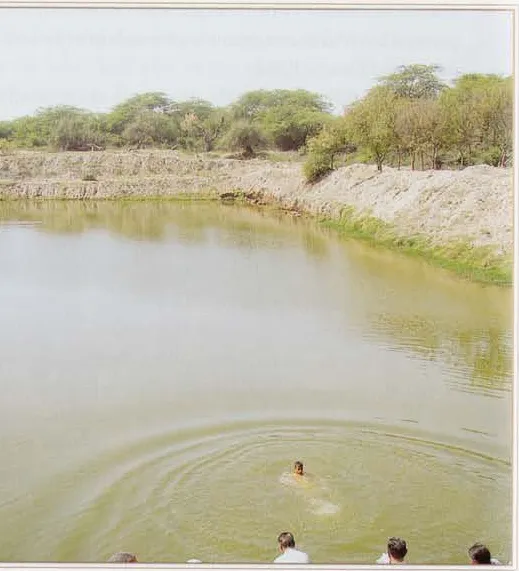
- What it is
- Yaśodā-kuṇḍa is the pond of Mother Yaśodā, south of Nanda-bhavana at Nandagrāma.
- Visiting
- Śrī Vraja-maṇḍala Parikramā places Yaśodā-kuṇḍa south of Nanda-bhavana, with the temple of Nṛsiṁhadeva on its bank and Hāū-bilāū on its western bank.
- Places here
- Nṛsiṁhadeva Mandira (Yaśodā-kuṇḍa, Nandagrāma), Hāū-bilāū
In short
Yaśodā-kuṇḍa is the pond of Mother Yaśodā, south of Nanda-bhavana at Nandagrāma.[1 +2] Śrīla Nārāyaṇa Bhaṭṭa Gosvāmī's Vraja-bhakti-vilāsa counts it among the holy places of Nandagrāma and says that it bears Yaśodā's name because she bathed there every day.[4 +1] In the Bhakti-ratnākara it is the place where Yaśodā watches Rāma and Kṛṣṇa play with Their friends.[6] Śrīmad-Bhāgavatam tells such scenes of Kṛṣṇa's childhood in Gokula and does not name the pond.[7 +1] A temple of Nṛsiṁhadeva and the old stone figures of Hāū-bilāū stand on its banks.[1 +2]
Key facts
Why it is glorified
The Vraja-bhakti-vilāsa says that Yaśodā bathes here every day without fail, and that is why the pond is called Yaśodā's.
The Vraja-bhakti-vilāsa says that Yaśodā bathes here every day without fail, and that is why the pond is called Yaśodā's. A woman who sees it or bathes in it comes to have plenty of milk, and a man becomes a master of cows, with wealth, grain and happiness. The book gives a bathing prayer to the pond as the king of holy waters, asking for these gifts and for the abode of Vaikuṇṭha (summarised here, not translated). It ascribes its list of Nandagrāma's holy places to the Vārāha.[4 +1]
यशोदा कुरुते स्नानं नित्यमेव दिनं प्रति । यतो मंजायते कुण्डं यशोदासंज्ञकं शुभम् ॥ यत्र पयस्विनी नारी गवामधिपतिर्नरः । दर्शनात्स्नानतो वापि धनधान्यसुखैर्युतः ॥ ततो यशोदाकुण्डस्नानप्रार्थनमन्त्रः— धनधान्यसुखं देहि तीर्थराज नमोस्तु ते । वैकुण्ठपदलाभाय प्रार्थयामि नमस्तु ते ॥
yaśodā kurute snānaṁ nityameva dinaṁ prati
yato maṁjāyate kuṇḍaṁ yaśodāsaṁjñakaṁ śubham
yatra payasvinī nārī gavāmadhipatirnaraḥ
darśanātsnānato vāpi dhanadhānyasukhairyutaḥ
tato yaśodākuṇḍasnānaprārthanamantraḥ— dhanadhānyasukhaṁ dehi tīrtharāja namostu te
vaikuṇṭhapadalābhāya prārthayāmi namastu te ||
Divine pastimes
Yaśodā watches her sons
Śrīmad-Bhāgavatam (10.8.21–25) tells how the cowherd women, with Yaśodā and Rohiṇī, delighted in the crawling babies Kṛṣṇa and Balarāma, and stopped their housework to watch and laugh when the calves dragged Them about by the tails They had caught. It sets this in Nanda's home in Gokula and names no pond.[7 +1] Śrīla Prabhupāda tells it in the Kṛṣṇa book:
General teaching (does not name the place)“Sometimes the naughty babies would crawl up to the cowshed, catch the tail of a calf and stand up. The calves, being disturbed, would immediately begin running here and there, and the children would be dragged over clay and cow dung. To see this fun, Yaśodā and Rohiṇī would call all their neighborhood friends, the gopīs.”
Śrīla Prabhupāda, Kṛṣṇa, the Supreme Personality of Godhead, Chapter 8 (Vision of the Universal Form) · vedabase.io
In the Bhakti-ratnākara, Śrīla Rāghava Paṇḍita Gosvāmī of Govardhana shows Śrīla Śrīnivāsa Ācārya and Śrīla Narottama dāsa Ṭhākura Yaśodā-kuṇḍa on their round of Nandīśvara. He says: this is Śrī Yaśodā-kuṇḍa; here Yaśodā watches Rāma and Kṛṣṇa play with Their friends, and Kṛṣṇa sports here in many ways at different ages. No one, he adds, can describe the parental love that Yaśodā showed Kṛṣṇa here in His earliest age (summarised here, not translated).[6]
এই শ্রীযশোদাকুণ্ড যশোদা এখানে। দেখ রামকৃষ্ণ ক্রীড়া করে সখাসনে ॥ অহে শ্রীনিবাস কৃষ্ণ প্রেমানন্দময়। বিবিধ বয়সে এথা বিলাসাতিশয় ॥ … কৌমারবয়সে কৃষ্ণে যশোদা এখানে। প্রকাশে যে বাৎসল্য তা কহিতে কে জানে ॥
ei śrīyaśodākuṇḍa yaśodā ekhāne| dekha rāmakṛṣṇa krīṛā kare sakhāsane
ahe śrīnibāsa kṛṣṇa premānandamaẏa| bibidha baẏase ethā bilāsātiśaẏa
… kaumārabaẏase kṛṣṇe yaśodā ekhāne| prakāśe ye bātsalya tā kahite ke jāne ||
The sources differ on when Kṛṣṇa's childhood at Nandīśvara began, and so on whether the pastimes of His earliest years can be set here. Read more: Nanda's family at Nandagrāma →
Accounts differ When Kṛṣṇa's childhood with Yaśodā at Nandīśvara began (whether pastimes of His kaumāra age can be set at Yaśodā-kuṇḍa).
- Bhakti-ratnākara, Fifth Wave, printed p. 224At Yaśodā-kuṇḍa: who knows how to describe the vātsalya Yaśodā showed Kṛṣṇa here in His kaumāra age (kaumāra up to five years, by the Bhakti-rasāmṛta-sindhu verse quoted there).
- Śrīla Viśvanātha Cakravartī on ŚB 10.45.3The kaumāra age of three years and four months was spent in Mahāvana; then, up to six years and eight months, 'there the stay at Nandīśvara' (the BBT purport by Śrīla Prabhupāda's disciples renders a fuller text: Vṛndāvana up to six years eight months, Nandīśvara from then through the tenth year; G012).
- Śrīla Prabhupāda, 28 November 1971 (parikramā transcript)'Gokula. And when He was three, four years old, then He was brought to Nanda-grāma.'
- the undated parikramā notes NandagrāmaKṛṣṇa was six years and eight months old when Nanda and his community settled in Nandagrāma. adds that Śrīla Viśvanātha Cakravartī 'tells us that Krsna didn't move there until He was six years old', and explains a baby-Kṛṣṇa pastime set at Nandagrāma as belonging to 'a different kalpa'.
The wording of these accounts is our summary of the sources, not a published translation.
Called home from play
Śrīmad-Bhāgavatam (10.11.12–20) tells that Rohiṇī went to call Kṛṣṇa and Balarāma, who were playing with the other boys at the riverside. When They did not come, Yaśodā called Them to drink her milk, to eat with Nanda and to bathe and be dressed for Kṛṣṇa's birthday star, and took Them home. It names no place but the riverside and tells the episode before the cowherds leave Mahāvana.[11 +4]
itthaṃ yaśodā tam aśeṣa-śekharaṃ matvā sutaṃ sneha-nibaddha-dhīr nṛpa / haste gṛhītvā saha-rāmam acyutaṃ nītvā sva-vāṭaṃ kṛtavaty athodayam
My dear Mahārāja Parīkṣit, because of intense love and affection, mother Yaśodā, Kṛṣṇa’s mother, considered Kṛṣṇa, who was at the peak of all opulences, to be her own son. Thus she took Kṛṣṇa by the hand, along with Balarāma, and brought Them home, where she performed her duties by fully bathing Them, dressing Them and feeding Them.
Translation: Śrīla A.C. Bhaktivedanta Swami PrabhupādaŚrīla Sanātana Gosvāmī calls this one day of the care Yaśodā gave her son every day, and takes the riverside to be the bank of the Yamunā (summarised here, not translated).[16 +1] Śrīla Jīva Gosvāmī's Gopāla-campū also sets the episode on the bank of a deep river in Bṛhadvana, before the move.[18 +1] Hāū-bilāū lies on the western bank of this pond, and the guidebook Śrī Vraja-maṇḍala Parikramā (2007) sets the calling home there, with a bogey that the Bhāgavatam does not have.[1 +7] The sources differ on the place; their accounts are set side by side on the Hāū-bilāū page.
Traditional accounts
According to the guidebook Śrī Vraja-maṇḍala Parikramā (2007), Mother Yaśodā bathed daily at Yaśodā-kuṇḍa, sometimes brought …
According to the guidebook Śrī Vraja-maṇḍala Parikramā (2007), Mother Yaśodā bathed daily at Yaśodā-kuṇḍa, sometimes brought Kṛṣṇa and Balarāma with her and joyfully watched Their games, and after her bath prayed to Nṛsiṁhadeva in the temple on the bank of the pond for Kṛṣṇa's well-being.[1] Read more: How Nanda and Yaśodā prayed for Kṛṣṇa's protection →
The Caitanya-caritāmṛta says that at Nandīśvara Śrī Caitanya Mahāprabhu bathed in all the kuṇḍas, beginning with Pāvana-sarovara; it names no other pond.[20]
Visiting today
Śrī Vraja-maṇḍala Parikramā places Yaśodā-kuṇḍa south of Nanda-bhavana, with the temple of Nṛsiṁhadeva on its bank and Hāū-bilāū on its western bank. Kāroharo-kuṇḍa, an ancient cave used for spiritual practice and Madhusūdana-kuṇḍa lie near it.[1 +2]
The temple of Nṛsiṁhadeva
Śrī Vraja-maṇḍala Parikramā (2007) says that a temple of Nṛsiṁhadeva stands on the bank of Yaśodā-kuṇḍa, where, according to the local tradition recorded in the book, Mother Yaśodā prayed after her daily bath for Kṛṣṇa's well-being (above); this is not certain.[1] No older text found so far mentions the temple or a prayer at the pond, and its date and founder are not known. The theme itself is old: the Gosvāmīs describe Yaśodā protecting Kṛṣṇa with Nṛsiṁha's names.[1 +3]
Śrīmad-Bhāgavatam tells that after Pūtanā's death in Gokula, Yaśodā, Rohiṇī and the elder gopīs protected the child Kṛṣṇa with a cow's switch, cow urine and dust, and with names of the Lord for each limb. Nṛsiṁha is not among those names.[29 +2]
yaśodā-rohiṇībhyāṃ tāḥ samaṃ bālasya sarvataḥ / rakṣāṃ vidadhire samyag go-puccha-bhramaṇādibhiḥ
Thereafter, mother Yaśodā and Rohiṇī, along with the other elderly gopīs, waved about the switch of a cow to give full protection to the child Śrī Kṛṣṇa.
Translation: Śrīla A.C. Bhaktivedanta Swami PrabhupādaGeneral teaching (does not name the place)“After this purificatory process, the gopīs, headed by Mother Yaśodā and Rohiṇī, chanted the names of Viṣṇu to give Kṛṣṇa’s body full protection from all evil influences.”
Śrīla Prabhupāda, Kṛṣṇa, the Supreme Personality of Godhead, Chapter 6 (Pūtanā Killed) · vedabase.io
The Garga-saṁhitā tells the same scene with a Kṛṣṇa-kavaca, a protective prayer in which Nṛsiṁha is asked to guard the child's eyes. Durvāsā had given the prayer to Yaśodā in Nanda's house in Gokula.[32 +1]
ब्रह्मणा शंभवे दत्तं शंभुर्दुर्वाससे ददौ । दुर्वासाः श्रीयशोमत्यै प्रादाच्छ्रीनन्दमन्दिरे ॥ 23 ॥ अनेन रक्षां कृत्वास्य गोपीभिः श्रीयशोमती । पाययित्वा स्तनं दानं विप्रेभ्यः प्रददौ महत् ॥ 24 ॥
brahmaṇā śaṁbhave dattaṁ śaṁbhurdurvāsase dadau
durvāsāḥ śrīyaśomatyai prādācchrīnandamandire
23
anena rakṣāṁ kṛtvāsya gopībhiḥ śrīyaśomatī
pāyayitvā stanaṁ dānaṁ viprebhyaḥ pradadau mahat || 24 ||
In the Gosvāmīs' accounts of Kṛṣṇa's daily pastimes the scene is at home, each morning, as He leaves for the forest (summarised here, not translated). In Śrīla Kṛṣṇadāsa Kavirāja Gosvāmī's Govinda-līlāmṛta, Yaśodā protects Him with the Lord's names and Nṛsiṁha's seed-mantras, and His parents bless Him that Śrī Nṛsiṁha may protect Him. In Śrīla Viśvanātha Cakravartī Ṭhākura's Kṛṣṇa-bhāvanāmṛta she protects His limbs with Nṛsiṁha's names, and in Śrīla Raghunātha dāsa Gosvāmī's Abhīṣṭa-sūcana she always entrusts Him to Nṛsiṁha, Balarāma and His friends. None of these mentions a temple or Yaśodā-kuṇḍa.[26 +2]
Which temple the guidebook means is not settled. Entwistle (1987) records a small Narasiṁha temple on the north-west side of Madhusūdana-kuṇḍa, which lies north of Yaśodā-kuṇḍa; it may or may not be this one.[34] Growse (1883) and the district gazetteer of 1911 list small temples of Narasiṁha in the village without giving their position.[35 +1] Entwistle also reports that an itinerary of 1849 calls the stone figures of Hāū-bilāū at the pond images of Narasiṁha; that itinerary could not be checked, so this is not certain.[23]
Location
| Where it is | south of Nanda-bhavana (map: row along the south, between 6 and 4)[37] |
|---|
Places at Yaśodā-kuṇḍa (Nandagrāma)
2 places
Nearby places
Nanda-bhavana (Nandagrāma) · Kāroharo-kuṇḍa
History
The Vraja-bhakti-vilāsa names both the pond and the stone figures beside it as stations of pilgrimage, and the Bhakti-ratnākara names the pond. Because Śrīla Nārāyaṇa Bhaṭṭa Gosvāmī already calls the figures hāvas, the historian A. W. Entwistle (1987) concluded that they have stood here at least since the sixteenth century.[4 +5] He also read the lion sculptures, a pile of architectural fragments beside them and carvings set into the walls of a nearby Sītalā shrine as signs that a fairly ornate temple once stood near the pond.[24]
According to Entwistle (1987), the poet Nāgarīdāsa's Tīrthānand (1753) describes how, at the Gopāṣṭamī festival, Kṛṣṇa and Balarāma (Deities or boys dressed as Them) were brought to Yaśodā-kuṇḍa and seated there, and the women warned Them not to wander far because of the lions and tigers in the jungle. Nāgarīdāsa's poem itself could not be checked, so this is not certain.[25]
Where the sources differ
What the stone figures on the western bank of Yaśodā-kuṇḍa are, the sources tell differently: the Vraja-bhakti-vilāsa names them …
What the stone figures on the western bank of Yaśodā-kuṇḍa are, the sources tell differently: the Vraja-bhakti-vilāsa names them as stone images of the hāvakas, worshipped with a prayer, the 2007 guidebook calls them figures of the hāūa, and in 1987 the historian Entwistle took them for lion-like figures from an old temple. The accounts are set side by side on the Hāū-bilāū page.[4 +6]
Accounts differ Whether Nṛsiṁha is among the forms of the Lord invoked when Yaśodā and the gopīs protected the infant Kṛṣṇa after Pūtanā's death.
- Śrīmad-Bhāgavatam 10.6.19–29 and Kṛṣṇa book ch. 6The gopīs protect each limb and activity with the names Aja, Maṇimān, Yajña, Acyuta, Hayagrīva, Keśava, Īśa, the sun-god, Viṣṇu, Urukrama, Īśvara, Cakrī, Hari, Madhuhā, Ajana, Urugāya, Upendra, Garuḍa, Haladhara, Hṛṣīkeśa, Nārāyaṇa, the Lord of Śvetadvīpa, Yogeśvara, Pṛśnigarbha, Govinda, Mādhava, Vaikuṇṭha, the husband of Śrī and Yajñabhuk; Nṛsiṁha is not named.
- Garga-saṁhitā, Goloka-khaṇḍa 13.15–24The gopīs recite the Śrī Kṛṣṇa-kavaca, in which 'Lord Nṛsiṁha' is to protect His eyes; Durvāsā had given the kavaca to Yaśodā in Nanda's palace.
More on this place
Nanda's family at Nandagrāma · How Nanda and Yaśodā prayed for Kṛṣṇa's protection
References
37 references
- Śrī Vraja-maṇḍala Parikramā (2007), PDF p. 199
- Śrī Vraja-maṇḍala Parikramā (2007), PDF p. 194
- Śrī Vraja-maṇḍala Parikramā (2007), PDF p. 200
- Śrīla Nārāyaṇa Bhaṭṭa, Vraja-bhakti-vilāsa, ch. 2 v.44) v.44, 1st ed., publ. Bābā Kṛṣṇadāsa, Kusuma-sarovara, Saṁvat 2008
- Śrīla Nārāyaṇa Bhaṭṭa, Vraja-bhakti-vilāsa, ch. 4 v.14) v.14, 1st ed., publ. Bābā Kṛṣṇadāsa, Kusuma-sarovara, Saṁvat 2008
- Śrīla Narahari Cakravartī, Bhakti-ratnākara, Fifth Wave, 1912 ed. p. 224; Grantha Mandira, 2nd ed., 1912
- Śrīmad-Bhāgavatam 10.8.24, Bhagavata Vidya Pith edition, ed. Bhagavata Rishi and Krishna Shankar Shastri, 1996
- Śrīla Prabhupāda, Kṛṣṇa, the Supreme Personality of Godhead, Chapter 8 (Vision of the Universal Form) · vedabase.io
- Śrīla Nārāyaṇa Bhaṭṭa, Vraja-bhakti-vilāsa, ch. 4 v.14) v.14, 1st ed., publ. Bābā Kṛṣṇadāsa, Kusuma-sarovara, Saṁvat 2008
- Śrīla Narahari Cakravartī, Bhakti-ratnākara, Fifth Wave, 1912 ed. p. 224; Grantha Mandira, 2nd ed., 1912
- Śrīmad-Bhāgavatam ŚB 10.11.12, GRETIL
- Śrīmad-Bhāgavatam ŚB 10.11.13, GRETIL
- Śrīmad-Bhāgavatam ŚB 10.11.14, GRETIL
- Śrīmad-Bhāgavatam ŚB 10.11.20, GRETIL
- Śrīla Prabhupāda, Kṛṣṇa, the Supreme Personality of Godhead, Chapter 11 (Killing the Demons Vatsāsura and Bakāsura) · vedabase.io
- Śrīla Sanātana Gosvāmī: commentary v.10.11.12, sanātana-gosvāmī (bṛhad-vaiṣṇava-toṣaṇī), Bhagavata Vidya Pith edition, ed. Bhagavata Rishi and Krishna Shankar Shastri, 1996
- Baladeva Vidyābhūṣaṇa: commentary v.10.11.13, baladeva-vidyabhūṣaṇaḥ (vaiṣṇavānandinī), Bhagavata Vidya Pith edition, ed. Bhagavata Rishi and Krishna Shankar Shastri, 1996
- Jīva Gosvāmī, Pūrva-campū, (9) navamaṁ pūraṇam with v.3
- Jīva Gosvāmī, Pūrva-campū, (9) navamaṁ pūraṇam
- Śrīla Prabhupāda, Śrī Caitanya-caritāmṛta, Madhya-līlā 18.58, translation · vedabase.io
Show all 37 references
- Śrīla Nārāyaṇa Bhaṭṭa, Vraja-bhakti-vilāsa, ch. 4 v.15) v.15, 1st ed., publ. Bābā Kṛṣṇadāsa, Kusuma-sarovara, Saṁvat 2008
- A. W. Entwistle, §40 Nandgaon, 5 'Tanks and ponds to the south-west and west of Nandgaon', printed pp. 381–382, Egbert Forsten, Groningen, 1987
- A. W. Entwistle, §40 Nandgaon, 5 'Tanks and ponds to the south-west and west of Nandgaon', source note, printed p. 381, Egbert Forsten, Groningen, 1987
- A. W. Entwistle, ch. 4 'Ancient and early medieval Braj', §17 'Finds in the north-western part of Mathura District' (pp. 130–131), printed p. 131, Egbert Forsten, Groningen, 1987
- A. W. Entwistle, §40 Nandgaon, 5 'Tanks and ponds to the south-west and west of Nandgaon', printed p. 382, Egbert Forsten, Groningen, 1987
- Śrīla Kṛṣṇadāsa Kavirāja Gosvāmī, Govinda-līlāmṛta 5.34 and 5.36, after the editions of Haridas Das and Haridas Shastri
- Viśvanātha Cakravartī, sarga 7 (saptamaḥ sargaḥ, kānana-prayāṇānumodana; text section (7), which the index labels 'ṣaṣṭhaḥ sargaḥ') v.50 with ṭīkā, after the edition of Radhikanath Goswami, Vrindavan, 1906
- Śrīla Raghunātha dāsa Gosvāmī, Abhīṣṭa-sūcana, Stavāvalī (30) Śrī Abhīṣṭa-sūcana 8
- Śrīmad-Bhāgavatam ŚB 10.6.19, GRETIL
- Śrīla Prabhupāda, Kṛṣṇa, the Supreme Personality of Godhead, Chapter 6 (Pūtanā Killed) · vedabase.io
- Śrīla Prabhupāda, Śrīmad-Bhāgavatam, Canto 10, Chapter 6, Texts 27–29, purport · vedabase.io
- Garga-saṁhitā, Goloka-khaṇḍa (1) 13.16, Sanskrit Wikisource
- Garga-saṁhitā, Goloka-khaṇḍa (1) 13.23–24, Sanskrit Wikisource
- A. W. Entwistle, §40 Nandgaon, 5 'Tanks and ponds to the south-west and west of Nandgaon', printed p. 381, Egbert Forsten, Groningen, 1987
- Mathurá (1883), F. S. Growse, B.C.S., M.A. Oxon., C.I.E. (as the title page gives him, p. 315
- Muttra (1911), D. L. Drake-Brockman, I.C.S. (edited and compiled), p. 314
- Śrī Vraja-maṇḍala Parikramā (2007), p. 372-373