Kṛṣṇa-Balarāma tree
कृष्ण-बलराम वृक्ष Hindi name proposed
In short
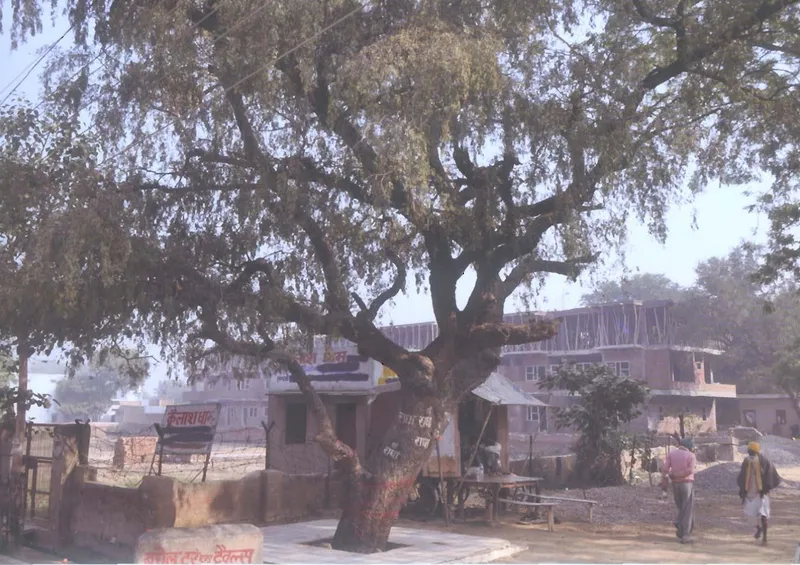
The Kṛṣṇa-Balarāma tree is a double tree on the parikramā path in Ramaṇa-reti, Vṛndāvana, about a kilometre north of the Kṛṣṇa-Balarāma Mandira.[1] According to local Vrajavāsīs, as two guides report, the two trees growing from one trunk mark a pastime place of Kṛṣṇa, and the guidebooks say that Kṛṣṇa and Balarāma came to Ramaṇa-reti with the cowherd boys and played in its soft sands while the cows rested.[1 +3] Śrīmad-Bhāgavatam tells of this play but names neither Ramaṇa-reti nor the tree, and no other scripture that mentions the tree has been found.[5 +5]
Key facts
| Kind | tree |
|---|---|
| Region · area | Vṛndāvana · Ramaṇa-reti (Vṛndāvana) |
Divine pastimes
Śrīmad-Bhāgavatam tells that Rāma and Kṛṣṇa were delighted to see Vṛndāvana, Govardhana and the sandbanks of the Yamunā, and that, old enough to tend the calves, They played with the other cowherd boys not far from the settlement. One verse says where: on the bank of the Yamunā.[5 +5]
kadācid yamunā-tīre vatsāṃś cārayatoḥ svakaiḥ / vayasyaiḥ kṛṣṇa-balayor jighāṃsur daitya āgamat
One day while Rāma and Kṛṣṇa, along with Their playmates, were tending the calves on the bank of the river Yamunā, another demon arrived there, desiring to kill Them.
Translation: Śrīla A.C. Bhaktivedanta Swami PrabhupādaFrom the age of six to ten the brothers herded the cows with Their friends and, standing hand in hand, praised the boys' games; in another verse Kṛṣṇa praises a riverbank of clean, soft sand as the best place for their play. Besides Vṛndāvana as a whole, these verses name only Govardhana and the banks of the Yamunā.[5 +5]
Śrīla Sanātana Gosvāmī notes that the Bhāgavatam names Rāma and Kṛṣṇa together, as equals, because Rāma's pleasure lies in Kṛṣṇa's pleasure; he names no particular sandbank or spot (summarised here, not translated).[11]
Traditional accounts
According to The Color Guide to Vṛndāvana (2000) and the undated parikramā notes Vṛndāvana, local Vrajavāsīs say that the two …
According to The Color Guide to Vṛndāvana (2000) and the undated parikramā notes Vṛndāvana, local Vrajavāsīs say that the two different trees growing from one trunk mark a sacred pastime place of Kṛṣṇa.[2 +1] The guidebooks add that Kṛṣṇa and Balarāma came to Ramaṇa-reti, "the pleasure-giving sands", with Their friends and played in the soft sand while the cows rested.[1 +6] The same two guides record a local tradition that this was also the area where Kṛṣṇa met Śrīmatī Rādhārāṇī before going on to Vṛndāvana; they give no source, and no verse or commentary tells it, so it is not certain.[2 +1]
Śrīla Prabhupāda
On a morning walk in Vṛndāvana in December 1975 a devotee told Śrīla Prabhupāda that the people there call Ramaṇa-reti the most …
On a morning walk in Vṛndāvana in December 1975 a devotee told Śrīla Prabhupāda that the people there call Ramaṇa-reti the most sacred spot where Kṛṣṇa and Balarāma would come; he answered only "Hmm".[14] In his purport to ŚB 10.13.5 he writes that the sounds and atmosphere of the forest that Kṛṣṇa praises there still prevail around the Kṛṣṇa-Balarāma temple, about a kilometre south of this tree. He does not mention the tree or say that the pastime of the verse took place here (a general teaching, not about the tree).[1 +2]
General teaching (does not name the place)“The same sounds and atmosphere still prevail in the area where our Kṛṣṇa-Balarāma temple is situated. Everyone who visits this temple is pleased to hear the chirping of the birds as described here (kūjat-kokila-haṁsa-sārasa).”
Śrīla Prabhupāda, Śrīmad-Bhāgavatam, 10.13.5, purport · vedabase.io
Location
| Where it is | 'on the parikramā path about a kilometer to the north of the Kṛṣṇa-Balarāma temple'[19] at Ramaṇa Reti (implied by the entry)[20] |
|---|
Nearby places
Kṛṣṇa-Balarāma Mandira (Ramaṇa-retī) · Parikramā path (Vṛndāvana)
Pictures
1 pictures
Where the sources differ
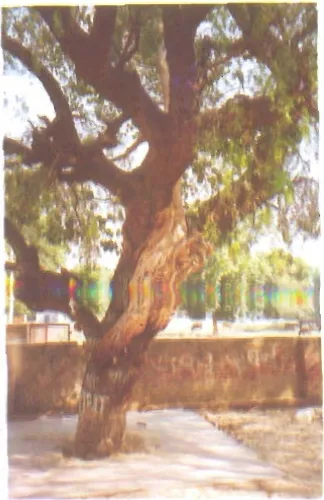
What the double tree is: two trees from one trunk, or two trees that grew into each other, a black śamī taken to stand for Kṛṣṇa and a white pipal for Balarāma. Vṛndāvana, the Playground of God (2010) says that the white pipal has died in recent years, and that the wood of the śamī produces fire when rubbed and has been used in fire sacrifices.[1 +2]
Accounts differ What the double tree is: two trees from one trunk, or two separate trees intertwined (and whether both still live).
- The Color Guide to Vṛndāvana (2000)two different trees growing from one trunk (photograph: a trunk dividing low into two)
- the undated parikramā notes Vṛndāvanatwo different trees growing from one trunk
- Vṛndāvana, the Playground of God (2010)actually two trees which had intertwined with each other, a black śamī and a white pipal; the white tree has died in recent years
Whether Balarāma was with Kṛṣṇa on the day of the lunch on the soft, sandy riverbank: Śrīla Viśvanātha Cakravartī Ṭhākura and Śrīla Baladeva Vidyābhūṣaṇa say that His mother kept Him at home, while Śrīla Prabhupāda's Kṛṣṇa book names Him among the boys that day.[9 +2]
Accounts differ Whether Balarāma was with Kṛṣṇa and the cowherd boys on the day of Aghāsura and of the lunch on the soft, sandy riverbank (ŚB 10.12.1–10.13.11), the one Canto 10 scene of the boys' play on soft sand, while the tradition at this tree speaks of Kṛṣṇa and Balarāma playing together in the soft sands of Ramaṇa-reti.
- Śrīmad-Bhāgavatam 10.12.1–10.13.27, with Śrīla Prabhupāda's translation of 10.12.14names Kṛṣṇa and the cowherd boys for that day, not Balarāma; 'sa-balam' in 10.12.14 is translated 'along with His assistants, the other cowherd boys'; Balarāma is named again in 10.13.28 ('sa-rāmaḥ'), five or six days before the end of the year that followed
- Śrīla Viśvanātha Cakravartī and Śrīla Baladeva Vidyābhūṣaṇa on ŚB 10.12.1; Vaṁśīdhara on 10.12.2 and 10.12.14Balarāma did not go to the forest that day: His mother kept Him at home for the propitiatory bath of His birth-star; Vaṁśīdhara: the 'bala' of 'sa-balam' (10.12.14) does not mean Baladeva, who did not go out on the day the calves and boys were hidden
- Śrīla Prabhupāda, Kṛṣṇa book ch. 12'Desiring to swallow all the boys at once, including Kṛṣṇa and Balarāma, he sat on the path.'
References
20 references
- Vṛndāvana, the Playground of God (2010), Bhakti Caitanya Svāmī, PDF p. 121
- The Color Guide to Vṛndāvana (2000), Written and Photographed by Rājaśekhara dāsa Brahmacārī, PDF p. 51
- the undated parikramā notes Vṛndāvana, ¶13
- Śrīla Prabhupāda-līlāmṛta 2.43 · vedabase.io
- Śrīmad-Bhāgavatam 10.11.36, GRETIL
- Śrīmad-Bhāgavatam 10.11.38, GRETIL
- Śrīmad-Bhāgavatam 10.11.39-40, GRETIL
- Śrīmad-Bhāgavatam 10.11.41, GRETIL
- Śrīmad-Bhāgavatam 10.13.5, GRETIL
- Śrīmad-Bhāgavatam 10.15.1, Bhagavata Vidya Pith edition, ed. Bhagavata Rishi and Krishna Shankar Shastri, 1996
- Śrīla Sanātana Gosvāmī: commentary on ŚB 10.11.36, Bhagavata Vidya Pith edition, ed. Bhagavata Rishi and Krishna Shankar Shastri, 1996
- Vṛndāvana-Dhāma Ki Jaya! (c. 1986), by Dhruva Mahārāja dāsa, PDF p. 62
- Śrīla Prabhupāda, Morning Walk, Vṛndāvana, 28 August 1975 · vedabase.io
- Śrīla Prabhupāda, Morning Walk, Vṛndāvana, 9 December 1975 · vedabase.io
- Śrīla Prabhupāda, Śrīmad-Bhāgavatam, 10.13.5, purport · vedabase.io
- Śrīmad-Bhāgavatam 9.14.44, GRETIL
- Śrīla Viśvanātha Cakravartī Ṭhākura: commentary on ŚB 10.12.1, Bhagavata Vidya Pith edition, ed. Bhagavata Rishi and Krishna Shankar Shastri, 1996
- Śrīla Prabhupāda, Kṛṣṇa, the Supreme Personality of Godhead (Kṛṣṇa book), Chapter 12, 'The Killing of the Aghāsura Demon' · vedabase.io
- Vṛndāvana, the Playground of God (2010), Bhakti Caitanya Svāmī, p. 121
- The Color Guide to Vṛndāvana (2000), Written and Photographed by Rājaśekhara dāsa Brahmacārī, p. 37