Kṛṣṇa-Balarāma Mandira (Ramaṇa-retī)
कृष्ण-बलराम मन्दिर (रमण-रेती) Hindi name proposed
Also called Krishna Balarāma Mandir
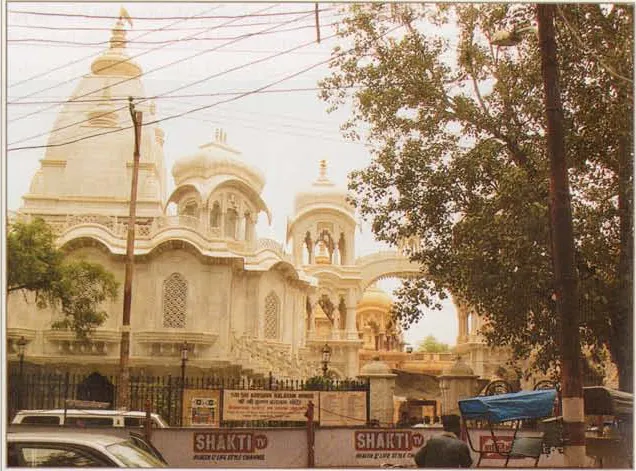
- What it is
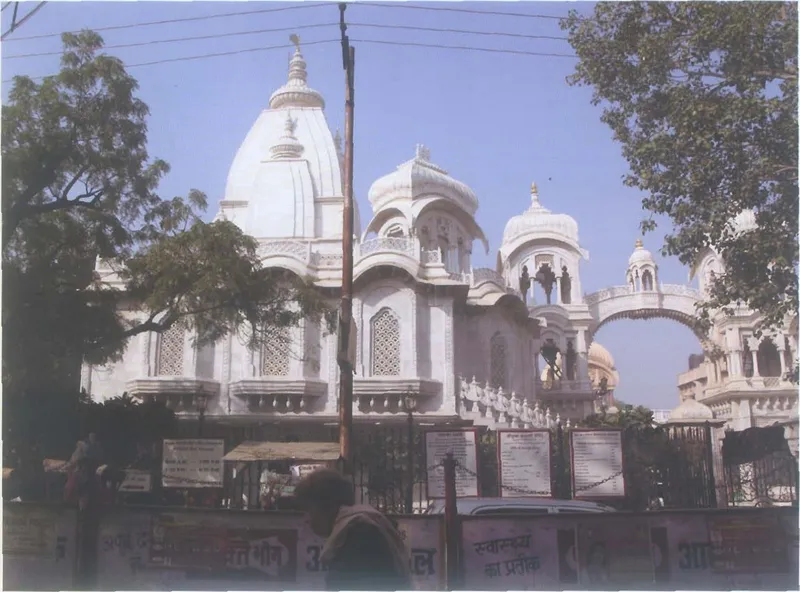
- The Kṛṣṇa-Balarāma Mandira is the temple that Śrīla Prabhupāda built in Ramaṇa-reti, a sandy area on the western edge of Vṛndāvana, and opened on Śrī Rāma-navamī, 20 April 1975.
- Visiting
- The temple stands on Bhaktivedanta Swami Marg, the old Chattikara road, in Ramaṇa-reti; Bhāgavat-nivāsa is beside the same road.
- Places here
- Prabhupāda Samādhi, Prabhupāda's house (Kṛṣṇa-Balarāma Mandira)
In short
The Kṛṣṇa-Balarāma Mandira is the temple that Śrīla Prabhupāda built in Ramaṇa-reti, a sandy area on the western edge of Vṛndāvana, and opened on Śrī Rāma-navamī, 20 April 1975.[1 +11] He chose Kṛṣṇa and Balarāma as its main Deities because Vṛndāvana had no prominent temple of the two brothers, to show that Gaura-Nitāi are Kṛṣṇa-Balarāma, and, as he said in 1975, because the brothers played in the sands of Ramaṇa-reti.[13 +7] He lived here and left this world here on 14 November 1977, and his samādhi stands in front of the temple.[18 +5] No scripture names this twentieth-century temple or Ramaṇa-reti.[26 +5]
Key facts
| Kind | temple |
|---|---|
| Region · area | Vṛndāvana · Ramaṇa-reti (Vṛndāvana) |
| Ācāryas | Śrīla A.C. Bhaktivedanta Swami Prabhupāda, Śrīla Bhaktisiddhānta Sarasvatī Ṭhākura |
Divine pastimes
Kṛṣṇa and Balarāma with the cowherd boys
Śrīmad-Bhāgavatam tells that when the cowherds had settled in Vṛndāvana, Rāma and Kṛṣṇa were delighted to see Vṛndāvana, Govardhana and the sandbanks of the Yamunā. Old enough to tend the calves, They played with the other cowherd boys not far from the settlement.[26 +5]
kvacid vādayato veṇuṃ kṣepaṇaiḥ kṣipataḥ kvacit / kvacit pādaiḥ kiṅkiṇībhiḥ kvacit kṛtrima-go-vṛṣaiḥ
vṛṣāyamāṇau nardantau yuyudhāte parasparam / anukṛtya rutair jantūṃś ceratuḥ prākṛtau yathā
Sometimes Kṛṣṇa and Balarāma would play on Their flutes, sometimes They would throw ropes and stones devised for getting fruits from the trees, sometimes They would throw only stones, and sometimes, Their ankle bells tinkling, They would play football with fruits like bael and āmalakī. Sometimes They would cover Themselves with blankets and imitate cows and bulls and fight with one another, roaring loudly, and sometimes They would imitate the voices of the animals. In this way They enjoyed sporting, exactly like two ordinary human children.
Translation: Śrīla A.C. Bhaktivedanta Swami PrabhupādaFrom the age of six to ten They herded the cows with Their friends, and the two brothers, standing hand in hand, laughed and praised the boys' dancing and wrestling. In another verse Kṛṣṇa praises a riverbank of clean, soft sand as the best place for the boys' play. None of these verses names Ramaṇa-reti or any particular spot in Vṛndāvana.[26 +5]
Śrīla Sanātana Gosvāmī explains that the Bhāgavatam names the Yamunā's sandbanks apart from Vṛndāvana because each such place is known for its own beauty, and that the calves were tended within calling distance of the settlement. He names no particular sandbank (summarised here, not translated).[32 +1]
That this play took place at Ramaṇa-reti is the local tradition that the guidebooks and Śrīla Prabhupāda's biographer report. On a morning walk in 1975 a disciple said it to Śrīla Prabhupāda, and he answered that this is why the temple was established:[5 +6]
Names this place“The sands of Raman Reti where Kṛṣṇa and Balarāma would enjoy Their pastimes. … Oh. Therefore we have established Kṛṣṇa-Balarāma temple.”
Śrīla Prabhupāda, Morning Walk, Vṛndāvana, 28 August 1975 · vedabase.io
On which day Balarāma was with the boys, the sources differ. Śrīla Viśvanātha Cakravartī Ṭhākura and Śrīla Baladeva Vidyābhūṣaṇa say that His mother kept Him at home on the day of the lunch on the sandbank, while Śrīla Prabhupāda's Kṛṣṇa book names Him among the boys that day (see below).[31 +3]
Śrīla Prabhupāda
In a purport written while the temple was being built, Śrīla Prabhupāda gives its purpose …
Why he built it
In a purport written while the temple was being built, Śrīla Prabhupāda gives its purpose:[13 +5]
Names this place“Since there is no prominent Kṛṣṇa-Balarāma temple in Vṛndāvana, we are attempting to construct one so that people will be attracted to Kṛṣṇa-Balarāma, or Nitāi-Gauracandra. … To propagate this fundamental principle, we are establishing a Kṛṣṇa-Balarāma temple to broadcast to the world that worship of Gaura-Nitāi is the same as worship of Kṛṣṇa-Balarāma.”
Śrīla Prabhupāda, Śrī Caitanya-caritāmṛta, Madhya-līlā 16.281, purport · vedabase.io
He also wrote that ISKCON was building it so that its members and outsiders could come and live peacefully in a spiritual atmosphere, and that foreigners would be attracted to it.[13 +5] Two days before the opening he told the devotees here why so much was spent on installing the Deities:[7 +5]
Names this placeSo we are expending so much money for installing Kṛṣṇa-Balarāma here. What is this purpose? The purpose is that you will be able to see Him present in this temple, and therefore, "You can think of Me." That is very natural.
Śrīla Prabhupāda, Śrīmad-Bhāgavatam 1.7.6 lecture, Vṛndāvana, 18 April 1975 · vedabase.io
The forest of the Bhāgavatam
In his purport to ŚB 10.13.5, where Kṛṣṇa praises a riverbank of soft sand, Śrīla Prabhupāda writes that the sounds and atmosphere of that forest still prevail where the temple stands. He does not say that the pastime of the verse took place here.[31 +1]
अहोऽतिरम्यं पुलिनं वयस्या:
स्वकेलिसम्पन्मृदुलाच्छबालुकम् ।
स्फुटत्सरोगन्धहृतालिपत्रिक-
ध्वनिप्रतिध्वानलसद्द्रुमाकुलम् ॥ ५ ॥
aho ’tiramyaṁ pulinaṁ vayasyāḥ
sva-keli-sampan mṛdulāccha-bālukam
sphuṭat-saro-gandha-hṛtāli-patrika-
dhvani-pratidhvāna-lasad-drumākulam
My dear friends, just see how this riverbank is extremely beautiful because of its pleasing atmosphere. And just see how the blooming lotuses are attracting bees and birds by their aroma. The humming and chirping of the bees and birds is echoing throughout the beautiful trees in the forest. Also, here the sands are clean and soft. Therefore, this must be considered the best place for our sporting and pastimes.
Translation: Śrīla A.C. Bhaktivedanta Swami PrabhupādaNames this place“The same sounds and atmosphere still prevail in the area where our Kṛṣṇa-Balarāma temple is situated. Everyone who visits this temple is pleased to hear the chirping of the birds as described here (kūjat-kokila-haṁsa-sārasa).”
Śrīla Prabhupāda, Śrīmad-Bhāgavatam, 10.13.5, purport · vedabase.io
In another purport he tells of a tamāla tree in the courtyard, neglected before the temple was built, which then grew to cover a whole corner of it: a sign, he writes, of great piety (bhūri-puṇya). Whether the tree still stands has not been checked.[68]
His residence and his samādhi
Śrīla Prabhupāda had a house on the land by November 1973 and signed the preface of The Nectar of Instruction at the "Kṛṣṇa-Balarāma Mandira, Ramaṇa-reti" in September 1975; in June 1977 the draft of his will described him as residing here. He left this world in his room at the temple on 14 November 1977. His house at the rear, Śrīla Prabhupāda's house, is now a museum.[18 +5]
On 8 October 1977 a site at the temple entrance, on the left as one enters and facing east, was discussed with him; the transcript is partly in Bengali that has not been translated.[24 +1] According to his biography, he described in those days where his samādhi should be, and workmen began to clear a space in front of the temple.[69 +1] On 22 October he proposed going to Māyāpur and being buried there.[18 +3] He left this world in Vṛndāvana, and the guidebooks say that his body was placed in the samādhi in front of the temple.[3 +7]
Songs
The Śrīla Prabhupāda-stotram, whose first verse was recited before his Bhāgavatam class in Vṛndāvana in April 1976, praises him …
The Śrīla Prabhupāda-stotram, whose first verse was recited before his Bhāgavatam class in Vṛndāvana in April 1976, praises him in its second verse for teaching in Ramaṇa-reti, at the feet of Kṛṣṇa-Balarāma.[75 +1]
Visiting today
The temple
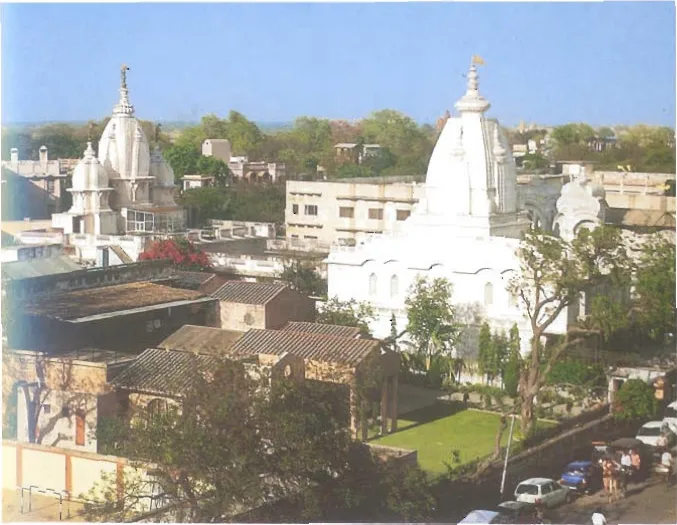
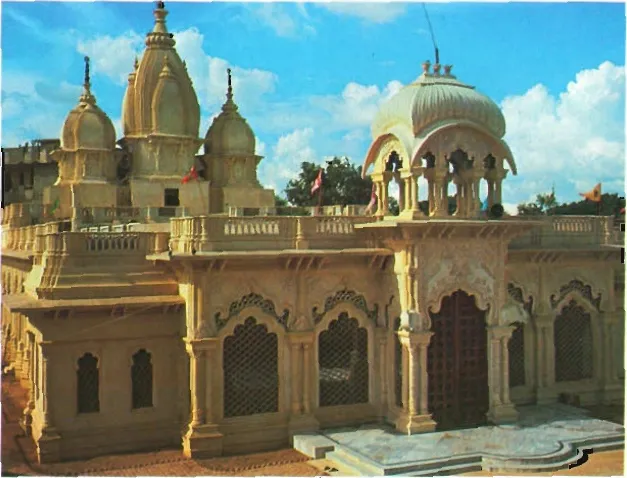
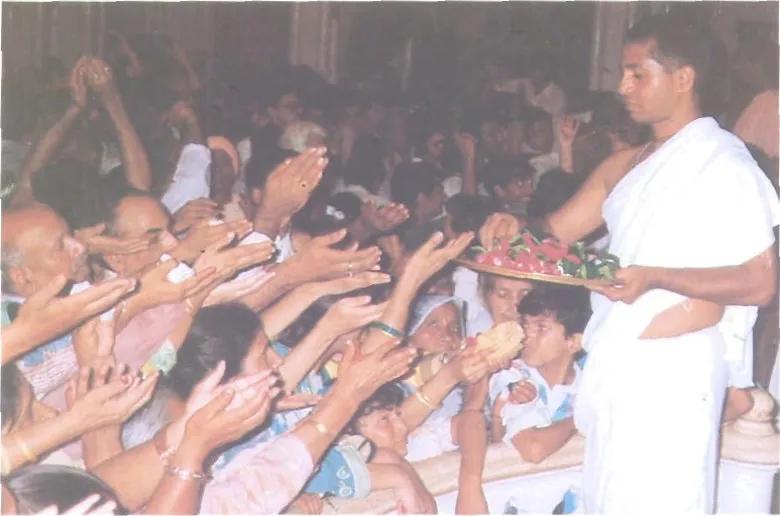
The temple stands on Bhaktivedanta Swami Marg, the old Chattikara road, in Ramaṇa-reti; Bhāgavat-nivāsa is beside the same road.[1 +9] The guidebooks of 1986 to 2010 describe three altars: Kṛṣṇa-Balarāma in the centre, Rādhā-Śyāmasundara with the gopīs Lalitā and Viśākhā on the right, and Gaura-Nitāi on the left, with the mūrtis of Śrīla Prabhupāda and of his spiritual master, Śrīla Bhaktisiddhānta Sarasvatī Ṭhākura, beside Gaura-Nitāi.[3 +5]
The same guidebooks describe an international guesthouse with a vegetarian restaurant, the Bhaktivedanta Swami International Gurukula, the samādhi in front of the temple and Śrīla Prabhupāda's house at the rear; the ISKCON gośālā about a kilometre away supplies the Deities' milk.[24 +5]
Śrīla Prabhupāda's samādhi
The samādhi is a shrine of carved marble on the left as one enters the grounds. On its altar is a larger-than-life-size mūrti of Śrīla Prabhupāda, worshipped from maṅgala-ārati onward.[24 +3] The Color Guide to Vṛndāvana (2000) says that a large festival is held here every year on his disappearance day, two days after Govardhana-pūjā, attended by his disciples and followers from many countries.[25]
Location
| Where it is | map key 27[84] |
|---|
Places at Kṛṣṇa-Balarāma Mandira (Ramaṇa-retī)
2 places
Nearby places
Vṛndāvana
Pictures
4 pictures
History
The land
According to Śrīla Prabhupāda's biography, Ramaṇa-reti in 1971 lay on the outskirts of Vṛndāvana, mostly forest with a few āśramas and abandoned fields, on the busy Chattikara Road beside the parikramā path.[6] One of those āśramas, according to Śrī Vraja-maṇḍala Parikramā (2007), is Bhāgavat-nivāsa, where Śrī Bhakti Hṛdaya Bon Mahārāja, a disciple of Śrīla Bhaktisiddhānta Sarasvatī Ṭhākura, founded a college; in 1972 Śrīla Prabhupāda placed his land just in front of Bon Mahārāja's college.[1 +4] In 1976 he said that before his temple there had been no temple in Ramaṇa-reti.[44]
The biography says that the land was offered after his appeal for land at a public reception in Vṛndāvana late in 1971, that the deed was completed at the magistrate's court in Mathurā in March 1972, and that the cornerstone was laid two days later.[6 +1] His own letters of 1972 speak of the gift deed for the land and ask that a saṅkīrtana party go every day from the Rādhā-Dāmodara temple to the new place.[42 +2]
Building and opening
By the middle of 1972 he had named it the "ISKCON Krsna-Balarama Temple", with Kṛṣṇa black and Balarāma white, and in 1973 he wrote of the Deities being carved in Jaipur.[20 +5] His letters mark the work: permission secured and materials on hand by July 1973, $100,000 sent by the ISKCON temples of the U.S.A. in January 1974, a guesthouse of 44 rooms by September 1975 and the domes complete by November 1975.[11 +5]
An opening planned for Janmāṣṭamī 1974 was called off; the biography says the building was not finished. Śrīla Prabhupāda opened the temple and installed the Deities on Śrī Rāma-navamī, 20 April 1975.[7 +5] Because the smārta-brāhmaṇas of Vṛndāvana would not accept his Western disciples as brāhmaṇas, he had brāhmaṇas perform costly Vedic ceremonies, while the devotees held loud saṅkīrtana at the same time, which he considered more important.[57] Read more: How Śrīla Prabhupāda built the Kṛṣṇa-Balarāma Mandira →
The first years
A year after the opening he called the temple the best attraction in Vṛndāvana, and in 1977 he said that thousands were coming; locally, he said in 1976, it was known as the "angrezi" (foreigners') temple.[44 +5] His letters give its address as Chattikara Road, Raman Reti in 1975 and 1976, and as Bhaktivedanta Swami Marg by 1977, after the Vṛndāvana Municipality had renamed the road; the date of the renaming is not recorded.[1 +5]
Where the sources differ
The darśana and ārati times printed by two older guides differ, and they may have changed since; check the present times before …
The darśana and ārati times printed by two older guides differ, and they may have changed since; check the present times before you go.[61 +2]
Accounts differ Darśana and ārati times of the Kṛṣṇa-Balarāma temple.
- The Color Guide to Vṛndāvana (2000)Maṅgala 4:30 am; darśana 7:15-11 am; Rāja-bhoga ārati 12 noon-12:30; evening darśana 4:00-8:30 pm (winter), 4:30-8:45 pm (summer).
- the undated parikramā notes Vṛndāvana (undated)Maṅgala 4 am; darśana 7-11 am and 4.30-9.30 pm; Rāja-bhoga darśana 12.00-12.30 pm. (These timings follow the two headings 'KRISHNA BALARĀMA MANDIR' and 'ŚRĪLA PRABHUPĀDA SAMĀDHI', so they may be meant for the samādhi or for both; The Color Guide to Vṛndāvana (2000) gives the samādhi 'same as temple' except maṅgala 4:10 am and darśana 7:00 am.)
The time of maṅgala-ārati at the samādhi.[24 +2]
Accounts differ Time of maṅgala-ārati at the samādhi.
- Vṛndāvana, the Playground of God (2010)maṅgala-ārati at 4.10am every morning
- The Color Guide to Vṛndāvana (2000)same as temple, except Maṅgala Ārati at 4:10 am and darśana at 7:00 am
- the undated parikramā notes VṛndāvanaMaṅgala 4 am (one timings block under the Krishna-Balarāma Mandir and Śrīla Prabhupāda Samādhi headings)
Whether Balarāma was with Kṛṣṇa and the boys on the day of the lunch on the sandbank, the sources answer differently; their accounts are set out on the page of Ramaṇa-reti.[31 +2]
More on this place
How Śrīla Prabhupāda built the Kṛṣṇa-Balarāma Mandira
References
84 references
- Śrīla Prabhupāda, Room Conversation with Professor Olivier Lacombe, Paris, 14 June 1974 · vedabase.io
- Śrī Vraja-maṇḍala Parikramā (2007), PDF p. 298
- Śrī Vraja-maṇḍala Parikramā (2007), PDF p. 339
- Śrī Vraja-maṇḍala Parikramā (2007), PDF p. 340
- Vṛndāvana-Dhāma Ki Jaya! (c. 1986), by Dhruva Mahārāja dāsa, PDF p. 62
- Satsvarūpa dāsa Gosvāmī, Śrīla Prabhupāda-līlāmṛta, vol. 2, ch. 37, November 1971 · vedabase.io
- Śrīla Prabhupāda, Letter to Akbar Ali Khan, letter dated 24 February 1975 · vedabase.io
- Śrīla Prabhupāda, Letter to Rupanuga, letter dated 18 December 1974, Bombay · vedabase.io
- Śrīla Prabhupāda, Letter to Prof. O.P. Goel, letter dated 10 May 1975, Perth · vedabase.io
- Śrīla Prabhupāda, Letter to Cyavana, letter dated 3 July 1974, Melbourne · vedabase.io
- Satsvarūpa dāsa Gosvāmī, Śrīla Prabhupāda-līlāmṛta, vol. 2, ch. 44, 4 August 1974 · vedabase.io
- Satsvarūpa dāsa Gosvāmī, Śrīla Prabhupāda-līlāmṛta, vol. 2, ch. 45, 20 April 1975 · vedabase.io
- Śrīla Prabhupāda, Śrī Caitanya-caritāmṛta, Madhya-līlā 16.281, purport · vedabase.io
- Śrīla Prabhupāda, Śrīmad-Bhāgavatam, 5.13.8, purport · vedabase.io
- Śrīla Prabhupāda, Śrī Caitanya-caritāmṛta, Madhya-līlā 17.156, purport · vedabase.io
- Śrīla Prabhupāda, Śrīmad-Bhāgavatam 1.7.6 lecture, Vṛndāvana, 18 April 1975 · vedabase.io
- Vṛndāvana, the Playground of God (2010), Bhakti Caitanya Svāmī, PDF p. 112
- Vṛndāvana, the Playground of God (2010), Bhakti Caitanya Svāmī, PDF p. 113
- Śrīla Prabhupāda, Morning Walk, Vṛndāvana, 28 August 1975 · vedabase.io
- Satsvarūpa dāsa Gosvāmī, Śrīla Prabhupāda-līlāmṛta, vol. 2, ch. 43, April 1972 · vedabase.io
Show all 84 references
- Śrīla Prabhupāda, Letter to Bhagavan, letter dated 19 November 1973, Vrindaban · vedabase.io
- Śrīla Prabhupāda, The Nectar of Instruction, Preface, signature, 20 September 1975 · vedabase.io
- Śrīla Prabhupāda, Discussions Will & Affidavit, Vṛndāvana, 2 June 1977 · vedabase.io
- Vṛndāvana, the Playground of God (2010), Bhakti Caitanya Svāmī, PDF p. 116
- The Color Guide to Vṛndāvana (2000), Written and Photographed by Rājaśekhara dāsa Brahmacārī, PDF p. 48
- Śrīmad-Bhāgavatam 10.11.36, GRETIL
- Śrīmad-Bhāgavatam 10.11.38, GRETIL
- Śrīmad-Bhāgavatam 10.11.39-40, GRETIL
- Śrīmad-Bhāgavatam 10.15.1, Bhagavata Vidya Pith edition, ed. Bhagavata Rishi and Krishna Shankar Shastri, 1996
- Śrīmad-Bhāgavatam 10.15.15, GRETIL
- Śrīmad-Bhāgavatam, 10.13.5, online edition · vedabase.io
- Śrīla Sanātana Gosvāmī: commentary on ŚB 10.11.36, Bhagavata Vidya Pith edition, ed. Bhagavata Rishi and Krishna Shankar Shastri, 1996
- Śrīla Sanātana Gosvāmī: commentary on ŚB 10.11.38, Bhagavata Vidya Pith edition, ed. Bhagavata Rishi and Krishna Shankar Shastri, 1996
- Vṛndāvana, the Playground of God (2010), Bhakti Caitanya Svāmī, PDF p. 121
- The Color Guide to Vṛndāvana (2000), Written and Photographed by Rājaśekhara dāsa Brahmacārī, PDF p. 51
- the undated parikramā notes Vṛndāvana, ¶13
- Śrīla Prabhupāda, Morning Walk, Vṛndāvana, 9 December 1975 · vedabase.io
- Śrīla Viśvanātha Cakravartī Ṭhākura: commentary on ŚB 10.12.1, Bhagavata Vidya Pith edition, ed. Bhagavata Rishi and Krishna Shankar Shastri, 1996
- Śrīmad-Bhāgavatam 10.12.14, Bhagavata Vidya Pith edition, ed. Bhagavata Rishi and Krishna Shankar Shastri, 1996
- Śrīla Prabhupāda, Kṛṣṇa, the Supreme Personality of Godhead (Kṛṣṇa book), Chapter 12, 'The Killing of the Aghāsura Demon' · vedabase.io
- Śrī Vraja-maṇḍala Parikramā (2007), PDF p. 341
- Śrīla Prabhupāda, Room Conversation with Sumati Morarjee, London, 11 July 1972 · vedabase.io
- The Colour Guide to Rādhā-kuṇḍa (1999), Rājaśekhara dāsa Brahmacārī, PDF p. 113
- Śrīla Prabhupāda, Prabhupāda Visits Palace and Garden, New Vrindaban, 22 June 1976 · vedabase.io
- Satsvarūpa dāsa Gosvāmī, Śrīla Prabhupāda-līlāmṛta, vol. 2, ch. 39, March 1972 · vedabase.io
- Śrīla Prabhupāda, Letter to Ksirodakasayi, letter dated 28 December 1972, Bombay · vedabase.io
- Śrīla Prabhupāda, Letter to Acyutananda, letter dated 5 August 1972, London · vedabase.io
- Śrīla Prabhupāda, Letter to Gurudasa, Yamuna, letter dated 25 April 1972, Tokyo · vedabase.io
- Śrīla Prabhupāda, Letter to Gurudasa, letter dated 14 July 1972, London · vedabase.io
- Śrīla Prabhupāda, Letter to Jayapataka, Bhavananda, letter dated 9 May 1973, Los Angeles · vedabase.io
- Śrīla Prabhupāda, Śrīmad-Bhāgavatam 1.7.45-46 lecture, Vṛndāvana, 5 October 1976 · vedabase.io
- Śrīla Prabhupāda, Morning Walk, Vṛndāvana, 18 September 1975 · vedabase.io
- Śrīla Prabhupāda, Letter to Gurudasa, letter dated 4 July 1973, Calcutta · vedabase.io
- Śrīla Prabhupāda, Letter to Manager of Punjab National Bank, letter dated 19 January 1974, Honolulu · vedabase.io
- Śrīla Prabhupāda, Letter to Sri Ramchandra Chabriaji, letter dated 11 September 1975, Vrindaban · vedabase.io
- Śrīla Prabhupāda, Letter to Deoji Punja, letter dated 4 November 1975, Bombay · vedabase.io
- Śrīla Prabhupāda, Śrīmad-Bhāgavatam, 6.3.25, purport · vedabase.io
- Śrīla Prabhupāda, Letter to Kashinath Mullick, letter dated 4 May 1976, Honolulu · vedabase.io
- Śrīla Prabhupāda, Conversation on Train to Allahabad, India, 11 January 1977 · vedabase.io
- Śrīla Prabhupāda, Śrīmad-Bhāgavatam 7.5.23-24 lecture, Vṛndāvana, 31 March 1976 · vedabase.io
- The Color Guide to Vṛndāvana (2000), Written and Photographed by Rājaśekhara dāsa Brahmacārī, PDF p. 40
- Vṛndāvana, the Playground of God (2010), Bhakti Caitanya Svāmī, PDF p. 141
- Śrīla Prabhupāda, Letter to Manager, Central Bank of India, letter dated 2 April 1976 (sender's address) · vedabase.io
- Śrīla Prabhupāda, Letter to Postmaster, letter dated 4 July 1977 (sender's address) · vedabase.io
- Vṛndāvana-Dhāma Ki Jaya! (c. 1986), by Dhruva Mahārāja dāsa, PDF p. 100
- Śrīla Prabhupāda, Interview, Māyāpur, 26 February 1977 · vedabase.io
- Śrīla Prabhupāda, Śrīmad-Bhāgavatam, 10.13.5, purport · vedabase.io
- Śrīla Prabhupāda, Śrīmad-Bhāgavatam, 10.13.49, purport · vedabase.io
- Śrīla Prabhupāda, Room Conversation (Astrologer's Report), Vṛndāvana, 8 October 1977 · vedabase.io
- Śrīla Prabhupāda-līlāmṛta 2.54 · vedabase.io
- Śrīla Prabhupāda, Room Conversation, Vṛndāvana, 22 October 1977 · vedabase.io
- The Color Guide to Vṛndāvana (2000), Written and Photographed by Rājaśekhara dāsa Brahmacārī, PDF p. 27
- Vṛndāvana-Dhāma Ki Jaya! (c. 1986), by Dhruva Mahārāja dāsa, PDF p. 16
- Śrīla Prabhupāda-līlāmṛta 2.55 · vedabase.io
- Krsnaika Ceta Mada Moha Vinasa (Srila Prabhupada Stotram) (Ananta Dasa Sastri (as the song book credits it)) · song book
- Śrīla Prabhupāda, Śrīmad-Bhāgavatam 7.9.50 lecture, Vṛndāvana, 5 April 1976 · vedabase.io
- Śrīla Prabhupāda, Letter to Karandhara, letter dated 29 January 1976, Mayapur · vedabase.io
- Śrīla Prabhupāda, Letter to Sudama, letter dated 13 January 1977, Allahabad · vedabase.io
- The Color Guide to Vṛndāvana (2000), Written and Photographed by Rājaśekhara dāsa Brahmacārī, PDF p. 50
- The Color Guide to Vṛndāvana (2000), Written and Photographed by Rājaśekhara dāsa Brahmacārī, PDF p. 54
- Vṛndāvana, the Playground of God (2010), Bhakti Caitanya Svāmī, PDF p. 115
- the undated parikramā notes Vṛndāvana, ¶5
- the undated parikramā notes Vṛndāvana, ¶6
- Śrī Vraja-maṇḍala Parikramā (2007), p. 652-653