Kṛṣṇa-kuṇḍa (Lohavana)
कृष्ण-कुण्ड (लोहवन) Hindi name proposed
Also called Krishna Kunda
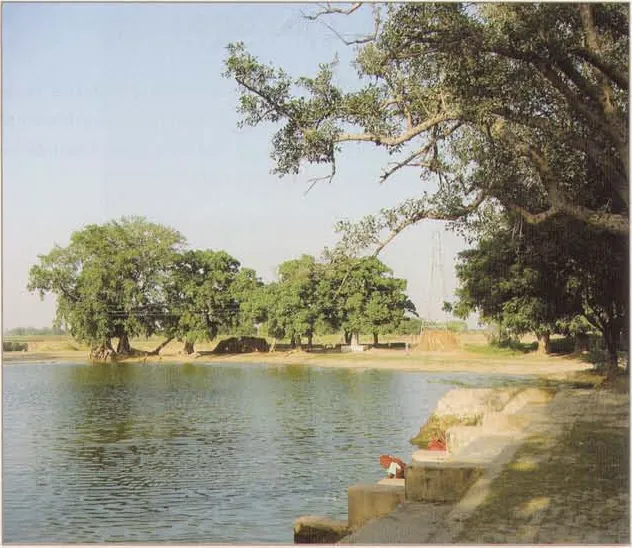
- What it is
- Kṛṣṇa-kuṇḍa is the pond of Lohavana, one of the forests of Vraja.
- Visiting
- Śrī Vraja-maṇḍala Parikramā (2007) gives a photograph of the kuṇḍa and lists it, Lohāsura's cave and Śrī Gopīnātha as the places of darśana at Lohavana, without describing the temple.
- Places here
- Gopīnātha Mandira (Lohavana)
In short
Kṛṣṇa-kuṇḍa is the pond of Lohavana, one of the forests of Vraja. The guidebook Śrī Vraja-maṇḍala Parikramā (2007) lists it among the places of darśana there, with Lohāsura's cave and Śrī Gopīnātha.[1] On its bank stands the temple of Gopīnātha, whose Deities Vṛndāvana-Dhāma Ki Jaya! (c. 1986) names Rādhā-Gopīnātha.[2 +1] The historians who described Lohavana in 1883 and 1987 found the places of the village grouped around this pond, with a well beside its ghāṭa.[4 +1]
Key facts
| Kind | kuṇḍa |
|---|---|
| Region · area | Bhāṇḍīravana · Lohavana |
Traditional accounts
In the Bhakti-ratnākara (Fifth Wave), Śrīla Rāghava Paṇḍita Gosvāmī shows Śrīla Śrīnivāsa Ācārya Lohavana, where Kṛṣṇa grazed the cows, and has darśana there of images of Kṛṣṇa, Balarāma, Nṛsiṁha and others (summarised here, not translated). The book names neither the kuṇḍa nor a Gopīnātha.[6]
The same book then sets Kṛṣṇa's boat pastime at a ghāṭa on the Yamunā near Lohavana. The undated parikramā notes Lohavana print that passage under the heading Kṛṣṇa-kuṇḍa; the two placings are set side by side on the page of the ghāṭa of Kṛṣṇa's boating pastimes.[7]
Visiting today
Śrī Vraja-maṇḍala Parikramā (2007) gives a photograph of the kuṇḍa and lists it, Lohāsura's cave and Śrī Gopīnātha as the places of darśana at Lohavana, without describing the temple.[1] Vṛndāvana-Dhāma Ki Jaya! (c. 1986) names the Deities in the temple on the bank Rādhā-Gopīnātha, and the undated parikramā notes Lohavana list the Rādhā-Gopīnātha temple first among the places to see there.[2 +1]
Places at Kṛṣṇa-kuṇḍa (Lohavana)
1 places
History
The pond
F. S. Growse (1883) described the Kṛṣṇa-kuṇḍa at Lohavana as a pond with a small grove of kadamba trees and fine pīpal trees. Under one of them was a small well, the Gop-kūā, which always held water, though the pond dried up in the hot month of Jyeṣṭha; on the opposite side a small shrine had been built over carved stones found in the pond.[4] In 1987 A. W. Entwistle wrote that the places visited at Lohavana lie around this pond, which then had a masonry ghāṭa (bathing steps) on the south-east side of the village, with the well, called Kṛṣṇa-kūpa or Gopī-kuāṅ, near the ghāṭa.[5]
The temple of Gopīnātha
Growse (1883) also described a temple of Gopīnātha by the pond, built in the old style, with a shrine and a porch each crowned by a spire. He reported that the year 1712 was assigned to the building, without saying who assigned it or on what evidence. Entwistle (1987) repeated the date after Growse and described the temple as belonging to the Puṣṭimārga, and Prabhudayāl Mītal (1966) also noted a temple of Śrī Gopīnātha at Lohavana.[4 +2] No Vaiṣṇava source found gives the founder, the date or the history of the Deity.[1 +3]
Where the sources differ
Which Deities are worshipped in the Lohavana temple and which tradition serves it.
Accounts differ Which Deities are worshipped in the Lohavana temple and which tradition serves it.
- Śrī Vraja-maṇḍala Parikramā (2007)'Śrī Gopīnātha' (a place of darśana at Lohavana); no tradition named.
- Vṛndāvana-Dhāma Ki Jaya! (c. 1986); the undated parikramā notes LohavanaThe Deities in the temple on the bank of Kṛṣṇa-kuṇḍa are Rādhā-Gopīnātha; 'Radha Gopinath Temple'.
- A. W. Entwistle (1987), a historianEntwistle says the temple belongs to the Puṣṭimārga and is dedicated to Gopīnātha; shrines of Śiva and Hanumān stand opposite it.
- Bhakti-ratnākara, Fifth Wave vv.1700-1701At Lohavana: images of Kṛṣṇa, Balarāma, Nṛsiṁha and others; no Gopīnātha named.
References
10 references
- Śrī Vraja-maṇḍala Parikramā (2007), PDF p. 264
- Vṛndāvana-Dhāma Ki Jaya! (c. 1986), by Dhruva Mahārāja dāsa, PDF p. 83
- the undated parikramā notes Lohavana, ¶18
- Mathurá (1883), F. S. Growse, B.C.S., M.A. Oxon., C.I.E. (as the title page gives him, p. 87
- A. W. Entwistle, ch. 8 §68 'Lohban', printed p. 420, Egbert Forsten, Groningen, 1987
- Śrīla Narahari Cakravartī, Bhakti-ratnākara, Fifth Wave (pañcama taraṅga), printed p. 276, vv.1696 and 1700-1701 in the Grantha Mandira numbering, 2nd ed., 1912
- Śrīla Narahari Cakravartī, Bhakti-ratnākara, Fifth Wave (pañcama taraṅga), printed p. 276, vv.1702-1705 in the Grantha Mandira numbering, 2nd ed., 1912
- Prabhudayāl Mītal, 'Brajyātrā' section, 21st halt 'लोहवन' (Lohavana), printed p. 141
- Śrī Vraja-maṇḍala Parikramā (2007), p. 502-503
- Vṛndāvana-Dhāma Ki Jaya! (c. 1986), by Dhruva Mahārāja dāsa, p. 65