Bhāṇḍīravana
भाण्डीरवन Hindi name proposed
- What it is
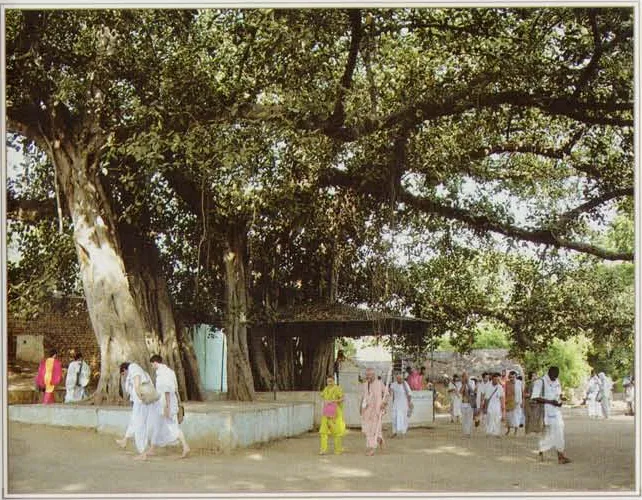
- Bhāṇḍīravana, the forest of the Bhāṇḍīra banyan, is one of the twelve forests of Vraja, and Śrīla Prabhupāda counts it among the five forests on the eastern bank of the Yamunā.
- Visiting
- Śrī Vraja-maṇḍala Parikramā (2007) calls Bhāṇḍīravana prominent among the twelve forests and names the Bhāṇḍīravaṭa, Veṇu-kūpa, the Vaṁśīvaṭa and the temples of Śrīdāmā and Baladeva among its places …
- Places here
- Bilvavana, Bhadravana, Lohavana, Pānī-gaon, Āyore-grāma +15 more
In short
Bhāṇḍīravana, the forest of the Bhāṇḍīra banyan, is one of the twelve forests of Vraja, and Śrīla Prabhupāda counts it among the five forests on the eastern bank of the Yamunā.[1 +9] Śrīmad-Bhāgavatam names the Bhāṇḍīra banyan twice: as the goal of the boys' game when Balarāma killed the demon Pralamba, and as the place where the boys found themselves after Kṛṣṇa swallowed a forest fire.[11 +5] Śrīla Prabhupāda's Kṛṣṇa book tells both pastimes in the Bhāṇḍīravana forest, and the Caitanya-caritāmṛta names Bhāṇḍīravana on Śrī Caitanya Mahāprabhu's tour of Vraja.[17 +6] The sources differ on which bank of the river the Bhāgavatam's banyan stood. Śrīla Prabhupāda locates the forest on the eastern bank, but he does not say where the banyan itself stood, and Śrīla Sanātana Gosvāmī and Śrīla Jīva Gosvāmī place the banyan on the western bank.[2 +15]
Key facts
| Kind | forest |
|---|---|
| Ācāryas | Śrī Caitanya Mahāprabhu, Śrīla Rūpa Gosvāmī, Śrīla Sanātana Gosvāmī, Śrīla Jīva Gosvāmī, Śrīla Raghunātha dāsa Gosvāmī |
Why it is glorified
The Varāha Purāṇa calls Bhāṇḍīra the eleventh forest, the best of forests and dear to the yogīs.
The Varāha Purāṇa calls Bhāṇḍīra the eleventh forest, the best of forests and dear to the yogīs. By merely seeing it one is not born again; one who reaches it and sees Vāsudeva there has no rebirth; and one who bathes at its Bhāṇḍīraka tīrtha with restraint is freed from all sins (summarised here, not translated). Śrīla Rūpa Gosvāmī collects these verses in his Mathurā-māhātmya under the heading "of Bhāṇḍīra-vana", and the Bhakti-ratnākara quotes them.[27 +10]
वनं बिल्ववनं नाम दशमं देवपूजितम् ।। तत्र गत्वा तु मनुजो ब्रह्मलोके महीयते ॥ 45 ॥ एकादशं तु भाण्डीरं योगिनः प्रियमुत्तमम् ।। तस्य दर्शनमात्रेण नरो गर्भं न गच्छति ॥ 46 ॥ भाण्डीरं तमनुप्राप्य वनानां वनमुत्तमम् ।। वासुदेवं ततो दृष्ट्वा पुनर्जन्म न विद्यते ॥ 47 ॥
vanaṁ bilvavanaṁ nāma daśamaṁ devapūjitam
tatra gatvā tu manujo brahmaloke mahīyate
45
ekādaśaṁ tu bhāṇḍīraṁ yoginaḥ priyamuttamam
tasya darśanamātreṇa naro garbhaṁ na gacchati
46
bhāṇḍīraṁ tamanuprāpya vanānāṁ vanamuttamam
vāsudevaṁ tato dṛṣṭvā punarjanma na vidyate || 47 ||
The Padma Purāṇa calls the Bhāṇḍīra the twelfth petal of the lotus of Vraja, where Kṛṣṇa plays surrounded by Śrīdāmā and the other boys.[27 +4] The Varāha Purāṇa also counts Bhāṇḍīra among six holy places of Mathurā that are equal to Kurukṣetra, and the Nārada Purāṇa says that one who bathes at Bhāṇḍīra with devotion is freed from all sins.[6 +2] Every list of the twelve forests found so far counts Bhāṇḍīravana, though the names and numbers change from list to list; the lists are set side by side on the page of Baelvana.[1 +5] Read more: The twelve forests of Vraja: the lists side by side →
The Harivaṁśa describes the Bhāṇḍīra as a huge banyan in the middle of Vṛndāvana, which Kṛṣṇa chose as His dwelling by day, playing there with the boys who herded the calves. The banyan has its own page, Bhāṇḍīravaṭa.[41 +6] In the Nārada Purāṇa's thousand names of Rādhā and Kṛṣṇa, He is the one who dwells at the Bhāṇḍīra banyan, and She is the one who dwells at the Bhāṇḍīra.[48 +1]
Divine pastimes
The pastimes are told here as Śrīla Prabhupāda's Kṛṣṇa book tells them, in the Bhāṇḍīravana forest. Śrīla Sanātana Gosvāmī and Śrīla Jīva Gosvāmī place the banyan of these pastimes on the western bank, and the Bhakti-ratnākara shows a Bhāṇḍīra-vaṭa there that people now call Akṣayavaṭa. Both traditions are given on this page, and neither site is called the only true one.[11 +12]
The killing of Pralamba
Śrīla Prabhupāda's Kṛṣṇa book tells how the cowherd boys played a game in which the losers had to carry the winners, while they tended the cows in the Bhāṇḍīravana forest:[11 +5]
Names this place“They began playing, and at the same time tended the cows as they proceeded through the Bhāṇḍīravana forest. The party of Balarāma, accompanied by Śrīdāmā and Vṛṣabha, came out victorious, and Kṛṣṇa’s party had to carry them on their backs through the Bhāṇḍīravana forest.”
Śrīla Prabhupāda, Kṛṣṇa, the Supreme Personality of Godhead (Kṛṣṇa book), Chapter 18, 'Killing the Demon Pralambāsura' · vedabase.io
The demon Pralamba had joined the game dressed as a cowherd boy. He carried Balarāma far beyond the spot where he should have put Him down, and Balarāma killed him with His fist. Śrīmad-Bhāgavatam (10.18.22) names the banyan Bhāṇḍīraka as the place to which the boys went in this game; it does not say on which bank of the Yamunā it stood.[11 +5]
vahanto vāhyamānāś ca cārayantaś ca go-dhanam / bhāṇḍīrakaṃ nāma vaṭaṃ jagmuḥ kṛṣṇa-purogamāḥ
Thus carrying and being carried by one another, and at the same time tending the cows, the boys followed Kṛṣṇa to a banyan tree known as Bhāṇḍīraka.
Translation: Śrīla Prabhupāda's disciples (BBT)Śrīla Viśvanātha Cakravartī Ṭhākura explains that the banyan was the place fixed for getting down in the game, and Śrīla Sanātana Gosvāmī calls it a banyan only in name, in truth a wish-fulfilling tree (summarised here, not translated).[53 +1] The Harivaṁśa, the Viṣṇu Purāṇa and the Padma Purāṇa also tell the Pralamba pastime at the Bhāṇḍīra banyan; the Garga-saṁhitā has Pralamba carry Balarāma away from the Bhāṇḍīra to the bank of the Yamunā.[42 +5] Read more: The Bhāṇḍīra banyan →
The forest fire
Śrīmad-Bhāgavatam (10.19) tells that the cows strayed into the Muñja forest, a fire surrounded the boys there, and Kṛṣṇa asked them to close their eyes and swallowed the fire. Śrīla Prabhupāda writes in the Kṛṣṇa book:[11 +5]
Names this place“Out of fear, the boys were almost unconscious, but when they regained their consciousness and opened their eyes, they saw that they were again in the Bhāṇḍīra forest with Kṛṣṇa, Balarāma and the cows.”
Śrīla Prabhupāda, Kṛṣṇa, the Supreme Personality of Godhead (Kṛṣṇa book), Chapter 19, 'Devouring the Forest Fire' · vedabase.io
tataś ca te 'kṣīṇy unmīlya punar bhāṇḍīram āpitāḥ / niśamya vismitā āsann ātmānaṃ gāś ca mocitāḥ
The cowherd boys opened their eyes and were amazed to find not only that they and the cows had been saved from the terrible fire but that they had all been brought back to the Bhāṇḍīra tree.
Translation: Śrīla Prabhupāda's disciples (BBT)Śrīla Viśvanātha Cakravartī Ṭhākura sums up the chapter in the same way: Hari brought His friends from the fire in the Muñja forest to the Bhāṇḍīra and then let them open their eyes (summarised here, not translated).[53 +1] Śrīla Rūpa Gosvāmī, Śrīla Jīva Gosvāmī and Śrīla Kavi-karṇapūra tell both pastimes at the foot of the Bhāṇḍīra in their poems; none of them says on which bank it stood.[11 +4] The Garga-saṁhitā ends the pastime in another way, as shown below. The forest of reeds where the fire broke out has its own page, Muñjāṭavī.
Herding the cows
Śrīmad-Bhāgavatam (10.15.1) tells that Kṛṣṇa and Balarāma began to herd the cows when They reached the paugaṇḍa age, from six to ten; it names no forest. The Garga-saṁhitā names the Bhāṇḍīra grove among the forests where Kṛṣṇa wandered with the cows.[58 +2] Śrīla Śrīnātha Cakravartī, explaining the Bhāgavatam's words "from forest to forest" (10.21.19), says that the boys took the cows sometimes to Vṛndāvana and sometimes to Bhāṇḍīravana (summarised here, not translated).[58 +1]
More pastimes at the Bhāṇḍīra
The Brahma-vaivarta Purāṇa connects several more of Kṛṣṇa's pastimes with the root of the Bhāṇḍīra banyan. There Brahmā, ashamed, found Kṛṣṇa among the cowherd boys after hiding the calves and boys for a year. There Rāma and Keśava waited while the boys went to ask the brāhmaṇas' wives for food, and that food is later remembered as eaten there. Uddhava, coming from Mathurā, saw before him "the imperishable banyan" at the Bhāṇḍīra. Śrīmad-Bhāgavatam tells these pastimes without naming the place.[62 +5] Where the brāhmaṇas' wives brought their food the sources tell differently; the accounts are set side by side on the page of Baelvana.[62 +5] Read more: Kṛṣṇa and the wives of the brāhmaṇas: the pastime and its places →
Single sources connect still more pastimes with this forest. The Brahma-vaivarta Purāṇa has the demon Keśī attack Kṛṣṇa as He went to the Bhāṇḍīra. Śrīla Jīva Gosvāmī's Gopāla-campū sets Balarāma's pastimes with the gopīs during His visit to Vraja, and His dragging of the Yamunā, in a secluded place north of the Bhāṇḍīravana (summarised here, not translated). Śrīmad-Bhāgavatam tells both pastimes without naming a place.[68 +9] Read more: Balarāma's visit to Vraja →
Śrīla Nārāyaṇa Bhaṭṭa Gosvāmī's Vraja-bhakti-vilāsa counts "the place of Aghāsura's killing" among the signs of Bhāṇḍīravana, and Śrīla Locana dāsa Ṭhākura's Caitanya-maṅgala also names the Bhāṇḍīra forest for Aghāsura's death. Śrīmad-Bhāgavatam names no place, and other sources set the killing elsewhere; the accounts are set side by side on the page of Pasaulī.[68 +6]
According to the Garga-saṁhitā, the sage Durvāsā, whom Kṛṣṇa calls His guru, came to Bhāṇḍīra, and the gopīs crossed the Yamunā to feed him there.[79 +1] Other sources set this pastime elsewhere; their accounts are set side by side on the page of Pānī-gaon. Read more: The gopīs cross the Yamunā to feed Durvāsā →
The cowherds' move to Vṛndāvana
Śrīmad-Bhāgavatam (10.11) tells how the cowherds left Gokula for Vṛndāvana with their carts and cows, without naming a crossing of the Yamunā. According to the Bhakti-ratnākara, they crossed the river beside Bhāṇḍīravana on the way.[5 +8] In Śrīla Locana dāsa Ṭhākura's Caitanya-maṅgala, Śrī Caitanya Mahāprabhu's guide tells Him that Nanda's people stayed two months in the "Bhadra-Bhāṇḍīra" forest before crossing to Vṛndāvana; Śrīla Murāri Gupta's account, which Śrīla Locana dāsa Ṭhākura follows, tells the same (both summarised here, not translated).[82 +1]
Śrī Rādhā and Kṛṣṇa at the Bhāṇḍīra
The Garga-saṁhitā tells that when Kṛṣṇa was still a child and Śrī Rādhā longed for the rāsa dance with Him, a voice from the sky at the Bhāṇḍīra told Her that Her desire would be fulfilled in Vṛndāvana. Kṛṣṇa recalls Her desire at the Bhāṇḍīra again before He leaves for Mathurā (summarised here, not translated).[84 +2]
The Gosvāmīs set many scenes of Śrī Rādhā and Kṛṣṇa's pastimes here. Śrīla Rūpa Gosvāmī, among Her hundred and eight names, calls Her the ornament of the Bhāṇḍīra, and in his play Lalita-mādhava She searches the land of the Bhāṇḍīra for Kṛṣṇa after He has gone to Mathurā.[36 +4] Śrīla Raghunātha dāsa Gosvāmī worships the Bhāṇḍīraka where Śrī Rādhā and Her friends, dressed as wrestlers, playfully wrestled with Kṛṣṇa.[50 +3] Śrīla Jīva Gosvāmī tells that Kṛṣṇa sometimes came to the Bhāṇḍīraka with the sakhīs to play on land, in the forest and in the Yamunā.[92 +2] Where the wrestling took place the sources tell differently, as the page of Akṣayavaṭa shows.[50 +3]
The wedding remembered here
Within the forest, pilgrims traditionally revere a spot beneath the Bhāṇḍīravaṭa as the place of Śrī Rādhā and Kṛṣṇa's wedding. According to the Garga-saṁhitā (Goloka-khaṇḍa, chapter 16) and the Brahma-vaivarta Purāṇa (Śrī-kṛṣṇa-janma-khaṇḍa, chapter 15), Brahmā performed this wedding in the Bhāṇḍīra forest; Śrīmad-Bhāgavatam does not narrate it.[96 +5] The account and Śrīla Prabhupāda's teaching on it are given on the page Rādhā-Kṛṣṇa Marriage Place.[96 +5]
Śrī Caitanya Mahāprabhu
The Caitanya-caritāmṛta tells that on His tour of Vraja Śrī Caitanya Mahāprabhu went to Bhāṇḍīravana after Khelā-tīrtha, and then, crossing the Yamunā, to Bhadravana. The verse gives the order of the route; it does not say where the crossing was made.[19 +4]
tabe ‘khelā-tīrtha’ dekhi’ ‘bhāṇḍīravana’ āilā
yamunā pāra hañā ‘bhadra-vana’ gelā
Afterwards, Śrī Caitanya Mahāprabhu saw Khelā-tīrtha and then went to Bhāṇḍīravana. After crossing the Yamunā River, He went to Bhadravana.
Translation: Śrīla A.C. Bhaktivedanta Swami PrabhupādaŚrīla Prabhupāda names Bhāṇḍīravana among the important places that the Lord visited in Vṛndāvana.[19 +4]
Traditional accounts
Śrī Vraja-maṇḍala Parikramā (2007) and the undated parikramā notes Bhāṇḍīravana call Bhāṇḍīravana the place where every kind of …
Śrī Vraja-maṇḍala Parikramā (2007) and the undated parikramā notes Bhāṇḍīravana call Bhāṇḍīravana the place where every kind of tattva-jñāna, knowledge of the Absolute Truth, is fully manifest; they name no source for this. The Brahma-vaivarta Purāṇa speaks of "the supreme truth" that Kṛṣṇa gave long ago at the Bhāṇḍīra, and in Śrīla Rūpa Gosvāmī's Bhakti-rasāmṛta-sindhu Nārada stands amazed on hearing Kṛṣṇa's parrots debate Vedānta in the Bhāṇḍīra grove.[32 +9]
Śrīla Nārāyaṇa Bhaṭṭa Gosvāmī's Vraja-bhakti-vilāsa names Śrīdhara as the presiding Deity of Bhāṇḍīravana. As its signs it gives a tīrtha named Asimāṇḍa-hrada, a well named Matsya-kūpa (it says there is no kuṇḍa), an Aśoka tree with the goddess of the Aśoka grove, Aśokamālinī, and the place of Aghāsura's killing. The walk around the forest, two krośas, is made on the twelfth day of the bright fortnight of Bhādra with prayers that the book gives from the Skanda and Mātsya Purāṇas, and on Dhruva's birthday, it says, the Matsya-kūpa is full of milk.[7 +6] Which well of Bhāṇḍīravana fills with milk is told differently on the page of Veṇu-kūpa.[93 +1]
The same book counts the forests of what it calls the "northern" bank of the Yamunā, and its eight banyans beginning with the Bhāṇḍīra-vaṭa, as the kingdom of Śrī Baladeva, and those of the southern bank as Śrī Kṛṣṇa's.[7 +1] Why the forests on this side of the river have temples of Baladeva is told on the page of the Baladeva Mandira, and the sources' accounts are set side by side on the page of Baelvana.[7 +1]
The Gosvāmīs and ācāryas
According to the Bhakti-ratnākara (Fifth Wave), Śrīla Rāghava Paṇḍita Gosvāmī of Govardhana showed Bhāṇḍīravana to Śrīla …
According to the Bhakti-ratnākara (Fifth Wave), Śrīla Rāghava Paṇḍita Gosvāmī of Govardhana showed Bhāṇḍīravana to Śrīla Śrīnivāsa Ācārya, who travelled with Śrīla Narottama dāsa Ṭhākura, as the eighth forest of their tour, after Bhadravana. He called it a supremely solitary forest where Rāma and Kṛṣṇa play with Their friends, quoted the verses of the Ādi-varāha on it, and showed him the village of Chāherī, named after the shade (chāyā) where Kṛṣṇa ate with His friends after playing at the Bhāṇḍīra (summarised here, not translated).[5 +4]
According to the same book (Thirteenth Wave), Śrīla Vīracandra Prabhu, after visiting Bhadravana on his tour of Vraja, wandered in the Bhāṇḍīra, Śrī and Loha forests.[52]
Śrīla Prabhupāda
Śrīla Prabhupāda gives Bhāṇḍīra among the forests on the eastern side of the Yamunā …
Śrīla Prabhupāda gives Bhāṇḍīra among the forests on the eastern side of the Yamunā:[2 +5]
Names this place“The five forests situated on the eastern side of the river Yamunā are Bhadra, Bilva, Loha, Bhāṇḍīra and Mahāvana. The seven forests situated on the western side of the Yamunā are Madhu, Tāla, Kumuda, Bahulā, Kāmya, Khadira and Vṛndāvana.”
Śrīla Prabhupāda, Śrī Caitanya-caritāmṛta, Madhya-līlā 5.12, purport · vedabase.io
In The Nectar of Devotion he renders Śrīla Rūpa Gosvāmī's example of wonder from the forest-fire pastime, and here he sets the fire itself in the Bhāṇḍīravana:[32 +5]
Names this place“Similarly, when there was a forest fire in the Bhāṇḍīra-vana, Kṛṣṇa instructed His friends to close their eyes tightly, and they all did this. Then when Kṛṣṇa had extinguished the fire, the cowherd boys opened their eyes and saw that they had been relieved from the danger and that their cows and calves were all safe.”
Śrīla Prabhupāda, The Nectar of Devotion, Chapter 46 (ecstatic love in wonder) · vedabase.io
He also writes that the pilgrims of his time, starting at Mathurā, went round twelve forests, Bhāṇḍīravana among them. An overview of all the lists is on the Vraja-maṇḍala page.[8 +2]
Songs
Śrīla Rūpa Gosvāmī calls Kṛṣṇa the dancer on the ground of the Bhāṇḍīra among His hundred and eight names …
Śrīla Rūpa Gosvāmī calls Kṛṣṇa the dancer on the ground of the Bhāṇḍīra among His hundred and eight names:[32 +5]
nandīśvara-dhṛtānando bhāṇḍīra-taṭa-tāṇḍavī
śaṅkhacūḍa-haraḥ krida-gendukrta-girīśvaraḥ
Visiting today
Smaller places described here
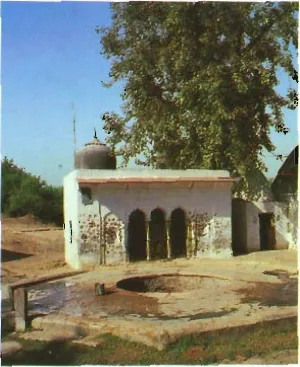
- Balarāma-mukuṭa, "Balarāma's crown": according to the undated parikramā notes Bhāṇḍīravana, the only source that names it, one can see the impression of Balarāma's crown on a rock just next to Veṇu-kūpa; no other source confirms this, so it is not certain.[113] In 1987 the historian A. W. Entwistle described instead a small shrine beside the well, called the Mukuṭa Mandira or a sitting place (baiṭhaka) of Balarāma, with the shape of a crown in relief above a low platform, worshipped on the morning of the Śrīdāmā fair. No scripture or Vaiṣṇava text mentions the mark.[114]
- The place of wrestling: Śrī Vraja-maṇḍala Parikramā (2007) lists it among the places to visit in Bhāṇḍīravana but does not describe it, place it within the forest or say which pastime it recalls, so what it marks is not certain.[77] Śrīmad-Bhāgavatam tells that Kṛṣṇa, Balarāma and the boys danced, wrestled and sang in the summer, without naming a place.[11 +4] The Bhaviṣya Purāṇa has Kṛṣṇa recall that, when He lived as an eight-year-old at the Bhāṇḍīra banyan on the bank of the Yamunā, strong wrestlers worshipped Him at the foot of the tree, and that this is why the twelfth day called Malla-dvādaśī is kept (summarised here, not translated).[26 +3] The Bhakti-ratnākara sets the play in wrestlers' dress, and Śrī Rādhā's wrestling with Kṛṣṇa, at the Bhāṇḍīra-vaṭa that "people now call Akṣayavaṭa", on the other bank.[50 +1]
The pilgrims' circuit
Śrī Vraja-maṇḍala Parikramā (2007) calls Bhāṇḍīravana prominent among the twelve forests and names the Bhāṇḍīravaṭa, Veṇu-kūpa, the Vaṁśīvaṭa and the temples of Śrīdāmā and Baladeva among its places; the undated parikramā notes Bhāṇḍīravana add Balarāma's crown mark beside the well.[77 +5] According to Vṛndāvana-Dhāma Ki Jaya! (c. 1986), when the new moon falls on a Monday the water of the forest's well turns white like milk, and the local people hold a large festival.[93 +1]
Location
Places at Bhāṇḍīravana
22 places
Areas (10)
Bilvavana
बेलवनBaelvana, in Sanskrit Bilvavana, "the forest of bilva (bael) trees", is one of the twelve forests of Vraja.
Bhadravana
भद्रवनBhadravana is one of the twelve forests of Vraja, and one of the five that lie across the Yamunā from Vṛndāvana, on its eastern bank.
Lohavana
लोहवनLohavana is one of the twelve forests of Vraja, across the Yamunā from Mathurā.
Pānī-gaon
पानी-गाँवPānī-gaon, also known as Pānī-ghāṭa, is a village on the bank of the Yamunā across the river from Vṛndāvana, two miles south of Māna-sarovara, in the forest of Māṭavana, …
Āyore-grāma
आयोरे-ग्रामĀyore-grāma is a village near Lohavana, according to the guidebook Śrī Vraja-maṇḍala Parikramā (2007).
Gorāī
गोराईGorāī is a village near Āyore-grāma, three miles north-east of Gokula; Śrī Vraja-maṇḍala Parikramā (2007) says that it is known today as Guru.
Show all (10)
Kuṇḍas
2 placesGhāṭas
1 placeTemples and shrines
2 placesAlso listed here
- Balarāma-mukuṭa śilā
- Place of wrestling (Bhāṇḍīravana) pastime site
Nearby places
Yamunā · Vṛndāvana (forest)
Pictures
1 pictures
Where the sources differ
On which bank of the Yamunā the Bhāgavatam's Bhāṇḍīra stood. Śrīla Sanātana Gosvāmī and Śrīla Jīva Gosvāmī, commenting on ŚB 10.11.29 and 10.19.13, identify it with the banyan well known in their day on the Vṛndāvana side of the river, north-west of a village with a well-known Śiva temple, and Śrīla Jīva Gosvāmī says that he had seen it himself; both place the Bhāṇḍīra tīrtha of the Varāha Purāṇa on the other bank (summarised here, not translated).[24 +9] The Bhakti-ratnākara records both: a Bhāṇḍīra-vaṭa on the western route that "people now call Akṣayavaṭa", and this Bhāṇḍīravana on the eastern route after Bhadravana.[5 +5] Śrīla Prabhupāda counts Bhāṇḍīravana among the forests on the eastern bank.[2 +5] All the positions are set side by side on the page of Akṣayavaṭa, and what became of the original tree on the page of the Bhāṇḍīravaṭa.[24 +3] Read more: The Bhāṇḍīra banyan →
Where Kṛṣṇa brought the boys and cows after swallowing the forest fire. Śrīmad-Bhāgavatam says that they found themselves back at the Bhāṇḍīra; the Garga-saṁhitā says that Kṛṣṇa took them to an Aśoka forest by the Yamunā, where they asked for food.[11 +5]
Accounts differ Where Kṛṣṇa brought the boys and cows after swallowing the forest fire.
- Śrīmad-Bhāgavatam 10.19.13 (disciples' translation)Opening their eyes, the boys found themselves and the cows saved and brought back to the Bhāṇḍīra.
- Śrīla Prabhupāda, Kṛṣṇa book ch. 19; The Nectar of Devotion ch. 46 (Bhakti-rasāmṛta-sindhu 4.2.11)They were again in the Bhāṇḍīra forest; the fire was in the Bhāṇḍīra-vana.
- Śrīla Rūpa Gosvāmī (Chando'ṣṭādaśaka), Śrīla Jīva Gosvāmī (Gopāla-campū Pūrva 16), Śrīla Kavi-karṇapūra (Ānanda-vṛndāvana-campū 11.22)Back at (the root of) the Bhāṇḍīra.
- Garga-saṁhitā 4.21.6Kṛṣṇa took the cowherds and cows to an auspicious Aśoka forest on the far bank of the Yamunā, where they asked for food.
Where Kṛṣṇa's pastimes on earth came to a close. Śrīmad-Bhāgavatam (11.30–31) tells that the Lord left this world at Prabhāsa and entered His own abode. The Brahma-vaivarta Purāṇa, in its own account, has Kṛṣṇa stay at the root of the Bhāṇḍīra banyan after His return to Gokula, and the gods come to the Bhāṇḍīra for His going to Goloka; from then on, it says, His presence remains in Vṛndāvana for ever.[65 +2]
Accounts differ Where Kṛṣṇa's earthly pastimes ended.
- Śrīmad-Bhāgavatam 11.30-31 (disciples' translation)At Prabhāsa, after the Yadus went there; the Lord entered His own abode.
- Brahma-vaivarta Purāṇa, Kṛṣṇa-janma-khaṇḍa 128-129At the root of the Bhāṇḍīra banyan in Vraja: the instruction of Nanda, the gopīs' departure to Goloka, the gods' prayers at the Bhāṇḍīra and the ascent to Goloka.
Where the wrestling pastimes connected with the Bhāṇḍīra took place: at the place of wrestling in this forest, or at the Bhāṇḍīra-vaṭa on the Vṛndāvana bank.[11 +6]
Accounts differ Where the wrestling pastimes connected with the Bhāṇḍīra took place: an east-bank place in Bhāṇḍīravana, or the Bhāṇḍīra-vaṭa / Akṣayavaṭa on the Vṛndāvana (west) bank.
- Śrī Vraja-maṇḍala Parikramā (2007) (printed p. 478)'The place of wrestling' is one of the pastime places of Bhāṇḍīravana, across the Yamunā; not described.
- Śrī Vraja-maṇḍala Parikramā (2007) (printed pp. 455-457); the undated parikramā notes AkṣayavaṭaThe boys' wrestling, Pralamba's killing and Rādhā's wrestling with Kṛṣṇa took place at Akṣayavaṭa (also called Bhāṇḍīravaṭa) on the west bank, near the village Kāśraṭa; the Bhāṇḍīravaṭa in Bhāṇḍīravana is a different place across the Yamunā.
- Bhakti-ratnākara, Fifth Wave vv.1567-1581The play in wrestlers' dress, Pralamba's killing and Rādhā and Kṛṣṇa's wrestling were at the Bhāṇḍīra-vaṭa now called Akṣayavaṭa on the west-bank route.
- Śrīla Jīva Gosvāmī, Laghu-toṣaṇī on ŚB 10.19.13The Malla-dvādaśī's wrestler-form Kṛṣṇa (Mahā-malla, the Deity Vāsudeva) is at the Bhāṇḍīra on the southern (Vṛndāvana) bank that he had seen.
The wording of these accounts is our summary of the sources, not a published translation.
What Balarāma's crown beside Veṇu-kūpa is: a mark on a rock or a small shrine.[114]
Accounts differ What the 'crown of Balarāma' at Veṇu-kūpa is.
- the undated parikramā notes Bhāṇḍīravana'Just next to Venu Kupa, one can see impression of Balram's crown upon a rock.'
- A. W. Entwistle (1987), a historianEntwistle describes a small shrine beside the well with a low platform and a crown carved in relief above it, called the Mukuṭa Mandira or a baiṭhaka of Balarāma.
More on this place
The Bhāṇḍīra banyan · The twelve forests of Vraja: the lists side by side · Balarāma's visit to Vraja · Kṛṣṇa and the wives of the brāhmaṇas: the pastime and its places
References
128 references
- Varāha Purāṇa, adhyāya 161, verses 7-10, Sanskrit Wikisource
- Padma Purāṇa, Vṛndāvana-māhātmya (1) vv.16-17 (= Padma Pātāla-khaṇḍa 69.16-17)
- Ādi-purāṇa, (9) navamo'dhyāyaḥ vv.19-20, Śrī Veṅkaṭeśvara Press, Mumbai, 1929
- Śrīla Nārāyaṇa Bhaṭṭa Gosvāmī, Vraja-bhakti-vilāsa, chapter 1, list of the twelve forests quoted 'pādme', vv.13-17, printed p. 2, 1st ed., publ. Bābā Kṛṣṇadāsa, Kusuma-sarovara, Saṁvat 2008
- Śrīla Narahari Cakravartī, Bhakti-ratnākara, Fifth Wave, printed p. 185: the twelve forests, with the Padma Purāṇa and Skanda verses, 2nd ed., 1912
- Nārada Purāṇa, उत्तरार्धः/अध्यायः 79 v.79-12
- Śrīla Nārāyaṇa Bhaṭṭa Gosvāmī, Vraja-bhakti-vilāsa, chapter 1, 'the two divisions of the twelve forests, north and south of the Yamunā', quoted 'ādivārāhe', printed p. 12, 1st ed., publ. Bābā Kṛṣṇadāsa, Kusuma-sarovara, Saṁvat 2008
- Śrīla Prabhupāda, Śrīmad-Bhāgavatam, 4.8.42, purport · vedabase.io
- Śrīla Prabhupāda, Śrī Caitanya-caritāmṛta, Madhya-līlā 17.193, purport · vedabase.io
- Śrīla Prabhupāda, Śrī Caitanya-caritāmṛta, Madhya-līlā 5.12, purport · vedabase.io
- Śrīmad-Bhāgavatam 10.18.22, GRETIL
- Śrīmad-Bhāgavatam 10.18.24, GRETIL
- Śrīmad-Bhāgavatam 10.18.25, GRETIL
- Śrīmad-Bhāgavatam 10.19.5, GRETIL
- Śrīmad-Bhāgavatam 10.19.12, GRETIL
- Śrīmad-Bhāgavatam 10.19.13, GRETIL
- Śrīla Prabhupāda, Kṛṣṇa, the Supreme Personality of Godhead (Kṛṣṇa book), Chapter 18, 'Killing the Demon Pralambāsura' · vedabase.io
- Śrīla Prabhupāda, Kṛṣṇa, the Supreme Personality of Godhead (Kṛṣṇa book), Chapter 19, 'Devouring the Forest Fire' · vedabase.io
- Śrīla Kṛṣṇadāsa Kavirāja Gosvāmī, Śrī Caitanya-caritāmṛta, CC Madhya-līlā 18.66, online edition · vedabase.io
- Śrīla Kṛṣṇadāsa Kavirāja Gosvāmī, Śrī Caitanya-caritāmṛta, Madhya-līlā 18.67, online edition · vedabase.io
Show all 128 references
- Śrīla Prabhupāda, Śrī Caitanya-caritāmṛta, Madhya-līlā 18.66, translation · vedabase.io
- Śrīla Prabhupāda, Śrī Caitanya-caritāmṛta, Madhya-līlā 18.67, purport · vedabase.io
- Śrīla Prabhupāda, Śrīmad-Bhāgavatam, Canto 1, Introduction, Introduction (life of Śrī Caitanya Mahāprabhu) · vedabase.io
- Śrīmad-Bhāgavatam canto 10 with commentaries — Śrīla Sanātana Gosvāmī: commentary on ŚB 10.11.29, Bhagavata Vidya Pith edition, ed. Bhagavata Rishi and Krishna Shankar Shastri, 1996
- Śrīla Sanātana Gosvāmī: commentary on ŚB 10.19.13, Bhagavata Vidya Pith edition, ed. Bhagavata Rishi and Krishna Shankar Shastri, 1996
- Bhaviṣya Purāṇa, Uttara-parva 73.21 (Malla-dvādaśī-vrata)
- Varāha Purāṇa, adhyāya 153, verses 45-47, Sanskrit Wikisource
- Varāha Purāṇa, adhyāya 156, verses 3-5, Sanskrit Wikisource
- Śrīla Rūpa Gosvāmī, Mathurā-māhātmya vv.354-356 ('of Bhāṇḍīra-vana'), quoting the Ādi-vārāha
- Śrīla Narahari Cakravartī, Bhakti-ratnākara, Fifth Wave, printed pp. 274-275: the eighth forest, Bhāṇḍīravana, with the Ādi-vārāha verses and Chāherī, 2nd ed., 1912
- Padma Purāṇa, Vṛndāvana-māhātmya (1) v.48 (= Padma Pātāla-khaṇḍa 69.48)
- Śrīla Rūpa Gosvāmī, Rādhā-Kṛṣṇa-gaṇoddeśa-dīpikā, part 2, v.119, in the list of Śrī Kṛṣṇa's places
- Śrīla Rūpa Gosvāmī, Bhakti-rasāmṛta-sindhu, 4.2.11, GRETIL
- Śrīla Rūpa Gosvāmī, Bhakti-rasāmṛta-sindhu, 3.3.118, GRETIL
- Śrīla Rūpa Gosvāmī, Bhakti-rasāmṛta-sindhu, 4.9.35, GRETIL
- Śrīla Rūpa Gosvāmī, Ujjvala-nīlamaṇi, 9.17, GRETIL
- Śrīla Rūpa Gosvāmī, Stava-mālā, part 7 (Premendu-sāgara, the hundred and eight names of Kṛṣṇa) v.15 with the ṭīkā, after the edition of Bhakti Saranga Goswami and Purushottam Das, Vrindavan, 1959
- Varāha Purāṇa, adhyāya 153, verses 45-47, Sanskrit Wikisource
- Varāha Purāṇa, adhyāya 168, verses 14-15, Sanskrit Wikisource
- Nārada Purāṇa, उत्तरार्धः/अध्यायः 79 v.79-15 to 79-17
- Harivaṁśa, HV 55.22-24, GRETIL
- Harivaṁśa, HV 52.25-27, GRETIL
- Harivaṁśa, HV 58.22-25, GRETIL
- Viṣṇu Purāṇa, 5.9.14-16, GRETIL
- Padma Purāṇa, Uttara-khaṇḍa (6) 245.138-141, Sanskrit Wikisource
- Garga-saṁhitā, Mādhurya-khaṇḍa (4), adhyāya 20, verse 5, Sanskrit Wikisource
- Garga-saṁhitā, Mādhurya-khaṇḍa (4), adhyāya 20, verse 8, Sanskrit Wikisource
- Nārada Purāṇa, पूर्वार्धः/अध्यायः 82 v.82-120: Pūrva-bhāga, chapter 82 (rādhā-kṛṣṇa-sahasranāma-kathana), verse 120
- Nārada Purāṇa, उत्तरार्धः/अध्यायः 80 v.80-75 to 80-77
- Śrīla Narahari Cakravartī, Bhakti-ratnākara, Fifth Wave (pañcama taraṅga), printed pp.267-268: the Bhāṇḍīra path 'now called Akṣayavaṭa', 2nd ed., 1912
- Śrīla Narahari Cakravartī, Bhakti-ratnākara, Fifth Wave, printed pp.268-269: Ārā-grāma and Muñjāṭavī near the Bhāṇḍīra, 2nd ed., 1912
- Śrīla Narahari Cakravartī, Bhakti-ratnākara, Thirteenth Wave, printed p. 1025: Vīracandra Prabhu's tour of Vraja, 2nd ed., 1912
- Śrīla Sanātana Gosvāmī: commentary on ŚB 10.18.22, Bhagavata Vidya Pith edition, ed. Bhagavata Rishi and Krishna Shankar Shastri, 1996
- Śrīla Viśvanātha Cakravartī Ṭhākura: commentary on ŚB 10.19.1, Bhagavata Vidya Pith edition, ed. Bhagavata Rishi and Krishna Shankar Shastri, 1996
- Śrīla Rūpa Gosvāmī, Stava-mālā, part 26 (Chando'ṣṭādaśaka) v.18 and the kalikā after it, section 'bhāṇḍīra-krīḍanādi', after the edition of Bhakti Saranga Goswami and Purushottam Das, Vrindavan, 1959
- Gopāla-campū, (16) ṣoḍaśaṁ pūraṇam ¶[27]
- Ānanda-vṛndāvana-campū, Stavaka 11 v.22
- Śrīmad-Bhāgavatam 10.15.1, GRETIL
- Garga-saṁhitā, Vṛndāvana-khaṇḍa (2), adhyāya 10, verses 20-21, Sanskrit Wikisource
- Śrīla Prabhupāda, Kṛṣṇa, the Supreme Personality of Godhead, ch. 15 'Killing of Dhenukāsura' · vedabase.io
- Śrīla Śrīnātha Cakravartī: commentary on ŚB 10.21.19, Bhagavata Vidya Pith edition, ed. Bhagavata Rishi and Krishna Shankar Shastri, 1996
- Brahma-vaivarta Purāṇa, Kṛṣṇa-janma-khaṇḍa (4) 20.7-8, Sanskrit Wikisource
- Brahma-vaivarta Purāṇa, Kṛṣṇa-janma-khaṇḍa (4) 18.21-22, Sanskrit Wikisource
- Brahma-vaivarta Purāṇa, Kṛṣṇa-janma-khaṇḍa (4) 98.16-17, Sanskrit Wikisource
- Brahma-vaivarta Purāṇa, Kṛṣṇa-janma-khaṇḍa (4) 128.1-2, Sanskrit Wikisource
- Brahma-vaivarta Purāṇa, Kṛṣṇa-janma-khaṇḍa (4) 92.7-8, Sanskrit Wikisource
- Śrīmad-Bhāgavatam 10.13.61, GRETIL
- Śrīla Nārāyaṇa Bhaṭṭa Gosvāmī, Vraja-bhakti-vilāsa, chapter 9, end of the Bhāṇḍīravana circuit: the place of Aghāsura's killing, printed p. 209, 1st ed., publ. Bābā Kṛṣṇadāsa, Kusuma-sarovara, Saṁvat 2008
- Śrīmad-Bhāgavatam 10.12.31, GRETIL
- Brahma-vaivarta Purāṇa, Kṛṣṇa-janma-khaṇḍa (4) 16.20, Sanskrit Wikisource
- Śrīmad-Bhāgavatam 10.37.1, GRETIL
- Gopāla-campū, Uttara-campū (20) viṁśa pūraṇa
- Śrīmad-Bhāgavatam 10.65.18, GRETIL
- Gopāla-campū, (1) prathamaṁ pūraṇam ¶[54] vv.28-29
- Gopāla-campū, Uttara-campū (37) saptatriṁśa pūraṇa
- Gopāla-campū, (37) saptatriṁśaṁ pūraṇam ¶[39] vv.52-53
- Śrī Vraja-maṇḍala Parikramā (2007), PDF p. 252
- Caitanya-maṅgala, Śeṣa-khaṇḍa, printed p. 173: left column line 1; right column lines 7-8 and 10-14
- Garga-saṁhitā, Mādhurya-khaṇḍa (4), adhyāya 1, verse 12, Sanskrit Wikisource
- Garga-saṁhitā, Mādhurya-khaṇḍa (4), adhyāya 1, verses 26-27, Sanskrit Wikisource
- Śrīla Narahari Cakravartī, Bhakti-ratnākara, Fifth Wave, printed p. 285: the cowherds' move from Gokula to Vṛndāvana, 2nd ed., 1912
- Caitanya-maṅgala, Śeṣa-khaṇḍa, printed p. 172, right column, first line of the last couplet (before Locana dāsa's signature line)
- Kṛṣṇa-caitanya-caritāmṛta of Murāri Gupta, prakrama 4, sarga 7, v.6 (4.7.6), PDF page 568
- Garga-saṁhitā, Vṛndāvana-khaṇḍa (2), adhyāya 15, verses 3-4, Sanskrit Wikisource
- Garga-saṁhitā, Vṛndāvana-khaṇḍa (2), adhyāya 15, verse 31, Sanskrit Wikisource
- Garga-saṁhitā, Mathurā-khaṇḍa (5), adhyāya 4, verse 23, Sanskrit Wikisource
- Śrīla Rūpa Gosvāmī, Lalita-mādhava, Act 3, v.45 of the Grantha Mandira text's running count
- Śrīla Rūpa Gosvāmī, Dāna-keli-kaumudī v.71, after the undated edition published by Krishna Das of Kusum Sarovar
- Śrīla Rūpa Gosvāmī, Haṁsadūta, v.27, first line, GRETIL
- Śrīla Rūpa Gosvāmī, Stava-mālā, part 17 v.24 with the ṭīkā, after the edition of Bhakti Saranga Goswami and Purushottam Das, Vrindavan, 1959
- Śrīla Raghunātha dāsa Gosvāmī, Stavāvalī, Vraja-vilāsa-stava 93
- Śrīla Jīva Gosvāmī, Saṅkalpa-kalpadruma, vv.52-55, GRETIL
- Vṛndāvana-Dhāma Ki Jaya! (c. 1986), by Dhruva Mahārāja dāsa, PDF p. 60
- Śrīla Jīva Gosvāmī, Saṅkalpa-kalpadruma, v.155, GRETIL
- Gopāla-campū, Pūrva-campū (1) prathama pūraṇa, v.13
- Garga-saṁhitā, Goloka-khaṇḍa (1), adhyāya 15, verses 60-61, Sanskrit Wikisource
- Garga-saṁhitā, Goloka-khaṇḍa (1), adhyāya 16, verse 1, Sanskrit Wikisource
- Garga-saṁhitā, Goloka-khaṇḍa (1), adhyāya 16, verse 11, Sanskrit Wikisource
- Garga-saṁhitā, Goloka-khaṇḍa (1), adhyāya 16, verses 30-31, Sanskrit Wikisource
- Garga-saṁhitā, Goloka-khaṇḍa (1), adhyāya 16, verse 49, Sanskrit Wikisource
- Garga-saṁhitā, Aśvamedha-khaṇḍa (10), adhyāya 59, verses 26-27, Sanskrit Wikisource
- the undated parikramā notes Bhāṇḍīravana, ¶2
- Brahma-vaivarta Purāṇa, Prakṛti-khaṇḍa (2) 17.80, Sanskrit Wikisource
- Śrīla Nārāyaṇa Bhaṭṭa Gosvāmī, Vraja-bhakti-vilāsa, chapter 1, the presiding Deities of the twelve forests quoted from the Bṛhan-nāradīya, nos. 6, 9, 10, 12, printed p. 5, 1st ed., publ. Bābā Kṛṣṇadāsa, Kusuma-sarovara, Saṁvat 2008
- Śrīla Nārāyaṇa Bhaṭṭa Gosvāmī, Vraja-bhakti-vilāsa, chapter 2, the list of the forests and their signs (introduced 'nāradapañcarātre'), printed pp. 50-51, 1st ed., publ. Bābā Kṛṣṇadāsa, Kusuma-sarovara, Saṁvat 2008
- Śrīla Nārāyaṇa Bhaṭṭa Gosvāmī, Vraja-bhakti-vilāsa, chapter 9, 'the glory and circumambulation of Bhāṇḍīravana' (quoted 'skānde'), printed p. 204, 1st ed., publ. Bābā Kṛṣṇadāsa, Kusuma-sarovara, Saṁvat 2008
- Śrīla Nārāyaṇa Bhaṭṭa Gosvāmī, Vraja-bhakti-vilāsa, chapter 9, the Bhāṇḍīravana circuit: the Matsya-kūpa (quoted 'mātsye'), printed p. 205, 1st ed., publ. Bābā Kṛṣṇadāsa, Kusuma-sarovara, Saṁvat 2008
- Śrīla Nārāyaṇa Bhaṭṭa Gosvāmī, Vraja-bhakti-vilāsa, chapter 2, the signs of the sixteen banyans (quoted 'skānde uttarakhaṇḍe'), printed p. 53, 1st ed., publ. Bābā Kṛṣṇadāsa, Kusuma-sarovara, Saṁvat 2008
- Śrīla Nārāyaṇa Bhaṭṭa Gosvāmī, Vraja-bhakti-vilāsa, chapter 2, vv.19-20 and the prose after v.20 (the forests and banyans of the two banks, and whose kingdom they are), printed p. 36, 1st ed., publ. Bābā Kṛṣṇadāsa, Kusuma-sarovara, Saṁvat 2008
- Śrīla Narahari Cakravartī, Bhakti-ratnākara, Fifth Wave, printed p. 274: across the Yamunā to Surukhuru; the seventh forest, Bhadravana, 2nd ed., 1912
- Śrīla Prabhupāda, Śrī Caitanya-caritāmṛta, Madhya-līlā 1.239, purport · vedabase.io
- Śrīla Prabhupāda, Śrīmad-Bhāgavatam 4.8.42, purport (the list, as reprinted with numbers)
- the undated parikramā notes Bhāṇḍīravana, ¶16
- A. W. Entwistle, §8.64 'Bhandirban', printed pp.398-399, Egbert Forsten, Groningen, 1987
- Śrīmad-Bhāgavatam ŚB 10.18.9, GRETIL
- Śrīmad-Bhāgavatam 10.18.12, GRETIL
- Śrīla Prabhupāda, Kṛṣṇa, the Supreme Personality of Godhead, ch. 18, 'Killing the Demon Pralambāsura' · vedabase.io
- Bhaviṣya Purāṇa, Uttara-parva (4) 73.2-4 (the Malla-dvādaśī vow)
- Bhaviṣya Purāṇa, Uttara-parva (4) 73.8-9 (the Malla-dvādaśī vow)
- Bhaviṣya Purāṇa, Uttara-parva (4) 73.17 (the Malla-dvādaśī vow)
- Śrīla Narahari Cakravartī, Bhakti-ratnākara, Fifth Wave, printed p.268: Rādhā and Kṛṣṇa's wrestling at the Bhāṇḍīra, 2nd ed., 1912
- Śrī Vraja-maṇḍala Parikramā (2007), PDF p. 253
- Śrī Vraja-maṇḍala Parikramā (2007), PDF p. 254
- Śrī Vraja-maṇḍala Parikramā (2007), PDF p. 255
- the undated parikramā notes Bhāṇḍīravana, ¶4
- the undated parikramā notes Bhāṇḍīravana, ¶5
- Śrīmad-Bhāgavatam 11.31.6, GRETIL
- Brahma-vaivarta Purāṇa, Kṛṣṇa-janma-khaṇḍa (4) 129.7-8, Sanskrit Wikisource