Līlāvati-kuṇḍa
लीलावती-कुण्ड
Also called Sakhī-kuṇḍa
On this page
In short
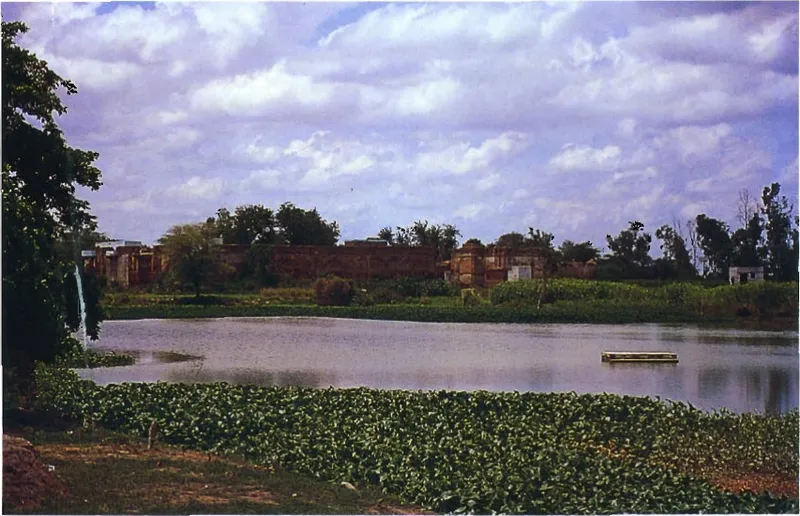
Līlāvati-kuṇḍa, also called Sakhī-kuṇḍa, is a pond at the village of Sakhī-sthalī; the guidebook Govardhana Hill (2001) shows it with the village in the background.[1] Śrīla Nārāyaṇa Bhaṭṭa Gosvāmī's Vraja-bhakti-vilāsa makes Līlāvatī-kuṇḍa, as it spells the name, part of the Sakhīvana station of the forest pilgrimage. It gives a prayer for bathing in the kuṇḍa that calls it the king of tīrthas (holy waters), arisen from Kṛṣṇa's pastimes, made by Līlāvatī and born of the play of the sakhīs, the girl companions.[2 +2] Who made the kuṇḍa, the sources tell differently.
Key facts
| Kind | kuṇḍa |
|---|---|
| Region · area | Govardhana · Sakhī-sthalī |
| Ācāryas | Śrīla Nārāyaṇa Bhaṭṭa Gosvāmī |
Traditional accounts
In the Vraja-bhakti-vilāsa, the forest pilgrimage comes to Sakhīvana and its Līlāvatī-kuṇḍa after Sakhāvana with Nārāyaṇa-kuṇḍa and before Kṛṣṇāntardhāna-vana. The book gives the circuit of Sakhīvana as half a krośa, an old measure of distance.[2 +2]
The bathing prayer is to be recited eight times while bathing, sipping the water and bowing down. In summary, it bows to the kuṇḍa as the king of tīrthas, arisen from Kṛṣṇa's pastimes, made by Līlāvatī and born of the play of the sakhīs (summarised here, not translated).[3] In the table of contents of the book's Hindi edition, the editor gives Sakhīvana the name of the present village, Sakhītarā.[5]
Visiting today
In 2001 Govardhana Hill described the kuṇḍa as neglected over the years but still visible.[1]
Where the sources differ
Who made the kuṇḍa: Govardhana Hill (2001) says that it lies within the village and, according to the local tradition it records, was dug by the girlfriends of Candrāvalī. The older Vraja-bhakti-vilāsa calls it made by Līlāvatī and born of the sakhīs' play, and does not name Candrāvalī; who this Līlāvatī is, the sources do not say, so the account is not certain.[1 +1]
Accounts differ Who made Līlāvatī-kuṇḍa?
- Govardhana Hill: India's Most Sacred Mountain (2001)it 'was dug by the girlfriends of Candrāvalī' (her sixty-four sakhīs)
- Vraja-bhakti-vilāsa of Śrīla Nārāyaṇa Bhaṭṭa (bathing prayer)the kuṇḍa is made by Līlāvatī (līlāvatī-kṛta), 'arisen from Kṛṣṇa's pastimes' and born of the play of the sakhīs; Candrāvalī is not named (the edition's Hindi: established by Līlāvatī in Kṛṣṇa's pastimes)
The wording of these accounts is our summary of the sources, not a published translation.
Location
| Where it is | 'Within this village' (Sakhī Sthali)[6] |
|---|
References
- Govardhana Hill: India's Most Sacred Mountain (2001), Rajasekhara dasa Brahmacari, PDF p. 149
- Śrīla Nārāyaṇa Bhaṭṭa, Vraja-bhakti-vilāsa, list of the stations of the forest pilgrimage (vana-yātrā), printed p. 52, 1st ed., publ. Bābā Kṛṣṇadāsa, Kusuma-sarovara, Saṁvat 2008
- Śrīla Nārāyaṇa Bhaṭṭa, Vraja-bhakti-vilāsa, Twelfth chapter, Sakhīvana section: Līlāvatī-kuṇḍa prayer and end of the Sakhīvana circuit (section 8), printed p. 250, 1st ed., publ. Bābā Kṛṣṇadāsa, Kusuma-sarovara, Saṁvat 2008
- Śrīla Nārāyaṇa Bhaṭṭa, Vraja-bhakti-vilāsa, list of the circuit lengths of the forests (in krośa), printed p. 41, 1st ed., publ. Bābā Kṛṣṇadāsa, Kusuma-sarovara, Saṁvat 2008
- Vraja-bhakti-vilāsa, edition's table of contents, chapter 12, 1st ed., publ. Bābā Kṛṣṇadāsa, Kusuma-sarovara, Saṁvat 2008
- Govardhana Hill: India's Most Sacred Mountain (2001), Rajasekhara dasa Brahmacari, p. 135