Sakhī-sthalī
सखी-स्थली Hindi name proposed
Also called Sakhītharā
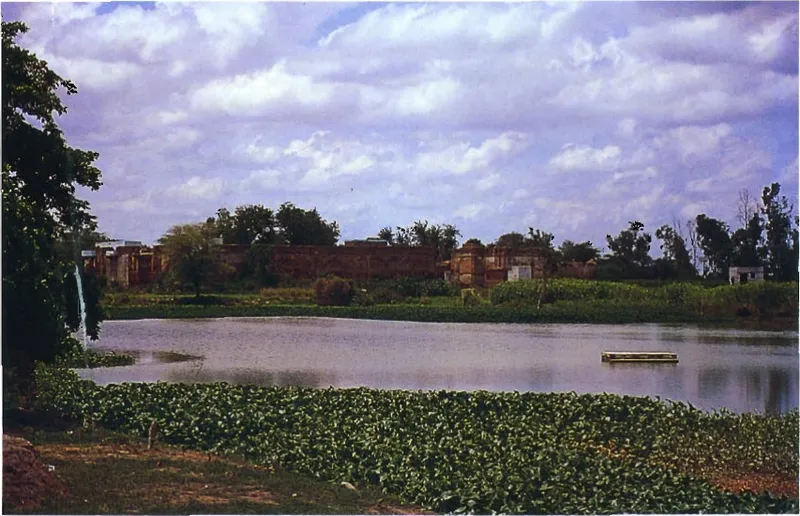
- What it is
- Sakhī-sthalī, the place of the sakhīs (girl companions), is the village now called Sakhītharā near Govardhana.
- Visiting
- Śrī Vraja-maṇḍala Parikramā (2007) gives the village's present name as Sakhītharā and places Sauṅkarāī one and a half miles north-west of it; Govardhana Hill (2001) speaks of the forest of Sakhīvana …
- Parikramā
- Govardhana parikramā, station 40
- Places here
- Līlāvati-kuṇḍa
In short
Sakhī-sthalī, the place of the sakhīs (girl companions), is the village now called Sakhītharā near Govardhana. The guidebook Śrī Vraja-maṇḍala Parikramā (2007) places it north-west of Mānasī-gaṅgā, within Sakhīvana.[1 +4] In the Gosvāmīs' books it is the home of Candrāvalī, whom Śrīla Prabhupāda describes as Śrīmatī Rādhārāṇī's competitor among the gopīs.[6 +5] Śrīla Rūpa Gosvāmī's plays, Śrīla Raghunātha dāsa Gosvāmī's Muktā-carita and Śrīla Kṛṣṇadāsa Kavirāja Gosvāmī's Govinda-līlāmṛta place her here, and Śrīla Viśvanātha Cakravartī Ṭhākura calls it Candrāvalī's village, known as Sakhītharā.[4 +5] According to the Bhakti-ratnākara, Śrīla Raghunātha dāsa Gosvāmī once threw away a cup of buttermilk because its leaves had come from here.[16 +1]
Key facts
| Kind | village |
|---|---|
| Region · area | Govardhana · Sakhīvana |
| On the parikramā | Govardhana parikramā, station 40 · the route |
| Ācāryas | Śrīla Raghunātha dāsa Gosvāmī, Śrīla Narahari Cakravartī Ṭhākura, Śrīla Śrīnivāsa Ācārya, Śrīla Rūpa Gosvāmī |
Divine pastimes
Uddhava's wish
Śrīmad-Bhāgavatam tells that Uddhava, whom Kṛṣṇa had sent to Vraja, wished to become one of the bushes, creepers or herbs of Vṛndāvana that the gopīs walk on, so as to receive the dust of their feet. It names Vṛndāvana but no particular place in it.[18 +2]
Two Purāṇas speak of a Sakhī-sthala near Govardhana hill, but they set it by Kusuma-sarovara, and no source says that it is this village. In the Skanda Purāṇa's Bhāgavata-māhātmya, Uddhava still stays at that Sakhī-sthala as young shoots and creepers, out of longing for the gopīs' foot-dust, and the kīrtana festival at which he appeared was held there, at Kusuma-sarovara; the passage does not quote the Bhāgavatam's verse, and G. V. Tagare's English translation queries whether Sakhī-sthala is a name at all (summarised here, not translated).[18 +3] The Nārada Purāṇa likewise places Govardhana hill near a Sakhi-sthala, in the setting of the Kusuma lake, and says that Rādhā's friends reach it every evening on their way home with Rādhikā (summarised here, not translated).[20 +3] Read more: Uddhava among the creepers: the queens' kīrtana →
Accounts differ Where Sakhī-sthalī lies, and whether the Skanda Purāṇa's 'sakhī-sthala' is this village
- Skanda Purāṇa, Bhāgavata-māhātmya 2.24, 2.30'sakhī-sthala' is near Govardhana, at Kusuma-sarovara (kusumāmbhodhau), where Uddhava lives as grass and creepers; the translator queries whether it is a name
- Śrī Vraja-maṇḍala Parikramā (2007)Sakhī-sthalī is north-west of Mānasī-gaṅgā, within Sakhīvana, now the village Sakhītharā; Uddhava-kuṇḍa is described separately, west of Kusuma-sarovara
- Bhakti-ratnākara (1912 ed. p. 209)the village of Sakhī-sthalī, now Sakhitharā, shown after Sauṅkarāī; no lake or Uddhava mentioned
- Nārada Purāṇa, Uttara-bhāga 80.6–9, 80.46Govardhana hill is near 'sakhi-sthala', in the setting of the Kusuma lake and Vṛndā's āśrama; Rādhā's friends reach Sakhi-sthala on their way home
Candrāvalī's village
Śrīla Rūpa Gosvāmī's plays treat Sakhī-sthalī as Candrāvalī's ground (summarised here, not translated). In the Vidagdha-mādhava her friend Padmā consoles her with the news that Kṛṣṇa has come near Sakhī-sthalī, and later Padmā takes leave of Rādhā to hurry to Sakhī-sthalī and gladden Candrāvalī by singing of Kṛṣṇa's pastimes. In the Lalita-mādhava, Rādhā, maddened by separation, wanders with Lalitā and Viśākhā as far as Sakhī-sthalī and at once thinks of Candrāvalī.[12 +2] Explaining the Vidagdha-mādhava, Śrīla Viśvanātha Cakravartī Ṭhākura writes that Sakhī-sthalī is Candrāvalī's village, known as Sakhītharā.[4 +2]
In the midday pastimes of Śrīla Kṛṣṇadāsa Kavirāja Gosvāmī's Govinda-līlāmṛta (6.77–78), Śaibyā brings Candrāvalī out on the pretext of worshipping the goddess Durgā, leaves her near Sakhī-sthalī in Padmā's care, and goes to look for Kṛṣṇa. The commentary of Śrīla Vṛndāvana Cakravartī places Sakhī-sthalī near Govardhana (summarised here, not translated).[4 +2]
Śrīla Raghunātha dāsa Gosvāmī's Muktā-carita gives Sakhī-sthalī as the home of Candrāvalī, whose house is near it, and of her companion Śaibyā. In a joking list Lalitā calls Candrāvalī the one who lives at the banyan grove of Sakhī-sthalī, and says that, living in a banyan forest, she is rightly called Ṣaṣṭhī, a goddess linked with the banyan (summarised here, not translated).[6 +4]
Traditional accounts
The Bhakti-ratnākara says that Govardhana-malla, Candrāvalī's husband, stays with her sometimes in Sakhī-sthalī and sometimes at …
Candrāvalī and her family
The Bhakti-ratnākara says that Govardhana-malla, Candrāvalī's husband, stays with her sometimes in Sakhī-sthalī and sometimes at Karālā. It names her husband as Govardhana, the son of Karālā, and her father as Candrabhānu, one of five brothers of whom King Vṛṣabhānu is the eldest, and it calls Candrāvalī Rādhikā's elder sister. The guidebook Govardhana Hill (2001) also gives Govardhana Malla as her husband and Candrabhānu, Vṛṣabhānu's brother, as her father.[2 +1]
Śrīla Rūpa Gosvāmī's drama Lalita-mādhava makes Candrāvalī Rukmiṇī, and Govardhana Hill (2001) gives this as his teaching that Candrāvalī expands as Rukmiṇī in Dvārakā.[2 +1]
Sakhīvana and the sixty-four sakhīs
Govardhana Hill (2001) says that a forest called Sakhī Vana used to stand here, with the village inside it, where Candrāvalī lived with her sixty-four sakhīs. The Muktā-carita and the Bhakti-ratnākara place Candrāvalī at Sakhī-sthalī but speak of no forest called Sakhīvana and no sixty-four friends, while Śrīla Nārāyaṇa Bhaṭṭa Gosvāmī's Vraja-bhakti-vilāsa, which joins Sakhīvana with sixty-four sakhīs, does not name Candrāvalī.[2 +3] Whose forest Sakhīvana is, the sources tell differently; their accounts are set side by side on the page of Sakhīvana.[2 +3]
The Gosvāmīs and ācāryas
According to the Bhakti-ratnākara, a Vrajavāsī named Dāsa, dear to Śrīla Raghunātha dāsa Gosvāmī, went to Sakhī-sthalī one day …
Śrīla Raghunātha dāsa Gosvāmī and the leaf-cup
According to the Bhakti-ratnākara, a Vrajavāsī named Dāsa, dear to Śrīla Raghunātha dāsa Gosvāmī, went to Sakhī-sthalī one day while herding cows and picked some large palāśa leaves. The Gosvāmī had given up grain and by rule drank only one leaf-cup of buttermilk, and the Vrajavāsī hoped that a bigger cup would give him a little more food. When Śrīla Raghunātha dāsa Gosvāmī heard where the leaves came from, he angrily threw the cup and its buttermilk far away; when he was calm again he told Dāsa not to go there, because it is Candrāvalī's village (summarised here, not translated).[1 +5] The Caitanya-caritāmṛta does not tell this story; it records only that he lived on a little buttermilk.[16 +1]
Śrīla Śrīnivāsa Ācārya's visit
In the Bhakti-ratnākara, Śrīla Rāghava Paṇḍita Gosvāmī of Govardhana shows Śrīla Śrīnivāsa Ācārya the village of Sakhī-sthalī, where Candrāvalī stays, right after Sauṅkarāī, and says that its name is now Sakhitharā.[4 +1]
Śrīla Prabhupāda
Śrīla Prabhupāda does not speak of Sakhī-sthalī by name.
Śrīla Prabhupāda does not speak of Sakhī-sthalī by name. In his translation of the Caitanya-caritāmṛta he records the diet of Śrīla Raghunātha dāsa Gosvāmī that the story of the leaf-cup takes for granted:[17]
General teaching (does not name the place)“Raghunātha dāsa Gosvāmī gradually gave up all food and drink but a few drops of buttermilk.”
Śrīla Prabhupāda, Śrī Caitanya-caritāmṛta, Ādi-līlā 10.98, translation · vedabase.io
He mentions Candrāvalī as Rādhārāṇī's rival among the gopīs in a purport, and he tells Uddhava's wish to be born as a plant or creeper of Vṛndāvana in the Kṛṣṇa book, but neither passage names this village.[11 +1]
Songs
In Śrīla Bhaktivinoda Ṭhākura's song Āmi to' svānanda-sukhada-bāsī, the singer never looks towards Sakhī-sthalī, because its …
In Śrīla Bhaktivinoda Ṭhākura's song Āmi to' svānanda-sukhada-bāsī, the singer never looks towards Sakhī-sthalī, because its sight brings to mind Śaibyā, Candrāvalī's companion, who lives there according to the Muktā-carita.[6 +5]
sakhī-sthalī nāhi heri nayane
dekhile śaibyāke paraye mane
Visiting today
Śrī Vraja-maṇḍala Parikramā (2007) gives the village's present name as Sakhītharā and places Sauṅkarāī one and a half miles north-west of it; Govardhana Hill (2001) speaks of the forest of Sakhīvana as one that used to stand here.[1 +4]
Location
| Where it is | Town map: dot 'Sakhī-sthalī', upper left; Govardhana map: '38' left of the parikramā path inside the town rectangle[30] |
|---|---|
| On the numbered Govardhana chart | 67 (printed as “Sakhi Sthali”)[31] |
Places at Sakhī-sthalī
1 places
Nearby places
Mānasī-gaṅgā · Govardhana
Where the sources differ
The details of Śrīla Raghunātha dāsa Gosvāmī's leaf-cup episode, as the Bhakti-ratnākara and two guidebooks tell it.
Accounts differ Details of Śrīla Raghunātha dāsa Gosvāmī's leaf-cup episode
- Bhakti-ratnākara (1912 ed. p. 197)a Vrajavāsī named Dāsa picked large palāśa leaves at Sakhī-sthalī while herding cows, made a cup at home and brought buttermilk in it; Raghunātha threw the cup with the buttermilk far away and then told him not to go to Candrāvalī's village
- Śrī Vraja-maṇḍala Parikramā (2007)a Vrajavāsī brought buttermilk in a larger kadamba-leaf cup and said 'I brought it from Sakhī-sthalī'; Dāsa Gosvāmī angrily ordered him to leave, and he fled
- The Colour Guide to Rādhā-kuṇḍa (1999) (Rādhā-kuṇḍa book)a devotee brought buttermilk in an unusually large leaf cup; asked from which tree and village the leaf came, he said Sakhīsthalī, Candrāvalī's residence; Raghunātha threw the cup and its contents far away
More on this place
Uddhava among the creepers: the queens' kīrtana
References
31 references
- Śrī Vraja-maṇḍala Parikramā (2007), PDF p. 134
- Govardhana Hill: India's Most Sacred Mountain (2001), Rajasekhara dasa Brahmacari, PDF p. 149
- the key of the numbered Govardhana chart, ¶70
- Śrīla Narahari Cakravartī, Bhakti-ratnākara, Fifth Wave, 1912 ed. p. 209, last couplet, 2nd ed., 1912
- Viśvanātha Cakravartī Ṭhākura, Viśvanātha Cakravartī's commentary on Vidagdha-mādhava 4.4 (the text prints the commentary after the play: '(7) … after v.91 (part 14/30)')
- Śrīla Raghunātha dāsa Gosvāmī, Muktā-carita, prose, GRETIL
- Śrīla Raghunātha dāsa Gosvāmī, Muktā-carita, prose, GRETIL
- Śrīla Raghunātha dāsa Gosvāmī, Muktā-carita, prose, GRETIL
- Śrīla Raghunātha dāsa Gosvāmī, Muktā-carita, prose, GRETIL
- Śrīla Raghunātha dāsa Gosvāmī, Śrī Śrī Rādhā-Kṛṣṇojjvala-kusuma-keli, Stavāvalī hymn 19 (Rādhā-Kṛṣṇojjvala-kusuma-keli), v.11 v.11')
- Śrīla Prabhupāda, Śrī Caitanya-caritāmṛta, Antya-līlā 1.163, purport · vedabase.io
- Śrīla Rūpa Gosvāmī, Lalita-mādhava, act 3, prose after v.37
- Śrīla Rūpa Gosvāmī, Vidagdha-mādhava, act 4 (veṇu-haraṇa), v.4 (text label '(4) veṇu-nāda-vilāsaḥ v.4')
- Śrīla Rūpa Gosvāmī, Vidagdha-mādhava, act 6 (śarad-vihāra), prose after v.2 (text label '(6) veṇu-nāda-vilāsaḥ after v.2')
- Śrīla Kṛṣṇadāsa Kavirāja Gosvāmī, Govinda-līlāmṛta 6.77–78 and the ṭīkā on 6.78 v.78)
- Śrīla Narahari Cakravartī, Bhakti-ratnākara, Fifth Wave, 1912 ed. p. 197, 2nd ed., 1912
- Śrīla Prabhupāda, Śrī Caitanya-caritāmṛta, Ādi-līlā 10.98, translation · vedabase.io
- Śrīmad-Bhāgavatam 10.47.61, GRETIL
- Śrīla Prabhupāda, Kṛṣṇa, the Supreme Personality of Godhead (Kṛṣṇa book), Chapter 47, Delivery of the Message of Kṛṣṇa to the Gopīs · vedabase.io
- Skanda Purāṇa, 2.6.2.24, Sanskrit Wikisource
Show all 31 references
- Skanda Purāṇa, Vaiṣṇava-khaṇḍa (2), Bhāgavata-māhātmya, adhyāya 2, verse 30, Sanskrit Wikisource
- Nārada Purāṇa, Uttara-bhāga, adhyāya 80, verses 6–9
- Nārada Purāṇa, Uttara-bhāga, adhyāya 80, verses 46–47a
- Śrīla Narahari Cakravartī, Bhakti-ratnākara, Fifth Wave, 1912 ed. p. 244, 2nd ed., 1912
- Śrīla Rūpa Gosvāmī, Lalita-mādhava, act 10, prose (after v.16)
- Śrīla Nārāyaṇa Bhaṭṭa, Vraja-bhakti-vilāsa, Twelfth chapter, Sakhīvana-pradakṣiṇā (section 7), printed pp. 249-250, 1st ed., publ. Bābā Kṛṣṇadāsa, Kusuma-sarovara, Saṁvat 2008
- Śrīla Narahari Cakravartī, Bhakti-ratnākara, Fifth Wave, 1912 ed. p. 209, last four lines, 2nd ed., 1912
- The Colour Guide to Rādhā-kuṇḍa (1999), Rājaśekhara dāsa Brahmacārī, PDF p. 106
- Āmi To’ Swānanda Sukhada Bāsī (Bhaktivinoda Ṭhākura (as the song book credits it: 'Bhaktivinoda Thakura')) · song book
- Śrī Vraja-maṇḍala Parikramā (2007), p. 194-195
- Numbered list of the Govardhana sites (key of the Govardhana chart)