Murāri Gupta's Gaura-Nitāi Mandira
मुरारि गुप्त का गौर-निताई मन्दिर Hindi name proposed
Also called Murāri Gupta Gaura-nitai Temple, Murāri Gupta Gaur-nitai
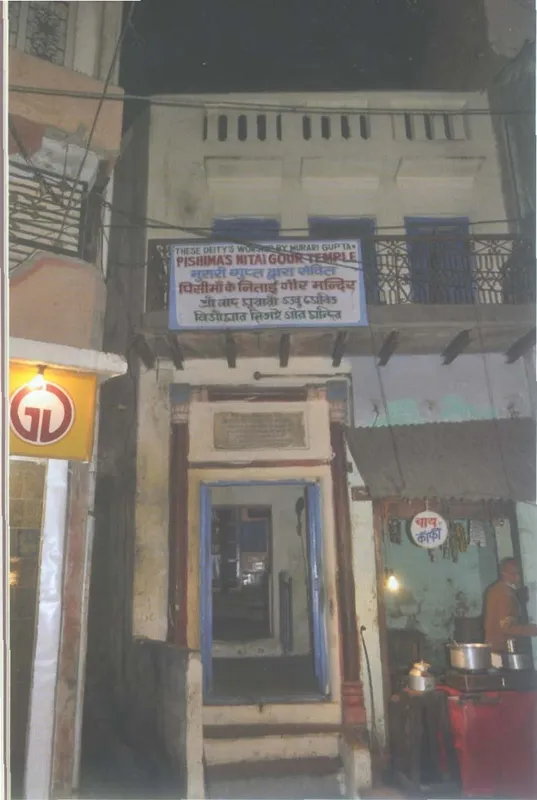
- What it is
- The Gaura-Nitāi Mandira of Śrīla Murāri Gupta is a small temple at the western end of Loī-bāzār in Vṛndāvana, across the road from the Bankhaṇḍī Mahādeva Mandira.
- Visiting
- The temple stands where Loī-bāzār meets Aṭhkhambā, the road coming from the Bāṅke-bihārī temple, across from Bankhaṇḍī Mahādeva; the 2010 photograph shows a signboard naming the Deities as worshipped …
In short
The Gaura-Nitāi Mandira of Śrīla Murāri Gupta is a small temple at the western end of Loī-bāzār in Vṛndāvana, across the road from the Bankhaṇḍī Mahādeva Mandira.[1 +5] Its Gaura-Nitāi Deities, carved of neem wood with Their hands in the bow-and-arrow gestures of Rāma and Lakṣmaṇa, were Śrīla Murāri Gupta's according to the local tradition recorded in two guidebooks; this is not certain.[1 +2] The Caitanya-caritāmṛta confirms what the guidebooks say about Śrīla Murāri Gupta himself: a devotee of Rāma, called Hanumān by Śrī Caitanya Mahāprabhu, who recorded the Lord's early pastimes. No older text mentions these Deities or this temple.[1 +6]
Key facts
| Kind | temple |
|---|---|
| Region · area | Vṛndāvana · Loī-bāzār |
| Ācāryas | Śrīla Murāri Gupta |
Traditional accounts
The Deities' story
The Deities' past is a local tradition recorded in two guidebooks, Vṛndāvana, the Playground of God (2010) and The Color Guide to Vṛndāvana (2000), which give no documents or dates, so the story is not certain.[1 +1]
- According to the 2010 book, Śrīla Murāri Gupta worshipped these Deities in Māyāpur, which is not certain; the 2000 book says that when he asked Śrī Caitanya's permission to make Deities of Gaura-Nitāi, the Lord told him to make Them in his own devotional mood.[1 +1]
- According to the 2010 book, the Deities were lost until about two hundred years ago, when devotees living where Śrīla Murāri Gupta had lived saw a cow give her milk every day at one spot and dug Them up there; a devotee named Balarāma Paṇḍita worshipped Them first; this is not certain.[1]
- The same book tells that a lady named Candrāsaśi Mukhopādhyāya, who came to see Them every day, took over Their worship after a dream in which They asked for more sweet rice and Lord Caitanya pulled the edge of her sārī. She became known as Pisimā ("aunt"), and the Deities as Pisimā's Gaura-Nitāi; this too is not certain.[1 +1]
- It also tells that British soldiers who grabbed the curtain of the Deities' palanquin were blinded by a flash of light, that the Deities caught a cold after a cold bath, and that at Pisimā's word the small Deities grew to Their present height; it gives no source, so these stories are not certain.[4]
The Gosvāmīs and ācāryas
The Caitanya-caritāmṛta says that Śrīla Murāri Gupta was a great devotee of Lord Rāmacandra, and that Śrī Caitanya Mahāprabhu …
Śrīla Murāri Gupta
The Caitanya-caritāmṛta says that Śrīla Murāri Gupta was a great devotee of Lord Rāmacandra, and that Śrī Caitanya Mahāprabhu called him Hanumān himself, the eternal servant of Rāma. The guidebooks give this devotion as the reason for the Deities' gestures.[1 +5]
মুরারিগুপ্ত–মুখে শুনি’ রাম–গুণগ্রাম ।
ললাটে লিখিল তাঁর ‘রামদাস’ নাম ॥ ৬৯ ॥
murāri-gupta-mukhe śuni’ rāma-guṇa-grāma
lalāṭe likhila tāṅra ‘rāmadāsa’ nāma
Murāri Gupta was a great devotee of Lord Rāmacandra. When Lord Caitanya heard Lord Rāmacandra’s glories from his mouth, He immediately wrote on his forehead “rāmadāsa” [the eternal servant of Lord Rāmacandra].
Translation: Śrīla A.C. Bhaktivedanta Swami PrabhupādaWhen Śrī Caitanya Mahāprabhu showed His great manifestation (mahā-prakāśa) at Śrīvāsa's house in Navadvīpa, He appeared before Śrīla Murāri Gupta as Lord Rāmacandra. Śrīla Prabhupāda gives the Caitanya-bhāgavata as the source, and the Bhakti-ratnākara adds that, seeing Rāma with Sītā and Lakṣmaṇa, Śrīla Murāri Gupta saw himself as Hanumān (summarised here, not translated).[1 +4] The Gaura-gaṇoddeśa-dīpikā (91) also says that he was Hanumān.[1 +3] He recorded the Lord's early pastimes in Navadvīpa; Śrīla Prabhupāda calls his book Śrī Caitanya-carita.[7 +3]
Śrīla Prabhupāda
No statement of Śrīla Prabhupāda about these Deities or the temple has been found in the works searched.
No statement of Śrīla Prabhupāda about these Deities or the temple has been found in the works searched. He says this of Śrīla Murāri Gupta in a purport (general, about the person):[1 +6]
General teaching (does not name the place)“Śrī Murāri Gupta wrote a book called Śrī Caitanya-carita. … When Śrī Caitanya Mahāprabhu exhibited His mahā-prakāśa form, He appeared before Murāri Gupta as Lord Rāmacandra. … He was a great devotee of Lord Rāmacandra, and his staunch devotion is vividly described in the Caitanya-caritāmṛta, Madhya-līlā, fifteenth chapter, verses 137 through 157.”
Śrīla Prabhupāda, Śrī Caitanya-caritāmṛta, Ādi-līlā 10.49, purport · vedabase.io
Visiting today
The temple stands where Loī-bāzār meets Aṭhkhambā, the road coming from the Bāṅke-bihārī temple, across from Bankhaṇḍī Mahādeva; the 2010 photograph shows a signboard naming the Deities as worshipped by Śrīla Murāri Gupta and the temple as Pisimā's.[1 +5] The guidebooks describe the Deities with Their hands in the gestures (mudrā) of Rāma and Lakṣmaṇa holding bows and arrows; the 2000 guide also notes Their three-fold bending stance and Their hair tied in a topknot, as in the Navadvīpa pastimes.[1 +2] That guide gave the darśana hours as 7:30 am to noon and 4 to 8:30 pm; they may have changed.[7]
Location
| Where it is | 'at the beginning of Loi Bazaar, at its intersection with the road from the Bankebihārī Bazaar', opposite Bankhandi Mahādeva; 'at the western end of Loi Bazaar'[17] |
|---|
Nearby places
Bankhaṇḍī Mahādeva Mandira (Vṛndāvana) · Loī-bāzār
Where the sources differ
Who brought the Deities to Vṛndāvana, and whether Pisimā worshipped Them before or after They came: the 2010 book says that They told her in a dream at the end of the nineteenth century to take Them to Vṛndāvana, and that she brought Them by boat to Keśī-ghāṭa, to this newly built temple; the 2000 book says that she worshipped Them after They came. Neither gives a source, and either may be right.[1]
Accounts differ Who brought Śrīla Murāri Gupta's Gaura-Nitāi to Vṛndāvana, and whether Pisimā worshipped Them before or after They came.
- Vṛndāvana, the Playground of God (2010)Candrāsaśi (Pisimā) had already taken over the Deities' worship in Bengal; at the end of the 19th century They told her in a dream to take Them to Vṛndāvana, and she brought Them by boat to Keśī-ghāṭa and installed Them in this newly built temple.
- The Color Guide to Vṛndāvana (2000)'They were brought to Vṛndāvana, and later worshipped by Pīshimā mātājī' (her worship comes after the move; who brought Them is not said).
References
17 references
- Vṛndāvana, the Playground of God (2010), Bhakti Caitanya Svāmī, PDF p. 158
- Śrī Vraja-maṇḍala Parikramā (2007), PDF p. 337
- Śrī Vraja-maṇḍala Parikramā (2007), PDF p. 345
- Vṛndāvana, the Playground of God (2010), Bhakti Caitanya Svāmī, PDF p. 160
- A. W. Entwistle, gazetteer of Vrindaban, sub-entry '19 Bankhandi Mahadev' (source given: 'BBP 5.33'), printed p. 408, Egbert Forsten, Groningen, 1987
- Vṛndāvana-kathā, chapter 14 (caturdaśa pariccheda), section on Vṛndāvana's Śiva-liṅgas, 'বনখণ্ডী মহাদেব', printed pp. 168–169
- The Color Guide to Vṛndāvana (2000), Written and Photographed by Rājaśekhara dāsa Brahmacārī, PDF p. 100
- Vṛndāvana, the Playground of God (2010), Bhakti Caitanya Svāmī, PDF p. 159
- Śrīla Kṛṣṇadāsa Kavirāja Gosvāmī, Śrī Caitanya-caritāmṛta, Ādi-līlā 17.69, online edition · vedabase.io
- Śrīla Kṛṣṇadāsa Kavirāja Gosvāmī, Śrī Caitanya-caritāmṛta, Madhya-līlā 15.156, online edition · vedabase.io
- Śrīla Prabhupāda, Śrī Caitanya-caritāmṛta, Ādi-līlā 10.49, purport · vedabase.io
- Śrīla Kṛṣṇadāsa Kavirāja Gosvāmī, Śrī Caitanya-caritāmṛta, Ādi-līlā 13.15, online edition · vedabase.io
- Śrīla Prabhupāda, Śrīmad-Bhāgavatam, Canto 1, Introduction · vedabase.io
- Gaura-gaṇoddeśa-dīpikā, v.91
- Śrīla Prabhupāda, Śrī Caitanya-caritāmṛta, Ādi-līlā 17.18, purport · vedabase.io
- Śrīla Narahari Cakravartī, Bhakti-ratnākara, Twelfth Wave (dvādaśa taraṅga), 1912 ed. p. 896, 2nd ed., 1912
- Vṛndāvana, the Playground of God (2010), Bhakti Caitanya Svāmī, p. 158