Rādhā-Gopāla Mandira
राधा-गोपाल मन्दिर Hindi name proposed
Also called Radha Gopala Temple (Brahmacari Mandir), Rādhā Gopāla Temple, Brahmacārī Ṭhākura-bāḍī, Brahmacari Mandir
On this page
In short
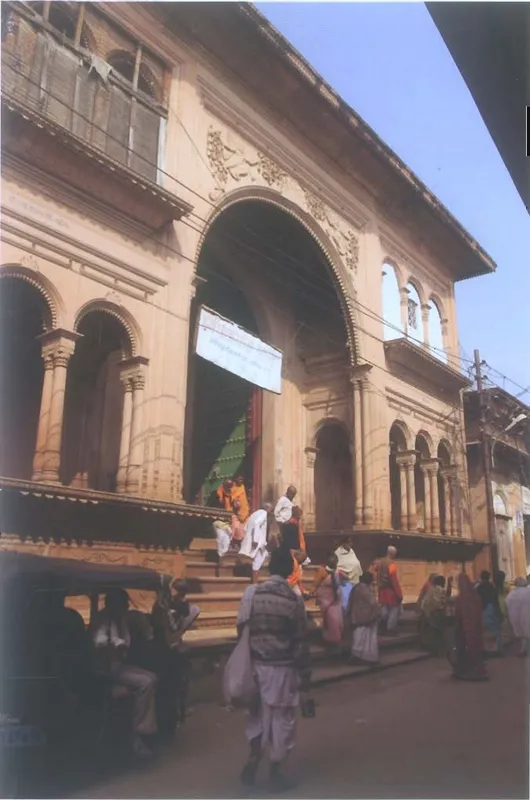
The Rādhā-Gopāla Mandira is a stone temple of 1860 in Vṛndāvana. It stands between the Lālā Bābū temple and the Gopeśvara Mahādeva temple, and it is also called the Brahmacārījī temple or Brahmacārī Ṭhākura-bāḍī, after the guru for whom it was built.[1 +5] The guidebooks and three historians agree that the Mahārāja of Gwalior, Jiyājī Sindhiyā (Scindia), built it in 1860 for his guru, Śrī Giridhārī dāsa Brahmacārī.[1 +6] No scripture and no ācārya speaks of this nineteenth-century temple.
Key facts
| Kind | temple |
|---|---|
| Region · area | Vṛndāvana |
History
The three guidebooks agree on the year and on the Scindia family, but they word the guru's part differently. Śrī Vraja-maṇḍala Parikramā (2007) says that Mahārāja Jiyājī Sindhiyā gave the service of the Deities to his spiritual guide Śrī Giridhārī dāsa Brahmacārī; The Color Guide to Vṛndāvana (2000) says that he built the temple on his guru's order; Vṛndāvana, the Playground of God (2010) says only that members of the Scindia family built it.[1 +4]
Three historians give the same date and builder. F. S. Growse (1883) says that the temple was built under the direction of the guru and opened for worship in 1860, at a cost of four lakhs of rupees. Prabhudayāl Mītal (1966) gives the year as Saṁvat 1917 (about 1860–61) and says that the Rājā offered the temple to his guru; A. W. Entwistle (1987) says that the guru built it with the Rājā's money.[6 +3] Mītal adds that images of the first ācāryas of the Nimbārka-sampradāya, the guru's own line, are seated in the temple, and Entwistle counts the guru among the notable teachers of that line in the nineteenth century.[7 +1] No inscription or dated document has been seen.
Visiting today
According to Śrī Vraja-maṇḍala Parikramā (2007), three Deities preside here in three separate chambers: Śrī Rādhā-Gopāla, Haṁsa-Gopāla and Nitya-Gopāla. The other guidebooks name the temple after Rādhā-Gopāla only.[1] The Color Guide to Vṛndāvana printed darśana hours in 2000 (in summer, 8:30 am to 12:30 pm and 5 to 9 pm); they may have changed.[4]
In a letter of 17 April 1971 Śrīla Prabhupāda gives the address "Brahmacari Mandir, Gopesvara Road" in Vṛndāvana. It is probably this temple, but the letter says nothing about the temple itself.[1 +5]
Location
| Where it is | 'between the Lāl Babu Temple and the Gopeśvara Temple'[10] |
|---|
Nearby places
References
- Śrī Vraja-maṇḍala Parikramā (2007), PDF p. 337
- Śrī Vraja-maṇḍala Parikramā (2007), PDF p. 322
- Vṛndāvana, the Playground of God (2010), Bhakti Caitanya Svāmī, PDF p. 200
- The Color Guide to Vṛndāvana (2000), Written and Photographed by Rājaśekhara dāsa Brahmacārī, PDF p. 131
- Śrīla Prabhupāda, Letter to Kṣīrodakaśāyī, letter 71-04-17, 17 April 1971 · vedabase.io
- A. W. Entwistle, ch. 8 §66.36 'Gopishwar', printed p. 415, Egbert Forsten, Groningen, 1987
- A. W. Entwistle, ch. 5 §37 'The Nimbark Sampraday in modern times', printed p. 220, Egbert Forsten, Groningen, 1987
- Prabhudayāl Mītal, part 1 ('ब्रज-संस्कृति की भूमिका'), 'Braj-yātrā', Vṛndāvana: 'Brahmacārī jī kā mandir', printed p. 140
- Mathurá (1883), F. S. Growse, B.C.S., M.A. Oxon., C.I.E. (as the title page gives him, p. 263
- Vṛndāvana, the Playground of God (2010), Bhakti Caitanya Svāmī, p. 200