Rādhā-Vallabha Mandira
राधावल्लभ मन्दिर Hindi name proposed
Also called Śrī Rādhā-Vallabha temple
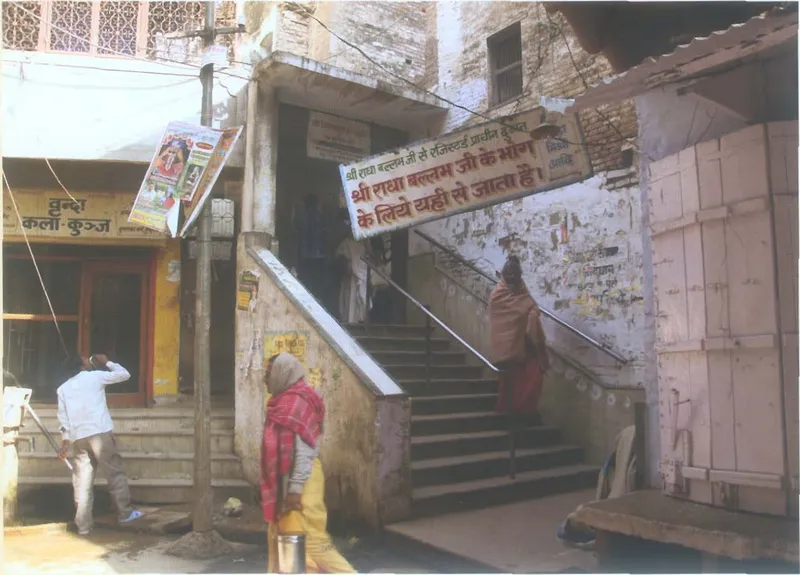
- What it is
- The Rādhā-Vallabha Mandira in Vṛndāvana is the present temple of Śrī Rādhā-Vallabha, the Deity served by Śrī Hita Harivaṁśa, who founded the Rādhā-Vallabha line (sampradāya), according to three …
- Visiting
- The temple is reached by a staircase from the street.
- Places here
- Rādhā Ananda-vallabha, Rādhā Jivan-vallabha and Rādhā Kisori-vallabha temples
In short
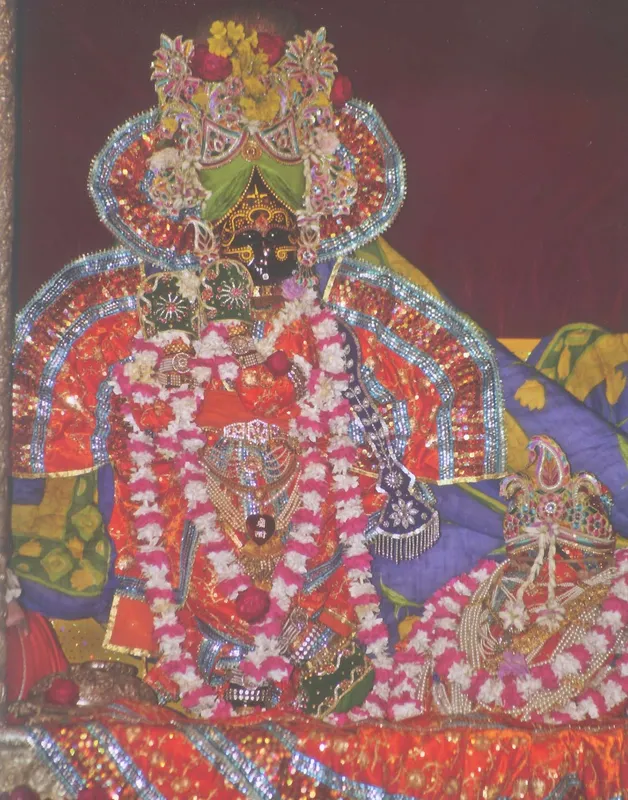
The Rādhā-Vallabha Mandira in Vṛndāvana is the present temple of Śrī Rādhā-Vallabha, the Deity served by Śrī Hita Harivaṁśa, who founded the Rādhā-Vallabha line (sampradāya), according to three guidebooks.[1 +2] It stands next to the original temple, which the guidebooks say was destroyed or desecrated by Aurangzeb's soldiers, though they give no evidence; the dates of both are not certain.[2 +1] According to the guidebooks, there is no Deity of Śrī Rādhā on the altar: a crown is worshipped as Śrī Rādhikā.[1 +4] No scripture, work of the Gosvāmīs or statement of Śrīla Prabhupāda about this temple has been found.[1 +2]
Key facts
| Kind | temple |
|---|---|
| Region · area | Vṛndāvana |
Traditional accounts
Śrī Vraja-maṇḍala Parikramā (2007) says that Śrī Hita Harivaṁśa received the Deity of Śrī Rādhā-Vallabha as a dowry at his wedding, and Vṛndāvana, the Playground of God (2010) that he installed the Deity in 1535; neither gives a source, so this is not certain.[1 +4] The Bengali Vṛndāvana-kathā (1920) tells the dowry story at length: Śrī Rādhā told a brāhmaṇa in a dream to give his two daughters in marriage to that day's guest, Harivaṁśa, with the Deity of his house as dowry, and Śrī Hita Harivaṁśa took the Deity to Vṛndāvana. The same book dates the first temple to Saṁvat 1565. Other books tell it differently, so none of this is certain.[1 +2]
Visiting today
The temple is reached by a staircase from the street. Śrī Vraja-maṇḍala Parikramā (2007) places it opposite the second Madana-mohana temple and near Śrī Hita Harivaṁśa Gosvāmī's place; on the 1986 map it is in the north-west of the old town, near Bāṅke-bihārī.[2 +4] A crown on the altar is worshipped as Śrī Rādhikā, and Vṛndāvana, the Playground of God (2010) adds that Her clothes and ornaments are kept beside Kṛṣṇa.[1 +4] The Color Guide to Vṛndāvana (2000) calls it very popular, especially with the local Vrajavāsīs; its darśana hours may have changed since.[2 +1]
Śrī Hita Harivaṁśa Gosvāmī's place
Śrī Vraja-maṇḍala Parikramā (2007) lists "Śrī Hitahari-vaṁśa Gosvāmī's place" near the temple of Śrī Rādhā-Vallabha as one of the well-known samāja and samādhi sites of the town. It does not say what stands there.[1 +1] A samāja, the book explains, is a place where devotees gather to hear and speak the Lord's glories, and a samādhi is where the body of an elevated devotee is laid to rest. No scripture, Gauḍīya text or statement of Śrīla Prabhupāda about the place was found.[7] The Color Guide to Vṛndāvana (2000) calls Śrī Hita Harivaṁśa the founder of the Rādhā-Vallabha sampradāya.[1 +2]
The historian F. S. Growse, writing in 1883, saw a monument to a founder across the street from the Rādhā-Vallabha temple, then out of repair. He does not make clear whether he meant Śrī Hita Harivaṁśa, who founded the sect, or Sundar Dās, who built the temple, and no source says whether that monument is the place the guidebook lists, so the link is not certain.[14]
The same guidebook says that the temples of Rādhā Ānanda-vallabha, Rādhā Jīvan-vallabha and Rādhā Kiśorī-vallabha stand in the same compound; nothing more is known of them, so this may need a check on site.[3]
Places at Rādhā-Vallabha Mandira
2 places
Also described on this page
- Hitahari-vaṁśa Gosvāmī's place samāja / samādhi place
Nearby places
Rādhā-Vallabha Mandira (original) · Madana-mohana Mandira (Bhaṭṭa neighbourhood)
Pictures
1 pictures
History
The guidebooks say, without giving evidence, that the original temple was destroyed or desecrated in 1670, so this year is not certain, and that the present temple was built next to it, where the original Deity was installed again.[2 +1] According to the Vṛndāvana-kathā (1920), the new temple looks like a Bengali ṭhākura-dālāna, a shrine hall with a courtyard in front, and a merchant from Gujarat named Lallubhāi built it.[8] The historians A. W. Entwistle (1987) and Prabhudayāl Mītal (1966) give other years, and Entwistle, after the Rādhā-Vallabha line's own tradition, says that the Deity was taken away to Kāmā (Kāmyavana) in Aurangzeb's time (see below).[9 +1]
Where the sources differ
When Śrī Hita Harivaṁśa installed Rādhā-Vallabha in Vṛndāvana.
When Śrī Hita Harivaṁśa installed Rādhā-Vallabha in Vṛndāvana.
Accounts differ When Hit Harivaṁśa installed Rādhāvallabha in Vṛndāvana
- Vṛndāvana, the Playground of God (2010), p. 142'It is said that he installed the Deity in 1535.'
- Vṛndāvana-kathā (1920), p. 136He founded a temple of Rādhāvallabhajī in Kārttika of saṁvat 1565 (about 1508 CE by the usual conversion; editorial) in the old town, a little away from Madana-mohanajī's house.
Accounts differ When and by whom the present Rādhā-Vallabha temple was built
- Vṛndāvana-kathā (1920), p. 137by Lallubhāi, a merchant from Gujarat, in 1772
- Entwistle (1987), p. 403 (and p. 211), citing P. Mital 1968by Seth Lallubhai Bhagwandas and other Gujarati devotees after the Deity was brought back from Kaman in 1784 ('thirty years later' than 1755, p. 211)
- Mītal (1966), p. 137the new temple was built in saṁvat 1871 (about 1814-15 CE; editorial conversion), with the original image
- Vṛndāvana, the Playground of God (2010), p. 142; The Color Guide to Vṛndāvana (2000), p. 68built next to the old temple after its destruction or desecration in 1670; no date or builder
Accounts differ Whether the Deity Rādhāvallabha left Vṛndāvana
- Entwistle (1987), pp. 185, 211 and 403, after the Rādhāvallabh sampradāya's oral tradition and P. Mital 1968Removed during an attack ordered by Aurangzeb, installed in a new temple at Kaman in 1682, brought back in 1784 (p. 403) or 1785 (p. 185).
- The Color Guide to Vṛndāvana (2000), p. 68; Mītal (1966), p. 137The original Deity was reinstalled in, or is present in, the new temple; they do not say where He was in between.
References
16 references
- Śrī Vraja-maṇḍala Parikramā (2007), PDF p. 335
- Vṛndāvana, the Playground of God (2010), Bhakti Caitanya Svāmī, PDF p. 142
- The Color Guide to Vṛndāvana (2000), Written and Photographed by Rājaśekhara dāsa Brahmacārī, PDF p. 68
- The Color Guide to Vṛndāvana (2000), Written and Photographed by Rājaśekhara dāsa Brahmacārī, PDF p. 69
- Vṛndāvana, the Playground of God (2010), Bhakti Caitanya Svāmī, PDF p. 143
- Pulinbihārī Datta, ch. 10 'Rādhāvallabhajī', printed p. 136, continuing from p. 134
- Śrī Vraja-maṇḍala Parikramā (2007), PDF p. 345
- Pulinbihārī Datta, ch. 10 'Rādhāvallabhajī', printed p. 137
- A. W. Entwistle, ch. 8 §66.5 'Radhavallabh', printed p. 403, Egbert Forsten, Groningen, 1987
- Prabhudayāl Mītal, running heads 'वृ दाबन' and 'ब्रज-संस्कृति के उपकरण', paragraph 'श्री राधाबल्लभ जी', printed p. 137
- Śrī Vraja-maṇḍala Parikramā (2007), PDF p. 333
- Śrī Vraja-maṇḍala Parikramā (2007), PDF p. 298
- Vṛndāvana-Dhāma Ki Jaya! (c. 1986), by Dhruva Mahārāja dāsa, PDF p. 100
- F. S. Growse, Mathurá: A District Memoir, 3rd ed
- Śrī Vraja-maṇḍala Parikramā (2007), p. 644-645
- Vṛndāvana, the Playground of God (2010), Bhakti Caitanya Svāmī, p. 142