Raṅgeśvara Mahādeva
रंगेश्वर महादेव Hindi name proposed
Also called Rāṅgeśvara
- What it is
- Raṅgeśvara Mahādeva is a shrine of Lord Śiva in the southern part of Mathurā, beside Raṅga-bhūmi, the arena where Kṛṣṇa killed Kaṁsa.
- Visiting
- According to Śrī Vraja-maṇḍala Parikramā (2007), the Keśavajī Gauḍīya Maṭha stands next to Raṅgeśvara Mahādeva and Kaṁsa-ṭīlā, and Sapta-sāmudrī-kūpa lies near the temple on its eastern side.
In short
Raṅgeśvara Mahādeva is a shrine of Lord Śiva in the southern part of Mathurā, beside Raṅga-bhūmi, the arena where Kṛṣṇa killed Kaṁsa.[1 +4] The guidebooks call Raṅgeśvara the protector of the southern part of the city, and one of them records a local tradition, not found in older sources and so not certain, that he got his name from the spectacle (raṅga) of Kaṁsa's death.[1 +5] The Nārada Purāṇa names Raṅgeśa among the Deities of Mathurā whose worship gives the fruit of pilgrimage.[10] The historians report a pillar of AD 380 found near the temple, recording the installation of two Śiva images.[11 +2]
Key facts
| Kind | temple |
|---|---|
| Region · area | Mathurā |
Why it is glorified
In its glorification of Mathurā the Nārada Purāṇa names Raṅgeśa together with Bhūteśa, Mahāvidyā and Bhairava: one who sees them …
In its glorification of Mathurā the Nārada Purāṇa names Raṅgeśa together with Bhūteśa, Mahāvidyā and Bhairava: one who sees them and worships them duly obtains the fruit of pilgrimage (summarised here, not translated). The verse does not say where Raṅgeśa stands or how he got his name.[10]
The Varāha Purāṇa speaks of one Śiva who guards Mathurā: Lord Varāha made Śiva the kṣetra-pāla, the protector of the holy field, and the rules of the walk around Mathurā name him Bhūteśvara. Śrīla Rūpa Gosvāmī quotes the verse of that appointment under a heading for Bhūteśvara (summarised here, not translated).[14 +3] No scripture or Gosvāmī text found so far names Raṅgeśvara as a protector (see below).
Traditional accounts
According to the guidebooks, Raṅgeśvara Mahādeva is the protector of the southern part of Mathurā, one of four Śivas who guard the city; Vṛndāvana-Dhāma Ki Jaya! (c. 1986) calls him the most visited of the four.[4 +4]
According to the local tradition recorded in the guidebook Śrī Vraja-maṇḍala Parikramā (2007), the Śiva whom Kaṁsa had worshipped was overjoyed to see the spectacle of Kṛṣṇa's victory in the arena, and so was named Śrī Raṅgeśvara, "the lord of the spectacle". No older source for this explanation has been found, so it is not certain.[1]
Śrīmad-Bhāgavatam tells that Kaṁsa ordered his bow sacrifice on the Caturdaśī, with offerings to Lord Śiva, but it names no temple. Śrīla Sanātana Gosvāmī and Śrīla Jīva Gosvāmī explain that this Śiva was Bhūteśvara, the protector of Mathurā, while the guidebooks say that Kaṁsa worshipped Raṅgeśvara (see below).[18] Read more: How Kṛṣṇa killed Kaṁsa in the wrestling arena →
Śrīla Prabhupāda
No statement of Śrīla Prabhupāda about Raṅgeśvara has been found in the works searched.
No statement of Śrīla Prabhupāda about Raṅgeśvara has been found in the works searched. In his Kṛṣṇa book he tells that Kaṁsa arranged the worship of Lord Śiva for the bow sacrifice, naming no temple.[18]
General teaching (does not name the place)“Kaṁsa also advised his friends to arrange to worship Lord Śiva by offering animal sacrifices and performing the sacrifice called Dhanur-yajña and the sacrifice performed on the fourteenth day of the moon, known as Caturdaśī. This date falls three days after Ekādaśī, and it is set aside for the worship of Lord Śiva.”
Śrīla Prabhupāda, Kṛṣṇa, the Supreme Personality of Godhead, Chapter 36 · vedabase.io
Visiting today
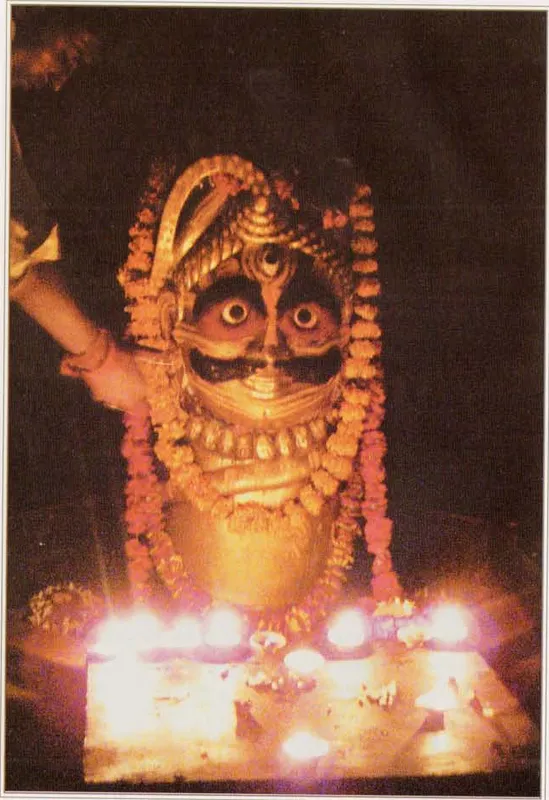
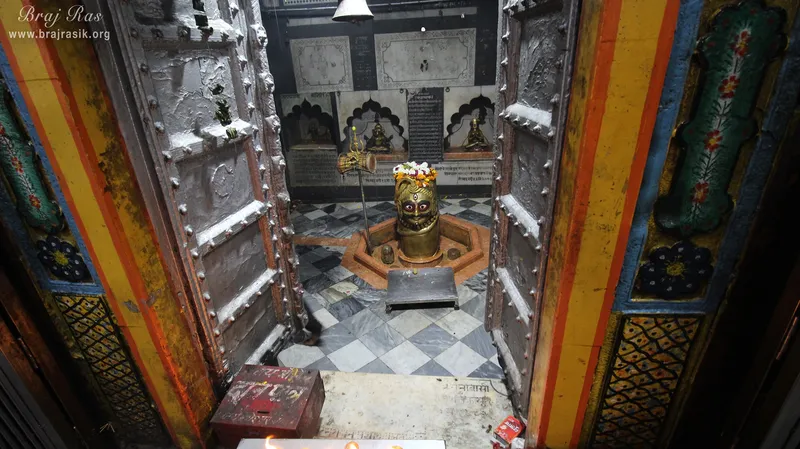
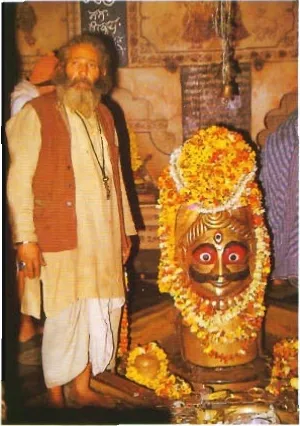
According to Śrī Vraja-maṇḍala Parikramā (2007), the Keśavajī Gauḍīya Maṭha stands next to Raṅgeśvara Mahādeva and Kaṁsa-ṭīlā, and Sapta-sāmudrī-kūpa lies near the temple on its eastern side. Photographs in this book and in Vṛndāvana-Dhāma Ki Jaya! (c. 1986) show the Deity as a liṅga with a metal face mask.[1 +4] The undated parikramā notes Mathurā mention Deities of Kṛṣṇa and Balarāma and a model of Kṛṣṇa killing Kaṁsa in a temple here, without naming the temple, so which shrine they mean is not certain. Its present state has not been checked.[9 +1]
Nearby places
Keśavajī Gauḍīya Maṭha · Sapta-sāmudrī-kūpa (Mathurā) · Raṅga-bhūmi
Pictures
2 pictures
History
According to the historians A. W. Entwistle (1987) and Prabhudayāl Mītal (1966), a pillar with an inscription of the Gupta period was found near the Raṅgeśvara temple. Entwistle dates it to AD 380, in the reign of Candragupta II, and Mītal to Gupta Saṁvat 61. Both say that it records the installation of two Śiva images named Upamiteśvara and Kapileśvara, and both take it to show that the Pāśupata Śaivas had a centre here in that period. The inscription, as they report it, does not name Raṅgeśvara.[11 +2]
In 1883 F. S. Growse described Kaṁsa's hill and the Raṅga-bhūmi, with an image of Raṅgeśvara Mahādeva, as sacred sites just outside the city of his day, and the district gazetteer of 1911 placed Raṅgeśvara on the Kaṁsa-ṭīlā outside the Holī gate.[19 +1]
Where the sources differ
Which Śiva protects Mathurā: the guidebooks name four, with Raṅgeśvara in the south; the Varāha Purāṇa names Bhūteśvara.
Which Śiva protects Mathurā: the guidebooks name four, with Raṅgeśvara in the south; the Varāha Purāṇa names Bhūteśvara.
Accounts differ The Śiva protectors (kṣetra-pāla, dik-pāla) of Mathurā.
- Vṛndāvana-Dhāma Ki Jaya! (c. 1986)Four śiva-liṅgas protect Mathurā: Pippaleśvara (east, just south of Viśrāma-ghāṭa), Gokarṇeśvara (north), Bhūteśvara (west) and Raṅgeśvara (south), the most visited.
- Śrī Vraja-maṇḍala Parikramā (2007)Pīpaleśvara is one of the four area-protectors (east); Bhūteśvara is the eternal area-protector on the western side; Raṅgeśvara is the protector of the dhāma in the south.
- Varāha Purāṇa 168.1-6 and 160.31One kṣetra-pāla protects Mathurā: Śiva, appointed by Varāha, named Bhūteśvara in the circumambulation rules.
- Varāha Purāṇa 160.63-64At the end of the Mathurā circumambulation the pilgrim prays to the kṣetra-pa Śiva addressed as Avimukteśa.
The wording of these accounts is our summary of the sources, not a published translation.
Accounts differ Which Śiva Kaṁsa worshipped at the bow festival, and the Śiva connected with the arena.
- Śrī Vraja-maṇḍala Parikramā (2007)Raṅgeśvara: his deity was decorated for the festival; 'Śaṅkara, whom Kaṁsa had worshipped', rejoiced at the spectacle and so was named Raṅgeśvara.
- Vṛndāvana-Dhāma Ki Jaya! (c. 1986)Kaṁsa worshipped the Raṅgeśvara-liṅga before the wrestling match.
- Śrīmad-Bhāgavatam 10.36.26The bow sacrifice was offered to 'bhūta-rāja', the boon-giver (no temple named).
- Śrīla Sanātana Gosvāmī and Śrīla Jīva Gosvāmī on ŚB 10.36.26 (Viśvanātha similar)'Bhūta-rāja' is Śrī Rudra named Bhūteśvara, the protector of Mathurā (Jīva: also the deity of that bow).
On which day the bow sacrifice was held and Kaṁsa was killed is told differently; the accounts are set side by side on the page of Raṅga-bhūmi.[1 +5]
More on this place
How Kṛṣṇa killed Kaṁsa in the wrestling arena
References
27 references
- Śrī Vraja-maṇḍala Parikramā (2007), PDF p. 46
- Śrī Vraja-maṇḍala Parikramā (2007), PDF p. 54
- Śrī Vraja-maṇḍala Parikramā (2007), PDF p. 44
- Vṛndāvana-Dhāma Ki Jaya! (c. 1986), by Dhruva Mahārāja dāsa, PDF p. 23
- the undated parikramā notes Mathurā, ¶60
- Śrī Vraja-maṇḍala Parikramā (2007), PDF p. 43
- Śrī Vraja-maṇḍala Parikramā (2007), PDF p. 42
- Vṛndāvana-Dhāma Ki Jaya! (c. 1986), by Dhruva Mahārāja dāsa, PDF p. 20
- the undated parikramā notes Mathurā, ¶54
- Nārada Purāṇa, उत्तरार्धः/अध्यायः 79 v.79-51: Uttara-bhāga, chapter 79, verse 51
- A. W. Entwistle, ch. 4 §12 'Finds at other places along the circumambulation of Mathura', printed p. 127, Egbert Forsten, Groningen, 1987
- Prabhudayāl Mītal, first part ('ब्रज-संस्कृति की भूमिका'), section 'Mathurā kī parikramā', entry 'Śrī Raṅgeśvara Mahādeva', printed p. 153
- Prabhudayāl Mītal, history part ('ब्रज का इतिहास'), early medieval period, the paragraph 'Candragupta ke śāsan meṁ Mathurā kī sthiti' (running heads 'Candragupta Vikramāditya' and 'Pūrva madhya kāl'), printed p. 101
- Varāha Purāṇa, adhyāya 168, verses 2–6, Sanskrit Wikisource
- Varāha Purāṇa, adhyāya 160, verse 31, Sanskrit Wikisource
- Varāha Purāṇa, adhyāya 160, verses 62-65, Sanskrit Wikisource
- Śrīla Rūpa Gosvāmī, Mathurā-māhātmya v.221-223
- Śrīla Prabhupāda, Kṛṣṇa, the Supreme Personality of Godhead, Chapter 36 · vedabase.io
- Mathurá (1883), F. S. Growse, B.C.S., M.A. Oxon., C.I.E. (as the title page gives him, p. 64
- Muttra (1911), D. L. Drake-Brockman, I.C.S. (edited and compiled), p. 297
Show all 27 references
- Śrī Vraja-maṇḍala Parikramā (2007), PDF p. 45
- Śrīmad-Bhāgavatam 10.36.26, Bhagavata Vidya Pith edition, ed. Bhagavata Rishi and Krishna Shankar Shastri, 1996
- Śrīmad-Bhāgavatam: commentary ŚB 10.45.3, commentaries: Jīva Gosvāmī (Laghu-vaiṣṇava-toṣaṇī) and Viśvanātha Cakravartī (Sārārtha-darśinī), Bhagavata Vidya Pith edition, ed. Bhagavata Rishi and Krishna Shankar Shastri, 1996
- Garga-saṁhitā, Mathurā-khaṇḍa (5) 1.15, Sanskrit Wikisource
- Garga-saṁhitā, Mathurā-khaṇḍa (5) 6.26-28, Sanskrit Wikisource
- Śrī Vraja-maṇḍala Parikramā (2007), p. 60-61
- Vṛndāvana-Dhāma Ki Jaya! (c. 1986), by Dhruva Mahārāja dāsa, p. 5