The Scholar of Halisahar #
Bhagavan Acharya, the Gaudiya Vaishnava Abhidhana records, first appeared in Sri Dham Nabadwip but was raised at Halisahar in the 24 Parganas district of Bengal. His father, Shatananda Khan, was a wealthy man wholly absorbed in worldly affairs, the kind of householder Chaitanya-charitamrita elsewhere calls simply "materialistic." Bhagavan Acharya took the opposite path. He applied himself so seriously to nyaya, the formal discipline of logic and argument, that he earned the title Nyayacharya. This title shows that he was trained as a logician. It does not mean that he held any temple post or priestly office. Everything else recorded of him comes from how he actually lived, not from any position he held.
Two Households, One Heart #
Renunciation showed itself in him so early that his father tried to stop it in the ordinary way. His father arranged Bhagavan Acharya's marriage to the daughter of Nabadwip's Madhusudana Ghataka. It did not work for long. Once Sri Chaitanya Mahaprabhu had taken sannyasa and word of His extraordinary presence had spread through Bengal, Bhagavan Acharya went to Puri to be near Him. But the Lord Himself sent him home again. He would not let a married man simply abandon the household he had taken responsibility for. It is a small but telling detail. Even with a devotee eager to renounce everything for Him, Mahaprabhu insisted first on the ordinary duty the devotee had already taken on.
Back in Bengal, two sons were born, Raghunath and Ramanatha. But the pull toward Puri never left him. In time Bhagavan Acharya placed his wife and sons in the care of his brother-in-law and his own disciples, accepted the renounced order, and returned to Jagannatha Puri to stay. Chaitanya-charitamrita does not date any of this. But it shows the same struggle happening twice before he finally settled down to a life at the Lord's side.
Cook and Host at Purushottama #
When word reached the devotees that Mahaprabhu had come back to Puri after His long tour through South India, they hurried to see Him again. Chaitanya-charitamrita names Bhagavan Acharya among them, arriving together with Ramabhadra Acharya and "giving up all other responsibilities" for good (Madhya-lila 10.184). From then on Krishnadasa Kaviraja Goswami counts him among the devotees who lived constantly at Jagannatha Puri. He describes him as "a gentleman, a learned scholar," whose relationship with the Lord was that of a cowherd companion. This is the sakhya mood of pure friendship, not the awe of a distant worshiper (Antya-lila 2.84-85).
That friendship showed itself, above all, in food. Bhagavan Acharya prepared varieties of vegetable dishes with his own hands and personally served them to Mahaprabhu. At times he invited the Lord to his own residence to eat, instead of sending a servant with the meal (Antya-lila 2.86-87). This was not a small privilege in a community where hundreds of devotees longed for the Lord's personal attention. Chaitanya-charitamrita notes that even on a day when Mahaprabhu had already accepted another devotee's invitation, He would set it aside if Gadadhara Pandit, Sarvabhauma Bhattacharya, or Bhagavan Acharya asked Him to come instead (Antya-lila 8.90-91). It is a short verse. But it places Bhagavan Acharya, a Bengali logician who held no important position, in the company of Puri's most senior Vaishnava scholar and the Lord's own dearest boyhood friend.
Lame, Yet First to Follow #
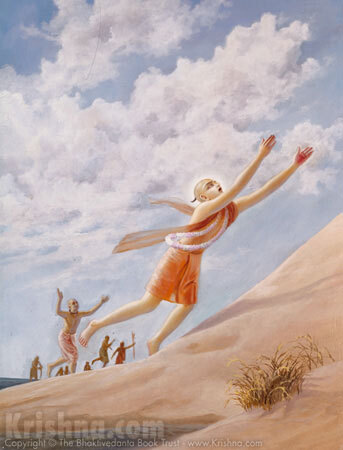
One evening in the garden known as Jagannatha-vallabha, near the Puri seashore, Mahaprabhu's mood shifted into a deep ecstasy of separation from Krishna. Seeing the long dunes of sand along the beach, He took them for Govardhana Hill, the sacred hill of Vrindavana, and ran toward them; reaching the water, He took the ocean itself for the river Yamuna and rushed on into it. The devotees around Him scattered after Him at once, afraid He would go on into the waves and be lost from their sight. Paramananda Puri and Brahmananda Bharati reached the beach quickly, matching the Lord's own speed as best they could. Bhagavan Acharya could not. Chaitanya-charitamrita records the detail with no embellishment at all: "Bhagavan Acharya, who was lame, followed them very slowly" (Antya-lila 14.90).
It is a single, short verse, but later Gaudiya writers clearly thought it worth remembering. The word used in that verse is khanja, "lame," and the Gaura-ganoddesha-dipika (verse 74) also calls him khanja. In later sources the word became permanently attached to his name. These sources speak of his son as "Raghunath Acharya, son of Khanja Bhagavan Acharya." Consider everything else told of him: the cooking, the hosting, the dining privilege shared with only two other devotees. When we compare this with all of that, the picture of him limping across the sand behind faster men says something the more flattering verses do not. A body that could not keep pace was, in the end, no obstacle at all to being counted among the few the Lord trusted most.
