Bhagavan Acharya
The Householder-Scholar Who Cooked for Sri Chaitanya Mahaprabhu
The complete life, on one page: The main biography and every pastime page, in order, in one place
Introduction
Bhagavan Acharya was a Bengali householder-turned-renunciate who spent his last years at Jagannatha Puri as one of the small circle of devotees Sri Chaitanya Mahaprabhu kept closest to Him. Krishnadasa Kaviraja Goswami counts him among the principal "branches" of Mahaprabhu's devotee-tree in Sri Chaitanya-charitamrita, and gives him a title, Nyayacharya, that marks him out as a trained logician rather than a professional priest. He is not to be confused with Bhagavan Pandita, a different and far more obscure devotee named a few verses earlier in the very same chapter of Chaitanya-charitamrita.
| Detail | Description |
|---|---|
| Title | Nyayacharya, "master of logic" |
| Birthplace | Sri Dham Nabadwip; raised at Halisahar, 24 Parganas, Bengal |
| Association | One of the intimate devotees who stayed constantly with Mahaprabhu at Jagannatha Puri |
| Family | Father Shatananda Khan; sons Raghunath Acharya and Ramanatha; younger brother Gopala Bhattacharya |
| Identity | An incarnation of a cowherd boy (Chaitanya-charitamrita Antya 2.85); a kala, or portion, of Sri Gaura (Gaura-ganoddesha-dipika 74) |
| Known for | Personally cooking for and hosting Sri Chaitanya Mahaprabhu; close friendship with Svarupa Damodara Goswami |
| Principal source | Sri Chaitanya-charitamrita, Adi-lila 10 and Antya-lila 2, 5, 8 and 14 |
At a Glance:
- A logician by training (Nyayacharya), not a priest or a poet, who nonetheless became one of Mahaprabhu's closest personal attendants at Puri.
- Twice tried and failed to remain a householder before finally taking the renounced order for good.
- Best remembered for cooking for and personally serving Sri Chaitanya Mahaprabhu, and for an earnest simplicity that again and again led him into trouble he never intended.
- His simplicity led to trouble in three separate episodes, each with its own lesson: one about his own younger brother, one about an errand for a bowl of rice, and one about a visiting poet's play.
- No date, place, or circumstance of his disappearance survives in any known source.
Scriptural evidence for the introduction (3)
prataparudra raja, ara odhra krsnananda / paramananda mahapatra, odhra sivananda / bhagavan acarya, brahmanandakhya bharati / sri-sikhi mahiti, ara murari mahiti
Word for word
prataparudra raja--King Prataparudra of Orissa; paramananda mahapatra--of the name Paramananda Mahapatra; bhagavan acarya--of the name Bhagavan Acarya; brahmananda-akhya bharati--of the name Brahmananda Bharati; sri-sikhi mahiti--of the name Sri Sikhi Mahiti; murari mahiti--of the name Murari Mahiti.
King Prataparudra of Orissa, the Oriya devotees Krishnananda and Sivananda, Paramananda Mahapatra, Bhagavan Acharya, Brahmananda Bharati, Sri Sikhi Mahiti and Murari Mahiti constantly associated with Chaitanya Mahaprabhu while He resided in Jagannatha Puri.
From the purport: Purport excerpt: "Bhagavan Acarya, a very learned scholar, was formerly an inhabitant of Halisahara, but he left everything to live with Caitanya Mahaprabhu in Jagannatha Puri."
The single verse in which Krishnadasa Kaviraja Goswami first names Bhagavan Acharya among the devotees who lived constantly with Mahaprabhu at Puri; Prabhupada's purport here is the richest capsule account of him found anywhere in print.
সখ্যভাবাক্রান্ত-চিত্ত, গোপ-অবতার ।
স্বরূপ-গোসাঞি-সহ সখ্য-ব্যবহার ॥ ৮৫ ॥
sakhya-bhāvākrānta-citta, gopa-avatāra
svarūpa-gosāñi-saha sakhya-vyavahāra
He was fully absorbed in thoughts of fraternal relationships with God. He was an incarnation of a cowherd boy, and thus his dealings with Svarūpa Dāmodara Gosvāmī were very friendly.
Krishnadasa Kaviraja Goswami's own description of Bhagavan Acharya as a gopa-avatara, an incarnation of a cowherd boy, in the mood of friendship (sakhya). Translation: Srila Prabhupada.
आवेशश्च तथा ज्ञेयो मिश्रे प्रद्युम्नसंज्ञके ।
आचार्यो भगवान्खञ्जः कला गौरस्य कथ्यते ॥७४॥
āveśaś ca tathā jñeyo miśre pradyumna-saṁjñake |
ācāryo bhagavān khañjaḥ kalā gaurasya kathyate ||74||
In the same way, a particle of Lord Caitanya also entered the body of Pradyumna Misra. Bhagavan Acarya Khanja is said to be a partial manifestation of Lord Gaura.
The second line names Bhagavan Acharya Khanja as a kala, a partial manifestation, of Lord Gaura; this is Kavi Karnapura's recorded identification. The first line concerns Pradyumna Mishra. Sanskrit: diacritic edition of the Gaura-ganoddesha-dipika; English translation as published at bvmlu.org.
Chapter 1
Coming to Live Near the Lord
A scholar of Halisahar renounces two households before Sri Chaitanya Mahaprabhu will let him stay for good.
The Scholar of Halisahar #
Bhagavan Acharya, the Gaudiya Vaishnava Abhidhana records, first appeared in Sri Dham Nabadwip but was raised at Halisahar in the 24 Parganas district of Bengal. His father, Shatananda Khan, was a wealthy man wholly absorbed in worldly affairs, the kind of householder Chaitanya-charitamrita elsewhere calls simply "materialistic." Bhagavan Acharya took the opposite path. He applied himself so seriously to nyaya, the formal discipline of logic and argument, that he earned the title Nyayacharya. This title shows that he was trained as a logician. It does not mean that he held any temple post or priestly office. Everything else recorded of him comes from how he actually lived, not from any position he held.
Two Households, One Heart #
Renunciation showed itself in him so early that his father tried to stop it in the ordinary way. His father arranged Bhagavan Acharya's marriage to the daughter of Nabadwip's Madhusudana Ghataka. It did not work for long. Once Sri Chaitanya Mahaprabhu had taken sannyasa and word of His extraordinary presence had spread through Bengal, Bhagavan Acharya went to Puri to be near Him. But the Lord Himself sent him home again. He would not let a married man simply abandon the household he had taken responsibility for. It is a small but telling detail. Even with a devotee eager to renounce everything for Him, Mahaprabhu insisted first on the ordinary duty the devotee had already taken on.
Back in Bengal, two sons were born, Raghunath and Ramanatha. But the pull toward Puri never left him. In time Bhagavan Acharya placed his wife and sons in the care of his brother-in-law and his own disciples, accepted the renounced order, and returned to Jagannatha Puri to stay. Chaitanya-charitamrita does not date any of this. But it shows the same struggle happening twice before he finally settled down to a life at the Lord's side.
Cook and Host at Purushottama #
When word reached the devotees that Mahaprabhu had come back to Puri after His long tour through South India, they hurried to see Him again. Chaitanya-charitamrita names Bhagavan Acharya among them, arriving together with Ramabhadra Acharya and "giving up all other responsibilities" for good (Madhya-lila 10.184). From then on Krishnadasa Kaviraja Goswami counts him among the devotees who lived constantly at Jagannatha Puri. He describes him as "a gentleman, a learned scholar," whose relationship with the Lord was that of a cowherd companion. This is the sakhya mood of pure friendship, not the awe of a distant worshiper (Antya-lila 2.84-85).
That friendship showed itself, above all, in food. Bhagavan Acharya prepared varieties of vegetable dishes with his own hands and personally served them to Mahaprabhu. At times he invited the Lord to his own residence to eat, instead of sending a servant with the meal (Antya-lila 2.86-87). This was not a small privilege in a community where hundreds of devotees longed for the Lord's personal attention. Chaitanya-charitamrita notes that even on a day when Mahaprabhu had already accepted another devotee's invitation, He would set it aside if Gadadhara Pandit, Sarvabhauma Bhattacharya, or Bhagavan Acharya asked Him to come instead (Antya-lila 8.90-91). It is a short verse. But it places Bhagavan Acharya, a Bengali logician who held no important position, in the company of Puri's most senior Vaishnava scholar and the Lord's own dearest boyhood friend.
Lame, Yet First to Follow #
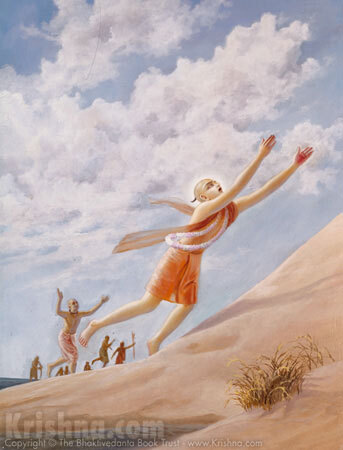
One evening in the garden known as Jagannatha-vallabha, near the Puri seashore, Mahaprabhu's mood shifted into a deep ecstasy of separation from Krishna. Seeing the long dunes of sand along the beach, He took them for Govardhana Hill, the sacred hill of Vrindavana, and ran toward them; reaching the water, He took the ocean itself for the river Yamuna and rushed on into it. The devotees around Him scattered after Him at once, afraid He would go on into the waves and be lost from their sight. Paramananda Puri and Brahmananda Bharati reached the beach quickly, matching the Lord's own speed as best they could. Bhagavan Acharya could not. Chaitanya-charitamrita records the detail with no embellishment at all: "Bhagavan Acharya, who was lame, followed them very slowly" (Antya-lila 14.90).
It is a single, short verse, but later Gaudiya writers clearly thought it worth remembering. The word used in that verse is khanja, "lame," and the Gaura-ganoddesha-dipika (verse 74) also calls him khanja. In later sources the word became permanently attached to his name. These sources speak of his son as "Raghunath Acharya, son of Khanja Bhagavan Acharya." Consider everything else told of him: the cooking, the hosting, the dining privilege shared with only two other devotees. When we compare this with all of that, the picture of him limping across the sand behind faster men says something the more flattering verses do not. A body that could not keep pace was, in the end, no obstacle at all to being counted among the few the Lord trusted most.
Scriptural evidence for this chapter (4)
Later, Ramabhadra Acharya and Bhagavan Acharya also joined them, and, giving up all other responsibilities, remained under Sri Chaitanya Mahaprabhu's shelter.
Marks the moment Bhagavan Acharya gave up worldly duties for good to live permanently under Mahaprabhu's direct shelter at Puri.
At Jagannatha Puri, in the association of Sri Chaitanya Mahaprabhu, lived Bhagavan Acharya, who was certainly a gentleman, a learned scholar and expert in all kinds of understanding.
Chaitanya-charitamrita's own introduction of Bhagavan Acharya's character, opening the long passage describing his daily service to the Lord.
Paramananda Puri and Brahmananda Bharati also went toward the beach, and Bhagavan Acharya, who was lame, followed them very slowly.
The one verse recording Bhagavan Acharya's physical disability, set during the pastime in which Mahaprabhu ran toward the ocean at Jagannatha-vallabha garden, mistaking the beach dunes for Govardhana Hill.
Even on a day when Sri Chaitanya Mahaprabhu was invited to dine by others, if Gadadhara Pandit, Bhagavan Acharya or Sarvabhauma Bhattacharya invited Him, Sri Chaitanya Mahaprabhu would give them precedence.
Shows how highly Mahaprabhu ranked an invitation from Bhagavan Acharya, placing him alongside Gadadhara Pandit and Sarvabhauma Bhattacharya as one of the very few devotees whose call took priority.
Chapter 2
The Mayavada Scholar Brother
An innocent brother's pride in Shankara's Vedanta draws a sharp warning from Svarupa Damodara Goswami.
A Brother's Learning #
This episode belongs to the same later years at Jagannatha Puri as Bhagavan Acharya's own arrival to live permanently near the Lord, the period that Chaitanya-charitamrita's Antya-lila covers. Gopala Bhattacharya, Bhagavan Acharya's younger brother, had gone to Kashi (Varanasi) to study Vedanta. He returned to Puri newly trained in Shankara's Sariraka-bhashya. This is the influential Mayavada commentary on the Vedanta-sutra that understands the Absolute Truth as formless and the individual soul as ultimately identical with it. He came first to see his older brother, who was overjoyed to learn how learned Gopala had become. Mahaprabhu, as the Supreme Personality of Godhead, knows the heart of everyone. Chaitanya-charitamrita notes that He recognized at once that Gopala Bhattacharya held Mayavadi views. He greeted him with no more than formal courtesy, even as Bhagavan Acharya beamed with brotherly pride at the meeting.
Svarupa Damodara's Rebuke #
Bhagavan Acharya was eager to share what he saw as his brother's accomplishment with the whole community of devotees. So he went to Svarupa Damodara Goswami and asked him to come and hear Gopala recite his Vedanta commentary. Svarupa Damodara was Mahaprabhu's closest secretary and constant companion. He was also the devotee generally entrusted with guarding what teachings and literature reached the Lord. His answer came from his affection for Bhagavan Acharya, not from anger at him, but it was blunt: "You have lost your intelligence in the association of Gopala, and therefore you are eager to hear the Mayavada philosophy" (Antya-lila 2.94). Svarupa Damodara went on to explain exactly why even a single sitting with such a commentary was dangerous. A Vaishnava who hears the Sariraka-bhashya risks losing the understanding that the living being is the Lord's eternal servant, and replacing it with the idea that he himself is the Supreme (Antya-lila 2.95).
Bhagavan Acharya pushed back gently. He argued that devotees whose hearts were already fixed on Krishna's lotus feet in full surrender had nothing to fear from merely listening to an opposing philosophy. Svarupa Damodara did not give way. He said that even hearing such teachings, without accepting them, was enough to injure the heart and soul of a sincere devotee. The teachings in question are that the living entity is ultimately illusory and that the Lord Himself is only a product of ignorance (Antya-lila 2.98-99). The danger he was warning against was the hearing itself, not only whether the listener consciously agreed with what he heard.
Sent Back to Bengal #
The force of the rebuke was enough to quiet Bhagavan Acharya completely. By the next day he had asked his brother to return to his own district in Bengal. The episode ended as simply as it began, without any drama (Antya-lila 2.100). Chaitanya-charitamrita does not suggest any lasting quarrel between the two brothers. Nor does it suggest that Bhagavan Acharya felt any bitterness toward Svarupa Damodara. It suggests only that his plain-hearted enthusiasm had, for a moment, carried him further than his own better judgment should have allowed.
The episode says as much about Svarupa Damodara Goswami's role at Puri as it does about Bhagavan Acharya himself. Svarupa Damodara guarded which teachings reached Mahaprabhu. The same instinct to protect the purity of what reached the Lord's ears would appear again a little later. At that time a poet from East Bengal brought a new play to Puri, hoping it would be read before Mahaprabhu. Once again Svarupa Damodara stood between an eager, well-meaning devotee and the Lord.
Mayavada philosophy comes up again and again in Chaitanya-charitamrita. It is the one teaching that Mahaprabhu treated with real severity, far more than any other opposing view of His time. His severity was toward the teaching, not toward the people who held it. He welcomed brahmanas, kings such as Maharaja Prataparudra, logicians and ordinary householders of every background into His movement. He even turned great Mayavadi scholars to devotion. At Puri He changed the heart of Sarvabhauma Bhattacharya, as told on The Conversion of Sarvabhauma Bhattacharya. At Varanasi He did the same with Prakashananda Sarasvati, as told on The Debate with Prakashananda Sarasvati at Varanasi. But He always drew a firm line at Shankara's impersonal reading of Vedanta. In Chaitanya-charitamrita He says: "Srila Vyasadeva presented the Vedanta philosophy for the deliverance of conditioned souls, but if one hears the commentary of Sankaracarya, everything is spoiled" (Madhya-lila 6.169). He knew this teaching could quietly undo years of real devotion, even in an advanced devotee. Bhagavan Acharya's short, well-meaning mistake with his own brother is a small, family example of this same concern. It shows that the danger Svarupa Damodara warned about was never only a theory. It could appear even inside the home of one of the Lord's dearest devotees.
Scriptural evidence for this chapter (4)
Quoted in the text above:
- Antya 2.94 Sri Chaitanya-charitamrita
- Madhya 6.169 Sri Chaitanya-charitamrita
Further verses:
Thus Bhagavan Acharya, greatly ashamed and fearful, remained silent. The next day, he asked Gopala Bhattacharya to return to his own district.
The episode's resolution: Bhagavan Acharya sends his brother back to Bengal the day after Svarupa Damodara's warning.
When a Vaishnava listens to the Sariraka-bhashya, the Mayavada commentary upon the Vedanta-sutra, he gives up the Krishna conscious attitude that the Lord is the master and the living entity is His servant. Instead, he considers himself the Supreme Lord.
Svarupa Damodara Goswami's explanation of exactly why even a single sitting with the Sariraka-bhashya endangers a Vaishnava's understanding of his own eternal position.
Chapter 3
The Rice of Madhavidevi
A well-meant errand to feed the Lord leads to one of Sri Chaitanya Mahaprabhu's harshest judgments on a renunciate.
An Innocent Request #
Bhagavan Acharya wanted to prepare something especially fine for Sri Chaitanya Mahaprabhu's meal. So he turned to a young devotee named Chota Haridasa (Junior Haridasa), who sang regularly in Mahaprabhu's kirtana assembly and was well known and liked among the devotees at Puri. He asked Chota Haridasa to go to Madhavidevi, the elder sister of Shikhi Mahiti, and beg a measure of good white rice from her in Bhagavan Acharya's own name (Antya-lila 2.101-103). At first sight it was an entirely ordinary request between devotees who saw each other daily.
Madhavidevi, however, was no ordinary figure in this community. She was an elderly woman devoted to strict austerity. Chaitanya-charitamrita counts her among the only "three and a half" people in the entire world whom Mahaprabhu considered qualified to discuss Krishna's most confidential conjugal pastimes with Him. The other three were Svarupa Damodara Goswami, Ramananda Raya and her own brother Shikhi Mahiti (Antya-lila 2.105-106). Madhavidevi herself was counted as the "half," because she was a woman sharing a mood of service otherwise reserved for the three men named with her. However innocent the intention was, sending an unmarried, renounced young man to her door to beg alms placed him in exactly the kind of situation Mahaprabhu watched most carefully among His renunciate followers.
Fine Rice and a Harsh Order #
Chota Haridasa carried out the errand without trouble and brought the rice back to Bhagavan Acharya. Bhagavan Acharya cooked it with clear pleasure into a meal for the Lord, along with a variety of vegetable preparations Mahaprabhu was known to like (Antya-lila 2.107-108). When Mahaprabhu sat to eat, He noticed the unusual fineness of the rice at once and asked where it had come from. When He was told that Chota Haridasa had begged it from Madhavidevi, His mood changed instantly (Antya-lila 2.109-111). Without further explanation to Bhagavan Acharya, He gave a lasting order on the spot: Chota Haridasa was never to be allowed to come near Him again (Antya-lila 2.113).
The Cost of an Errand #
Chota Haridasa fasted for three continuous days in grief at being cut off from the Lord's presence. At last Svarupa Damodara Goswami and the Lord's other confidential devotees approached Mahaprabhu to ask what offense had actually been committed. His answer left no room for argument or appeal. He said He could no longer bear even to look upon a sannyasi who exchanges words with a woman, however innocently the conversation began (Antya-lila 2.117). Every later account of this episode treats it as one of the strictest judgments Mahaprabhu is recorded to have passed on any renunciate in His company.
This is really far more Chota Haridasa's story than Bhagavan Acharya's own. This Chota Haridasa, "Junior Haridasa," should not be confused with Srila Haridasa Thakura, the namacharya. Haridasa Thakura was an entirely different and far more senior devotee who shares only a name with him. Bhagavan Acharya set the whole chain of events in motion with no ill intention at all, wanting only to feed the Lord well. Chaitanya-charitamrita records nothing further of what he personally felt at having unknowingly caused so severe a judgment against a fellow devotee. That silence should be noted, not filled in with guesswork. The text is concerned with the lesson for renunciates about association with women, not with Bhagavan Acharya's own reaction to the result of his simple household errand.
Chota Haridasa's fate did not end with exile from the Lord's presence. Later sources record that roughly a year after this incident, still unable to bear separation from Mahaprabhu, he traveled to the place where the Ganges and Yamuna meet and ended his own life there. Chaitanya-charitamrita's own commentators do not read this sad ending as cruelty on the Lord's part. They read it as a lesson set at the strictest possible standard for anyone who has taken the vows of renunciation. Bhagavan Acharya's rice was cooked with nothing but affection for his Lord. Yet it set in motion consequences far beyond anything a simple household errand should reasonably carry. This is exactly why, of everything told of him, this is the episode Gaudiya Vaishnava writers return to most often. They return to it when they want to show just how seriously Mahaprabhu enforced the discipline of sannyasa among those closest to Him.
Scriptural evidence for this chapter (3)
The three were Svarupa Damodara Gosvami, Ramananda Raya and Sikhi Mahiti, and the half a person was Sikhi Mahiti's sister [Madhavidevi].
Establishes just how exceptional a devotee Madhavidevi was considered, explaining why an errand to her door was not an ordinary household request.
The Lord replied, "I cannot tolerate seeing the face of a person who has accepted the renounced order of life but who still talks intimately with women."
Mahaprabhu's own, uncompromising explanation for permanently barring Chota Haridasa, the strictest standard He is recorded applying to any renunciate in His company.
At noon, when Sri Chaitanya Mahaprabhu came to eat the offerings of Bhagavan Acharya, He first appreciated the fine rice and therefore questioned him.
The moment Mahaprabhu's mood changed on learning where the fine rice for His meal had come from.
Chapter 4
The Poet's Play at Puri
A visiting poet's drama nearly reaches Sri Chaitanya Mahaprabhu carrying two hidden theological errors.
A Play in Praise of the Lord #
A poet from East Bengal came to Jagannatha Puri with a play he had written about Sri Chaitanya Mahaprabhu. He had written it entirely on his own. He had not first asked the Lord's senior devotees how such a subject ought to be handled. He read the finished work first to Bhagavan Acharya, who praised its literary quality warmly and without any caution. Then he read it to the wider circle of devotees gathered at Puri, and they were pleased with it as well. Encouraged by this, they wanted the play placed before Mahaprabhu Himself so that He too could hear it. But at Puri nothing reached the Lord's ears until Svarupa Damodara Goswami had first checked it. It was his fixed practice to examine every new composition for wrong teaching before he allowed it to be read in Mahaprabhu's presence. Not long before this, the very same duty had already brought him into a direct but gentle clash with Bhagavan Acharya's own brother.
Two Hidden Errors #
Bhagavan Acharya urged him again and again, and at last Svarupa Damodara agreed to hear the play. Trouble appeared at once, in its very first verse, the invocation. The poet had written that Lord Jagannatha's form was nothing more than lifeless matter, a "dull, destructible body" made of the external, material energy. He had also described Sri Chaitanya Mahaprabhu as merely "a spark of spiritual energy" and not its very source (Antya-lila 5.114-115). Yet Mahaprabhu is the Supreme Personality of Godhead Himself, full in all six opulences. Svarupa Damodara's answer was sharp and immediate. Both statements, he said, were serious theological offenses. They came from someone who simply did not understand the philosophy well enough to glorify the Lord safely. Jagannatha's form is fully spiritual and blissful, and never material in any sense. And there is no difference at all between the Lord's own body and the Lord Himself, since both are equally manifestations of spiritual energy (Antya-lila 5.117-122).
Turned Toward Vaishnava Shelter #
Svarupa Damodara saw how deeply ashamed and frightened the poet had become under this correction, and at once his sharpness gave way to compassion. He showed the poet, verse by verse, how the very same invocation could be reworded to glorify the Lord correctly instead of offending Him. He did not send the poet away with punishment. He sent him away with instruction: go study Srimad-Bhagavatam from a genuine, self-realized Vaishnava, take exclusive shelter of Chaitanya Mahaprabhu's lotus feet, and keep the constant company of His devotees. Only then would the poet understand the true waves of Vaishnava philosophy (Antya-lila 5.131-132). Every surviving account of the episode says that the poet took the advice fully to heart and surrendered to the devotees present.
Bhagavan Acharya's own part in the episode ends where it began. No further word from him is recorded once Svarupa Damodara stepped in. His open, trusting enthusiasm for a friend's literary work had nearly carried an unchecked and theologically dangerous verse straight into Mahaprabhu's presence. Once again, it was Svarupa Damodara's careful judgment, and not Bhagavan Acharya's own, that caught the problem before any harm was done. If we read this together with the Mayavada scholar brother and the rice of Madhavidevi, the same pattern is clear in all three episodes. Bhagavan Acharya had a generous nature that did not suspect anyone, and it made him truly dear to Sri Chaitanya Mahaprabhu. But just as often, and with no bad intention at all, that same nature needed a steadier hand watching close behind it.
Such plays and poems about Mahaprabhu were not unusual at Puri in these years. Devotees with a gift for writing often composed verses and dramas in His honor. At least one of them, the Jagannatha-vallabha-nataka, is remembered as a genuine, celebrated work of the period. For Svarupa Damodara, what made one composition celebrated and another rejected was never literary skill alone. It was whether the philosophy underneath it held up. Did it correctly understand Krishna's body and identity as sac-cid-ananda, eternal and full of knowledge and bliss? Or did it describe the Lord in terms taken, even without knowing it, from Mayavada or from ordinary material ideas? The East Bengal poet was grateful for this correction, not resentful. This is part of why the episode is remembered as an example of Svarupa Damodara's mercy as much as his strictness.
Scriptural evidence for this chapter (4)
The poet said, "Lord Jagannatha is a most beautiful body, and Sri Chaitanya Mahaprabhu, who is exceptionally grave, is the owner of that body."
The poet's own explanation of the invocation verse that Svarupa Damodara went on to identify as doctrinally offensive.
"If you want to understand Srimad-Bhagavatam," he said, "you must approach a self-realized Vaishnava and hear from him. You can do this when you have completely taken shelter of the lotus feet of Sri Chaitanya Mahaprabhu."
Svarupa Damodara's closing instruction to the corrected poet, showing the episode ending in guidance rather than punishment.
Svarupa Damodara continued, "Associate regularly with the devotees of Sri Chaitanya Mahaprabhu, for then only will you understand the waves of the ocean of devotional service.
Svarupa Damodara's closing instruction to the corrected poet, continuing directly from the previous verse, showing the episode ending in guidance rather than punishment.
"You are a fool," he said. "You have brought ill fortune upon yourself, for you have no knowledge of the existence of the two Lords, Jagannathadeva and Sri Chaitanya Mahaprabhu, nor have you faith in Them."
Svarupa Damodara Goswami's opening rebuke to the poet, identifying the invocation verse's error as a lack of faith in the two Lords rather than a mere literary slip.
Closing
A Scholar Torn Between Two Lives #
According to the Gaudiya Vaishnava Abhidhana, Bhagavan Acharya first appeared in Sri Dham Nabadwip but grew up at Halisahar, where his father Shatananda Khan lived as a prosperous but thoroughly materialistic man. Bhagavan Acharya went the opposite direction: he studied hard enough in nyaya, the discipline of logic, to earn the title Nyayacharya. Renunciation stirred in him early, and to counter it his father arranged his marriage to the daughter of Nabadwip's Madhusudana Ghataka.
Marriage did not settle him. Once Sri Chaitanya Mahaprabhu accepted sannyasa, Bhagavan Acharya went to Puri to be near Him. But the Lord Himself sent him back to his wife, since a vairagi could not simply walk away from a family he had already taken on. Two sons, Raghunath and Ramanatha, were born of the marriage. Even so, Bhagavan Acharya could not stay content as a householder for long. He eventually placed his wife and children in the care of his brother-in-law and his own disciples, took the renounced order, and returned to Puri for good. Chaitanya-charitamrita and the Gaudiya Vaishnava Abhidhana agree on this decision, though neither gives a year for any of it.
Final Years and Kheturi #
No source records a date or place for Bhagavan Acharya's disappearance. The last thing recorded is that he and his son Raghunath Acharya traveled with Jahnava Mata to the great festival that Narottama Dasa Thakura held at Kheturi. By that time Jahnava Mata had become the guiding elder of the Gaudiya Vaishnava community that Mahaprabhu's own generation had left behind. Later writers also permanently attached the word "Khanja," meaning "the lame one," to his name. Beyond that, Chaitanya-charitamrita and the related literature preserve nothing further of him.
- Sri Chaitanya-charitamrita, Adi-lila 10.135-136 (vedabase.io)
- Sri Chaitanya-charitamrita, Madhya-lila 10.184 (vedabase.io)
- Sri Chaitanya-charitamrita, Antya-lila 2.84-117 (vedabase.io)
- Sri Chaitanya-charitamrita, Antya-lila 5.91-158 (vedabase.io)
- Sri Chaitanya-charitamrita, Antya-lila 8.90-91 (vedabase.io)
- Sri Chaitanya-charitamrita, Antya-lila 14.90 (vedabase.io)
- Sri Caitanya-caritamrta, Adi-lila, Chapter 10 (original edition text, bvmlu.org)
- Bhagavan Acarya - Gaudiya History, ISKCON Desire Tree
- Svarupa Damodara Goswami - Gaudiya History, ISKCON Desire Tree
