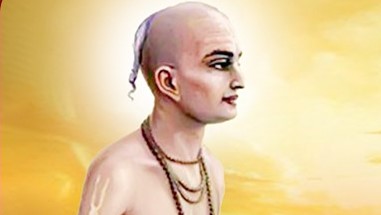
Sri Chaitanya Mahaprabhu had not yet accepted sannyasa when Lokanatha Gosvami first came before Him at Nabadwipa, sometime around 1509-1510 CE. Mahaprabhu embraced him, told him He intended to renounce household life very shortly and go to Vrindavana Himself, and instructed Lokanatha to go there ahead of Him and settle. Lokanatha was, by every account, a person of deep feeling. He was overcome when he imagined the Lord's beautiful hair being cut off for sannyasa, and the grief His devotees would feel. But he surrendered to the order and prepared to leave.
A Friend Who Would Not Let Go #
As far as any source records, Bhugarbha Goswami was not given a personal instruction from Mahaprabhu to travel to Vrindavana. His reason was simpler. He saw how much the parting pained his close companion, and he chose to walk the road with him instead of letting him go alone. The sources do not agree whether that closeness was a blood tie (the Sadhana-dipika calls Bhugarbha Lokanatha's paternal uncle) or simply the bond of two men who had grown up devoted to the same Lord (see Bhugarbha Goswami's main biography page for that disagreement in full). But the decision itself is recorded. Bhugarbha went with him.
The Road from Bengal to Vraja #
One later account, compiled by Srila Bhakti Ballabh Tirtha Goswami Maharaj of Sree Chaitanya Gaudiya Math, traces the route the two companions walked: through Rajmahal, Tajpur, Purnia, Ayodhya, Lucknow, and other holy places along the way, before finally arriving in Vraja-mandala. No source gives an exact date for their arrival. The route of a sixteenth-century pilgrimage on foot across northern India is hard to fit into any exact timeline. But the distance itself shows how serious the journey was. It was several hundred miles through unfamiliar country. As far as is recorded, the two men had no material means beyond what devotees along the way chose to offer them.
Ahead of Rupa and Sanatana #
Even after reaching Vrindavana, Lokanatha Gosvami's own heart kept pulling him back toward Mahaprabhu. News reached him that the Lord had taken sannyasa and gone to Puri, and from there on pilgrimage to South India. Lokanatha then set off to find Him. First he went south. Then he turned back toward Vraja when he heard Mahaprabhu had gone there, and then toward Prayag when he heard the Lord had moved on again. Lokanatha finally settled only after Mahaprabhu appeared to him in a dream and told him plainly to stop wandering and remain in Vrindavana for his bhajana. Bhugarbha Goswami's own movements during these years are not separately recorded. But every source that mentions the two of them together places them in Vraja, already established there, well before Rupa Goswami, Sanatana Goswami and Gopala Bhatta Goswami gradually arrived to join them. They were there so early that later Gaudiya Vaishnava tradition remembers Bhugarbha and Lokanatha as senior in age and experience to several Goswamis whose names became far better known. Their years in Vraja before that larger community formed are told in full at Calling Out the Names of the Twelve Forests.
