Srila Bhugarbha Goswami
Lokanatha Gosvami's Lifelong Companion in Vrindavana
The complete life, on one page: The main biography and every pastime page, in order, in one place
Introduction
Srila Bhugarbha Goswami is remembered not so much for himself as for being one half of an inseparable pair. Alongside his lifelong companion Lokanatha Gosvami, he was among the very first Gaudiya Vaishnavas to settle in Vrindavana. They arrived years before Rupa Goswami and Sanatana Goswami came to live there. Bhugarbha Goswami was a disciple of Gadadhara Pandit. He is named directly, though briefly, in Sri Chaitanya-charitamrita itself. He is one of the few Vrindavana Goswamis whom Krishnadasa Kaviraja Goswami mentions by name in his own account of events he personally witnessed.
| Detail | Description |
|---|---|
| Guru | Gadadhara Pandit |
| Closest companion | Lokanatha Gosvami, a relative (paternal uncle, by one account) or simply a lifelong friend; sources differ |
| Birth | Not recorded |
| Identity | Prema-manjari, in Krishna's eternal pastimes (Gaura-ganoddesha-dipika 187; Chaitanya-charitamrita Adi 12.82 purport) |
| Known disciples | Chaitanya Dasa (pujari of Sri Govindadeva), Mukundananda Chakravarti, Premi Krishnadasa |
| Named in Chaitanya-charitamrita | Adi-lila 12.82; Madhya-lila 18.50 |
| Disappearance | Chaturdashi (14th day) of the Kartika full-moon fortnight; year not recorded |
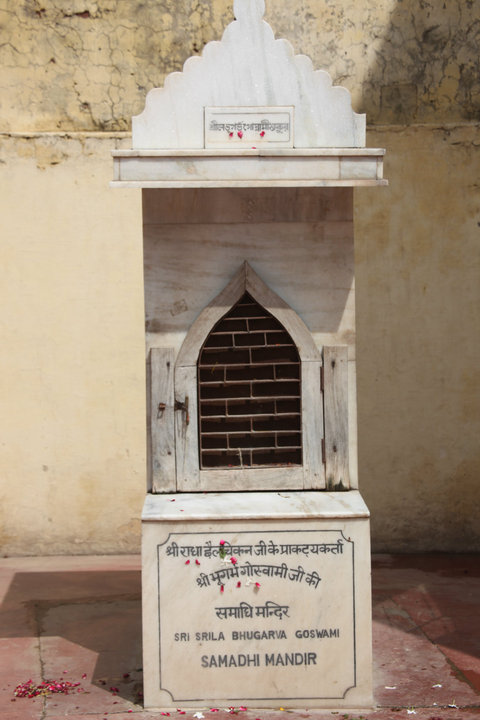
| Samadhi | Radha-Damodara temple courtyard, Vrindavana |
Scriptural evidence for the introduction (6)
gadadhara-gosanira ekadasa sakha
— bhugarbha-gosani, dvadasa — bhagavata-dasa
dunhe vrndavane giya rahila nirantara
Word for word
gadadhara-gosanira: of Gadadhara Gosani; ekadasa sakha: the eleventh branch; bhugarbha-gosani: named Bhugarbha Gosani; dvadasa: the twelfth; bhagavata-dasa: named Bhagavata dasa; dunhe: both of them; vrndavane: to Vrindavana; giya: having gone; rahila: remained; nirantara: continuously, for life
The eleventh branch of Gadadhara Gosvami was Bhugarbha Gosani, and the twelfth was Bhagavata dasa. Both of them went to Vrindavana and resided there for life.
From the purport: Bhūgarbha Gosāñi, formerly known as Prema-mañjarī, was a great friend of Lokanātha Gosvāmī...
Krishnadasa Kaviraja Goswami's own genealogical listing of Gadadhara Pandit's disciples, placing Bhugarbha Goswami as the eleventh of them and confirming, in the primary source itself, that he settled permanently in Vrindavana.
Lokanatha's affection for Bhugarbha was well known everywhere. They only had different bodies; in spirit they were one.
Narahari Chakravarti Thakura's own description of the closeness between Bhugarbha Goswami and Lokanatha Gosvami, quoted in secondary Gaudiya Vaishnava biographical sources rather than independently verified against a critical edition of the Bengali text.
Gopal Bhatta Gosvami was extremely compassionate. Bhugarbha Gosvami and Lokanatha Gosvami are a goldmine of virtues.
A further verse of praise for Bhugarbha Goswami from the Bhakti-ratnakara, again paired with Lokanatha Gosvami and here also naming Gopala Bhatta Goswami; quoted in secondary sources rather than independently checked against a critical edition.
gosvaminam ca bhugarbham bhugarbhottham suvishrutam
sada mahashayam vande krishna-prema-pradam prabhum
shrila-govinda-devasya seva-sukha-vilasinam
dayalum premadam svaccham nityam ananda-vigraham
I offer my reverence to the illustrious Bhugarbha Prabhu, who is said to have been born from the bowels of the earth. He bestows love of Krishna; he takes pleasure in the service of Govinda Deva, is compassionate, simple and always joyful.
A genealogical praise-verse explaining the traditional etymology of the name Bhugarbha (earth-womb) and explicitly linking him to the service of Sri Govindadeva, consistent with the tradition that one of his own disciples served as Govindadeva's pujari.
svarupa sanatana rupa raghunatha bhatta-yuga
bhugarbha sri-jiva lokanatha
inha sabhara pada-padma na sevinu tila-ardha
ara kise puribeka sadha
Even for half a moment I did not worship the lotus feet of Srila Svarupa Damodara Gosvami, Srila Sanatana Gosvami, Srila Rupa Gosvami, Srila Raghunatha dasa Gosvami, Srila Raghunatha Bhatta Gosvami, Srila Gopala Bhatta Gosvami, Srila Bhugarbha Gosvami, Srila Jiva Gosvami and Srila Lokanatha Gosvami. How will it be possible for me to attain my desire?
Narottama Dasa Thakura's own lament, naming Bhugarbha Goswami among the Vraja Goswamis whose service he regrets having missed.
भूगर्भ ठक्कुरस्यासीत्पूर्वाख्या प्रेम मञ्जरी ।
लोकनाथाख्य गोस्वामी श्री लीला मञ्जरी पुरा ॥१८७॥
bhūgarbha ṭhakkurasyāsīt pūrvākhyā prema mañjarī |
lokanāthākhya gosvāmī śrī līlā mañjarī purā ||187||
Bhugarbha Thakura was the incarnation of Prema-manjari. Lokanatha Gosvami was the incarnation of Lila-manjari.
From the purport: Bhūgarbha Gosāñi, formerly known as Prema-mañjarī, was a great friend of Lokanātha Gosvāmī...
Kavi Karnapura names Bhugarbha Goswami as Prema-manjari and, in the same verse, his companion Lokanatha Goswami as Lila-manjari. Srila Prabhupada repeats the identity in his purport to Chaitanya-charitamrita Adi 12.82. Sanskrit: diacritic edition of the Gaura-ganoddesha-dipika; English translation as published at bvmlu.org.
Chapter 1
Walking to Vraja with Lokanatha Gosvami
Two companions leave Bengal together, setting out on a road neither of them had walked before
Sri Chaitanya Mahaprabhu had not yet accepted sannyasa when Lokanatha Gosvami first came before Him at Nabadwipa, sometime around 1509-1510 CE. Mahaprabhu embraced him, told him He intended to renounce household life very shortly and go to Vrindavana Himself, and instructed Lokanatha to go there ahead of Him and settle. Lokanatha was, by every account, a person of deep feeling. He was overcome when he imagined the Lord's beautiful hair being cut off for sannyasa, and the grief His devotees would feel. But he surrendered to the order and prepared to leave.
A Friend Who Would Not Let Go #
As far as any source records, Bhugarbha Goswami was not given a personal instruction from Mahaprabhu to travel to Vrindavana. His reason was simpler. He saw how much the parting pained his close companion, and he chose to walk the road with him instead of letting him go alone. The sources do not agree whether that closeness was a blood tie (the Sadhana-dipika calls Bhugarbha Lokanatha's paternal uncle) or simply the bond of two men who had grown up devoted to the same Lord (see Bhugarbha Goswami's main biography page for that disagreement in full). But the decision itself is recorded. Bhugarbha went with him.
The Road from Bengal to Vraja #
One later account, compiled by Srila Bhakti Ballabh Tirtha Goswami Maharaj of Sree Chaitanya Gaudiya Math, traces the route the two companions walked: through Rajmahal, Tajpur, Purnia, Ayodhya, Lucknow, and other holy places along the way, before finally arriving in Vraja-mandala. No source gives an exact date for their arrival. The route of a sixteenth-century pilgrimage on foot across northern India is hard to fit into any exact timeline. But the distance itself shows how serious the journey was. It was several hundred miles through unfamiliar country. As far as is recorded, the two men had no material means beyond what devotees along the way chose to offer them.
Ahead of Rupa and Sanatana #
Even after reaching Vrindavana, Lokanatha Gosvami's own heart kept pulling him back toward Mahaprabhu. News reached him that the Lord had taken sannyasa and gone to Puri, and from there on pilgrimage to South India. Lokanatha then set off to find Him. First he went south. Then he turned back toward Vraja when he heard Mahaprabhu had gone there, and then toward Prayag when he heard the Lord had moved on again. Lokanatha finally settled only after Mahaprabhu appeared to him in a dream and told him plainly to stop wandering and remain in Vrindavana for his bhajana. Bhugarbha Goswami's own movements during these years are not separately recorded. But every source that mentions the two of them together places them in Vraja, already established there, well before Rupa Goswami, Sanatana Goswami and Gopala Bhatta Goswami gradually arrived to join them. They were there so early that later Gaudiya Vaishnava tradition remembers Bhugarbha and Lokanatha as senior in age and experience to several Goswamis whose names became far better known. Their years in Vraja before that larger community formed are told in full at Calling Out the Names of the Twelve Forests.
Chapter 2
Calling Out the Names of the Twelve Forests
Before Rupa and Sanatana Gosvami's careful survey work, two companions simply asked Vrinda Devi to show them the way
Rupa Goswami and Sanatana Goswami came to Vrindavana to begin their own careful work of finding and restoring the places of Krishna's pastimes. By the time they arrived, Lokanatha Gosvami and Bhugarbha Goswami had already been living there for some years. At that time the district's forests were overgrown. For centuries there had been no organized Gaudiya Vaishnava presence to maintain its most sacred sites, so they were scattered and half-forgotten.
A Search Without a Map #
Later devotional accounts describe how the two companions went about the work in front of them. They had no map and no local guide who remembered the old names accurately, and no scholarly method to fall back on. So they simply walked through the district calling out the names of Vraja's twelve principal forests (Bhandiravana, Kamyavana, Mahavana, Talavana, and the rest). They trusted that the forests themselves, or their presiding deity, would answer. Tradition holds that Srimati Vrinda Devi responded to that sincerity by revealing the exact location of each forest to them in turn. She is the guardian of Vraja's sacred groves, and herself an expansion of Krishna's own pastime potency.
Before the Larger Community Arrived #
The sources that mention it record this as work Bhugarbha and Lokanatha did before Rupa and Sanatana Goswami began their own more thorough recovery of Vraja's sacred places. It was a first, less systematic effort. Later scholarship would build on it, not repeat it from nothing. Several accounts connect this same period to Radha-Govindaji specifically. The two companions are said to have worked to uncover the lost and neglected sites connected to that Deity's own pastime places. This was years before the famous Govindadeva temple was built in the following generation. This entire episode survives only in devotional biographical tradition, not in any of Bhugarbha's or Lokanatha's own writings. Neither man left behind an account of how, or exactly when, this search took place, and no independent record fixes a date to it.
These two companions are remembered as having located the twelve forests (Bhandiravana, Kamyavana, Mahavana, Talavana and the others named in Vraja's own devotional geography). To this day, these forests remain the basic map that pilgrims follow on parikrama of Vraja-mandala. The exact history of how that map was recovered in the sixteenth century is not known. But the tradition that gives Bhugarbha and Lokanatha an early part in it at least places them at the right time. It places them there before the district had any organized Gaudiya Vaishnava presence to maintain such a map at all.
A Quiet Foundation #
Nothing about this work made either man famous. Lokanatha Gosvami went on to actively avoid recognition for the rest of his life, and Bhugarbha Goswami is recorded nowhere as claiming credit for what the two of them found. But the tradition does preserve a link between this early, humble search and Bhugarbha's later disciples. One of them, Chaitanya Dasa, went on to serve as pujari of Sri Govindadeva itself. This detail reads naturally as the continuation of an attachment to serving that particular Deity, one that reached back to these first years in Vraja (see Bhugarbha Goswami's main biography page for his disciples in full). A later moment in Bhugarbha's own life is better recorded. This is his direct appearance by name in Sri Chaitanya-charitamrita, told at Named at Gopala's Darshan in Mathura.
Chapter 3
Named at Gopala's Darshan in Mathura
The one moment Krishnadasa Kaviraja Goswami wrote Bhugarbha Gosvami's own name directly into Sri Chaitanya-charitamrita
Almost everything recorded about Bhugarbha Goswami comes from genealogical verses and later biographical tradition, not from any text he is known to have written himself. There is exactly one moment where Sri Chaitanya-charitamrita places him at a specific event that is told as a story. It comes from Krishnadasa Kaviraja Goswami's own account of something he says he witnessed directly.
The Gopala Deity Comes to Mathura #
By the time of this episode, Rupa Goswami was old, and the walk to Govardhan Hill to take darshan of the Gopala Deity there had become difficult for him. Sri Chaitanya-charitamrita describes how the Deity Himself responded. Gopala came to stay for a month at the house of Vitthalesvara in Mathura, closer to where Rupa Goswami could reach Him. Outwardly, the text says, this was a precaution against the threat of Muslim iconoclasts of the period, people who broke temple images. But the Vaishnavas around Rupa Goswami understood it as the Lord's own mercy toward an aging devotee. For that month, Rupa Goswami and his associates went to Mathura for daily darshan.
Named Beside Jiva Goswami #
Krishnadasa Kaviraja Goswami lists the party by name. Lokanatha Gosvami appears in the preceding verse. Then, in Madhya-lila 18.50, Krishnadasa writes: "Bhugarbha Gosvami, Sri Jiva Gosvami, Sri Yadava Acharya and Govinda Gosvami also accompanied Srila Rupa Gosvami." This is the only place in the entire text where Bhugarbha Goswami is named as taking part in a particular event. Earlier, in the lineage chapters of Adi-lila, he is only folded into a list of "branches" (see Bhugarbha Goswami's main biography page for that earlier mention, Adi-lila 12.82). Jiva Goswami is named in the same verse. This is a small but real point of contact between the two men. Neither of them is recorded as having spoken about this occasion afterward.
What the Verse Leaves Unsaid #
Krishnadasa Kaviraja Goswami gives no further detail about what Bhugarbha Goswami said or did during that month of darshan, and no other source fills in the gap. The verse shows only that he was present. He was one name among several in a list of devotees who accompanied Rupa Goswami. That is the full extent of what can be said about this episode with any confidence. The value of the verse is not in any drama it records, but in what it confirms. By this point in Rupa Goswami's life, Bhugarbha Goswami was still active in Vraja. He was still counted among the respected Gaudiya Vaishnavas there. And he was still close enough to that inner circle to be named by Krishnadasa Kaviraja Goswami himself, not left anonymous.
The verse itself sits inside a much larger passage of Sri Chaitanya-charitamrita's Madhya-lila describing Sri Chaitanya Mahaprabhu's own tour of Vrindavana and its surrounding pastime places. That chapter overlaps with several other episodes from this same Vrindavana era. Krishnadasa Kaviraja Goswami pauses his account of the Lord's own tour just long enough to record this earlier mercy shown to Rupa Goswami, then returns to Mahaprabhu's journey on to Kamyavana. So Bhugarbha Goswami's name survives inside a single sentence of a much larger narrative. That is close to the whole of what history preserved of him.
Scriptural evidence for this chapter (1)
Quoted in the text above:
- CC Madhya 18.50 Sri Chaitanya-charitamrita
Closing
A Disciple of Gadadhara Pandit #
Every source agrees that Bhugarbha Goswami took initiation from Gadadhara Pandit, Sri Chaitanya Mahaprabhu's own intimate associate and, in the sampradaya's understanding, the shelter of Srimati Radharani's mood. That single fact places Bhugarbha only one step away from Mahaprabhu's own household of associates. Krishnadasa Kaviraja Goswami also counts him among Gadadhara Pandit's own line of disciples in the genealogical chapters of Sri Chaitanya-charitamrita (see below). His very name is said to describe his practice, not his birth. Bhu means earth, and garbha means womb or hidden cave. Tradition holds that he looked for underground or enclosed places for his bhajana, so that nothing outside could distract him from remembering Krishna. A later verse of praise in the Shakha-nirnayamrita, a genealogical text of the sampradaya, calls him a devotee "born from the earth's own womb," compassionate, simple, always joyful. The verse says he delighted specifically in service connected to Sri Govindadeva. This detail matches what little else is known of his disciples' own lives (see below).
Legacy at Radha-Damodara #
The Gaura-ganoddesha-dipika of Kavi Karnapura identifies Bhugarbha Goswami's eternal identity, in Krishna's ever-existing pastimes, as the gopi Prema-manjari. He passed from this world in Vrindavana on the Chaturdashi, the fourteenth day, of the Kartika full-moon fortnight. No source records the year. His samadhi stands today in the courtyard of the Radha-Damodara temple, close to Rupa Goswami's own, alongside those of Jiva Goswami and Krishnadasa Kaviraja Goswami. ISKCON and Gaudiya Math sources repeat this detail consistently. Wikipedia's own short list of that courtyard's samadhis does not name him individually. But this says more about how little of his life is recorded in independent sources than about any real dispute over where he is buried. This should be said plainly. Almost everything known about Bhugarbha Goswami comes down to a few verses naming him alongside Lokanatha Gosvami, a note on his lineage in Sri Chaitanya-charitamrita, and the fact of a courtyard samadhi. It is the record of a life lived, by every account, with no wish to be remembered separately.
The verse is number 187 of the Gaura-ganoddesha-dipika, and it names him together with his lifelong friend Lokanatha Gosvami:
bhūgarbha ṭhakkurasyāsīt pūrvākhyā prema mañjarī
lokanāthākhya gosvāmī śrī līlā mañjarī purā
"Bhugarbha Thakura was the incarnation of Prema-manjari. Lokanatha Gosvami was the incarnation of Lila-manjari." (Gaura-ganoddesha-dipika 187)
Srila Prabhupada repeats this in his purport to Chaitanya-charitamrita Adi 12.82: "Bhūgarbha Gosāñi, formerly known as Prema-mañjarī, was a great friend of Lokanātha Gosvāmī..."
- Bhugarbha Goswami – Biography | Gaudiya History
- Sri Bhugarbha Gosvami | Vrindavan Chandrodaya Mandir
- Glories of Sri Bhugarbha Gosvami (Sree Chaitanya Gaudiya Math)
- Sri Sri Radha Damodar Temple - ISKCON Desire Tree
- Sri Bhugarbha Goswami - ISKCON Bangalore Blog
- Sri Chaitanya-charitamrita, Adi-lila 12.82
- Sri Chaitanya-charitamrita, Madhya-lila 18.50
