Srila Chandrashekhara Acharya
The Physician of Varanasi Who Sheltered Sri Chaitanya Mahaprabhu
The complete life, on one page: The main biography and every pastime page, in order, in one place
Introduction
Srila Chandrashekhara Acharya was a learned physician (vaidya) of Varanasi, also called Kashi. He is said to have been one of only three devotees that Sri Chaitanya Mahaprabhu had in that city. Sri Chaitanya-charitamrita names him alongside Tapana Mishra and, later, Tapana Mishra's son Raghunatha Bhatta Goswami as the Lord's circle at Kashi. Twice Sri Chaitanya Mahaprabhu stayed as a guest in his home. At his doorway, Sanatana Goswami, disguised as a Muslim wandering beggar, found his way back to the Lord after escaping from a prison in Bengal. Little independent history survives about Chandrashekhara Acharya outside these events. But the sources are specific and consistent about his profession, his household and his hospitality.
| Detail | Description |
|---|---|
| Also called | Chandrasekhara Vaidya, Candrasekhara Acarya |
| Profession | Physician (vaidya) of Varanasi; also worked as a scribe copying scripture for the city's panditas |
| Residence | Varanasi (Kashi) |
| Close associates | Tapana Mishra and his son Raghunatha Bhatta Goswami |
| Known for | Hosting Sri Chaitanya Mahaprabhu for two months; receiving Sanatana Goswami at his door |
| Principal source | Sri Chaitanya-charitamrita, Adi-lila 10 and Madhya-lila 19-20 |
| Guru | Not recorded |
Scriptural evidence for the introduction (1)
বারাণসী–মধ্যে প্রভুর ভক্ত তিন জন । চন্দ্রশেখর বৈদ্য, আর মিশ্র তপন ॥ রঘুনাথ ভট্টাচার্য—মিশ্রের নন্দন । প্রভু যবে কাশী আইলা দেখি' বৃন্দাবন ॥ চন্দ্রশেখর–গৃহে কৈল দুই মাস বাস । তপন–মিশ্রের ঘরে ভিক্ষা দুই মাস ॥
varanasi-madhye prabhura bhakta tina jana
candrasekhara vaidya, ara misra tapana
raghunatha bhattacarya - misrera nandana
prabhu yabe kasi aila dekhi' vrndavana
candrasekhara-grhe kaila dui masa vasa
tapana-misrera ghare bhiksa dui masa
Word for word
varanasi-madhye - at Varanasi; prabhura bhakta tina jana - three devotees of the Lord; candrasekhara vaidya - the physician Candrasekhara; misra tapana - Tapana Misra; raghunatha bhattacarya - Raghunatha Bhattacarya; misrera nandana - the son of Tapana Misra; prabhu yabe kasi aila - when the Lord came to Varanasi; dekhi' vrndavana - after visiting Vrindavana; candrasekhara-grhe - in the house of Candrasekhara Vaidya; kaila dui masa vasa - resided for two months; tapana-misrera ghare - in the house of Tapana Misra; bhiksa dui masa - accepted prasadam for two months.
The prominent devotees at Varanasi were the physician Candrasekhara, Tapana Misra and Raghunatha Bhattacarya, Tapana Misra's son. When Lord Caitanya came to Varanasi after seeing Vrndavana, for two months He lived at the residence of Candrasekhara Vaidya and accepted prasadam at the house of Tapana Misra.
From the purport: Purport excerpt: "After that, by the order of the Lord, Tapana Misra resided in Varanasi, and when Lord Caitanya visited Varanasi He would accept prasadam at the home of Tapana Misra."
Krishnadasa Kaviraja Goswami's own summary naming Chandrasekhara Acharya as one of only three devotees Sri Chaitanya Mahaprabhu kept in Varanasi, and dating his two-month stay to after the Lord's visit to Vrindavana.
Chapter 1
Life and Profession in Varanasi
What Chaitanya-charitamrita and later Vaishnava writers record about the physician of Kashi, and the other man who shared his name.
Almost everything known about Chandrashekhara Acharya comes from his role as host to Sri Chaitanya Mahaprabhu at Varanasi. Independent detail about his own life is thin.
The Physician's Trade #
Sri Chaitanya-charitamrita's account of Sri Chaitanya Mahaprabhu's associates at Varanasi introduces him in a single, precise phrase: "the physician Candrasekhara." The word used, vaidya, means a doctor of the classical Indian medical tradition. The text treats it almost as part of his name, "Candrasekhara Vaidya," and not as a passing detail. A traditional account of the household built around Tapana Mishra also records that Chandrasekhara Acharya worked as a scribe. He copied scripture by hand for the panditas of Kashi in a fine style of calligraphy. The same account says he belonged to a family long recognized for its learning. In this period Kashi was a major center of Sanskrit scholarship and Ayurvedic medicine. A physician who also copied manuscripts for the city's scholars would have moved easily among its learned circles. This fits the little else that is recorded of him. He appears as a settled, respected householder, not a wanderer who had given up family life.
Three Devotees in a City of Scholars #
Sri Chaitanya Mahaprabhu drew great fame in Varanasi. Even so, Sri Chaitanya-charitamrita clearly names only three devotees that He kept there: Chandrasekhara Acharya, Tapana Mishra, and in time Tapana Mishra's son, Raghunatha Bhatta Goswami. The text's own purport to this listing notes that the Lord went to Varanasi essentially alone, without a large party. It also notes that His local friendships were limited to this small circle, even as His public influence in the city grew large. So the Lord had a huge following across the city, but almost no personal companions. This is part of what makes Chandrasekhara Acharya's house significant. It was one of only two Vaishnava homes in all of Kashi that Sri Chaitanya Mahaprabhu treated as His own.
Two Men, One Name #
Any search for "Chandrasekhara Acharya" quickly turns up a second, better-documented person of the same name. He was a Navadvipa householder, sometimes called Acharyaratna, who lived beside the home of Sri Chaitanya Mahaprabhu's own father, Jagannatha Mishra. The young Lord's early kirtans, and a celebrated Vraja-lila play, were held in his house. Some traditional sources describe him as a relative of Mahaprabhu's mother's family. That Navadvipa Chandrasekhara is an important figure. Chaitanya-bhagavata even records his birth at Sylhet, along with several other associates who took birth ahead of Mahaprabhu by the Lord's own arrangement. His samadhi is still shown at Sridhama Mayapur. But he is a different person from the physician described here. Srila Prabhupada spoke about this confusion directly in a recorded conversation with Srila Bhakti Raksaka Sridhara Maharaja. In it, the two discussed a published article that had mixed up "Benares Chandrasekhara" with "Navadvipa Chandrasekhara." Prabhupada's reply was clear. The Benares Chandrasekhara "was a vaidya," a physician, and a separate person from the Navadvipa householder called Mahaprabhu's uncle. This account is only about the Varanasi physician. Readers researching the Navadvipa figure should look elsewhere.
A Class of Physician-Scholars #
In the Bengal and Kashi of this period, vaidya was not only a trade. It was also a recognized social community, standing among the learned, respectable classes alongside brahmanas and kayasthas. Chandrasekhara Acharya is said to have been a physician who could also read and copy Sanskrit manuscripts. Such a man would have belonged naturally to Varanasi's wider world of pandits, even without formal brahmana birth. This background helps explain a question that Chaitanya-charitamrita itself never answers. Sri Chaitanya Mahaprabhu was a sannyasi with no interest in wealth or status. Why would He twice choose to make His home in a physician's house, and not in a temple or a monastery? The text simply presents it as friendship. It says nothing more, and lets the two months of daily hospitality that followed show that friendship.
Chapter 2
Hosting Sri Chaitanya Mahaprabhu in Kashi
Twice Sri Chaitanya Mahaprabhu passed through Varanasi, and twice Chandrasekhara Acharya opened his home to Him.
Sri Chaitanya Mahaprabhu passed through Varanasi twice during the years He travelled after accepting sannyasa. On both occasions He was found at Chandrasekhara Acharya's house.
A Brief Meeting on the Way to Vrindavana #
The first contact came in passing. As Sri Chaitanya Mahaprabhu journeyed toward Vrindavana, He stopped in Varanasi only briefly. Chaitanya-charitamrita records that Tapana Mishra's entire family took the remnants of the Lord's food that day, and that "when news spread that the Lord had come, Candrasekhara came" to see Him. It is a single verse, no more - a courtesy call rather than a stay - but it establishes that Chandrasekhara Acharya was already known to Sri Chaitanya Mahaprabhu well before the Lord's longer visit on His way back.
Two Months Under One Roof #
That longer visit came after Sri Chaitanya Mahaprabhu had seen Vrindavana and turned back toward Jagannatha Puri. The text says that Chandrasekhara Acharya had already seen the Lord's arrival in a dream the night before. He rose in the morning and went outside the city to receive Him in person. He then took Sri Chaitanya Mahaprabhu into his own home. That same day he also invited Balabhadra Bhattacharya, the brahmana companion who had escorted the Lord on His journey, to take lunch there. For the full two months that followed, Sri Chaitanya Mahaprabhu lived at Chandrasekhara Acharya's house and accepted His daily meals at Tapana Mishra's residence nearby. Krishnadasa Kaviraja Goswami records this arrangement in a single couplet. It names Chandrasekhara Acharya, Tapana Mishra and Tapana Mishra's son Raghunatha Bhattacharya as "the prominent devotees at Varanasi." It is one of the plainest and simplest facts in the whole of Sri Chaitanya-charitamrita. It is also the clearest evidence of how much Sri Chaitanya Mahaprabhu trusted this one household.
Witnessing the Lord's Victory in Kashi #
During this same stay, Sri Chaitanya Mahaprabhu performed one of His most important public acts in Varanasi. He debated with the Mayavadi sannyasis of the city, led by the famous scholar Prakashananda Sarasvati. After that, at the temple of Bindu Madhava, He explained Srimad-Bhagavatam as the true commentary on Vedanta-sutra. Chaitanya-charitamrita's own summary of this episode says that a Maharashtrian brahmana devotee arranged the sannyasis' meeting with the Lord. It was not Chandrasekhara Acharya. This difference matters, because later retellings sometimes confuse who called that famous gathering. Chandrasekhara Acharya's part was smaller but still notable. A shorter retelling of the episode records that "Chandrasekhara, Tapana Mishra and Sanatana" were all "extremely pleased" on hearing the arguments and seeing Sri Chaitanya Mahaprabhu's victory. The explanation that goes with it notes that the Lord's only local friendships in Varanasi were with Chandrasekhara Acharya and Tapana Mishra. This was so even as His fame in the city spread far beyond His own small circle after that victory. In other words, from this same household Sri Chaitanya Mahaprabhu quietly began to turn the whole city's leading Vedanta scholars to devotion, without ever moving from this house.
Chandrasekhara Acharya welcomed Balabhadra Bhattacharya, a brahmana, to lunch that first day. Balabhadra was the traveling companion who had cooked for Sri Chaitanya Mahaprabhu and looked after Him throughout the hard journey to and from Vrindavana. His presence at Chandrasekhara Acharya's table is a small sign of how completely the household had opened itself to the Lord's entire traveling party, not to Mahaprabhu alone.
By the time Sri Chaitanya Mahaprabhu finally left Kashi for Jagannatha Puri, He had spent two full months as a guest under Chandrasekhara Acharya's roof. He had converted the city's most prominent Mayavadi sannyasis to devotional service. And at that same front door He had received one of the Six Goswamis of Vrindavana, as told in Relationship to Sanatana and Rupa Goswami.
Scriptural evidence for this chapter (3)
প্রভুর 'শেষান্ন' মিশ্র সবংশে খাইল । 'প্রভু আইলা' শুনি' চন্দ্রশেখর আইল ॥
prabhura 'sesanna' misra savamse khaila
'prabhu aila' suni' candrasekhara aila
Word for word
prabhura - of Sri Caitanya Mahaprabhu; sesa-anna - remnants of food; misra - Tapana Misra; sa-vamse - along with his family; khaila - ate; prabhu aila - the Lord has arrived; suni' - hearing; candrasekhara aila - Candrasekhara came.
The remnants of food left by Sri Caitanya Mahaprabhu were taken by the whole family of Tapana Misra. When news spread that the Lord had come, Candrasekhara came to see Him.
Records Chandrasekhara Acharya's first, brief meeting with Sri Chaitanya Mahaprabhu at Varanasi, on the Lord's way to Vrindavana, well before the two-month stay described in Adi-lila 10.
মহাপ্রভু চলি' চলি' আইলা বারাণসী । চন্দ্রশেখর মিলিলা গ্রামের বাহিরে আসি' ॥ রাত্রে তেঁহো স্বপ্ন দেখে, — প্রভু আইলা ঘরে । প্রাতঃকালে আসি' রহে গ্রামের বাহিরে ॥
mahaprabhu cali' cali' aila varanasi
candrasekhara mililara gramera bahire asi'
ratre teho svapna dekhe, - prabhu aila ghare
pratah-kale asi' rahe gramera bahire
Word for word
mahaprabhu - Sri Caitanya Mahaprabhu; cali' cali' - walking and walking; aila varanasi - arrived at Varanasi; candrasekhara mililara - He met Candrasekhara; gramera bahire asi' - coming outside the city; ratre - at night; teho - he; svapna dekhe - saw a dream; prabhu aila ghare - the Lord has come to his home; pratah-kale - in the morning; asi' rahe - came and remained; gramera bahire - outside the city.
After walking and walking, Sri Caitanya Mahaprabhu finally arrived at Varanasi, where He met Candrasekhara, who was coming out of the city. In a dream Candrasekhara had seen that Lord Sri Caitanya Mahaprabhu had come to his home; therefore in the morning Candrasekhara went outside the city to receive the Lord.
Describes how Chandrasekhara Acharya, forewarned in a dream, went outside Varanasi to personally receive Sri Chaitanya Mahaprabhu at the start of the two-month stay in his home.
চন্দ্রশেখর, তপন মিশ্র, আর সনাতন । শুনি' দেখি' আনন্দিত সবাকার মন ॥
candrasekhara, tapana misra, ara sanatana
suni' dekhi' anandita sabakara mana
Word for word
candrasekhara - Candrasekhara; tapana misra - Tapana Misra; ara - and; sanatana - Sanatana Gosvami; suni' - hearing; dekhi' - seeing; anandita - very pleased; sabakara mana - the minds of all of them.
Hearing the arguments of Sri Caitanya Mahaprabhu and seeing His victory, Candrasekhara, Tapana Misra and Sanatana Gosvami were all extremely pleased.
From the purport: Purport excerpt: "Locally, however, He made friendships with Candrasekhara and Tapana Misra, and Sanatana Gosvami also came to see Him."
Places Chandrasekhara Acharya alongside Tapana Mishra and Sanatana Goswami among the small circle of devotees Sri Chaitanya Mahaprabhu made in Varanasi during His debate with the Mayavadi sannyasis there.
Chapter 3
Relationship to Sanatana and Rupa Goswami
No source ties him to the Gosvami brothers by blood, but his own doorstep became the place where Sanatana Goswami's exile ended.
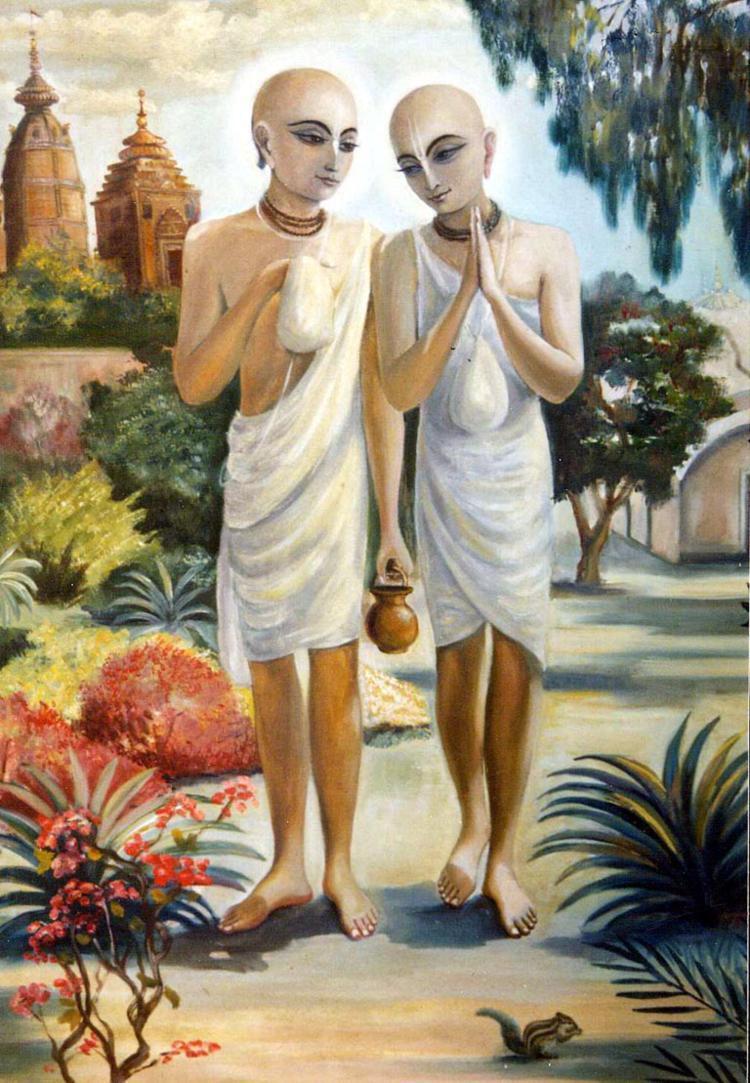
No source documents a family relationship between Chandrasekhara Acharya of Varanasi and either Sanatana Goswami or Rupa Goswami. What the sources do document, in specific and moving detail, is that his house was the setting for one of the turning points of Sanatana Goswami's life.
No Documented Family Tie #
Some retellings of Gaudiya Vaishnava history describe a "Chandrasekhara Acharya" as a maternal relative of the Gosvami brothers, or otherwise connect the name to their family. Careful research finds no such connection for the Varanasi physician specifically. The confusion most likely comes from the other, better-known Chandrasekhara Acharya of Navadvipa. Some traditional sources describe that man as a relative of Sri Chaitanya Mahaprabhu's own mother, Sachi Devi. But that claim is about Mahaprabhu's family, not the family of the Gosvami brothers. It also belongs to a different man entirely (see Life and Profession in Varanasi for that distinction). Whatever family Sanatana Goswami and Rupa Goswami had at this stage of their lives was separate from Chandrasekhara Acharya's household. What joined them was hospitality and shared devotion to Sri Chaitanya Mahaprabhu, not family relation.
A Mendicant at the Door #
This is the connection that is documented. Sanatana Goswami had resigned his position under Nawab Hussain Shah, and the Nawab had put him in prison for that resignation. After escaping, Sanatana Goswami travelled toward Varanasi to find Sri Chaitanya Mahaprabhu, who was staying at the time in Chandrasekhara Acharya's house. He was still disguised as a Muslim beggar, as he had been for his escape. He reached the house and sat down quietly by the door, without announcing himself. Inside, Sri Chaitanya Mahaprabhu understood at once who had arrived. He told Chandrasekhara Acharya to bring the visitor in. According to Srila Prabhupada's retelling in Teachings of Lord Caitanya, He said of him, "He is a Vaishnava, a great devotee of the Lord." Chandrasekhara Acharya went to the door, but at first he saw only a man who looked like a Muslim beggar, and no Vaishnava at all. Sri Chaitanya-charitamrita keeps this small, human detail in Chandrasekhara Acharya's own reported reply to the Lord: "There is a Muslim mendicant." The Lord insisted that the man be brought inside. When Sanatana Goswami entered the courtyard, Sri Chaitanya Mahaprabhu hurried out and embraced him. The two wept in each other's arms, and Chandrasekhara Acharya watched in amazement at what he saw.
At the Lord's instruction, Chandrasekhara Acharya then offered Sanatana Goswami a new set of clothes to replace his beggar's dress. Sanatana Goswami had already decided on a life of renunciation, so he declined them. Sri Chaitanya-charitamrita says that when the Lord heard of this refusal, it filled Him with "unlimited happiness." By Mahaprabhu's own arrangement, Sanatana Goswami was then formally received by both Chandrasekhara Acharya and Tapana Mishra. For a time, the Varanasi households of these two devotees became his shelter too.
Sent Onward to Vrindavana #
Near the end of this same stay in Chandrasekhara Acharya's house, Sri Chaitanya Mahaprabhu gave Sanatana Goswami long instruction in devotional philosophy. This chapter of Chaitanya-charitamrita is named for that instruction. Then the Lord sent him on to Vrindavana. Rupa Goswami's own famous meeting with the Lord, and the instruction he received, took place separately at Prayag. That was on Mahaprabhu's way to Varanasi, not inside the city. This detail is easy to confuse, but it is important to keep it clear. Chandrasekhara Acharya's house was where Sanatana, not Rupa, was reunited with the Lord. What Sanatana Goswami and Rupa Goswami went on to build together at Vrindavana is told in their own stories. Chandrasekhara Acharya's part ends at his own doorway, but Chaitanya-charitamrita takes care to record that part in full.
Scriptural evidence for this chapter (2)
চন্দ্রশেখরের ঘরে আসি' দ্বারেতে বসিলা । মহাপ্রভু জানি' চন্দ্রশেখরে কহিলা ॥ ... তেঁহো কহে, — এক 'দরবেশ' আছে দ্বারে । 'তাঁরে আন' প্রভুর বাক্যে কহিল তাঁহারে ॥
candrasekharera ghare asi' dvarete vasila
mahaprabhu jani' candrasekhare kahila
...
teho kahe, - eka 'daravesa' ache dvare
'tare ana' prabhura vakye kahila tahare
Word for word
candrasekharera ghare - to the house of Candrasekhara; asi' - going; dvarete vasila - sat down at the door; mahaprabhu jani' - Sri Caitanya Mahaprabhu, knowing; candrasekhare kahila - said to Candrasekhara; teho kahe - he replied; eka daravesa ache dvare - there is a Muslim mendicant at the door; tare ana - bring him; prabhura vakye - by the Lord's order; kahila tahare - was told to him.
Sanatana Gosvami then went to the house of Candrasekhara and sat down by the door. Understanding what was happening, Sri Caitanya Mahaprabhu spoke to Candrasekhara ... Candrasekhara replied, "There is a Muslim mendicant."
From the purport: Purport excerpt: "Sri Caitanya Mahaprabhu immediately said, 'Please bring him here.'"
The moment Sanatana Goswami, disguised as a Muslim mendicant after escaping prison, reached Chandrasekhara Acharya's door, and Sri Chaitanya Mahaprabhu recognized him through mystic vision.
চন্দ্রশেখরেরে প্রভু কহে বোলাঞা । 'এই বেষ দূর কর, যাহ ইঁহারে লঞা' ॥ ... সেই বস্ত্র সনাতন না কৈল অঙ্গীকার । শুনিয়া প্রভুর মনে আনন্দ অপার ॥
candrasekharere prabhu kahe bolana
'ei vesa dura kara, yaha inhare lana'
...
sei vastra sanatana na kaila angikara
suniya prabhura mane ananda apara
Word for word
candrasekharere - unto Candrasekhara; prabhu kahe bolana - Sri Caitanya Mahaprabhu said, calling him; ei vesa dura kara - take away this dress; yaha inhare lana - go, taking him with you; sei vastra - that new dress; sanatana na kaila angikara - Sanatana did not accept; suniya - hearing; prabhura mane ananda apara - unlimited happiness in the Lord's mind.
Sri Caitanya Mahaprabhu called Candrasekhara and asked him to take Sanatana Gosvami with him, also asking him to take away Sanatana's mendicant's dress ... Candrasekhara offered a new set of garments to Sanatana Gosvami, but Sanatana did not accept them. When Sri Caitanya Mahaprabhu heard news of this, He became unlimitedly happy.
Chandrasekhara Acharya, acting on Sri Chaitanya Mahaprabhu's instruction, offered Sanatana Goswami new clothes to replace his mendicant's dress - an offer Sanatana, already resolved on renunciation, declined.
Chapter 4
Character and Legacy
How later Vaishnavas remembered the physician who twice had Sri Chaitanya Mahaprabhu under his roof.
After Sri Chaitanya Mahaprabhu's final departure from Varanasi, Chandrasekhara Acharya himself largely disappears from the written record. Later Vaishnava writers filled this silence with reverence for his household. They did not fill it with the kind of life details that have come down to us for some other Kashi devotees.
A Life the Sources Leave Mostly Silent #
One traditional account of Sri Chaitanya Mahaprabhu's departure from Kashi describes Him embracing Tapana Mishra and Chandrasekhara Acharya before setting out on foot for Jagannatha Puri. Some years afterward, Raghunatha Bhatta Goswami arrived in Puri as a young man. Sri Chaitanya Mahaprabhu is said to have asked him about "Tapana Mishra and his wife" and "Chandrasekhara" by name. Apart from these two short, affectionate mentions, no source gives a birth year or place, a disappearance year or place, or an independently confirmed guru or samadhi site for Chandrasekhara Acharya of Varanasi. The Navadvipa Chandrasekhara Acharya has a samadhi still shown at Sridhama Mayapur and a listed identity in the Gaura-ganoddesha-dipika. But the Varanasi physician has neither. This is a real gap in the record, and it should not be filled with invented detail.
Remembered as a Household of Refuge #
What can be said with confidence is narrower, but still meaningful. As Chaitanya-charitamrita preserves it, Chandrasekhara Acharya's legacy rests entirely on two acts of hospitality. First, he gave Sri Chaitanya Mahaprabhu Himself a home in Varanasi for two full months, as described in Hosting Sri Chaitanya Mahaprabhu in Kashi. Second, he opened his door to Sanatana Goswami, disguised and newly escaped, at the exact moment the future Gosvami needed shelter, as described in Relationship to Sanatana and Rupa Goswami. He left no writings, and no tradition credits him with disciples or a teaching lineage. His identity is sometimes confused with that of a man of the same name in Navadvipa. But both his identity and his profession as a physician, noted in Life and Profession in Varanasi, appear to have been settled facts in his own lifetime, not points of dispute.
Comparing him with the Navadvipa Chandrasekhara Acharya helps us understand this too. That householder is remembered for a specific eternal identity in the Gaura-ganoddesha-dipika, for founding one of the recognized "branches" of the Chaitanya tree, and for a samadhi still visited today. Nothing of that kind survives for the Varanasi physician. This is not because his service mattered less to Sri Chaitanya Mahaprabhu. The two months the Lord spent under his roof show that it did not. It is simply because Chaitanya-charitamrita and the other early sources chose to record his acts of hospitality and nothing more.
A Teaching Without Words #
Krishnadasa Kaviraja Goswami wrote Sri Chaitanya-charitamrita decades after these events. He had no shortage of philosophers, poets and renunciants from Sri Chaitanya Mahaprabhu's life to write about. Still, he gave Chandrasekhara Acharya a fixed place in the text. He gives a named devotee, a specific profession, a specific two-month stay, a specific dream and a specific door. This suggests that in his eyes plain hospitality counted as a form of devotional service, worth recording beside the philosophy and the poetry. Chandrasekhara Acharya offered it without hesitation, first to a wandering sannyasi and later to a man escaping in disguise. Later generations of Gaudiya Vaishnavas have kept exactly this memory alive. They remember a physician in a foreign land who twice opened his home without hesitation when Sri Chaitanya Mahaprabhu or His devotee needed it most. It is a modest legacy, honestly reported, and it is no less real for being modest.
- Sri Chaitanya-charitamrita, Adi-lila 10.152-154 (Bhaktivedanta VedaBase)
- Sri Chaitanya-charitamrita, Adi-lila 7.153 (Bhaktivedanta VedaBase)
- Sri Chaitanya-charitamrita, Madhya-lila 17.91 (Bhaktivedanta VedaBase)
- Sri Chaitanya-charitamrita, Madhya-lila 19.244-248 (Bhaktivedanta VedaBase)
- Sri Chaitanya-charitamrita, Madhya-lila 20.46-71 (Bhaktivedanta VedaBase)
- Srila Prabhupada, Teachings of Lord Caitanya, Chapter 2: Sanatana Gosvami (Bhaktivedanta VedaBase)
- Srila Prabhupada, Room Conversation with Srila Sridhara Maharaja, June 27 1973, Nabadwip (Bhaktivedanta VedaBase)
- Raghunatha Bhatta - Stephen Knapp
- Sri Raghunatha Bhatta Goswami - Shyam Das Baba (excerpted from Bhakti Ballabh Tirtha Maharaja, Sri Chaitanya: His Life & Associates)
- Chandrashekhara Acharya (Navadvipa) - Gaudiya History
- Sri Chandrasekhara Acharya (Navadvipa) - Shyam Das Baba
