No source documents a family relationship between Chandrasekhara Acharya of Varanasi and either Sanatana Goswami or Rupa Goswami. What the sources do document, in specific and moving detail, is that his house was the setting for one of the turning points of Sanatana Goswami's life.
No Documented Family Tie #
Some retellings of Gaudiya Vaishnava history describe a "Chandrasekhara Acharya" as a maternal relative of the Gosvami brothers, or otherwise connect the name to their family. Careful research finds no such connection for the Varanasi physician specifically. The confusion most likely comes from the other, better-known Chandrasekhara Acharya of Navadvipa. Some traditional sources describe that man as a relative of Sri Chaitanya Mahaprabhu's own mother, Sachi Devi. But that claim is about Mahaprabhu's family, not the family of the Gosvami brothers. It also belongs to a different man entirely (see Life and Profession in Varanasi for that distinction). Whatever family Sanatana Goswami and Rupa Goswami had at this stage of their lives was separate from Chandrasekhara Acharya's household. What joined them was hospitality and shared devotion to Sri Chaitanya Mahaprabhu, not family relation.
A Mendicant at the Door #
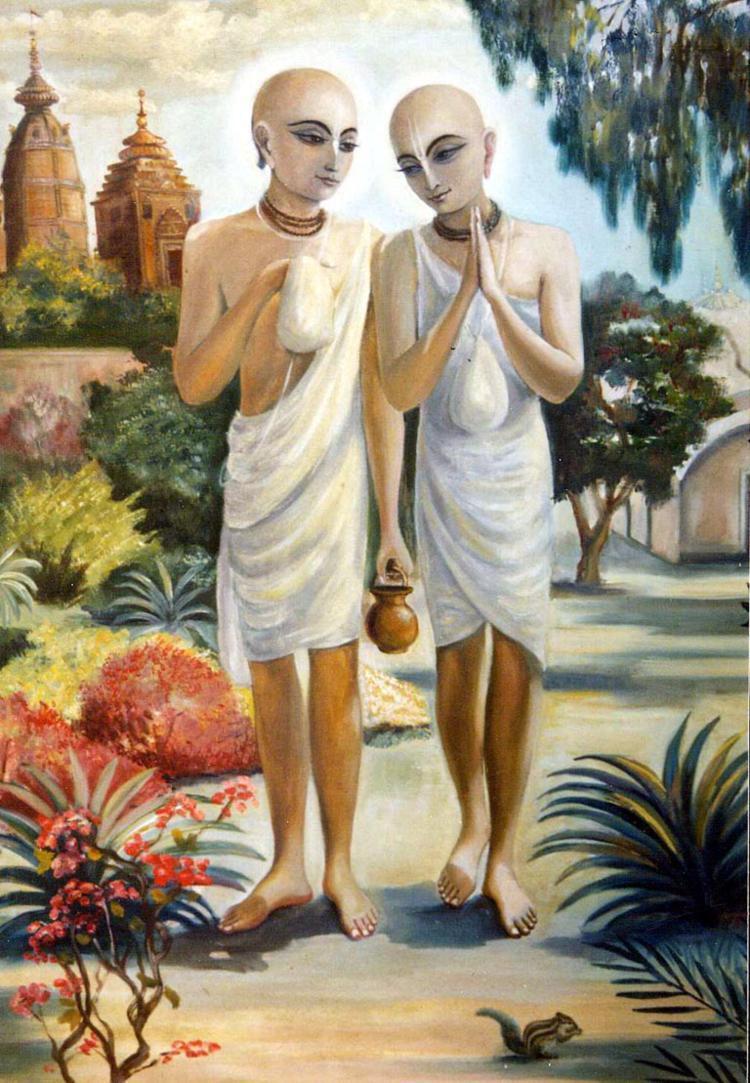
This is the connection that is documented. Sanatana Goswami had resigned his position under Nawab Hussain Shah, and the Nawab had put him in prison for that resignation. After escaping, Sanatana Goswami travelled toward Varanasi to find Sri Chaitanya Mahaprabhu, who was staying at the time in Chandrasekhara Acharya's house. He was still disguised as a Muslim beggar, as he had been for his escape. He reached the house and sat down quietly by the door, without announcing himself. Inside, Sri Chaitanya Mahaprabhu understood at once who had arrived. He told Chandrasekhara Acharya to bring the visitor in. According to Srila Prabhupada's retelling in Teachings of Lord Caitanya, He said of him, "He is a Vaishnava, a great devotee of the Lord." Chandrasekhara Acharya went to the door, but at first he saw only a man who looked like a Muslim beggar, and no Vaishnava at all. Sri Chaitanya-charitamrita keeps this small, human detail in Chandrasekhara Acharya's own reported reply to the Lord: "There is a Muslim mendicant." The Lord insisted that the man be brought inside. When Sanatana Goswami entered the courtyard, Sri Chaitanya Mahaprabhu hurried out and embraced him. The two wept in each other's arms, and Chandrasekhara Acharya watched in amazement at what he saw.
At the Lord's instruction, Chandrasekhara Acharya then offered Sanatana Goswami a new set of clothes to replace his beggar's dress. Sanatana Goswami had already decided on a life of renunciation, so he declined them. Sri Chaitanya-charitamrita says that when the Lord heard of this refusal, it filled Him with "unlimited happiness." By Mahaprabhu's own arrangement, Sanatana Goswami was then formally received by both Chandrasekhara Acharya and Tapana Mishra. For a time, the Varanasi households of these two devotees became his shelter too.
Sent Onward to Vrindavana #
Near the end of this same stay in Chandrasekhara Acharya's house, Sri Chaitanya Mahaprabhu gave Sanatana Goswami long instruction in devotional philosophy. This chapter of Chaitanya-charitamrita is named for that instruction. Then the Lord sent him on to Vrindavana. Rupa Goswami's own famous meeting with the Lord, and the instruction he received, took place separately at Prayag. That was on Mahaprabhu's way to Varanasi, not inside the city. This detail is easy to confuse, but it is important to keep it clear. Chandrasekhara Acharya's house was where Sanatana, not Rupa, was reunited with the Lord. What Sanatana Goswami and Rupa Goswami went on to build together at Vrindavana is told in their own stories. Chandrasekhara Acharya's part ends at his own doorway, but Chaitanya-charitamrita takes care to record that part in full.
