Chaitanya-charitamrita's Antya-lila, Chapter Three, is a chapter that Krishnadasa Kaviraja Goswami titles for the glories of Haridasa Thakura. Early in the chapter, he pauses to finally tell the story he had promised chapters earlier, in his list of Mahaprabhu's associates. It is the incident in which Damodara Pandit chastised Sri Chaitanya Mahaprabhu, and what came of it.
A Boy Who Would Not Stay Away #
At Jagannatha Puri there lived a young brahmana boy whose father had recently died. His mother was a widow known for her austerity and her chastity. The boy was unusually handsome and gentle, and he had formed the habit of visiting Mahaprabhu every day. He would offer obeisances and then settle in for a long, easy conversation. The Lord would ask him about his day, as if He were speaking with His own life and soul. Again and again, Damodara Pandit told the boy to stay away. It made no difference. A child goes where he is loved, and Mahaprabhu was plainly, visibly fond of him. Day after day the boy came back, and day after day Damodara's discomfort grew, until he could no longer stay silent.
What Damodara Said to His Own Lord #
One day, after the boy had paid his respects and left, Damodara finally spoke. What he said was so sharp that Krishnadasa Kaviraja calls it impudent, that is, boldly disrespectful. Yet he also insists that it came from pure love. "Everyone says You are a great teacher because of the instructions You give to others," he told Mahaprabhu. "Now we shall find out what kind of teacher You really are. Your reputation will spread through all of Puri: let us see how it holds up." Mahaprabhu was confused and asked him to explain himself plainly, and Damodara did: "You can act as You please, and no one has the right to stop You. But the world is full of gossips, and their tongues cannot be silenced. You are a learned man. Have You considered why You show such affection to a widow's son? His mother may be austere and chaste, but she has one fault: she is young and beautiful. And You, my Lord, are a young and handsome man Yourself. People will talk. Why give them the opening?" Having said it, Damodara fell silent.
Mahaprabhu did not answer with anger. Chaitanya-charitamrita says He smiled, truly pleased. Within Himself He thought that this very impudence was itself a sign of pure love. He also thought that no one among His associates was as close a friend to Him as Damodara Pandit. He went about His noon duties as though nothing unusual had happened. The next day, in a private moment, He answered Damodara properly.
Sent to Guard His Mother #
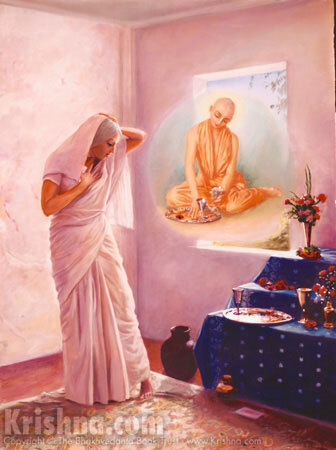
Calling Damodara aside, Mahaprabhu told him plainly: go to Nadia, and stay with My mother. No one else, He said, was fit to protect her, because no one else was careful enough to caution even Him. Among all His associates, Damodara alone was impartial enough for the post. Religious principles, Mahaprabhu added, can only be defended by someone free of bias. He told Damodara to visit Puri from time to time. He asked him to offer His mother, Sachi Devi, millions of obeisances in His name. And He gave Damodara one especially private secret to share with her, as proof that He was truly happy at Nilachala. He still came to her home again and again to eat the food she cooked and offered to Krishna. But she was caught in the pain of separation, so afterward she always mistook it for a dream. He described it in detail. At the Magha-sankranti festival she had cooked vegetables, condensed milk, cakes and sweet rice. As she offered the food in meditation, her eyes filled with tears, and suddenly she felt Him arrive and eat it. She wiped her eyes, found the plate empty, and told herself she must have imagined it. She returned to the kitchen and found every pot still full. Then, after cleaning the altar, she offered the food again. In this way, Mahaprabhu said, He came again and again to eat what she offered, pulled back to Nadia by nothing but her pure love. He added that He continued to live at Puri at all only because of her own order.
With that message and a parcel of Jagannatha's own prasadam for the Vaishnavas of Nadia, Damodara Pandit set out for Navadvipa. He delivered the prasadam and took up residence near mother Sachi. As always, he became the keeper of discipline there too. No devotee dared act carelessly with Damodara Pandit watching, and anyone who slipped in etiquette, however slightly, could expect to be corrected on the spot. Krishnadasa Kaviraja closes the account with his own judgment on the whole episode. He says that simply hearing the story of Damodara Pandit's chastisement of the Lord is enough to drive out ignorance and atheistic thinking in whoever hears it. That is an unusually strong claim to make for a story that begins with a devotee scolding God.
Why the Story Is Told This Way #
Chaitanya-charitamrita had already mentioned this story once, chapters earlier. When it first named Damodara as the tenth branch of the Chaitanya tree, it promised that the full account would come later. This shows that Krishnadasa Kaviraja considered it one of the most important episodes of Damodara's life, not a side story. Nowhere in the text does Damodara express regret for what he said, and nowhere does Mahaprabhu ask him to soften it. The chapter does not end with an apology. Instead, Damodara is promoted into the one role in Mahaprabhu's household where that same plain speaking was needed most. The discipline he kept over the devotees at Puri, and the reason Mahaprabhu once gave for leaving him behind on His pilgrimage through South India, are told on Guardian of the Devotees' Conduct. Read alongside them, the episode seems less like a rebuke that was simply forgiven, and more like one that was, in its own way, exactly what Mahaprabhu's household needed.
