Long before the episode for which Chaitanya-charitamrita best remembers him, Damodara Pandit had already become the one associate whose disapproval Sri Chaitanya Mahaprabhu truly took seriously. Chaitanya-charitamrita's Madhya-lila, which covers the Lord's years of pilgrimage across India, returns to him again and again. He appears there not as someone just standing by, but as a kind of conscience, and the Lord Himself spoke of him in this way openly.
The Reason the Lord Traveled Alone #
When Mahaprabhu prepared to leave Puri for His pilgrimage through South India, Nityananda Prabhu and the other devotees asked to come with Him. The Lord refused, and the reason He gave was surprisingly open. He was a sannyasi, and Damodara was only a brahmachari, junior to Him in formal rank. Yet Damodara still kept a stick in his hand, so to speak, just to educate Him. Mahaprabhu said that in Damodara's view He was still a beginner where social etiquette was concerned, and Damodara did not approve of His independent nature. Mahaprabhu went on to say that devotees like Damodara were so advanced in Krishna's mercy that they no longer cared what the world thought. So they might encourage Him toward things a sannyasi should not do. But He was bound by His own vows. He had no choice but to follow the rules strictly, and to travel without companions who would only become unhappy watching Him keep those rules. It is a remarkable thing for the Lord Himself to say about a devotee. He was saying that Damodara's mere presence held Him to a stricter standard than He might otherwise have kept.
Racing to the Road #
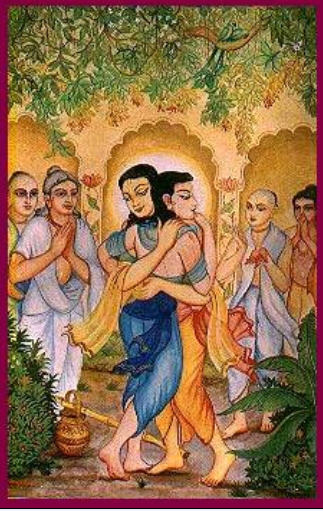
When Mahaprabhu at last turned back toward Puri after His long tour, He sent word ahead from Alalanath through His attendant Krishnadasa. The devotees who had waited through the separation could not hold themselves back. Nityananda Prabhu was first on his feet, too impatient in his own ecstasy to wait for anyone. Jagadananda Pandit, Damodara Pandit and Mukunda Datta went dancing down the road behind him, and Gopinatha Acharya followed in the same joyful mood. When they finally met the Lord on the road, He embraced each of them in turn, filled with the same ecstatic love that had sent them running to meet Him. Damodara is usually shown as the one person in Mahaprabhu's circle too stern to be carried away by feelings. But here he is remembered dancing with everyone else, overcome by the same longing.
Shankara Placed in His Care #
Some time after the Lord's return, Mahaprabhu formally settled where Damodara's own younger brother, Shankara Pandita, would live. Looking at Shankara, He told Damodara that His love for Damodara carried an element of awe and reverence. But His love for Shankara was pure and direct, with nothing held back. For that very reason, He said, Shankara should stay under Damodara's watch, because no one else could keep Shankara from growing careless in the Lord's presence. Damodara answered simply. Shankara was younger than him in years, he said, but by the Lord's own mercy he would treat Shankara as an elder from that day. It is a small exchange, but it shows the same trust running in the other direction. Mahaprabhu relied on Damodara's strictness not only to correct Himself but also to protect the devotees closest to Him.
The King Mahaprabhu Would Not Meet Without Him #
The clearest statement of that trust came with King Prataparudra of Orissa. The king was desperate for even a single audience with Mahaprabhu, and he threatened to give up his throne and become a wandering beggar if he was refused again. The devotees were moved by the king's devotion and pressed the Lord to agree. Mahaprabhu replied by naming the one condition He would not give up. People would criticize Him for meeting a king, He said, and that criticism did not trouble Him. But Damodara would criticize Him too, and that He would not risk. He would meet Prataparudra, Mahaprabhu said, only if Damodara himself gave the permission. Damodara's answer was just as direct. He called Mahaprabhu the fully independent Supreme Personality of Godhead. He said that an insignificant jiva like himself had no authority to instruct Him either way. And he predicted that the Lord's own affection for the king would decide the matter, whatever anyone said. As it turned out, he was correct. It is one of the few places in Chaitanya-charitamrita where Damodara speaks not as a critic but as a theologian, one who explains the truth about the Lord. He describes the very independence of the Lord that he spent his life guarding.
Read together, these four episodes explain why Chaitanya-charitamrita calls Damodara's love pracanda, overpowering. It was strong enough to affect even how the Lord traveled, whom He embraced on the road, where Damodara's own younger brother lived, and whom He would or would not meet. The most direct test of that love, and its most surprising reward, is told separately on The Chastisement That Pleased the Lord.
