Sri Damodara Pandit
The Devotee Whose Rebuke Mahaprabhu Called Pure Love
The complete life, on one page: The main biography and every pastime page, in order, in one place
Introduction
Damodara Pandit was one of the strictest and most trusted of Sri Chaitanya Mahaprabhu's personal associates at Jagannatha Puri. He was so strict about the Lord's own conduct that he once openly scolded Mahaprabhu to His face. Mahaprabhu was not displeased. Instead, as a direct reward for that scolding, He trusted Damodara with His household and sent him to look after His mother in Navadvipa. Sri Chaitanya-charitamrita names him the tenth of the many "branches" that grew from the tree of Mahaprabhu's own life. The single verse given to him is unlike anything said of the others. It says plainly that his prema for the Lord ran so pracanda, so intense, that it came out as vakya-danda, chastisement in words, aimed at God Himself.
| Detail | Description |
|---|---|
| Era | Contemporary of Chaitanya Mahaprabhu, early sixteenth century |
| Documented as | Tenth branch of the Chaitanya tree (Chaitanya-charitamrita, Adi-lila 10.31-32) |
| Younger brother | Shankara Pandita, called the Lord's own "foot-pillow" |
| Best-known episode | Rebuked Sri Chaitanya Mahaprabhu over His affection for a widowed brahmani's son; sent, in reward, to Navadvipa |
| Role among the devotees | Enforced etiquette and discipline in the Lord's circle, at Puri and later in Navadvipa |
| Identity | Shaivya, a hot-tempered gopi of Vraja; the goddess Sarasvati also entered him (Gaura-ganoddesha-dipika 159; Chaitanya-charitamrita Adi 10.32 purport) |
| Birth and disappearance | Not recorded |
Scriptural evidence for the introduction (5)
dāmodara-paṇḍita śākhā premete pracaṇḍa
prabhura upare yeṅho kaila vākya-daṇḍa
Word for word
dāmodara-paṇḍita: Dāmodara Paṇḍita; śākhā: another branch (the tenth branch); premete: in affection; pracaṇḍa: very advanced; prabhura: the Lord; upare: upon; yeṅho: he who; kaila: did; vākya-daṇḍa: chastisement by speaking.
Dāmodara Paṇḍita, the tenth branch of the Caitanya tree, was so elevated in love of Lord Caitanya that he once unhesitatingly chastised the Lord with strong words.
The verse that first introduces Damodara Pandit among the branches of the Chaitanya tree and names his defining trait: love intense enough to become open chastisement of the Lord.
daṇḍa-kathā kahiba āge vistāra kariyā
daṇḍe tuṣṭa prabhu tāṅre pāṭhāilā nadīyā
Word for word
daṇḍa-kathā: the narration of such chastisement; kahiba: I shall speak; āge: ahead; vistāra kariyā: making a detailed description; daṇḍe tuṣṭa prabhu: the Lord is very much satisfied by the chastisement; tāṅre: him; pāṭhāilā: sent back; nadīyā: Nadia (a district in Bengal).
Later in the Caitanya-caritamrita I shall describe this incident of chastisement in detail. The Lord, being very much satisfied by this chastisement, sent Damodara Pandita to Navadvipa.
From the purport: Purport excerpt: "Damodara Pandita, who was formerly known as Saibya in Vraja-dhama, used to carry messages from Lord Caitanya to Sacimata, and during the Ratha-yatra festival he carried messages from Sacimata to Lord Caitanya Mahaprabhu."
Krishnadasa Kaviraja's own promise, kept later in Antya-lila 3, that the chastisement story would be told in full; the purport independently confirms Damodara's identity as Saibya (Shaivya) of Vraja-lila and his ongoing role carrying messages between Mahaprabhu and Sachi Mata.
In the third chapter is a description of the forceful glories of Haridasa Thakura. That chapter also mentions how Damodara Pandita spoke words of criticism to Sri Caitanya Mahaprabhu.
Krishnadasa Kaviraja's own chapter-by-chapter summary of Antya-lila, confirming that the Damodara Pandit chastisement story belongs to Antya-lila Chapter Three alongside the glorification of Haridasa Thakura.
āmi kon kṣudra-jīva, tomāke vidhi diba?
āpani milibe tāṅre, tāhāo dekhiba
Word for word
āmi: I; kon: some; kṣudra-jīva: insignificant living entity; tomāke: unto You; vidhi diba: shall give direction; āpani: personally; milibe: You will meet; tāṅre: him; tāhāo: that also; dekhiba: I shall see.
"I am merely an insignificant jiva, so what power do I have to give directions to You? By Your own personal choice You will meet with the King. I shall see it."
The continuation of Damodara Pandita's reply on the King Prataparudra question, completing the exact quotation used as the pull-quote here (Chaitanya-charitamrita, Madhya-lila 12.26-27).
शैब्या यासीद्व्रजे चण्डी स दामोदरपण्डितः ।
कुतश्चित्कार्यतो देवी प्राविशत्तं सरस्वती ॥१५९॥
śaibyā yāsīd vraje caṇḍī sa dāmodara-paṇḍitaḥ |
kutaścit kāryato devī prāviśat taṁ sarasvatī ||159||
Hot-tempered Saibya-gopi who previously appeared in Vraja, appeared as Damodara Pandita during Lord Caitanya's pastimes. The goddess Sarasvati also entered the body of Damodara Pandita, who is thus the combined incarnation of them both.
Kavi Karnapura's verse identifying Damodara Pandit as the hot-tempered gopi Shaivya, with the goddess Sarasvati also entering him; Srila Prabhupada's purport naming him Shaivya is shown under Chaitanya-charitamrita Adi 10.32. Sanskrit: diacritic edition of the Gaura-ganoddesha-dipika; English translation as published at bvmlu.org.
Chapter 1
Guardian of the Devotees' Conduct
Four episodes from Madhya-lila in which Sri Chaitanya Mahaprabhu Himself named Damodara Pandit as the one associate whose disapproval He would not risk.
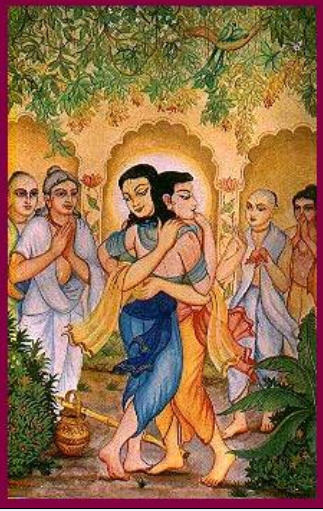
Long before the episode for which Chaitanya-charitamrita best remembers him, Damodara Pandit had already become the one associate whose disapproval Sri Chaitanya Mahaprabhu truly took seriously. Chaitanya-charitamrita's Madhya-lila, which covers the Lord's years of pilgrimage across India, returns to him again and again. He appears there not as someone just standing by, but as a kind of conscience, and the Lord Himself spoke of him in this way openly.
The Reason the Lord Traveled Alone #
When Mahaprabhu prepared to leave Puri for His pilgrimage through South India, Nityananda Prabhu and the other devotees asked to come with Him. The Lord refused, and the reason He gave was surprisingly open. He was a sannyasi, and Damodara was only a brahmachari, junior to Him in formal rank. Yet Damodara still kept a stick in his hand, so to speak, just to educate Him. Mahaprabhu said that in Damodara's view He was still a beginner where social etiquette was concerned, and Damodara did not approve of His independent nature. Mahaprabhu went on to say that devotees like Damodara were so advanced in Krishna's mercy that they no longer cared what the world thought. So they might encourage Him toward things a sannyasi should not do. But He was bound by His own vows. He had no choice but to follow the rules strictly, and to travel without companions who would only become unhappy watching Him keep those rules. It is a remarkable thing for the Lord Himself to say about a devotee. He was saying that Damodara's mere presence held Him to a stricter standard than He might otherwise have kept.
Racing to the Road #
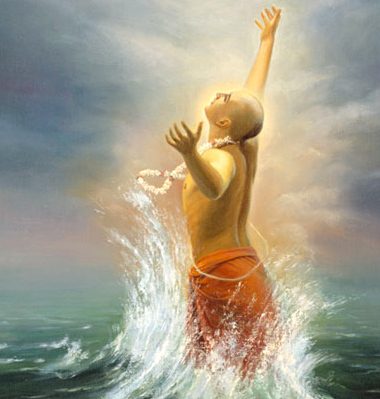
When Mahaprabhu at last turned back toward Puri after His long tour, He sent word ahead from Alalanath through His attendant Krishnadasa. The devotees who had waited through the separation could not hold themselves back. Nityananda Prabhu was first on his feet, too impatient in his own ecstasy to wait for anyone. Jagadananda Pandit, Damodara Pandit and Mukunda Datta went dancing down the road behind him, and Gopinatha Acharya followed in the same joyful mood. When they finally met the Lord on the road, He embraced each of them in turn, filled with the same ecstatic love that had sent them running to meet Him. Damodara is usually shown as the one person in Mahaprabhu's circle too stern to be carried away by feelings. But here he is remembered dancing with everyone else, overcome by the same longing.
Shankara Placed in His Care #
Some time after the Lord's return, Mahaprabhu formally settled where Damodara's own younger brother, Shankara Pandita, would live. Looking at Shankara, He told Damodara that His love for Damodara carried an element of awe and reverence. But His love for Shankara was pure and direct, with nothing held back. For that very reason, He said, Shankara should stay under Damodara's watch, because no one else could keep Shankara from growing careless in the Lord's presence. Damodara answered simply. Shankara was younger than him in years, he said, but by the Lord's own mercy he would treat Shankara as an elder from that day. It is a small exchange, but it shows the same trust running in the other direction. Mahaprabhu relied on Damodara's strictness not only to correct Himself but also to protect the devotees closest to Him.
The King Mahaprabhu Would Not Meet Without Him #
The clearest statement of that trust came with King Prataparudra of Orissa. The king was desperate for even a single audience with Mahaprabhu, and he threatened to give up his throne and become a wandering beggar if he was refused again. The devotees were moved by the king's devotion and pressed the Lord to agree. Mahaprabhu replied by naming the one condition He would not give up. People would criticize Him for meeting a king, He said, and that criticism did not trouble Him. But Damodara would criticize Him too, and that He would not risk. He would meet Prataparudra, Mahaprabhu said, only if Damodara himself gave the permission. Damodara's answer was just as direct. He called Mahaprabhu the fully independent Supreme Personality of Godhead. He said that an insignificant jiva like himself had no authority to instruct Him either way. And he predicted that the Lord's own affection for the king would decide the matter, whatever anyone said. As it turned out, he was correct. It is one of the few places in Chaitanya-charitamrita where Damodara speaks not as a critic but as a theologian, one who explains the truth about the Lord. He describes the very independence of the Lord that he spent his life guarding.
Read together, these four episodes explain why Chaitanya-charitamrita calls Damodara's love pracanda, overpowering. It was strong enough to affect even how the Lord traveled, whom He embraced on the road, where Damodara's own younger brother lived, and whom He would or would not meet. The most direct test of that love, and its most surprising reward, is told separately on The Chastisement That Pleased the Lord.
Scriptural evidence for this chapter (4)
"Although I am in the renounced order of life and Damodara is a brahmacari, he still keeps a stick in his hand just to educate Me. According to Damodara, I am still a neophyte as far as social etiquette is concerned; therefore he does not like My independent nature. Damodara Pandita and others are more advanced in receiving the mercy of Lord Krishna; therefore they are independent of public opinion."
Mahaprabhu's own reason, given to His devotees, for touring South India without companions; He names Damodara's disapproval as a real constraint on His behavior.
Sri Nityananda Raya, Jagadananda, Damodara Pandita and Mukunda all became ecstatic in their happiness, and dancing along the way, they went to meet the Lord.
Damodara Pandit rushing with the other devotees to greet Mahaprabhu on His return from the South India pilgrimage.
After seeing Sankara, Lord Sri Caitanya Mahaprabhu told Damodara, "My affection for you is on the platform of awe and reverence. Therefore keep your younger brother Sankara with you because he is connected to Me by pure unalloyed love." Damodara Pandita replied, "Sankara is my younger brother, but from today he becomes my elder brother because of Your special mercy upon him."
Mahaprabhu formally entrusts Damodara's younger brother, Shankara Pandita, to his care, explaining the two different kinds of love He feels for each brother.
dāmodara kahe, — tumi svatantra īśvara
kartavyākartavya saba tomāra gocara
Word for word
dāmodara kahe: Pandita Damodara said; tumi: You; svatantra: fully independent; īśvara: the Supreme Personality of Godhead; kartavya: duty which is permissible; akartavya: duty which is not permissible; saba: all; tomāra: of You; gocara: within knowledge.
Sri Caitanya Mahaprabhu continued, "What to speak of spiritual advancement — all the people will blaspheme Me. And what to speak of all the people — Damodara would chastise Me. I shall not meet the King at the request of all the devotees, but I shall do so if Damodara will give his permission." Damodara immediately replied, "My Lord, You are the fully independent Supreme Personality of Godhead. Since everything is known to You, You know what is permissible and what is not permissible."
Mahaprabhu names Damodara as the one authority whose disapproval He will not overrule, on the question of meeting King Prataparudra; Damodara's own reply is the pull-quote here.
Chapter 2
The Chastisement That Pleased the Lord
Damodara Pandit's rebuke of Sri Chaitanya Mahaprabhu over a widow's son, and the mission of trust it earned him in Navadvipa.
Chaitanya-charitamrita's Antya-lila, Chapter Three, is a chapter that Krishnadasa Kaviraja Goswami titles for the glories of Haridasa Thakura. Early in the chapter, he pauses to finally tell the story he had promised chapters earlier, in his list of Mahaprabhu's associates. It is the incident in which Damodara Pandit chastised Sri Chaitanya Mahaprabhu, and what came of it.
A Boy Who Would Not Stay Away #
At Jagannatha Puri there lived a young brahmana boy whose father had recently died. His mother was a widow known for her austerity and her chastity. The boy was unusually handsome and gentle, and he had formed the habit of visiting Mahaprabhu every day. He would offer obeisances and then settle in for a long, easy conversation. The Lord would ask him about his day, as if He were speaking with His own life and soul. Again and again, Damodara Pandit told the boy to stay away. It made no difference. A child goes where he is loved, and Mahaprabhu was plainly, visibly fond of him. Day after day the boy came back, and day after day Damodara's discomfort grew, until he could no longer stay silent.
What Damodara Said to His Own Lord #
One day, after the boy had paid his respects and left, Damodara finally spoke. What he said was so sharp that Krishnadasa Kaviraja calls it impudent, that is, boldly disrespectful. Yet he also insists that it came from pure love. "Everyone says You are a great teacher because of the instructions You give to others," he told Mahaprabhu. "Now we shall find out what kind of teacher You really are. Your reputation will spread through all of Puri: let us see how it holds up." Mahaprabhu was confused and asked him to explain himself plainly, and Damodara did: "You can act as You please, and no one has the right to stop You. But the world is full of gossips, and their tongues cannot be silenced. You are a learned man. Have You considered why You show such affection to a widow's son? His mother may be austere and chaste, but she has one fault: she is young and beautiful. And You, my Lord, are a young and handsome man Yourself. People will talk. Why give them the opening?" Having said it, Damodara fell silent.
Mahaprabhu did not answer with anger. Chaitanya-charitamrita says He smiled, truly pleased. Within Himself He thought that this very impudence was itself a sign of pure love. He also thought that no one among His associates was as close a friend to Him as Damodara Pandit. He went about His noon duties as though nothing unusual had happened. The next day, in a private moment, He answered Damodara properly.
Sent to Guard His Mother #
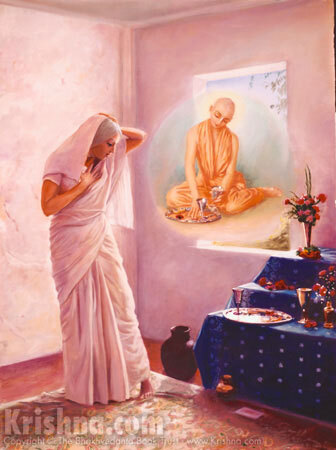
Calling Damodara aside, Mahaprabhu told him plainly: go to Nadia, and stay with My mother. No one else, He said, was fit to protect her, because no one else was careful enough to caution even Him. Among all His associates, Damodara alone was impartial enough for the post. Religious principles, Mahaprabhu added, can only be defended by someone free of bias. He told Damodara to visit Puri from time to time. He asked him to offer His mother, Sachi Devi, millions of obeisances in His name. And He gave Damodara one especially private secret to share with her, as proof that He was truly happy at Nilachala. He still came to her home again and again to eat the food she cooked and offered to Krishna. But she was caught in the pain of separation, so afterward she always mistook it for a dream. He described it in detail. At the Magha-sankranti festival she had cooked vegetables, condensed milk, cakes and sweet rice. As she offered the food in meditation, her eyes filled with tears, and suddenly she felt Him arrive and eat it. She wiped her eyes, found the plate empty, and told herself she must have imagined it. She returned to the kitchen and found every pot still full. Then, after cleaning the altar, she offered the food again. In this way, Mahaprabhu said, He came again and again to eat what she offered, pulled back to Nadia by nothing but her pure love. He added that He continued to live at Puri at all only because of her own order.
With that message and a parcel of Jagannatha's own prasadam for the Vaishnavas of Nadia, Damodara Pandit set out for Navadvipa. He delivered the prasadam and took up residence near mother Sachi. As always, he became the keeper of discipline there too. No devotee dared act carelessly with Damodara Pandit watching, and anyone who slipped in etiquette, however slightly, could expect to be corrected on the spot. Krishnadasa Kaviraja closes the account with his own judgment on the whole episode. He says that simply hearing the story of Damodara Pandit's chastisement of the Lord is enough to drive out ignorance and atheistic thinking in whoever hears it. That is an unusually strong claim to make for a story that begins with a devotee scolding God.
Why the Story Is Told This Way #
Chaitanya-charitamrita had already mentioned this story once, chapters earlier. When it first named Damodara as the tenth branch of the Chaitanya tree, it promised that the full account would come later. This shows that Krishnadasa Kaviraja considered it one of the most important episodes of Damodara's life, not a side story. Nowhere in the text does Damodara express regret for what he said, and nowhere does Mahaprabhu ask him to soften it. The chapter does not end with an apology. Instead, Damodara is promoted into the one role in Mahaprabhu's household where that same plain speaking was needed most. The discipline he kept over the devotees at Puri, and the reason Mahaprabhu once gave for leaving him behind on His pilgrimage through South India, are told on Guardian of the Devotees' Conduct. Read alongside them, the episode seems less like a rebuke that was simply forgiven, and more like one that was, in its own way, exactly what Mahaprabhu's household needed.
Scriptural evidence for this chapter (5)
anya-upadeśe paṇḍita — kahe gosāñira ṭhāñi
'gosāñi' 'gosāñi' ebe jānimu 'gosāñi'
Word for word
anya-upadeśe: by instructing others; paṇḍita: learned teacher; kahe: says; gosāñira ṭhāñi: in front of Sri Caitanya Mahaprabhu; gosāñi gosāñi: Lord Sri Caitanya Mahaprabhu, the supreme teacher; ebe: now; jānimu: we shall know; gosāñi: what kind of teacher.
Damodara Pandita impudently said to the Lord, "Everyone says that You are a great teacher because of Your instructions to others, but now we shall find out what kind of teacher You are.
From the purport: Purport excerpt: "Damodara Pandita was a great devotee of Sri Caitanya Mahaprabhu. Sometimes, however, a person in such a position becomes..."
The opening line of Damodara Pandit's rebuke, which Krishnadasa Kaviraja himself calls impudent even as he frames it as an act of intimate love.
"Dear Lord, You are a learned teacher. Why then don't You consider that this boy is the son of a widowed brahmani? Why are You so affectionate to him? Although the boy's mother is completely austere and chaste, she has one natural fault — she is a very beautiful young girl. And You, my dear Lord, are a handsome, attractive young man. Therefore certainly people will whisper about You. Why should You give them such an opportunity?"
The specific content of Damodara Pandit's criticism: not a rumor about a letter, but a direct, spoken warning about how Mahaprabhu's public affection for a widow's young son could be misread.
ইহারে কহিয়ে শুদ্ধপ্রেমের তরঙ্গ ।
দামোদর-সম মোর নাহি 'অন্তরঙ্গ' ॥
ihāre kahiye śuddha-premera taraṅga
dāmodara-sama mora nāhi 'antaraṅga'
Word for word
ihāre: such behavior; kahiye: I can say; śuddha-premera taraṅga: waves of pure devotional service; dāmodara-sama: like Damodara; mora: My; nāhi: there is not; antaraṅga: intimate friend.
"This impudence is also a sign of pure love for Me. I have no other intimate friend like Damodara Pandita."
Sri Chaitanya Mahaprabhu's own private reaction to being rebuked; the verse that reframes the whole episode as an expression of pure love rather than an offense.
prabhu kahe, — "dāmodara, calaha nadīyā
mātāra samīpe tumi raha tāṅhā yāñā"
Word for word
prabhu kahe: Sri Caitanya Mahaprabhu said; dāmodara: My dear friend Damodara; calaha nadīyā: you had better go to Nadia (Navadvipa); mātāra samīpe: with My mother; tumi: you; raha: stay; tāṅhā: there; yāñā: going.
The Lord said, "My dear friend Damodara, you had better go to Nadia and stay with My mother. I see no one but you to protect her, for you are so careful that you can caution even Me."
Mahaprabhu's response to the rebuke: not correction but a mission of trust, sending Damodara to guard His mother's household in Navadvipa.
Everyone knew that Damodara Pandita was strict in practical dealings. Therefore everyone was afraid of him and dared not do anything independent. Damodara Pandita would verbally chastise every devotee of Sri Caitanya Mahaprabhu whom he found deviating even slightly from proper behavior. Thus he established the standard etiquette. In this way I have described Damodara Pandita's verbal chastisements. As one hears about this, atheistic principles and ignorance depart.
Krishnadasa Kaviraja's closing verdict on Damodara's later role in Navadvipa, and his own claim for the spiritual value of the story just told.
Closing
A Branch Known for Its Sternness #
In the tenth chapter of Chaitanya-charitamrita's Adi-lila, Krishnadasa Kaviraja Goswami names, one verse at a time, the devotees who gathered around Sri Chaitanya Mahaprabhu in Nadia and Puri. He describes them as a tree with a trunk, branches and sub-branches. In this way even the most modest of the Lord's followers has some line of scripture to his name. Damodara Pandit is the tenth branch. His verse promises that the "incident of chastisement" behind his reputation will be told later, in full. Krishnadasa Kaviraja keeps that promise many chapters afterward, in Antya-lila.
His younger brother was Shankara Pandita. Mahaprabhu loved Shankara freely, without the reserve He showed toward Damodara. Shankara stayed in the Lord's own room at night, sometimes with Mahaprabhu's feet resting against his body. He became known, half in affection, as prabhu-padopadhana, "the Lord's foot-pillow." When Mahaprabhu formally placed Shankara under his older brother's care, He Himself explained the difference. His love for Damodara was mixed with awe and reverence. His love for Shankara was pure and open, without holding back. Shankara needed someone to guard him, and that is why he belonged with Damodara. Damodara accepted this duty, and from that day treated his own younger brother with the respect due to an elder brother. Gaura-ganoddesha-dipika is the traditional key that identifies Mahaprabhu's associates with figures from Krishna's Vraja pastimes. It names Damodara Pandit as the gopi Shaivya, who is known there for the same sharp temper. It also notes that the goddess Sarasvati would sometimes enter him for special purposes.
This is the verse of Srila Kavi Karnapura's Gaura-ganoddesha-dipika (159):
śaibyā yāsīd vraje caṇḍī sa dāmodara-paṇḍitaḥ
kutaścit kāryato devī prāviśat taṁ sarasvatī
"Hot-tempered Saibya-gopi who previously appeared in Vraja, appeared as Damodara Pandita during Lord Caitanya's pastimes. The goddess Sarasvati also entered the body of Damodara Pandita, who is thus the combined incarnation of them both." (Gaura-ganoddesha-dipika 159)
Srila Prabhupada also remembers him by his Vraja name in his purport to Chaitanya-charitamrita Adi 10.32: "Dāmodara Paṇḍita, who was formerly known as Śaibyā in Vraja-dhāma, used to carry messages from Lord Caitanya to Śacīmātā..."
Later Years and Remembrance #
Damodara Pandit is not to be confused with Svarupa Damodara Goswami, Mahaprabhu's personal secretary at Puri. Svarupa Damodara Goswami was a completely separate person who shares only the name Damodara. Chaitanya-charitamrita is careful to keep the two apart, and they should never be mixed up. Damodara Pandit continued in his post in Navadvipa for years afterward, watching over Sachi Mata's household and the standard of conduct among the devotees there. Narahari Chakravarti's Bhakti-ratnakara records that Narottama Dasa Thakura, on arriving in Navadvipa many years later, sought him out and paid obeisances at his feet. He did this simply because Damodara had been a direct associate of the Lord. This shows how far Damodara's reputation had traveled by then. No available source gives a year of birth or disappearance for him, or any family details beyond his brother Shankara. What survives instead is one of the most specific and most quoted stories in the whole of Chaitanya-charitamrita. As Krishnadasa Kaviraja puts it, the story is proof that even a chastisement can be a form of pure love.
- Sri Chaitanya-charitamrita, Adi-lila, Chapter 10 (verses 31-32)
- Sri Chaitanya-charitamrita, Antya-lila, Chapter 3 ("The Glories of Srila Haridasa Thakura")
- Sri Chaitanya-charitamrita, Antya-lila, Chapter 20 (summary verses)
- Sri Chaitanya-charitamrita, Madhya-lila, Chapter 7
- Sri Chaitanya-charitamrita, Madhya-lila, Chapter 9
- Sri Chaitanya-charitamrita, Madhya-lila, Chapter 11
- Sri Chaitanya-charitamrita, Madhya-lila, Chapter 12
- Damodar Pandit (Gaudiya History biography)
