Sri Devananda Pandit
Bhagavatam reciter of Kuliya, forgiven at the place where offenses are forgiven
The complete life, on one page: The main biography and every pastime page, in order, in one place
Introduction
Sri Devananda Pandit made his living reciting Srimad-Bhagavatam to crowded classes in Kuliya, on the western bank of the Ganges at Navadvipa. But he never taught that devotion to Krishna was the book's real point. That habit cost him dearly. When Srivasa Thakura wept through one of his recitations, Devananda's own students threw the weeping devotee out of the room, and Devananda said nothing to stop them. This offense put him, for a time, completely out of favor with Sri Chaitanya Mahaprabhu. In the end, what changed him was not a scripture lesson but a person. It was Vakresvara Pandit, a guest in his own house, with his ecstatic dancing and open-hearted devotion.
| Detail | Description |
|---|---|
| Home and school | Kuliya, Navadvipa, near the house of Sarvabhauma Bhattacharya's father, Maheshvara Visharada |
| Occupation | Professional reciter and teacher of Srimad-Bhagavatam, trained in Nyaya |
| Central offense | Silently allowed his students to drive Srivasa Thakura from a Bhagavatam class |
| Turning point | Service to Vakresvara Pandit, an intimate associate of Mahaprabhu |
| Identity | Bhaguri Muni, the chief pandita in Nanda Maharaja's court in Vraja (Gaura-ganoddesha-dipika 106; Chaitanya-charitamrita Adi 10.77 purport) |
| Disappearance | Krishna Ekadashi of Pausha (year not recorded) |
Scriptural evidence for the introduction (2)
bhāgavatī devānanda vakreśvara-kṛpāte
bhāgavatera bhakti-artha pāila prabhu haite
Word for word
bhāgavatī devānanda: Devānanda, who used to recite Śrīmad-Bhāgavatam; vakreśvara-kṛpāte: by the mercy of Vakreśvara; bhāgavatera: of Śrīmad-Bhāgavatam; bhakti-artha: the bhakti interpretation; pāila: got; prabhu haite: from the Lord.
Devananda Pandita was a professional reciter of Srimad-Bhagavatam, but by the mercy of Vakresvara Pandita and the grace of the Lord he understood the devotional interpretation of the Bhagavatam.
From the purport: Purport excerpt: "Devananda Pandita was a professional reciter of Srimad-Bhagavatam, but Lord Caitanya Mahaprabhu did not like his interpretation of it. Formerly, when Devananda was expounding the Mayavadi interpretation, Srivasa Thakura was once present in his meeting, and when he began to cry, Devananda's students drove him away."
The defining verse naming Devananda Pandit in the 'branches of the Caitanya tree' chapter; Srila Prabhupada's purport here summarizes the entire Srivasa Thakura incident and the Vakresvara Pandit reconciliation, citing Sri Chaitanya-bhagavata, Madhya-khanda, chapter 21, as its source.
पुराणानामर्थवेत्ता श्रीदेवानन्द पण्डितः ।
पुरासीन्नन्दपरिषत्पण्डितो भागुरिर्मुनिः ॥१०६॥
purāṇānām artha-vettā śrī-devānanda paṇḍitaḥ |
purāsīn nanda-pariṣat-paṇḍito bhāgurir muniḥ ||106||
Lord Caitanya's associate Sri Devananda Pandita, who was very learned in the Puranas, had previously been Bhaguri Muni, the chief pandita in the court of Maharaja Nanda.
From the purport: In the Gaura-gaṇoddeśa-dīpikā (106) it is described that he was formerly Bhāguri Muni, the sabhā-paṇḍita who recited Vedic literatures in the house of Nanda Mahārāja.
Kavi Karnapura's verse identifying Devananda Pandit as Bhaguri Muni, the chief pandita of Nanda Maharaja's court. The diacritic edition, the bvmlu translation and Srila Prabhupada's purport to Chaitanya-charitamrita Adi 10.77 all give the name as Bhaguri. Sanskrit: diacritic edition of the Gaura-ganoddesha-dipika; English translation as published at bvmlu.org.
Chapter 1
The Weeping of Srivasa Thakura
A visiting devotee's tears, a class of students who mistook them for madness, and a teacher who let it happen
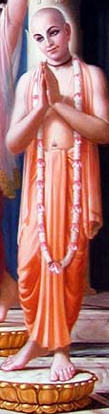
Before anyone in Navadvipa spoke of Devananda Pandit as a man Mahaprabhu had to forgive, they knew him simply as the best teacher of Srimad-Bhagavatam in Kuliya. He was a brahmana whose classes on the western bank of the Ganges drew students by the dozen. One afternoon Srivasa Thakura happened to attend one of those classes. What happened there became one of the most often quoted warning stories in the entire Gaudiya Vaishnava tradition.
A Full Room and a Familiar Lecture #
By this point in his career, Devananda taught the Bhagavatam in a fixed way: first the verse, then the explanation. According to every source that describes his classes, he consistently gave no real explanation of bhakti as the book's actual purpose. Sri Chaitanya-charitamrita calls him a professional reciter of the Bhagavatam. This is not an unkind description. It is simply accurate. He knew the text inside and out, but he taught it as a scholar teaches a text, not as a devotee shares what he loves. Students who wanted a careful, learned class on the Bhagavatam's Sanskrit and its Nyaya-trained logic came to exactly the right teacher. Students looking for anything more devotional went elsewhere, or simply never thought to ask.
An Uninvited Guest's Tears #
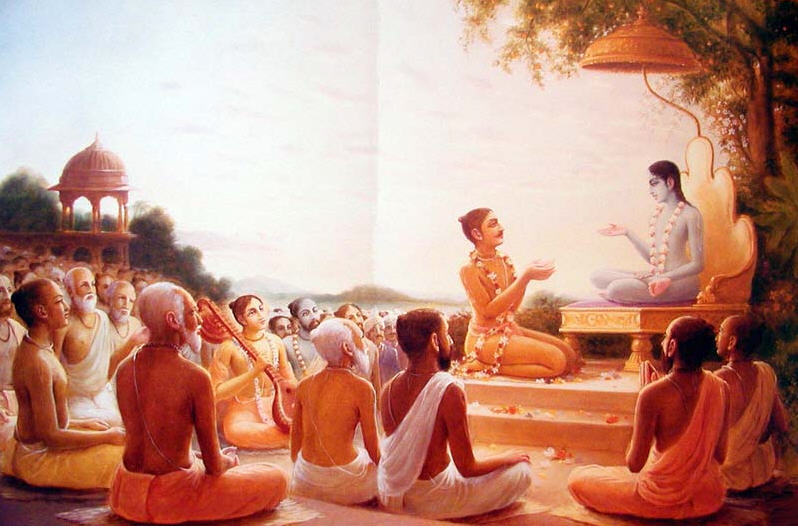
Srivasa Thakura was not one of Devananda's regular students. On this particular day he came simply to hear a Bhagavatam class. But he brought to it a nature that nobody else in the room had. Navadvipa's devotees already knew him as a rasika bhakta, someone whose heart responded to Krishna-katha the way dry wood responds to fire. Devananda's recitation moved through the Bhagavatam's own verses. Whatever the commentary around them left out, these were verses about Krishna, and as he heard them, something in Srivasa broke open. He began to weep. Then he fell to the ground. His voice was catching, and his body was no longer fully under his own control. He was absorbed in an ecstasy that had nothing to do with following the lecture's argument.
Carried Out of the Room #
To the students seated around him, none of this looked like devotion. It looked like a disturbance. Sri Chaitanya-charitamrita's purport records their reaction plainly: they judged Srivasa disruptive and simply picked him up and removed him from the assembly, so the rest of the class could continue undisturbed. Devananda watched all of this happen in his own classroom, in front of his own students, and said nothing to stop it. Srivasa, for his part, made no protest either: he simply went home, kept the incident to himself, and told no one what had happened.
The Offense Behind the Silence #
The tradition places the blame for this moment almost entirely on Devananda, not on the students who actually carried Srivasa out. A teacher who allows his own disciples to insult a devotee of the Lord shares directly in whatever sin they commit. Sri Chaitanya-bhagavata's commentary calls offenses of this kind, committed at the feet of a Vaishnava, hati-mata, the mad-elephant offense. It is a single careless act that can trample a whole garden of devotional merit built up over time. Devananda had spent years building his name as Kuliya's greatest scholar of the Bhagavatam. Yet he had just watched the central teaching of that very book trampled in his own class, and he did not lift a hand.
The incident was not forgotten after that afternoon. Years later came the maha-prakasha-lila, the extraordinary twenty-one-hour display of divine ecstasy at Srivasa Thakura's own house, when Mahaprabhu revealed His full identity to the assembled devotees. At that time, the Lord is remembered as having turned to Srivasa and asked whether he still recalled being carried out of Devananda's class, silently, without complaint. It is a striking detail. Srivasa had suffered this old, private humiliation without saying a word to anyone. Yet the Lord Himself remembered it and spoke of it openly, in front of the very devotees who had gathered to witness His most public revelation of who He was. The page the mercy of Vakresvara Pandit tells what finally became of Devananda after this: a direct scolding from Mahaprabhu, years of quiet regret, and a reconciliation that neither man could have expected.
Scriptural evidence for this chapter (1)
yadi vaiṣṇava-aparādha uṭhe hātī mātā
upāḍe vā chiṇḍe, tāra śukhi' yāya pātā
Word for word
yadi: if; vaiṣṇava-aparādha: an offense at the feet of a Vaishnava; uṭhe: arises; hātī mātā: a mad elephant; upāḍe: uproots; vā: or; chiṇḍe: breaks; tāra: of the creeper; śukhi' yāya: shrivels up; pātā: the leaf.
If the devotee commits an offense at the feet of a Vaishnava while cultivating the creeper of devotional service, his offense is compared to a mad elephant that uproots the creeper and breaks it. In this way the leaves of the creeper are dried up.
Sri Chaitanya-charitamrita's own teaching on vaishnava-aparadha, cited here because Devananda's silence while his students drove Srivasa Thakura from the room is exactly the offense this verse describes: a single act at the feet of a Vaishnava capable of trampling an otherwise well-tended creeper of devotional service.
Chapter 2
The Mercy of Vakresvara Pandit
How a scholar who ignored a direct rebuke from Mahaprabhu was won over instead by serving one of His dancing devotees
Sri Chaitanya Mahaprabhu's anger, when it came directly to Devananda Pandit's door, did nothing to change him. What eventually did was watching an ordinary guest dance in his own courtyard.
A Rebuke Heard from the Road #
Some time after the incident told on the weeping of Srivasa Thakura, Mahaprabhu happened to be walking near the house of Maheshvara Visharada, Sarvabhauma Bhattacharya's father. He was close enough to Devananda's own home to hear him still teaching the Bhagavatam exactly as before. Sri Chaitanya-bhagavata records that the Lord was clearly angry. He declared that no amount of scholarship could take the place of understanding that devotion is the Bhagavatam's entire subject. He also declared that the book is, in a real sense, Krishna Himself in literary form. Anyone who teaches it while missing that point, He said, has not understood a single verse, however learned he may be. He said all of this in a voice loud enough to reach Devananda where he sat. Devananda heard every word. By his own later account, he simply let the moment pass without changing anything about how he taught.
Five Years of Nothing Changing #
Mahaprabhu accepted sannyasa not long afterward and left for Jagannatha Puri. For years, Devananda's life in Kuliya went on much as it had before. In the end it was not another confrontation that moved him, but an ordinary act of hospitality. Vakresvara Pandit was one of Mahaprabhu's own associates. He is known through the whole Gaudiya tradition for dancing in kirtana with great intensity. On at least one occasion his dancing continued for three days without a pause. Vakresvara Pandit came to stay as a guest in Kuliya, at a devotee's house near Devananda's own. One evening a kirtana broke out around him, and it drew a growing crowd as the night went on. Devananda heard the noise and went to see for himself what was happening.
Standing Guard Over a Dancing Devotee #
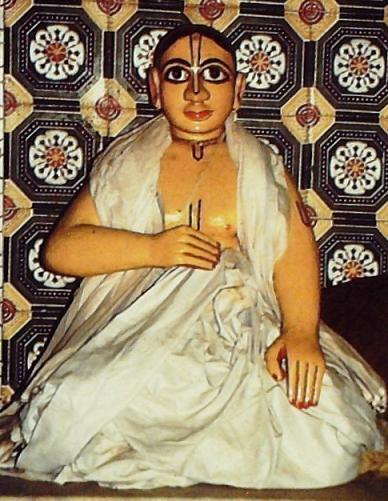
What Devananda found kept him standing there, unable to look away, for what the tradition describes as hours. Vakresvara was dancing without holding back, in front of everyone. Tears, trembling and a voice broken by ecstasy passed through him openly. The crowd grew large enough to press in and threaten to disturb the dancing. Devananda was a respected local scholar, not a formal disciple of anyone in that courtyard. Yet it was he who took up a cane and held the crowd back, so that Vakresvara could continue undisturbed. When Vakresvara finally collapsed, overcome, Devananda caught him, laid his head in his own lap, and used his own cloth to wipe the dust from his body. All accounts agree that this was the first time in his life Devananda had served a Vaishnava, and not simply lectured about one.
Meeting Mahaprabhu at Kuliya #
That single night of service opened something in Devananda that years of scholarship and one direct rebuke had not. Afterward Devananda heard Vakresvara speak about who Mahaprabhu actually was, and his long-held doubt about the Lord's divinity gave way. Mahaprabhu later returned to Navadvipa from Puri, and thousands gathered at Kuliya to seek His forgiveness for old offenses. Devananda came among them. He was hesitant, and he stood off to one side even after offering his obeisances. When Mahaprabhu saw him, He needed no explanation of what had changed: "You are the servant of My dear devotee Vakresvara Pandita," He is remembered as saying. "By your service to him, you have pleased Me, and by that service you have come close to Me."
The Instruction and the Apology #
Mahaprabhu did not lecture Devananda about his years of dry scholarship. Instead He gave him a direct instruction on what to do with it: always explain the Bhagavatam in terms of bhakti, and never let any other interpretation leave his lips again. Then came the one instruction that mattered more than any point of philosophy. Devananda was to go to Srivasa Thakura and beg forgiveness at his feet. Sri Chaitanya-charitamrita's purport and the fuller Chaitanya-bhagavata account both agree on the reason. In the end, there is no difference between the book Bhagavata and the devotee who is its teaching in living form. Mercy from one opens the way to understanding the other. Devananda did exactly that. Srivasa had carried the memory of that old humiliation silently for years, without ever naming the man responsible. Now Srivasa embraced Devananda without hesitation.
From that day, the tradition remembers Devananda Pandit as one of Mahaprabhu's own, not as the scholar whose students once drove a weeping devotee from his classroom. The change was so complete that Kuliya itself came to be called aparadha-bhanjanera pata, the place where offenses are forgiven. The name can still be traced in the older lanes of the neighborhood. Centuries later, it is also kept in the very ground where Sri Devananda Gaudiya Math now stands.
Closing
A Bhagavatam Scholar Without Bhakti #
All the accounts that have come down to us agree that Devananda Pandit was a truly learned man. He was trained in Nyaya, the formal study of logic, which also shaped Sri Chaitanya Mahaprabhu's own early studies. He knew Srimad-Bhagavatam so well that students filled his classes in Kuliya to hear him explain it verse by verse. Srila Prabhupada's purport to Sri Chaitanya-charitamrita speaks directly about what was missing from those classes. Devananda explained the Bhagavatam without teaching that bhakti, devotional service to Krishna, is its real subject. Sri Chaitanya-bhagavata is even harsher. It describes his explanation as colored by Mayavada, the philosophy that treats the Supreme as ultimately formless and Krishna's personal pastimes as something less than final truth. A brahmana who wanted liberation more than loving service to God could teach the Bhagavatam that way for years, and no one in Kuliya would think to object. Then one day a rasika devotee happened to come into one of his classes.
Mahaprabhu's Anger at Maheshvara Visharada's House #
Some time afterward, Mahaprabhu was walking near the house of Sarvabhauma Bhattacharya's father, Maheshvara Visharada. He passed close enough to Devananda's own home to hear him still teaching the Bhagavatam the same way. Sri Chaitanya-bhagavata records that the Lord became openly angry. He condemned as worthless any explanation of Srimad-Bhagavatam that leaves out bhakti, however great the scholarship behind it. The same account says that He spoke loudly enough for Devananda to hear every word from a distance. As Devananda himself later admitted, he let the Lord's sharp words pass without changing anything.
Kuliya, the Place Where Offenses Are Forgiven #
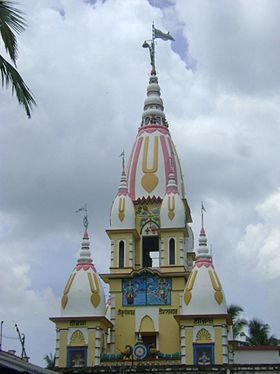
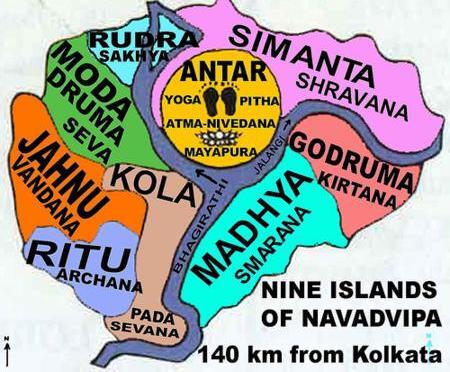
After Devananda's reconciliation, the neighborhood of Kuliya itself came to be remembered in Gaudiya Vaishnava tradition as aparadha-bhanjanera pata, the place where offenses are forgiven. Srila Bhaktisiddhanta Sarasvati Thakura's own commentary on Sri Chaitanya-bhagavata gives Devananda's story as part of the reason. The old names of several nearby neighborhoods, such as Koler Ganj and Koler Daha, still keep a trace of Koladwipa. Koladwipa is one of the nine islands of the Navadvipa-mandala, and its devotional service is pada-sevana, service to the Lord's feet. This is a fitting link for the place where Devananda's own life turned around. Centuries later, in 1940, Srila Bhakti Prajnana Kesava Gosvami Maharaja built Sri Devananda Gaudiya Math on this same ground. He named the temple after the very devotee Mahaprabhu had forgiven there. Srila Bhakti Prajnana Kesava Gosvami Maharaja was also the sannyasa-guru who would later give the sannyasa order to A. C. Bhaktivedanta Swami Srila Prabhupada.
Gaura-ganoddesha-dipika (106) goes back even further. It identifies Devananda, in Krishna's own Vraja pastimes, as a scholar-priest who recited Vedic literatures in the court of Nanda Maharaja. Srila Prabhupada's purport names him Bhaguri Muni, and the Sanskrit verse itself reads bhāgurir muniḥ. The main shape of his own story, however, is not in dispute. He was a scholar whose learning, for years, missed the one thing his own subject was really about. He was brought around, not by better arguments, but by serving a devotee himself, in his own house, without being asked.
The verse reads:
purāṇānām artha-vettā śrī-devānanda paṇḍitaḥ
purāsīn nanda-pariṣat-paṇḍito bhāgurir muniḥ
"Lord Caitanya's associate Sri Devananda Pandita, who was very learned in the Puranas, had previously been Bhaguri Muni, the chief pandita in the court of Maharaja Nanda." (Gaura-ganoddesha-dipika 106)
Srila Prabhupada's purport to Chaitanya-charitamrita Adi 10.77 says the same: "In the Gaura-gaṇoddeśa-dīpikā (106) it is described that he was formerly Bhāguri Muni, the sabhā-paṇḍita who recited Vedic literatures in the house of Nanda Mahārāja."
- Sri Chaitanya-charitamrita, Adi-lila 10.77, purport (Bhaktivedanta VedaBase)
- Devananda Pandit – Biography, Gaudiya History (excerpted from Sri Chaitanya: His Life & Associates by Srila Bhakti Ballabh Tirtha Maharaj)
- Devananda Pandit, Gaudiya History (alternate retelling)
- Devananda Pandit, Gaudiya History (short entry)
- Srila Devananda Pandita – Disappearance, ISKCON Desire Tree
