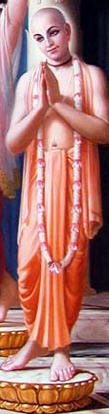
Sri Devananda Pandit
Bhagavatam reciter of Kuliya, forgiven at the place where offenses are forgiven
Also known as Devananda Pandita, Devananda of Kuliya
“There is no difference between the book Bhagavata and the Bhakta Bhagavata. If you get the mercy of the Bhakta Bhagavata, you will easily attain the mercy of the book Bhagavata.”
Sri Chaitanya Mahaprabhu's instruction to Devananda Pandit at Kuliya, sending him to beg forgiveness of Srivasa Thakura, as recorded in Sri Chaitanya-bhagavata and rendered in Sri Chaitanya: His Life & Associates by Srila Bhakti Ballabh Tirtha Maharaj
Sri Devananda Pandit made his living reciting Srimad-Bhagavatam to crowded classes in Kuliya, on the western bank of the Ganges at Navadvipa. But he never taught that devotion to Krishna was the book's real point. That habit cost him dearly. When Srivasa Thakura wept through one of his recitations, Devananda's own students threw the weeping devotee out of the room, and Devananda said nothing to stop them. This offense put him, for a time, completely out of favor with Sri Chaitanya Mahaprabhu. In the end, what changed him was not a scripture lesson but a person. It was Vakresvara Pandit, a guest in his own house, with his ecstatic dancing and open-hearted devotion.
| Detail | Description |
|---|---|
| Home and school | Kuliya, Navadvipa, near the house of Sarvabhauma Bhattacharya's father, Maheshvara Visharada |
| Occupation | Professional reciter and teacher of Srimad-Bhagavatam, trained in Nyaya |
| Central offense | Silently allowed his students to drive Srivasa Thakura from a Bhagavatam class |
| Turning point | Service to Vakresvara Pandit, an intimate associate of Mahaprabhu |
| Identity | Bhaguri Muni, the chief pandita in Nanda Maharaja's court in Vraja (Gaura-ganoddesha-dipika 106; Chaitanya-charitamrita Adi 10.77 purport) |
| Disappearance | Krishna Ekadashi of Pausha (year not recorded) |
A Bhagavatam Scholar Without Bhakti #
All the accounts that have come down to us agree that Devananda Pandit was a truly learned man. He was trained in Nyaya, the formal study of logic, which also shaped Sri Chaitanya Mahaprabhu's own early studies. He knew Srimad-Bhagavatam so well that students filled his classes in Kuliya to hear him explain it verse by verse. Srila Prabhupada's purport to Sri Chaitanya-charitamrita speaks directly about what was missing from those classes. Devananda explained the Bhagavatam without teaching that bhakti, devotional service to Krishna, is its real subject. Sri Chaitanya-bhagavata is even harsher. It describes his explanation as colored by Mayavada, the philosophy that treats the Supreme as ultimately formless and Krishna's personal pastimes as something less than final truth. A brahmana who wanted liberation more than loving service to God could teach the Bhagavatam that way for years, and no one in Kuliya would think to object. Then one day a rasika devotee happened to come into one of his classes.
The Day His Students Turned Away Srivasa Thakura #
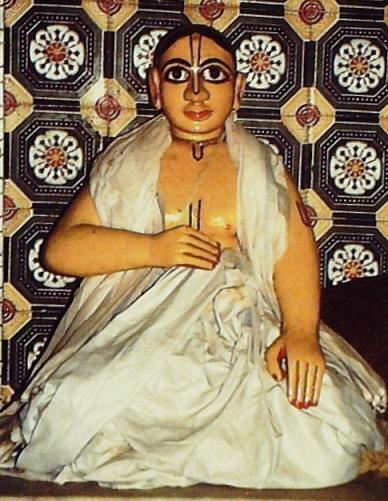
That devotee was Srivasa Thakura. He was already famous in Navadvipa for a heart that could not stay calm when he heard genuine Krishna-katha. Hearing Devananda recite the Bhagavatam's own verses, Srivasa began to weep and then fell to the ground. He was overcome by an ecstasy that the other listeners had no way to understand. Devananda's students saw only a disturbance. They physically carried him out of the room, and Devananda, who was present the whole time, did nothing to stop them. The page the weeping of Srivasa Thakura tells in full what happened next, and why it mattered so much that Mahaprabhu Himself was said to have referred back to it years later. It also tells what name the tradition gives to this kind of offense.
Mahaprabhu's Anger at Maheshvara Visharada's House #
Some time afterward, Mahaprabhu was walking near the house of Sarvabhauma Bhattacharya's father, Maheshvara Visharada. He passed close enough to Devananda's own home to hear him still teaching the Bhagavatam the same way. Sri Chaitanya-bhagavata records that the Lord became openly angry. He condemned as worthless any explanation of Srimad-Bhagavatam that leaves out bhakti, however great the scholarship behind it. The same account says that He spoke loudly enough for Devananda to hear every word from a distance. As Devananda himself later admitted, he let the Lord's sharp words pass without changing anything.
Vakresvara Pandit's Mercy #
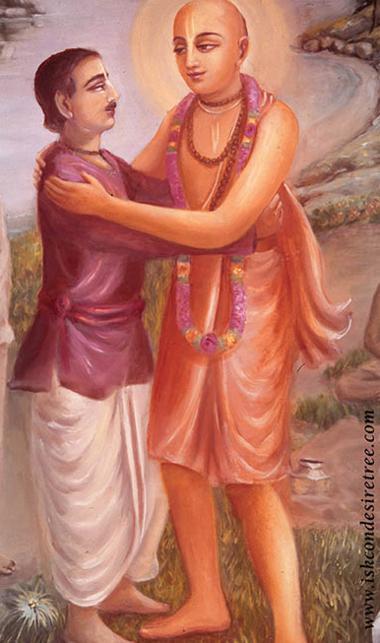
What scholarship and a direct correction from the Lord could not do, simple service finally did. Some time after Mahaprabhu had accepted sannyasa, Vakresvara Pandit, one of His most joyful dancing associates, stayed as a guest at Devananda's own house in Kuliya. Devananda was drawn by a devotion that he could see but could not yet share. He began to serve Vakresvara Pandit with his own hands. Through that single act of service, Devananda finally understood who Mahaprabhu was. He met the Lord, and he made peace with Srivasa Thakura himself. The full account is told on the mercy of Vakresvara Pandit. It includes the exact words that, according to the tradition, Mahaprabhu spoke to him.
Kuliya, the Place Where Offenses Are Forgiven #
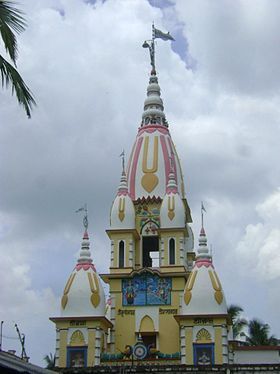
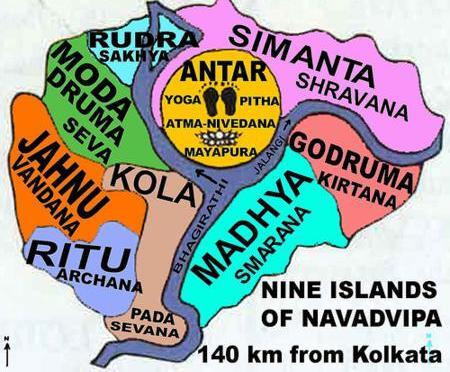
After Devananda's reconciliation, the neighborhood of Kuliya itself came to be remembered in Gaudiya Vaishnava tradition as aparadha-bhanjanera pata, the place where offenses are forgiven. Srila Bhaktisiddhanta Sarasvati Thakura's own commentary on Sri Chaitanya-bhagavata gives Devananda's story as part of the reason. The old names of several nearby neighborhoods, such as Koler Ganj and Koler Daha, still keep a trace of Koladwipa. Koladwipa is one of the nine islands of the Navadvipa-mandala, and its devotional service is pada-sevana, service to the Lord's feet. This is a fitting link for the place where Devananda's own life turned around. Centuries later, in 1940, Srila Bhakti Prajnana Kesava Gosvami Maharaja built Sri Devananda Gaudiya Math on this same ground. He named the temple after the very devotee Mahaprabhu had forgiven there. Srila Bhakti Prajnana Kesava Gosvami Maharaja was also the sannyasa-guru who would later give the sannyasa order to A. C. Bhaktivedanta Swami Srila Prabhupada.
Gaura-ganoddesha-dipika (106) goes back even further. It identifies Devananda, in Krishna's own Vraja pastimes, as a scholar-priest who recited Vedic literatures in the court of Nanda Maharaja. Srila Prabhupada's purport names him Bhaguri Muni, and the Sanskrit verse itself reads bhāgurir muniḥ. The main shape of his own story, however, is not in dispute. He was a scholar whose learning, for years, missed the one thing his own subject was really about. He was brought around, not by better arguments, but by serving a devotee himself, in his own house, without being asked.
The verse reads:
purāṇānām artha-vettā śrī-devānanda paṇḍitaḥ
purāsīn nanda-pariṣat-paṇḍito bhāgurir muniḥ
"Lord Caitanya's associate Sri Devananda Pandita, who was very learned in the Puranas, had previously been Bhaguri Muni, the chief pandita in the court of Maharaja Nanda." (Gaura-ganoddesha-dipika 106)
Srila Prabhupada's purport to Chaitanya-charitamrita Adi 10.77 says the same: "In the Gaura-gaṇoddeśa-dīpikā (106) it is described that he was formerly Bhāguri Muni, the sabhā-paṇḍita who recited Vedic literatures in the house of Nanda Mahārāja."
Scriptural evidence
Quoted in the text above:
- Verse 106 Gaura-ganoddesha-dipika
Further verses:
bhāgavatī devānanda vakreśvara-kṛpāte
bhāgavatera bhakti-artha pāila prabhu haite
Word for word
bhāgavatī devānanda: Devānanda, who used to recite Śrīmad-Bhāgavatam; vakreśvara-kṛpāte: by the mercy of Vakreśvara; bhāgavatera: of Śrīmad-Bhāgavatam; bhakti-artha: the bhakti interpretation; pāila: got; prabhu haite: from the Lord.
Devananda Pandita was a professional reciter of Srimad-Bhagavatam, but by the mercy of Vakresvara Pandita and the grace of the Lord he understood the devotional interpretation of the Bhagavatam.
From the purport: Purport excerpt: "Devananda Pandita was a professional reciter of Srimad-Bhagavatam, but Lord Caitanya Mahaprabhu did not like his interpretation of it. Formerly, when Devananda was expounding the Mayavadi interpretation, Srivasa Thakura was once present in his meeting, and when he began to cry, Devananda's students drove him away."
The defining verse naming Devananda Pandit in the 'branches of the Caitanya tree' chapter; Srila Prabhupada's purport here summarizes the entire Srivasa Thakura incident and the Vakresvara Pandit reconciliation, citing Sri Chaitanya-bhagavata, Madhya-khanda, chapter 21, as its source.
- Sri Chaitanya-charitamrita, Adi-lila 10.77, purport (Bhaktivedanta VedaBase)
- Devananda Pandit – Biography, Gaudiya History (excerpted from Sri Chaitanya: His Life & Associates by Srila Bhakti Ballabh Tirtha Maharaj)
- Devananda Pandit, Gaudiya History (alternate retelling)
- Devananda Pandit, Gaudiya History (short entry)
- Srila Devananda Pandita – Disappearance, ISKCON Desire Tree
Frequently asked
When was Sri Devananda Pandit born?
Sri Devananda Pandit appeared Not recorded in Not recorded (resident of Kuliya, present-day central Navadvipa, Nadia district, Bengal).
When and where did Sri Devananda Pandit disappear?
Sri Devananda Pandit disappeared Krishna Ekadashi (the eleventh day of the waning moon) of the month of Pausha, year not recorded at Not recorded (associated throughout life with Kuliya, Navadvipa).
What are the main pastimes of Sri Devananda Pandit?
The pastimes covered here include: The Weeping of Srivasa Thakura, The Mercy of Vakresvara Pandit.