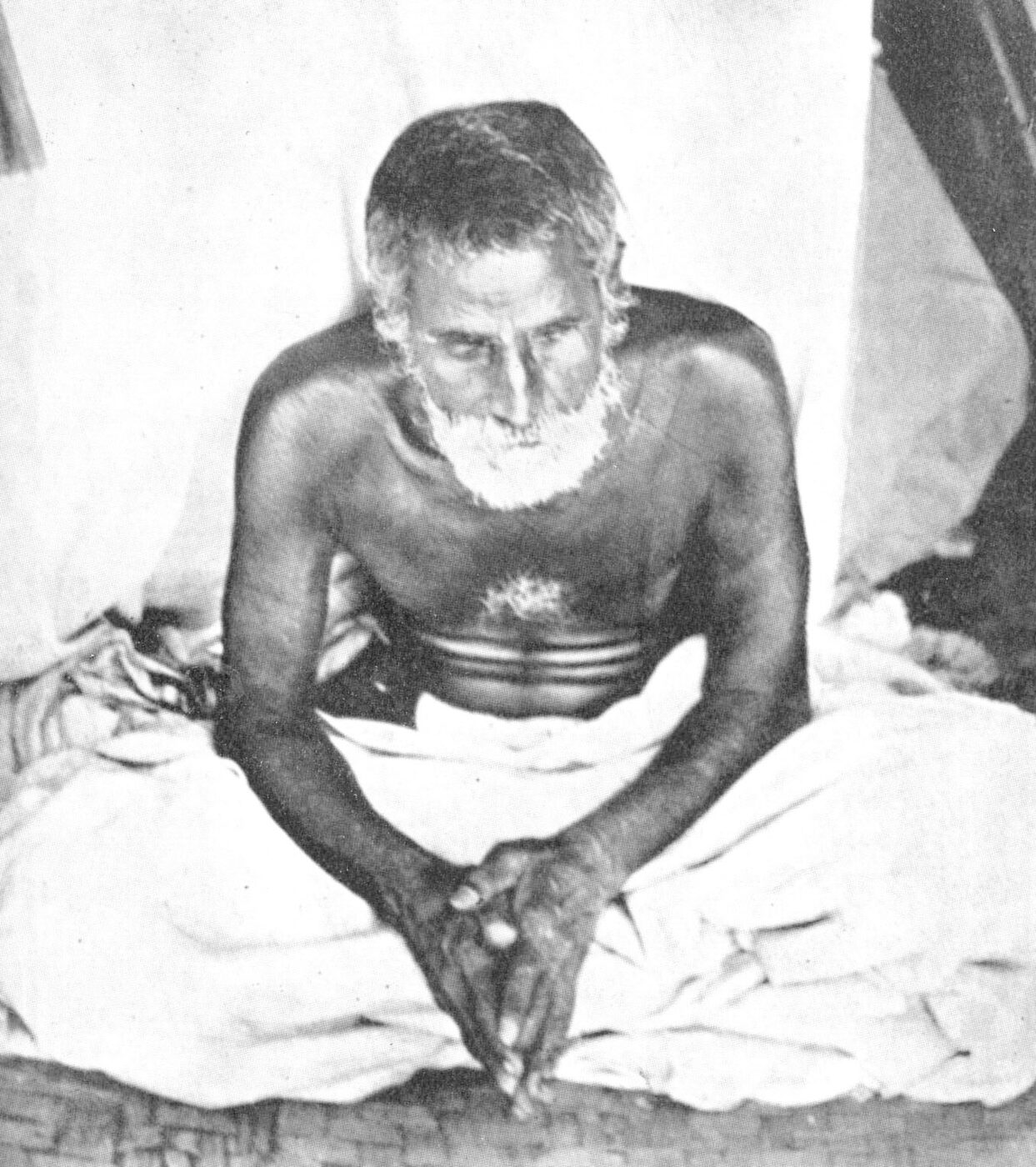
After taking up babaji life, Srila Gaura Kishora Dasa Babaji spent the greater part of five decades as a mendicant. He moved mainly between Vrindavan and Nabadwip, absorbed in chanting the names of Radha and Krishna. Wikipedia describes him as having become "famous for his teachings on the process of bhakti yoga and for his unorthodox avadhuta like behaviour as a sadhu." Almost none of that teaching survives as a written text. What survives instead is a collection of stories, recorded by his disciples and by others who watched him. They describe conduct so free of ordinary social and material custom that Vaishnava literature calls it avadhuta. This is a way of life considered to be outside the ordinary labels of caste, status, or possessions.
| Years in Vrindavan | Roughly three decades, by one account, serving the deities of Vraja |
| 1897 | Traveled from Vrindavan to Nabadwip; there given the title "Bhajananandi" |
| 1908 | Lost his eyesight; stopped traveling and remained in one place, chanting |
Decades of Bhajan Between Two Holy Cities #
According to the biography at gaudiyahistory.iskcondesiretree.com, he spent about thirty years in Vraja mandala. He lived on madhukari, food gathered by begging from house to house, and slept beneath trees. He offered obeisances to the residents of Vrindavan, and even to its trees and flowers, seeing in them Krishna's presence. During these years he would also travel at times to the holy places of Northern and Western India, and to Gaura-mandala, the circle of Nabadwip. Another devotional account records that on these travels he associated with Srila Svarupa Dasa Babaji in Jagannatha Puri. Bhaktivinoda Thakura later described Svarupa Dasa Babaji's ecstatic devotional activities in his autobiography.
In 1897, in the month of Phalguna, Gaura Kishora Dasa Babaji travelled from Vrindavan to Nabadwip Dhama. At that time the Yoga Pitha, the birthplace of Sri Chaitanya Mahaprabhu, had just been revealed through the efforts of Bhaktivinoda Thakura. Gaura Kishora Dasa Babaji did not go by his own choice. He went on the direct instruction of Jagannatha Dasa Babaji, the senior Vaishnava in whose line he had taken his babaji vows. He remained in Nabadwip for the rest of his life. There he was given the title "Bhajananandi," a term for a renounced devotee fully absorbed in devotional chanting, not in preaching or scholarship. There he continued the same life. He danced on the banks of the Ganges calling out the name "Gaura," and at times he lay in states that his disciples described as unconscious absorption. He also visited the groves along the river that Gaudiya Vaishnavas identify with the pastimes of Radha and Govinda.
An Avadhuta's Freedom From Convention #
The same source describes his personal habits in some detail. He owned nothing except a strand of tulasi beads and a hand-held chanting bead bag, and sometimes he went without even these. He wound a knotted cloth to use in place of a rosary. He wore a single strip of cloth, or at times none. For clothing he used thrown-away loin-cloths taken from corpses left at the cremation ground on the Ganges bank. At times he lived under an overturned, broken boat. It is said that he deliberately scattered fish bones near a hut he was using for bhajan, so that passers-by would take him for a fish-eater and leave him alone.
He begged only dry, uncooked food from the householders of the Dhama. Sometimes he offered it to the Lord simply by holding it in his own hand. He gathered dry wood from the roadside to cook with. To clothe and equip himself, he would collect and wash pots and cloth that others had thrown away as impure. These included earthen pots left along the Ganges after an eclipse, a time when villagers considered such pots unusable. He kept the Ekadashi fast very strictly, refusing even water. On ordinary days he ate little except dried, cracked rice soaked in water with chilies, or at times simply earth taken from the bank of the Ganges. "One who wants bhojana will spoil his bhajana," he would say. This was a favourite saying of his. It means that eating just to please the tongue destroys any real attempt to worship Krishna. According to this same account, Bhaktivinoda Thakura held him up as an example of "nirapeksha," or indifference to material honor and dishonor alike. Bhaktivinoda Thakura said that his renunciation was "beyond belief."
Srila Prabhupada was once asked in a letter about the relationship between the two men. In his reply he explained that this respect went both ways, even though their formal positions were different: "Thakur Bhaktivinode was not official Spiritual Master of Gour Kishore das Babaji Maharaj. Gour Kishore das Babaji Maharaj was already renounced order, Paramhamsa, but Thakur Bhaktivinode, while He was even playing the part of a householder, was treated by Gour Kishore das Babaji Maharaj as Preceptor, on account of His highly elevated spiritual understanding, and thus He was always treating Him as His Spiritual Master. The Spiritual Master is divided into two parts, namely, siksha guru and diksha guru. So officially Bhaktivinode Thakur was like siksha guru of Gour Kishore das Babaji Maharaj" (Srila Prabhupada, Letter, 1 May 1969).
A Bhajana-Kutira Like No Other #
For a time Gaura Kishora Dasa Babaji stayed in rooms that the owners of a dharmashala at Kuliya kept aside for him. But he remarked to those nearby that "it is not possible to properly worship the Supreme Lord in an outhouse," explaining that "a house where persons always indulge in eating and sensual pleasure is not a place for sadhus," however much it might look like an ashrama or temple. Some days later the owner of the dharmashala, a Mr. Girish, came with his wife. They were worried about his hardship in the rains and cold, so they offered to build him a proper bhajana-kutira, a small cottage for worship. Gaura Kishora Dasa Babaji answered that he suffered no hardship at all, except one: "Many people come to me with selfish motives. They do not desire their real welfare, and they simply create a disturbance to my bhajana. If you can give me your latrine, it will serve as a favorable place for my chanting the Holy Name of the Lord. There I shall be able to worship the Holy Name without disturbance. People will hate to go there." Girish's wife protested that it would be a sin to let a saint live in a privy. He replied, "I am not a saint... I am unable to worship the Lord in a proper way, so a privy is the right place for me." The couple had no other choice, so they agreed. The outside was repaired and the inside cleaned, but otherwise it was left as it was. Gaura Kishora Dasa Babaji then lived out this pastime in the public latrine of a dharmashala. By his own example he taught that attachment to material affairs, carried on under a false show of devotion, smells worse than stool.
How Krishna Conceals a Pure Vaishnava #
Someone once asked Gaura Kishora Dasa Babaji why the character of the topmost Vaishnavas does not always seem to match the descriptions of saintly behaviour found in scripture. He explained two things. First, a great Vaishnava is moved by compassion for fallen souls. So he sometimes appears at a particular time and place, out of his own free will and by Krishna's inspiration. Second, Krishna fears that He will be unable to repay the debt owed to those who surrender to such a Vaishnava. So, by the power of His own maya, Krishna sometimes hides that Vaishnava's spiritual qualities from the public eye. Then materialistic people see in him only an ordinary or even a bad character. "Without the exercise of the independent will of a Vaishnava," he said, "no one can know him even after seeing in him all of the characteristics described by the scriptures." He illustrated this with something he said he had seen himself. There was a bhajananandi in Vraja, north of Radha-kunda. This bhajananandi had become so famous for kindly fulfilling the desires of distressed visitors that he was overwhelmed by crowds. To protect his bhajana, he arranged a monthly allowance from a wealthy supporter. He also engaged a young sweeper woman as an attendant, who sat in front of his cottage. People then concluded that he must be a womanizer attached to wealth, and they stopped coming. "In fact, he was a real Vaishnava," Gaura Kishora Dasa Babaji said. He explained that only those who surrender fully and pray sincerely at the feet of Gaura-Nityananda are shown a Vaishnava's true identity in their own heart.
The Dress of a Gentleman #
In Kuliya there was a scholarly babaji who outwardly dressed only in a loincloth and was much respected for it. But Gaura Kishora Dasa Babaji knew that in private this man was immoral, and the hypocrisy hurt him. In response, Gaura Kishora Dasa Babaji set aside his own renunciate's dress for a day. He put on a fine dhoti and shawl like a well-to-do gentleman, and in these unexpected clothes he went to see Bhaktivinoda Thakura at Svananda-sukhada-kunja. When asked why he had dressed this way, he answered, "We have adopted the dress of Sri Chaitanya, but privately we do not hesitate to commit adultery. Hence it is better for us to dress like the husband of a prostitute than to assume the guise of Sri Chaitanya and commit adultery secretly. In this way we will at least be free from hypocrisy." Srila Bhaktisiddhanta Sarasvati Thakura would later say that Bhaktivinoda Thakura was amazed to see "the crest-jewel of possessionless saints" appear this way. He also said that Gaura Kishora Dasa Babaji had made his point by showing, through his own example, how much better an honest gentleman's dress was than a loincloth worn to hide secret immorality.
Refusing to Leave the Dhama #
When his eyesight began to fail around 1908, both Bhaktivinoda Thakura and Bhaktisiddhanta Sarasvati repeatedly urged him to go to Calcutta for medical treatment. "I will never go to the illusory universe, Calcutta," he would answer. Once Bhaktivinoda Thakura proposed that Bhaktisiddhanta Sarasvati himself should stay with the babaji in Calcutta, so that the arrangement would trouble Gaura Kishora Dasa Babaji as little as possible. Gaura Kishora Dasa Babaji replied, "I will never accept service from Prabhu; rather I shall die by drowning. If I drown myself in the Ganges, I will become a ghost, so I will drown myself in the Sarasvati." He immediately ran toward the Sarasvati river near the entrance to Svananda-kunja. Bhaktisiddhanta Sarasvati followed him, pleading with him to return. Then Gaura Kishora Dasa Babaji disappeared from view for forty-five days. He suddenly reappeared at Svananda-kunja and announced, "I can't achieve Sri Krishna by killing myself. Nevertheless, I cannot tolerate anyone serving me." No one could ever persuade him to accept medical treatment. In 1908 he lost his physical vision entirely. After that he lived mainly at Pradyumna-kunja in Nabadwip, and sometimes at Godruma with Bhaktivinoda Thakura.
Maya Takes Many Forms #
Once, during the rains, he was sheltering under the porch of a dharmashala, with rice prasada kept on a hanging shelf nearby. A poisonous snake slid down toward the food and then moved away again. An old woman who saw it ran to warn him, but by the time he groped for it with his hand, the snake had already gone. She insisted that the prasada must now be impure and that he could not stay there any longer. He told her gently that she should not trouble herself further. But she still refused to leave until he ate fresh food that she would bring instead. At last he said, "My dear Mother, if you do not leave this place, I shall not listen to anything else you have to say." After she had gone, he spoke to his attendant about how maya works through exactly this kind of interference that seems kind. Maya always finds some new excuse to draw a devotee's attention away from the Lord.
No Association With a Hypocrite #
A man named Damodara Dasa had been living with him, and because of this the local people respected Damodara Dasa. He was allowed to collect donations from visiting pilgrims. Without informing Gaura Kishora Dasa Babaji, Damodara Dasa passed part of the collection on to his own father-in-law. Gaura Kishora Dasa Babaji missed nothing. When he learned of it, he stopped speaking to Damodara Dasa and after that refused to eat anything the man had touched. He went back to his practice of eating only rice soaked in water. Damodara Dasa was terrified at being found out, and he began fasting himself. Then Gaura Kishora Dasa Babaji declared that if the man did not leave his association at once, he would give up his own life in the Ganges. He carried out the threat by wading into the river, until onlookers pulled him out. "Why did you take me from the Ganges?" he demanded of his rescuers. "This Orissan has given away all that I have to his father." The people offered to replace many times over whatever had been given away. But he told them plainly, "I don't need the money, but I refuse to keep this Orissan in my association. If I live with a hypocrite, then my bhajana will be hindered." So it was not attachment to money that had driven him into the river. It was his unwillingness to tolerate hypocrisy in the name of devotional service.
Concealing His Own Learning #
His disciples often recalled that Gaura Kishora Dasa Babaji outwardly appeared unable to read or write. Yet those close to him regarded him as deeply learned and self-realized. Vaishnava tradition holds that this was deliberate humility, not real illiteracy. In this view, he refused to let his own scholarship become a cause of pride or public attention. But no available source gives independent proof either way. So it is presented here as his disciples' understanding, not as an established fact about his life.
Documented Glimpses of His Character #
Some specific incidents appear again and again in the biographies written about him by others. Once he reached the Yogapitha, Lord Chaitanya's birthplace, alone in the middle of the night. When his disciple asked how, he would say only, "One person brought me across the river, that's all," so Bhaktisiddhanta concluded that it could only have been Krishna. He is also recorded as refusing an invitation to the palace of the Maharaja of Kashimbazar. Instead, he suggested that the Maharaja give away his wealth and come to live with him in a simple hut. These accounts come from Vaishnava biographies compiled from the memories of Bhaktisiddhanta Sarasvati and his associates. They do not come from independent records made at the time. So they are reported here as the tradition's memory of the man, not as verified reports of events.
"Renunciation Personified" #
A traditional Gaudiya Vaishnava verse of homage to him is still recited today. Srila Prabhupada translated it in a lecture at Los Angeles on 1 December 1968. It shows how his own spiritual grandchildren remembered him:
I offer my respectful obeisances unto Srila Gaurakisora dasa Babaji Maharaja, who is renunciation personified. He is always merged in a feeling of separation and intense love of Krishna.
In 1900 this same renounced babaji accepted the scholarly son of Bhaktivinoda Thakura as his disciple, as told in Initiating Bhaktisiddhanta Sarasvati.
