No source gives an exact date, or even a clear location, for Ishvara Puri's disappearance. That is not unusual for a figure of his period; precise dates are rare across the earliest generation of Gaudiya Vaishnavas. But in his case, the gap can at least be narrowed with some confidence, because of what his own disciples said about it afterward.
A Narrow Window #
When Ishvara Puri's personal servant, Govinda, arrived at Jagannatha Puri to serve Sri Chaitanya Mahaprabhu, he explained that his master had given the order to come "just before his departure from this mortal world." Mahaprabhu did not arrive at Jagannatha Puri until after He had accepted the renounced order of sannyasa. This happened a fairly short time after the Gaya initiation. If we put those two facts together, Ishvara Puri's disappearance falls somewhere in the short period between the initiation at Gaya, around 1509-1510, and Mahaprabhu's own arrival at Jagannatha Puri not long after taking sannyasa. That was likely no more than a year or two later, and possibly less. So Ishvara Puri had very little time left in this world after initiating the person who would carry the Gaudiya Vaishnava tradition forward. He is said to have spent much of his later life at Gaya, near his own guru's ashrama. But no source names exactly where he passed away, whether at Gaya or somewhere else on his travels.
A Final Order, Carried Out in Full #
Ishvara Puri used the time he had left to arrange for his own service to continue after he was gone. He instructed two of his disciples, Kashishvara and Govinda, to go to Sri Chaitanya Mahaprabhu once he had passed away and take up service under Him instead. Both men did exactly that. They arrived separately at Jagannatha Puri. On arrival, they introduced themselves not by their own achievements but as Ishvara Puri's servants, acting on his final instruction. Sri Chaitanya-charitamrita later lists both of them among the prominent devotees living at Jagannatha Puri. Kashishvara is eighteenth in that list and Govinda is nineteenth. The book also records that Govinda in particular stayed at Mahaprabhu's side for the rest of His manifest life. He was trusted with His personal service in a way usually kept only for a disciple's closest attendants. This was a striking result of a final order. Ishvara Puri could no longer go to Mahaprabhu himself, so he simply sent two disciples in his place. In this way he made sure that something of his own service to Madhavendra Puri continued at Mahaprabhu's side for years after his own life had ended. That service had been a constant, physical and humble presence.
Chaitanya Doba #
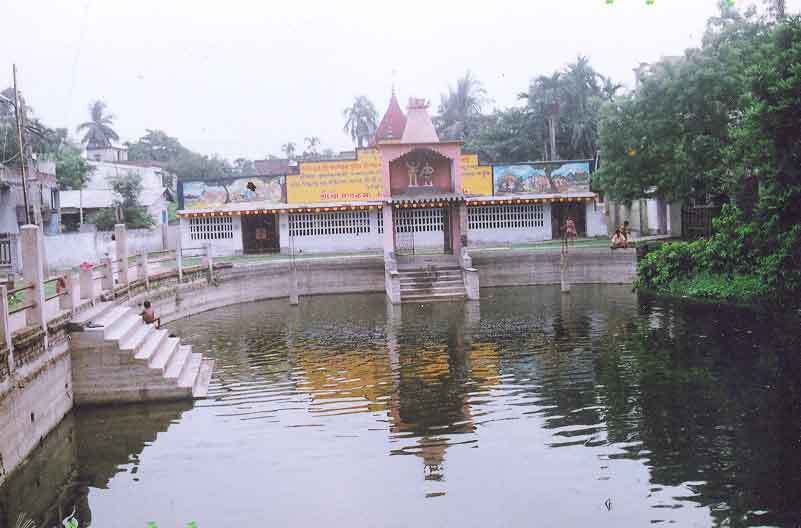
If Ishvara Puri's death itself left no clear trace, his birth did. Kumarahatta, the Bengal town where he was born, lies today within the Halisahar and Kanchrapara area of North 24 Parganas, not far from Kolkata. The spot identified as his birthplace has become a modest but continuously visited pilgrimage site. Local tradition holds that Sri Chaitanya Mahaprabhu passed through on His way to Jagannatha Puri and collected a handful of earth from the ground where His guru was born. It says that generations of pilgrims then followed His example and dug up soil from the same spot. In time the repeated digging left a hollow that filled with water. This gave the site its popular name, Chaitanya Doba, "Chaitanya's pool." A temple and ashrama stand beside it today, and an annual festival is still held there. For a man whose own life is otherwise so little recorded, it is a small, quiet legacy. People still travel to this place. It is named after an act of devotion that someone else performed there, in his honor.
What He Set in Motion #
Ishvara Puri's disappearance ended a life that left, by any ordinary measure, very little outward record. He left no long writings beyond Sri Krishna-lilamrita, no institution built in his name, and no biography with exact dates. Instead, his life produced a single act, and the Gaudiya Vaishnava tradition still lives within its results. Krishnadasa Kaviraja Goswami gives an image for the lineage. In it, Madhavendra Puri is the first sprout of the desire tree of devotional service, Ishvara Puri is the young plant, and Sri Chaitanya Mahaprabhu Himself is the trunk that every later branch depends on. This image is not just a beautiful way of speaking. It describes a real line of descent. In that image, every acharya, every book and every line of the sampradaya that descends from Sri Chaitanya Mahaprabhu rests on a trunk. And that trunk could not have grown without the young plant beneath it. Ishvara Puri gave the Krishna mantra to a young pilgrim at Gaya who had come there to honor his father. In doing so, with no way of knowing it at the time, he set the entire Chaitanya movement into motion.
