Srila Ishvara Puri
Diksha-Guru of Sri Chaitanya Mahaprabhu
The complete life, on one page: The main biography and every pastime page, in order, in one place
Introduction
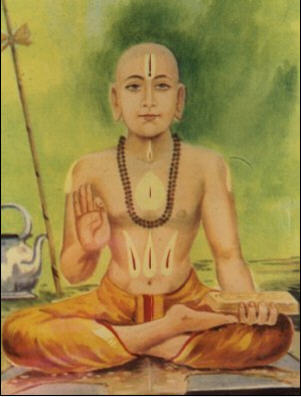
Srila Ishvara Puri has one of the most important single roles in the whole Gaudiya Vaishnava tradition. He is the sannyasi who gave Sri Chaitanya Mahaprabhu His diksha, or formal initiation, at Gaya around 1509-1510. The other parts of his life are also worth knowing for their own sake. These include his years of humble service to Srila Madhavendra Puri, his devotional writing in Bengal, and his short life after that meeting at Gaya. But it is the initiation itself, and what it set in motion, that makes Ishvara Puri's quietly recorded life one of the key turning points of the whole Chaitanya movement.
| Detail | Description |
|---|---|
| Sannyasa name | Ishvara Puri (his name before taking sannyasa is not recorded in the sources) |
| Father | Shyamasundara Acharya, a brahmana of the Rarha (Radha) region of Bengal |
| Birthplace | Kumarahatta, Bengal (today near Halisahar and Kanchrapara, North 24 Parganas, close to Kolkata) |
| Guru | Srila Madhavendra Puri, whose most devoted disciple he became |
| Best known for | Initiating Sri Chaitanya Mahaprabhu with the Krishna mantra at Gaya |
| Literary work | Sri Krishna-lilamrita, a devotional poem on Krishna's pastimes |
| Chief disciples | Kashishvara and Govinda, later sent to serve Sri Chaitanya Mahaprabhu |
Scriptural evidence for the introduction (1)
śrī-īśvarapurī-rūpe aṅkura puṣṭa haila
āpane caitanya-mālī skandha upajila
Word for word
śrī-īśvara-purī: by the name Sri Isvara Puri; rūpe: in the form of; aṅkura: the seed; puṣṭa: cultivated; haila: became; āpane: Himself; caitanya-mālī: the gardener of the name Sri Chaitanya Mahaprabhu; skandha: trunk; upajila: expanded.
The seed of devotional service next fructified in the form of Sri Isvara Puri, and then the gardener Himself, Chaitanya Mahaprabhu, became the main trunk of the tree of devotional service.
From the purport: Purport excerpt: "Isvara Purī appeared in a brāhmaṇa family and was the most beloved disciple of Srīla Mādhavendra Purī."
This is the verse that supplies the site's central image for Ishvara Puri: the second stage of growth between Madhavendra Puri's first sprout and Sri Chaitanya Mahaprabhu's own trunk.
Chapter 1
Discipleship Under Madhavendra Puri
How years of humble, hands-on service to a dying guru shaped the disciple Sri Chaitanya Mahaprabhu would later choose as His own.
Sri Chaitanya-charitamrita does not begin with Ishvara Puri's childhood. It moves almost at once to the one thing about him that the tradition thought worth recording at length: how he served his guru. He was born on the full moon day of the month of Jyestha, into a brahmana family of Bengal's Rarha region. His father's name, Shyamasundara Acharya, is the only detail of his early life that survives. Even his own name before he accepted sannyasa is unknown. "Ishvara Puri" is the name he carried after he had already become a disciple, and the sources call him only by that name. But they do not pass quickly over what he did after he took shelter of Srila Madhavendra Puri. They describe it at length.
By every account, Madhavendra Puri was an extraordinary guru. He was a wandering devotee whose life was filled with longing for Krishna. His search for the Gopala Deity of Govardhana, and later his devotion to the Gopinatha Deity at Remuna, became guiding examples for the whole Gaudiya tradition that followed him. Several of his disciples later became truly well known. But Sri Chaitanya-charitamrita singles out Ishvara Puri for the way he served, especially at the very end.
Cleaning What No One Else Would Touch #
By the last stage of his life, Madhavendra Puri had become so ill that he could not move his own body. Sri Chaitanya-charitamrita states plainly that Ishvara Puri "personally cleaned up his stool and urine". He did not give the task to someone else, and he did not only watch over it. He did it himself, with his own hands, for a man who could no longer do anything for himself. Ishvara Puri also gave his guru something just as necessary. He sat with him constantly, chanting the holy name of Krishna and reciting Krishna's pastimes. In this way Madhavendra Puri's mind stayed fixed on the Lord in his last days. It did not drift toward the pain and helplessness of his failing body. Krishnadasa Kaviraja Goswami records that Madhavendra Puri was moved by this service. He embraced Ishvara Puri and gave him a blessing that Krishna-prema, love for Krishna, would be his wealth. From that moment, the text says, Ishvara Puri became "an ocean of ecstatic love" for Krishna. The tradition insists that this was the direct fruit of how he had served, not of anything he had studied or achieved on his own.
A Godbrother Who Chose the Opposite Path #
Sri Chaitanya-charitamrita does not tell this story on its own. It places Ishvara Puri's service directly beside the very different conduct of a godbrother, Ramachandra Puri. Ramachandra Puri came to see Madhavendra Puri in that same final illness. Ishvara Puri served his guru, but Ramachandra Puri lectured him. He heard his dying guru cry out in longing for Krishna. Then, with the confidence of someone who thought himself spiritually advanced, he told him that a soul in full transcendental bliss should be absorbed in impersonal Brahman instead of weeping over separation. Madhavendra Puri answered at once and very clearly. He rebuked Ramachandra Puri as a "sinful rascal," told him plainly that his advice, which no one had asked for, was only adding to his pain, and refused to let him stay. Krishnadasa Kaviraja Goswami states the lesson clearly. Side by side, Ishvara Puri and Ramachandra Puri became living proof of what a great soul's blessing produces and what his rejection produces. Ramachandra Puri went on to a life of dry criticism. Later he would find fault even with Sri Chaitanya Mahaprabhu's eating habits at Jagannatha Puri. Ishvara Puri, on the other hand, went on to become the guru of the Lord Himself. The text makes it very clear which path it wants the reader to notice.
What This Service Prepared Him For #
In Sri Chaitanya-charitamrita, none of this reads as background detail. It reads as an explanation. Later the text describes Ishvara Puri as the second stage of the Gaudiya bhakti lineage. Madhavendra Puri is the first sprout of the desire tree of devotional service. Ishvara Puri is the young plant that sprout grew into, before Sri Chaitanya Mahaprabhu Himself became its trunk. In this description, Ishvara Puri's years of humble, physical, uncomplaining service to a dying guru are given as the reason that growth was possible at all. Sri Chaitanya-charitamrita even records a list of eternal associates whom Krishna is said to have specially asked to appear before He Himself appeared. Ishvara Puri's name is there beside Srila Madhavendra Puri's, Advaita Acharya's, and Srivasa Pandita's. He is placed on purpose among the people whose presence was needed for the coming of Sri Chaitanya Mahaprabhu. So, long before Ishvara Puri ever met the boy who would become his own disciple, his qualification for that role had already been settled. It was settled not by learning, but by how he had cared for the guru who came before him.
Scriptural evidence for this chapter (5)
śrī-śacī-jagannātha, śrī-mādhava-purī
keśava bhāratī, āra śrī-īśvara purī
advaita ācārya, āra paṇḍita śrīvāsa
ācāryaratna, vidyānidhi, ṭhākura haridāsa
Word for word
śrī-śacī-jagannātha: Srimati Sachidevi and Jagannatha Misra; śrī-mādhava-purī: Sri Madhavendra Puri; keśava bhāratī: Kesava Bharati; āra: and; śrī-īśvara-purī: Sri Isvara Puri; advaita ācārya: Advaita Acharya; paṇḍita śrīvāsa: Srivasa Pandita; ācārya-ratna: Acaryaratna; vidyānidhi: Vidyanidhi; ṭhākura haridāsa: Thakura Haridasa.
Lord Sri Krishna, before appearing as Lord Chaitanya, requested these devotees to precede Him: Sri Sachidevi, Jagannatha Misra, Madhavendra Puri, Kesava Bharati, Isvara Puri, Advaita Acharya, Srivasa Pandita, Acaryaratna, Vidyanidhi and Thakura Haridasa.
Ishvara Puri is named here among the small group of eternal associates whose presence in this world Krishna is said to have specifically arranged before descending as Sri Chaitanya Mahaprabhu.
īśvara-purī gosāñi kare śrīpāda-sevana
svahaste karena mala-mūtrādi mārjana
Word for word
īśvara-purī: Isvara Puri; gosāñi: Gosvami; kare: performs; śrīpāda-sevana: service to Madhavendra Puri; sva-haste: with his own hand; karena: performs; mala-mūtra-ādi: stool, urine, and so on; mārjana: cleaning.
Isvara Puri, the spiritual master of Sri Chaitanya Mahaprabhu, performed service to Madhavendra Puri, cleaning up his stool and urine with his own hand.
The verse the whole tradition points to when explaining why Ishvara Puri, and not any other disciple, became Madhavendra Puri's spiritual heir.
nirantara kṛṣṇa-nāma karāya smaraṇa
kṛṣṇa-nāma, kṛṣṇa-līlā śunāya anukṣaṇa
Word for word
nirantara: always; kṛṣṇa-nāma: the name of Lord Krishna; karāya smaraṇa: was reminding; kṛṣṇa-nāma: the holy name of Krishna; kṛṣṇa-līlā: pastimes of Krishna; śunāya anukṣaṇa: was always causing to hear.
Isvara Puri was always chanting the holy name and pastimes of Lord Krishna for Madhavendra Puri to hear. In this way he helped Madhavendra Puri remember the holy name and pastimes of Lord Krishna at the time of death.
Describes the second half of Ishvara Puri's service to his dying guru, not only physical care but keeping his guru's mind fixed on Krishna.
tuṣṭa hañā purī tāṅre kailā āliṅgana
vara dilā — 'kṛṣṇe tomāra ha-uka prema-dhana'
Word for word
tuṣṭa hañā: being pleased; purī: Madhavendra Puri; tāṅre: him; kailā āliṅgana: embraced; vara dilā: gave the benediction; kṛṣṇe: unto Krishna; tomāra: your; ha-uka: let there be; prema-dhana: the wealth of love.
Pleased with Isvara Puri, Madhavendra Puri embraced him and gave him the benediction that he would be a great devotee and lover of Krishna.
Madhavendra Puri's direct blessing on Ishvara Puri, given in response to his service, the moment the text treats as the origin of Ishvara Puri's own greatness.
sei haite īśvara-purī — 'premera sāgara'
rāmacandra-purī haila sarva-nindākara
Word for word
sei haite: from that; īśvara-purī: Isvara Puri; premera sāgara: the ocean of ecstatic love; rāmacandra-purī: Ramachandra Puri; haila: became; sarva-nindā-kara: critic of all others.
Thus Isvara Puri became like an ocean of ecstatic love for Krishna, whereas Ramachandra Puri became a dry speculator and a critic of everyone else.
Krishnadasa Kaviraja Goswami's direct contrast between the two godbrothers, used to show what a guru's blessing versus rejection each produced.
Chapter 2
Krishna-lilamrita and Life in Bengal
A devotional poem, a disguised sannyasi, and a first meeting with the boy he would one day initiate.
By the time Ishvara Puri met the boy who would become his own disciple, he was already a wandering sannyasi in every sense. He was a pilgrim who moved from one holy place to another. One account records that he spent much of his later life near Srila Madhavendra Puri's own ashrama at Gaya. But he traveled widely, and in time his path brought him to Navadvipa. There, in the town where Sri Chaitanya Mahaprabhu was born, two things happened that mattered greatly for what came later. Ishvara Puri wrote the one literary work credited to him. And he met Nimai Pandita for the first time. This was years before either of them had any idea what that meeting would lead to at Gaya.
Recognized Without Being Announced #
Sri Chaitanya-Bhagavata describes Ishvara Puri entering Navadvipa in disguise, without any of the outward signs that would mark him as a realized Vaishnava sannyasi. By one account, he came to the house of Advaita Acharya, who was at that time absorbed in Deity worship. He sat down quietly without introducing himself. Advaita Acharya sensed, as one Vaishnava senses another, that something was unusual about this visitor, and he pressed him to say who he was. Ishvara Puri answered very humbly, and his words became one of the most quoted lines associated with him: "I am a low-class shudra, come to see your lotus feet." Only a kirtana sung by Mukunda Datta, another devotee present, showed what Ishvara Puri's introduction had hidden. Hearing Krishna's pastimes described in song, Ishvara Puri fell to the ground in tears. Only then did Advaita Acharya and the others realize they were in the presence of Madhavendra Puri's most beloved disciple.
A House, a Manuscript, and a Boy Who Corrected Nothing #
Ishvara Puri stayed for several months as a guest in the house of Gopinatha Acharya. At that time Nimai Pandita was still simply a brilliant, somewhat proud young scholar in Navadvipa, with no public sign yet of what He would become. It was there that Nimai first met Ishvara Puri, reportedly while walking home from school with a manuscript in hand. Nimai invited him home, had His mother Sachi Devi cook for him, and personally served him. Then the two of them sat and talked about Krishna for a long while. Over the months that followed, Nimai made a habit of visiting Gopinatha Acharya's house daily to see him.
During this stay Ishvara Puri composed Sri Krishna-lilamrita, a devotional poem on Krishna's pastimes, and read it aloud there. He taught it with special affection to the young Gadadhara Pandit, whose deep renunciation had impressed him. Nimai was already known in Navadvipa as a very skilled young grammarian and logician. One evening, by Sri Chaitanya-Bhagavata's account, Ishvara Puri asked Him to listen to the manuscript and correct whatever errors He found in it. In its own quiet way, Nimai's reply became as important a statement as anything He said at Gaya. He said that anyone who finds fault with a devotee's description of Krishna's pastimes is himself at fault. He also said that even an imperfect word offered in love pleases Krishna more than perfect correctness ever could. It was not the answer of a proud scholar looking to make corrections. When Ishvara Puri heard it, he understood that he was speaking with no ordinary student.
What Bengal Gave Him, and What He Gave Bengal #
Ishvara Puri's own roots were in Bengal. He was born at Kumarahatta, not far from Navadvipa itself. Apart from that one formal meeting at Gaya, the tradition remembers him above all for the months he spent in Navadvipa with Gopinatha Acharya, Advaita Acharya, and the boy whom he would later initiate at Gaya. Sri Krishna-lilamrita does not survive today as a widely circulated separate text, as the writings of Srila Rupa Goswami or Bilvamangala Thakura do. Later Gaudiya sources are also not fully consistent about how much of Ishvara Puri's adult life was spent in Bengal itself and how much at Gaya near his own guru. This small question remains open. But all the sources agree on the character this story shows. Ishvara Puri was humble enough to call himself a low-caste shudra, and joyful enough to weep at a kirtana. He was also secure enough in his own devotion to hand his life's literary work to a teenager for correction. And instead of corrections, he received a lesson in what devotion really requires.
Scriptural evidence for this chapter (1)
Quoted in the text above:
- Adi-khanda 11.105-110 Sri Chaitanya-Bhagavata
Chapter 3
Initiating Sri Chaitanya Mahaprabhu at Gaya
A pilgrim's duty to his late father became the meeting that gave the Gaudiya Vaishnava tradition its formal starting point.
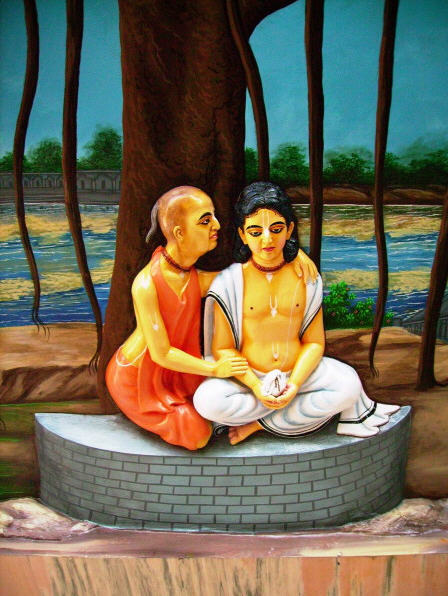
Every biography of Sri Chaitanya Mahaprabhu treats one journey as the turning point of His whole life. It is the trip to Gaya. He made it to perform an ordinary duty of a son, and it ended with Him accepting a spiritual master. Sri Chaitanya-charitamrita gives the episode only two verses of its own. Krishnadasa Kaviraja Goswami explains that Vrindavana Dasa Thakura had already told the story at length in Sri Chaitanya-Bhagavata. So Chaitanya-charitamrita tells only briefly what it knows its readers will already have read elsewhere. But a short account does not mean the event was unimportant. Those two verses, together with the fuller story in Chaitanya-Bhagavata, describe the single most important meeting in the history of the Gaudiya Vaishnava tradition.
A Pilgrim's Ordinary Purpose #
Nimai Pandita went to Gaya for the same reason that hundreds and thousands of people went there daily in His own time. He went to perform pinda-dana, making offerings at the feet of Lord Vishnu on behalf of a parent who had died. His father, Jagannatha Mishra, had died years earlier, and Vedic custom held that a son owed his father this rite at a recognized tirtha. The purport to this verse in Sri Chaitanya-charitamrita notes that Nimai fell seriously ill with fever on the journey. He asked His students to bring Him water that had washed a brahmana's feet, and He was cured by drinking it. This detail shows how far He carried His respect for brahmanas, even before He had a guru of His own. So when He arrived at Gaya, He was not anyone's disciple, and the pilgrims around Him did not yet see anything extraordinary in Him. He was simply a learned young householder-scholar from Navadvipa, attending to a son's duty.
The Meeting at the Vishnupada Temple #
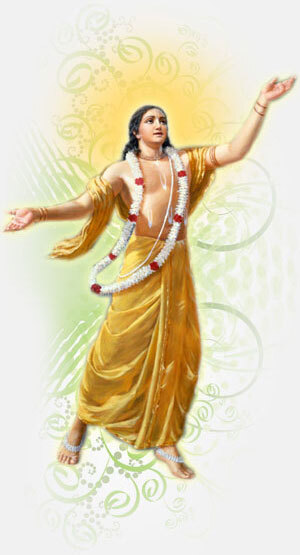
Ishvara Puri was in Gaya at that time. By one account, he lived there for much of his later life, close to the site of Srila Madhavendra Puri's own ashrama. The two met at the Vishnupada temple, where pilgrims go to see the footprint of Lord Vishnu that is said to mark the spot. According to the fuller story in Sri Chaitanya-Bhagavata, Nimai was overcome while hearing the glories of the shrine described, and He fell to the ground. Ishvara Puri came to that same spot and learned from the people there what had happened. When Nimai came back to His senses and saw him, the two fell into each other's arms, both in tears. This was not their first meeting. Ishvara Puri had already known Nimai from his earlier stay in Navadvipa. What was new was the way Nimai now spoke to him. He praised Ishvara Puri as more auspicious than the tirtha itself. In effect, He asked to be delivered, not only blessed. Chaitanya-Bhagavata's account of this exchange is not found on the main digital Sanskrit archives, as Chaitanya-charitamrita is. So what we have in English comes through translation and later retelling. It is not a source that can be checked verse by verse. This is a real gap, and we mention it openly instead of smoothing it over.
The Mantra, Named and Unnamed #
Some time after this reunion, Nimai asked Ishvara Puri directly to initiate Him. Chaitanya-Bhagavata describes a ten-syllable, or dasakshara, mantra being given, but it does not name which mantra it was. Later scholars have suggested an answer. The historian Friedhelm Hardy, citing the researcher Bimanbehari Majumdar, and the writer Steven Rosen both suggest that the mantra was very likely the ten-syllable Gopala-mantra. This mantra is connected with the worship of Krishna as the cowherd boy of Vrindavana. But this is still a conclusion drawn by scholars, not something the earliest texts state outright, and it should be presented only as that. Sri Chaitanya-charitamrita, however, is very clear on one point. It states it in a single line that works almost like a turning point in the text itself: in Gaya, Sri Chaitanya Mahaprabhu was initiated by Ishvara Puri, and immediately afterward He exhibited signs of love of Godhead, signs that appeared again once He returned home. Two short verses carry this whole claim, and Chaitanya-charitamrita adds no doubt or condition to it. Gaudiya theology holds that the Lord has no need of any teacher. Even so, diksha is not described here as a formality that Krishna went through only for the sake of appearances. It is described as the moment after which Nimai Pandita's outward behavior clearly and visibly changed.
A Second, Quieter Meaning #
There is also a scholarly question to mention, alongside the devotional one. Some later Gaudiya sources place Ishvara Puri, through Madhavendra Puri, within the guru-lineage of the Madhva, or Tattvavadi, sampradaya founded by Madhvacharya. Generations later, Srila Baladeva Vidyabhusana would draw on this connection to defend the philosophical position of Gaudiya Vaishnavism. Hardy's research notes that this Madhva link does not appear in the earliest Gaudiya sources. It also notes that neither Madhavendra Puri nor Ishvara Puri is found in the Madhva sampradaya's own recognized guru lists. This is a real point of disagreement among scholars. It concerns how the connection was understood in the earliest generation and how it came to be understood later. None of this changes what Sri Chaitanya-charitamrita itself says about the importance of the initiation. It only means that later tradition speaks more confidently than the earliest sources do about exactly how the formal lineage back to Madhvacharya was drawn.
What is not in dispute is what the initiation did. A pilgrim's duty to his father became, without anyone planning it that way, the moment Sri Chaitanya Mahaprabhu accepted a guru. From that moment, everything the Gaudiya Vaishnava tradition would become had its formal starting point.
Scriptural evidence for this chapter (3)
tabeta karilā prabhu gayāte gamana
īśvara-purīra saṅge tathāi milana
Word for word
tabeta: thereafter; karilā: did; prabhu: Lord Chaitanya Mahaprabhu; gayāte: to Gaya; gamana: travel; īśvara-purīra saṅge: with Isvara Puri; tathāi: there; milana: meeting.
Thereafter the Lord went to Gaya. There He met Srila Isvara Puri.
From the purport: Purport excerpt: "Following this principle, Lord Caitanya Mahāprabhu also went there to offer piṇḍa to His dead father. Fortunately He met Īśvara Purī there."
The opening verse of Chaitanya-charitamrita's account of the Gaya journey; the purport clarifies the Lord went there to perform pinda-dana for His deceased father.
dīkṣā-anantare haila, premera prakāśa
deśe āgamana punaḥ premera vilāsa
Word for word
dīkṣā: initiation; anantare: immediately after; haila: became; premera: of love of Godhead; prakāśa: exhibition; deśe: in His home country; āgamana: coming back; punaḥ: again; premera: of love of God; vilāsa: enjoyment.
In Gaya, Sri Chaitanya Mahaprabhu was initiated by Isvara Puri, and immediately afterwards He exhibited signs of love of Godhead. He again displayed such symptoms after returning home.
The single verse Chaitanya-charitamrita devotes to the initiation itself, brief in length, but treated by the whole tradition as the turning point of the Lord's outward life.
"My pilgrimage to Gaya is successful, for today I have seen your lotus feet. When one offers pinda at this holy place, then that ancestor is delivered — but simply by seeing you, ten million ancestors are delivered in a single moment. Therefore no holy place is your equal; you are the source of auspiciousness for even the holy places themselves."
Not preserved on the major digital Sanskrit archives; this English wording is reproduced consistently across several ISKCON-affiliated retellings of Chaitanya-Bhagavata's Gaya chapter and is treated here as a secondary-source translation rather than a verse verified directly against the Bengali text.
Chapter 4
Mahaprabhu's Reverence for His Guru
Personal service, an ecstatic reaction to a stranger, and a direct philosophical defense of the guru's transcendental authority.
Accepting initiation from Ishvara Puri did not end Sri Chaitanya Mahaprabhu's relationship with him. In fact, from then on Mahaprabhu showed His guru open and sometimes surprising reverence. This continued for years, well past Ishvara Puri's own lifetime. Three episodes in particular show how far that reverence went. They show how Mahaprabhu treated His guru in person, how He responded to a man He had never met simply because that man was connected to His guru, and how He defended His guru's authority when it was directly questioned.
Cooking for His Own Guru #
Not long after the initiation, Ishvara Puri visited the house where Mahaprabhu was staying. Mahaprabhu did not have someone else take care of the meal. He personally cooked for Ishvara Puri and served the food with His own hand. Several sources treat this as a lesson given on purpose, not just a passing act of politeness. According to Gaudiya theology, the Supreme Lord Himself was choosing to show exactly how a disciple should treat a spiritual master, down to the smallest physical details. Afterward He rubbed sandalwood paste on Ishvara Puri's body and placed a garland of flowers around his neck. On the journey back from Gaya, Mahaprabhu went out of His way to pass through Kumarahatta, His guru's birthplace. There He rolled on the ground in ecstasy and gathered dust from the site to carry with Him. Later pilgrims copied this gesture so widely that, over time, their digging left a hollow in the ground. The spot is still visited today. It became known as Chaitanya Doba, "Chaitanya's pool," after that hollow.
Weeping at the Feet of a Stranger #
Years later, while traveling through southern India, Sri Chaitanya Mahaprabhu heard that a sannyasi named Ranga Puri was staying at a brahmana's house in Pandarpura. Ranga Puri was a godbrother of Ishvara Puri, another disciple of Srila Madhavendra Puri, and Mahaprabhu had never personally met him before. He went immediately to see him. The moment He entered and saw Ranga Puri sitting there, He fell flat on the ground to offer obeisances. Even before a single word had passed between them, He showed full signs of ecstasy: tears, trembling, and His body covered in perspiration. Ranga Puri lifted Him up and embraced Him. Only when they had both become calm again did Sri Chaitanya Mahaprabhu explain that He was the disciple of Ishvara Puri. The two of them then spent five to seven days simply discussing Krishna together. Mahaprabhu did not react like this because of anything Ranga Puri himself had achieved. He did it only because of Ranga Puri's connection, through Madhavendra Puri, to the guru who had initiated Mahaprabhu.
Defending a Guru's Authority #
The most direct test of Mahaprabhu's reverence came after Ishvara Puri had already passed away. Ishvara Puri's personal servant, Govinda, arrived at Jagannatha Puri. He explained that he had come on Ishvara Puri's own order, given "just before his departure from this mortal world." Mahaprabhu welcomed him warmly and accepted him into His personal service. Then Sarvabhauma Bhattacharya, a great scholar and one of Mahaprabhu's own close associates, asked a sharp question. Ishvara Puri was a brahmana sannyasi, and the smriti-shastra generally forbids a brahmana guru from accepting a servant born into a shudra family. So why had Ishvara Puri accepted such a servant?
Mahaprabhu's answer was completely firm. He said that His spiritual master, like the Supreme Personality of Godhead Himself, was completely independent. He explained that neither Krishna's mercy nor Ishvara Puri's mercy is bound by caste rules. Krishna's own example proved the point, He said, for Krishna had accepted a meal at the home of Vidura, a shudra. He went further still. He added that dealings of pure affection with the Supreme Lord bring more happiness than any dealings based on formal awe and reverence. The next detail shows His humility as much as His firm faith. Mahaprabhu turned to Sarvabhauma and admitted that He felt uneasy. By ordinary rules of proper conduct, He said, a guru's personal servant should not be made to serve the guru's own disciple. Yet His spiritual master had ordered exactly that, and He did not know how to refuse. Sarvabhauma answered that the order of a spiritual master cannot be disobeyed under any circumstance. So Mahaprabhu accepted Govinda into His personal service on those terms. He kept him at His side for the rest of His manifest life, along with Ishvara Puri's other disciple, Kashishvara.
A Consistent Pattern #
Taken together, these episodes show something more than affection. Mahaprabhu cooked a meal, collected dust from a birthplace, wept before a stranger, and gave a full philosophical defense of a guru's transcendental authority. These are different ways of expressing the same basic teaching. For the disciple, the guru who gives diksha stands in the place of Krishna Himself. No social rule, caste custom, or personal discomfort is above what the guru's order requires. In Gaudiya theology, Sri Chaitanya Mahaprabhu is remembered as the source of that teaching for the whole world. These episodes show that He did not only teach it. He lived it, in small and large ways, for as long as He lived.
Scriptural evidence for this chapter (7)
mahāprasāda-kṣīra-lobhe rahilā prabhu tathā
pūrve īśvara-purī tāṅre kahiyāchena kathā
Word for word
mahā-prasāda: for the remnants of food; kṣīra: sweet rice; lobhe: in eagerness; rahilā: remained; prabhu: the Lord; tathā: there; pūrve: before that; īśvara-purī: Isvara Puri, His spiritual master; tāṅre: unto Him; kahiyāchena kathā: told a narration.
The Lord remained there because He was very eager to receive the remnants of sweet rice offered to the Gopinatha Deity, having heard a narration from His spiritual master, Isvara Puri, of what had once happened there.
Shows Ishvara Puri passing on Madhavendra Puri's own story of the Gopinatha Deity at Remuna to his disciple, who then made a point of visiting the spot himself.
kṣaṇeke āveśa chāḍi' duṅhāra dhairya haila
īśvara-purīra sambandha gosāñi jānāila
Word for word
kṣaṇeke: after just a few moments; āveśa chāḍi': giving up ecstasy; duṅhāra: of both of them; dhairya haila: there was patience; īśvara-purīra sambandha: relationship with Isvara Puri; gosāñi: Sri Chaitanya Mahaprabhu; jānāila: disclosed.
After some moments, they came to their senses and became patient. Sri Chaitanya Mahaprabhu then informed Sri Ranga Puri about His relationship with Isvara Puri.
Comes right after Mahaprabhu fell weeping at Ranga Puri's feet purely on learning he was Ishvara Puri's godbrother, a measure of how far His reverence for His own guru extended.
īśvara-purīra bhṛtya, — 'govinda' mora nāma
purī-gosāñira ājñāya āinu tomāra sthāna
Word for word
īśvara-purīra bhṛtya: servant of Isvara Puri; govinda mora nāma: my name is Govinda; purī-gosāñira ājñāya: on the order of Isvara Puri; āinu: I have come; tomāra sthāna: to Your place.
"I am the servant of Isvara Puri. My name is Govinda, and following the orders of my spiritual master, I have come here.
Govinda's own introduction of himself to Sri Chaitanya Mahaprabhu at Jagannatha Puri, on his late guru's final order.
eta śuni' sārvabhauma prabhure puchila
purī-gosāñi śūdra-sevaka kāṅhe ta' rākhila
Word for word
eta śuni': hearing this; sārvabhauma: Sarvabhauma Bhattacharya; prabhure puchila: inquired of the Lord; purī-gosāñi: Isvara Puri; śūdra-sevaka: a servant who is a shudra; kāṅhe ta' rākhila: why did he keep.
After hearing this, Sarvabhauma Bhattacharya asked Sri Chaitanya Mahaprabhu, "Why did Isvara Puri keep a servant who comes from a shudra family?"
From the purport: Purport excerpt: "Govinda came from a śūdra family, but because he was initiated by Īśvara Purī, he was certainly a brāhmaṇa."
The question that provokes Mahaprabhu's direct philosophical defense of His guru's transcendental authority in the following verse.
prabhu kahe, — īśvara haya parama svatantra
īśvarera kṛpā nahe veda-paratantra
Word for word
prabhu kahe: Sri Chaitanya Mahaprabhu said; īśvara: the Supreme Personality of Godhead or Isvara Puri; haya: is; parama svatantra: supremely independent; īśvarera kṛpā: the mercy of the Supreme Personality of Godhead or of Isvara Puri; nahe veda-paratantra: is not subject to Vedic rules.
Sri Chaitanya Mahaprabhu said, "Both the Supreme Personality of Godhead and My spiritual master, Isvara Puri, are completely independent. Therefore neither the mercy of the Supreme Personality of Godhead nor that of Isvara Puri is subject to any Vedic rules and regulations.
Mahaprabhu's own words placing His guru's mercy on the same footing as Krishna's own, one of the clearest statements of guru-tattva in the whole of Chaitanya-charitamrita.
dāmodara kahe, — ihāra 'govinda' nāma
īśvara-purīra sevaka ati guṇavān
Word for word
dāmodara kahe: Svarupa Damodara said; ihāra: of him; govinda nāma: the name Govinda; īśvara-purīra sevaka: servant of Isvara Puri; ati guṇavān: very much qualified.
Svarupa Damodara informed Him, "Govinda was the servant of Isvara Puri. He is very highly qualified.
Confirms Govinda's standing in Mahaprabhu's inner circle years after Ishvara Puri's disappearance.
prabhura sevā karite purī ājñā dila
ataeva prabhu iṅhāke nikaṭe rākhila
Word for word
prabhura sevā: the service of Sri Chaitanya Mahaprabhu; karite: to perform; purī: Isvara Puri; ājñā dila: ordered; ataeva: therefore; prabhu: Sri Chaitanya Mahaprabhu; iṅhāke: him; nikaṭe rākhila: kept by His side.
"Isvara Puri ordered Govinda to serve Sri Chaitanya Mahaprabhu. Thus the Lord keeps him by His side."
Shows Mahaprabhu continuing to honor Ishvara Puri's specific instruction about Govinda's service years into His stay at Jagannatha Puri.
Chapter 5
Final Days and Disappearance
An undated disappearance, a final order carried out by two disciples, and a pilgrimage site in Bengal that still bears his memory.
No source gives an exact date, or even a clear location, for Ishvara Puri's disappearance. That is not unusual for a figure of his period; precise dates are rare across the earliest generation of Gaudiya Vaishnavas. But in his case, the gap can at least be narrowed with some confidence, because of what his own disciples said about it afterward.
A Narrow Window #
When Ishvara Puri's personal servant, Govinda, arrived at Jagannatha Puri to serve Sri Chaitanya Mahaprabhu, he explained that his master had given the order to come "just before his departure from this mortal world." Mahaprabhu did not arrive at Jagannatha Puri until after He had accepted the renounced order of sannyasa. This happened a fairly short time after the Gaya initiation. If we put those two facts together, Ishvara Puri's disappearance falls somewhere in the short period between the initiation at Gaya, around 1509-1510, and Mahaprabhu's own arrival at Jagannatha Puri not long after taking sannyasa. That was likely no more than a year or two later, and possibly less. So Ishvara Puri had very little time left in this world after initiating the person who would carry the Gaudiya Vaishnava tradition forward. He is said to have spent much of his later life at Gaya, near his own guru's ashrama. But no source names exactly where he passed away, whether at Gaya or somewhere else on his travels.
A Final Order, Carried Out in Full #
Ishvara Puri used the time he had left to arrange for his own service to continue after he was gone. He instructed two of his disciples, Kashishvara and Govinda, to go to Sri Chaitanya Mahaprabhu once he had passed away and take up service under Him instead. Both men did exactly that. They arrived separately at Jagannatha Puri. On arrival, they introduced themselves not by their own achievements but as Ishvara Puri's servants, acting on his final instruction. Sri Chaitanya-charitamrita later lists both of them among the prominent devotees living at Jagannatha Puri. Kashishvara is eighteenth in that list and Govinda is nineteenth. The book also records that Govinda in particular stayed at Mahaprabhu's side for the rest of His manifest life. He was trusted with His personal service in a way usually kept only for a disciple's closest attendants. This was a striking result of a final order. Ishvara Puri could no longer go to Mahaprabhu himself, so he simply sent two disciples in his place. In this way he made sure that something of his own service to Madhavendra Puri continued at Mahaprabhu's side for years after his own life had ended. That service had been a constant, physical and humble presence.
Chaitanya Doba #
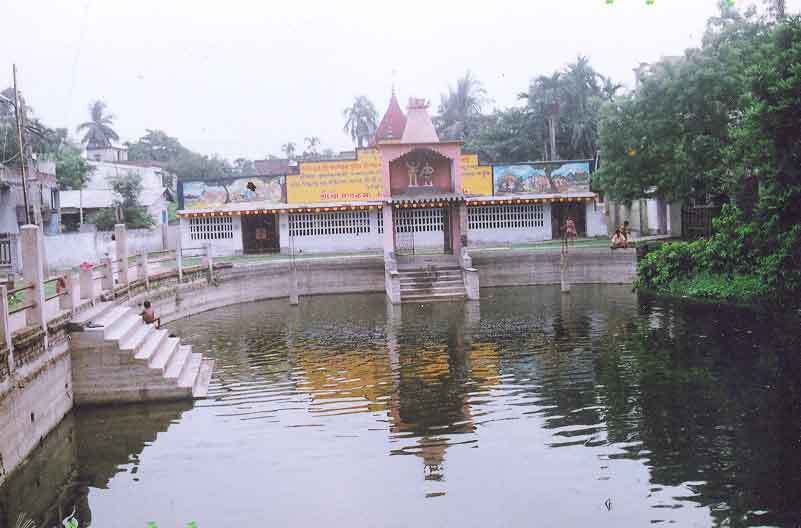
If Ishvara Puri's death itself left no clear trace, his birth did. Kumarahatta, the Bengal town where he was born, lies today within the Halisahar and Kanchrapara area of North 24 Parganas, not far from Kolkata. The spot identified as his birthplace has become a modest but continuously visited pilgrimage site. Local tradition holds that Sri Chaitanya Mahaprabhu passed through on His way to Jagannatha Puri and collected a handful of earth from the ground where His guru was born. It says that generations of pilgrims then followed His example and dug up soil from the same spot. In time the repeated digging left a hollow that filled with water. This gave the site its popular name, Chaitanya Doba, "Chaitanya's pool." A temple and ashrama stand beside it today, and an annual festival is still held there. For a man whose own life is otherwise so little recorded, it is a small, quiet legacy. People still travel to this place. It is named after an act of devotion that someone else performed there, in his honor.
What He Set in Motion #
Ishvara Puri's disappearance ended a life that left, by any ordinary measure, very little outward record. He left no long writings beyond Sri Krishna-lilamrita, no institution built in his name, and no biography with exact dates. Instead, his life produced a single act, and the Gaudiya Vaishnava tradition still lives within its results. Krishnadasa Kaviraja Goswami gives an image for the lineage. In it, Madhavendra Puri is the first sprout of the desire tree of devotional service, Ishvara Puri is the young plant, and Sri Chaitanya Mahaprabhu Himself is the trunk that every later branch depends on. This image is not just a beautiful way of speaking. It describes a real line of descent. In that image, every acharya, every book and every line of the sampradaya that descends from Sri Chaitanya Mahaprabhu rests on a trunk. And that trunk could not have grown without the young plant beneath it. Ishvara Puri gave the Krishna mantra to a young pilgrim at Gaya who had come there to honor his father. In doing so, with no way of knowing it at the time, he set the entire Chaitanya movement into motion.
Scriptural evidence for this chapter (2)
īśvara-purīra śiṣya — brahmacārī kāśīśvara
śrī-govinda nāma tāṅra priya anucara
Word for word
īśvara-purīra śiṣya: disciple of Isvara Puri; brahmacārī kāśīśvara: Brahmachari Kashishvara; śrī-govinda: Sri Govinda; nāma: name; tāṅra: his; priya anucara: very dear follower.
Brahmachari Kashishvara was a disciple of Isvara Puri, and Sri Govinda was another of his dear disciples.
Names Ishvara Puri's two chief disciples who later served Sri Chaitanya Mahaprabhu directly at Jagannatha Puri.
tāṅra siddhi-kāle doṅhe tāṅra ājñā pāñā
nīlācale prabhu-sthāne milila āsiyā
Word for word
tāṅra siddhi-kāle: at the time of Isvara Puri's passing away; doṅhe: the two of them; tāṅra ājñā pāñā: getting his order; nīlācale: at Jagannatha Puri; prabhu-sthāne: at the place of Lord Chaitanya Mahaprabhu; milila āsiyā: met, coming there.
In the list of prominent devotees at Nilachala [Jagannatha Puri], Kashishvara was the eighteenth and Govinda the nineteenth. They both came to see Chaitanya Mahaprabhu at Jagannatha Puri, being thus ordered by Isvara Puri at the time of his passing away.
The phrase "at the time of his passing away" is the closest thing to a chronological marker for Ishvara Puri's disappearance found anywhere in Chaitanya-charitamrita.
- Sri Chaitanya-caritamrta, Adi-lila 9.10-11 (desire tree of devotion)
- Sri Chaitanya-caritamrta, Adi-lila 13.54-55 (eternal associates)
- Sri Chaitanya-caritamrta, Adi-lila 17.7-9 (the Gaya initiation)
- Sri Chaitanya-caritamrta, Antya-lila 8.26-32 (service to Madhavendra Puri; contrast with Ramachandra Puri)
- Sri Chaitanya-caritamrta, Madhya-lila 4.18 (the Remuna Gopinatha story)
- Sri Chaitanya-caritamrta, Madhya-lila 9.285-301 (meeting Ranga Puri)
- Sri Chaitanya-caritamrta, Madhya-lila 10.130-148 (Govinda and Sarvabhauma Bhattacharya)
- Sri Chaitanya-caritamrta, Adi-lila 10.138-139 (Kashishvara and Govinda)
- Sri Chaitanya-Bhagavata, Adi-khanda, Chapter 11 — Meeting with Sri Isvara Puri (translated by Bhumipati Dasa)
- Sri Chaitanya-Bhagavata, Adi-khanda, Chapter 17 — The Lord's Travel to Gaya (translated by Bhumipati Dasa)
- Gaudiya History: Ishvara Puri — Biography
- Gaudiya History: Ishvara Puri — Biography (pastimes)
- ISKCON Desire Tree: Sri Isvara Puri — Disappearance
- The Gaudiya Treasures of Bengal: Chaitanya Doba, Halisahar — The Birthplace of Isvara Puri
