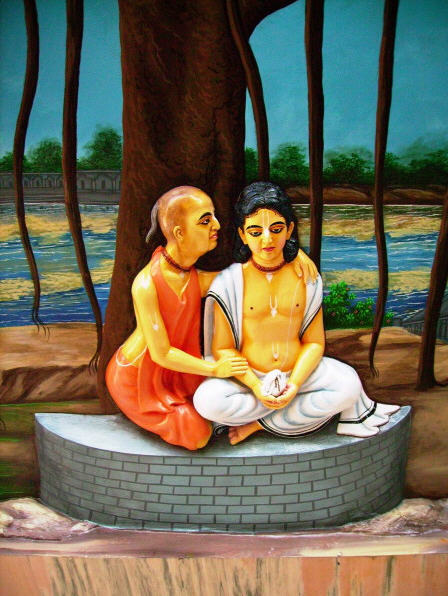
Every biography of Sri Chaitanya Mahaprabhu treats one journey as the turning point of His whole life. It is the trip to Gaya. He made it to perform an ordinary duty of a son, and it ended with Him accepting a spiritual master. Sri Chaitanya-charitamrita gives the episode only two verses of its own. Krishnadasa Kaviraja Goswami explains that Vrindavana Dasa Thakura had already told the story at length in Sri Chaitanya-Bhagavata. So Chaitanya-charitamrita tells only briefly what it knows its readers will already have read elsewhere. But a short account does not mean the event was unimportant. Those two verses, together with the fuller story in Chaitanya-Bhagavata, describe the single most important meeting in the history of the Gaudiya Vaishnava tradition.
A Pilgrim's Ordinary Purpose #
Nimai Pandita went to Gaya for the same reason that hundreds and thousands of people went there daily in His own time. He went to perform pinda-dana, making offerings at the feet of Lord Vishnu on behalf of a parent who had died. His father, Jagannatha Mishra, had died years earlier, and Vedic custom held that a son owed his father this rite at a recognized tirtha. The purport to this verse in Sri Chaitanya-charitamrita notes that Nimai fell seriously ill with fever on the journey. He asked His students to bring Him water that had washed a brahmana's feet, and He was cured by drinking it. This detail shows how far He carried His respect for brahmanas, even before He had a guru of His own. So when He arrived at Gaya, He was not anyone's disciple, and the pilgrims around Him did not yet see anything extraordinary in Him. He was simply a learned young householder-scholar from Navadvipa, attending to a son's duty.
The Meeting at the Vishnupada Temple #
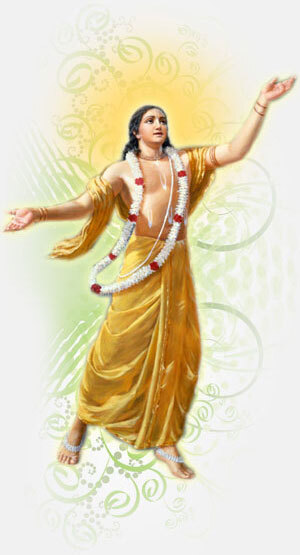
Ishvara Puri was in Gaya at that time. By one account, he lived there for much of his later life, close to the site of Srila Madhavendra Puri's own ashrama. The two met at the Vishnupada temple, where pilgrims go to see the footprint of Lord Vishnu that is said to mark the spot. According to the fuller story in Sri Chaitanya-Bhagavata, Nimai was overcome while hearing the glories of the shrine described, and He fell to the ground. Ishvara Puri came to that same spot and learned from the people there what had happened. When Nimai came back to His senses and saw him, the two fell into each other's arms, both in tears. This was not their first meeting. Ishvara Puri had already known Nimai from his earlier stay in Navadvipa. What was new was the way Nimai now spoke to him. He praised Ishvara Puri as more auspicious than the tirtha itself. In effect, He asked to be delivered, not only blessed. Chaitanya-Bhagavata's account of this exchange is not found on the main digital Sanskrit archives, as Chaitanya-charitamrita is. So what we have in English comes through translation and later retelling. It is not a source that can be checked verse by verse. This is a real gap, and we mention it openly instead of smoothing it over.
The Mantra, Named and Unnamed #
Some time after this reunion, Nimai asked Ishvara Puri directly to initiate Him. Chaitanya-Bhagavata describes a ten-syllable, or dasakshara, mantra being given, but it does not name which mantra it was. Later scholars have suggested an answer. The historian Friedhelm Hardy, citing the researcher Bimanbehari Majumdar, and the writer Steven Rosen both suggest that the mantra was very likely the ten-syllable Gopala-mantra. This mantra is connected with the worship of Krishna as the cowherd boy of Vrindavana. But this is still a conclusion drawn by scholars, not something the earliest texts state outright, and it should be presented only as that. Sri Chaitanya-charitamrita, however, is very clear on one point. It states it in a single line that works almost like a turning point in the text itself: in Gaya, Sri Chaitanya Mahaprabhu was initiated by Ishvara Puri, and immediately afterward He exhibited signs of love of Godhead, signs that appeared again once He returned home. Two short verses carry this whole claim, and Chaitanya-charitamrita adds no doubt or condition to it. Gaudiya theology holds that the Lord has no need of any teacher. Even so, diksha is not described here as a formality that Krishna went through only for the sake of appearances. It is described as the moment after which Nimai Pandita's outward behavior clearly and visibly changed.
A Second, Quieter Meaning #
There is also a scholarly question to mention, alongside the devotional one. Some later Gaudiya sources place Ishvara Puri, through Madhavendra Puri, within the guru-lineage of the Madhva, or Tattvavadi, sampradaya founded by Madhvacharya. Generations later, Srila Baladeva Vidyabhusana would draw on this connection to defend the philosophical position of Gaudiya Vaishnavism. Hardy's research notes that this Madhva link does not appear in the earliest Gaudiya sources. It also notes that neither Madhavendra Puri nor Ishvara Puri is found in the Madhva sampradaya's own recognized guru lists. This is a real point of disagreement among scholars. It concerns how the connection was understood in the earliest generation and how it came to be understood later. None of this changes what Sri Chaitanya-charitamrita itself says about the importance of the initiation. It only means that later tradition speaks more confidently than the earliest sources do about exactly how the formal lineage back to Madhvacharya was drawn.
What is not in dispute is what the initiation did. A pilgrim's duty to his father became, without anyone planning it that way, the moment Sri Chaitanya Mahaprabhu accepted a guru. From that moment, everything the Gaudiya Vaishnava tradition would become had its formal starting point.
