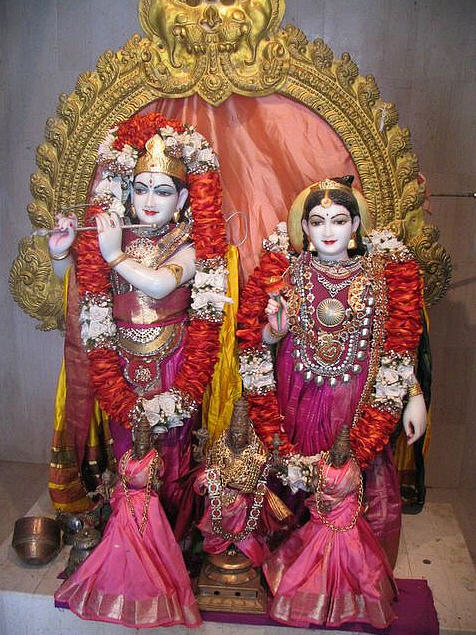
Gaudiya Vaishnavism generally holds that Sri Chaitanya Mahaprabhu's closest associates were not new souls meeting Him for the first time, but eternal companions of Krishna, appearing again to take part in Mahaprabhu's own pastimes. Most of the associates identified this way, Ramananda Raya among them, are traced back to Krishna's cowherd childhood in Vrindavana. Jagadananda Pandita's case is different in one specific way, and this is clearly recorded in the sources. So we should look carefully at exactly what the sources say, and not mix it up with the more familiar Vrindavana pattern.
An Identity Stated in the Text Itself #
Many such identifications rest mainly on Gaura-ganoddesha-dipika, a later work of genealogy by Kavi Karnapura. Jagadananda's case is different. His identity as an incarnation of Satyabhama is stated directly in Sri Chaitanya-charitamrita's own account. It comes in Krishnadasa Kaviraja Goswami's list of the branches of the "Chaitanya tree": "Pandita Jagadananda, the sixth branch of the Caitanya tree, was celebrated as the life and soul of the Lord. He is known to have been an incarnation of Satyabhama [one of the chief queens of Lord Krishna]." The very next verse links the identity directly to his behavior: "They sometimes appeared to fight over trifles, but these quarrels were based on their affection." Gaura-ganoddesha-dipika itself, in its fifty-first verse, states the same identification even more clearly: "Devotees make no inner distinction between Satyabhama and Jagadananda Pandit." Because this identification comes from Sri Chaitanya-charitamrita's main account as well as from Gaura-ganoddesha-dipika, it has more support in the texts than some other identity claims in the tradition.
Dvaraka, Not Vrindavana #
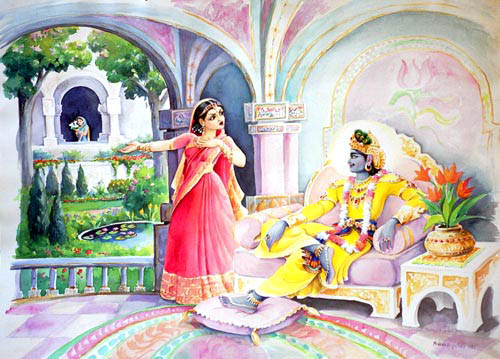
This identity points to the Krishna-lila of Dvaraka, not of Vrindavana. Satyabhama was one of Krishna's principal queens during His household years at Dvaraka, after His childhood in Vrindavana was long over. She is remembered above all for a jealous, possessive, sometimes quarrelsome love for Krishna. Srimad-Bhagavatam describes this love with real affection, not criticism. So Jagadananda's traditional identity is of a different kind from the Vrindavana-gopi identifications given to associates such as Ramananda Raya. Ramananda Raya's identifications as Lalita and Vishakha are drawn from the same Gaura-ganoddesha-dipika. On this reading, Jagadananda's love for Mahaprabhu is not the shy, humble devotion of a gopi hidden in the forest. It is the confident, sometimes demanding love of a queen, who has every right to worry over her Lord's welfare. This matches closely what The Mother's Love for the Lord actually shows him doing.
Vamya-svabhava: Love That Argues #
Sri Chaitanya-charitamrita itself names this particular kind of devotion vamya-svabhava. It is a quarrelsome nature, in which love shows itself through opposition, insistence and open disagreement, not through simple submission. This is the same pattern seen in the sandalwood oil episode and the refused quilt. It is also seen in Sanatana Goswami's own comment that being scolded by Mahaprabhu, as Jagadananda regularly was, was like being given nectar to drink. Sri Chaitanya-charitamrita makes the comparison clear in more than one place. It notes that "Jagadananda Pandita's pure ecstatic love for Sri Chaitanya Mahaprabhu was very deep. It can be compared to the love of Satyabhama, who always quarreled with Lord Krishna," and that he "was accustomed to provoking loving quarrels with the Lord. There was always some disagreement between them." None of this is presented anywhere in the sources as a flaw in his devotion. It is presented as the clearest sign of that devotion. In the tradition's own terms, it proves that Jagadananda's affection for Mahaprabhu ran so deep that he no longer needed the Lord's formal permission to worry about Him out loud.
A Simpler Case Than Most #
Gaura-ganoddesha-dipika identifies dozens of Sri Chaitanya Mahaprabhu's associates this way, and several of the better-known cases are truly complicated or disputed. Ramananda Raya's own Krishna-lila identity is built from two different Arjunas, and there is also an open disagreement over whether he was Lalita or Vishakha. Jagadananda's case is unusual because it is so much simpler. Sri Chaitanya-charitamrita's main narrative and Gaura-ganoddesha-dipika's genealogy agree with each other. They offer only one identity, not several competing ones, and neither text records any rival tradition proposing someone else. Like every claim of this kind, this identification remains a matter of devotional tradition, not recorded history. So this agreement does not make it any easier to prove historically. But it does mean that, for once, there are no different readings here to weigh against each other. We can say with confidence only what the texts themselves say. Sri Chaitanya-charitamrita calls Jagadananda Pandita an incarnation of Satyabhama. It offers this as the explanation for his particular way of loving Mahaprabhu. And no source disputes it.
