No source can say when or where Srila Jagadananda Pandita was born. Sri Chaitanya-charitamrita and Chaitanya-Bhagavata, the two texts that describe him in the most detail, are simply not interested in his life before he met Sri Chaitanya Mahaprabhu. This is common with the Lord's associates. In the tradition, their life stories begin, for practical purposes, on the day they joined Him. What follows is what the sources actually say about his first years in that circle. We should also be clear about what they do not say. They give no birth year, no confirmed village, and no named diksha-guru. Jagadananda appears in the sources only as a direct personal associate of Mahaprabhu Himself, never as the recorded formal disciple of anyone.
At a Glance #
- Present in Sri Chaitanya Mahaprabhu's tightly guarded sankirtana circle in Navadvipa before the Lord accepted sannyasa
- One of a handful of devotees who accompanied Mahaprabhu on the journey from Bengal to Jagannatha Puri after His sannyasa
- Present when a divine mishap broke Mahaprabhu's own sannyasa staff into three pieces
- Among the first devotees to meet Sarvabhauma Bhattacharya, later Mahaprabhu's great convert from Mayavada philosophy
- Settled permanently at Puri as one of the Lord's closest resident companions
Inside the Closed Circle at Navadvipa #
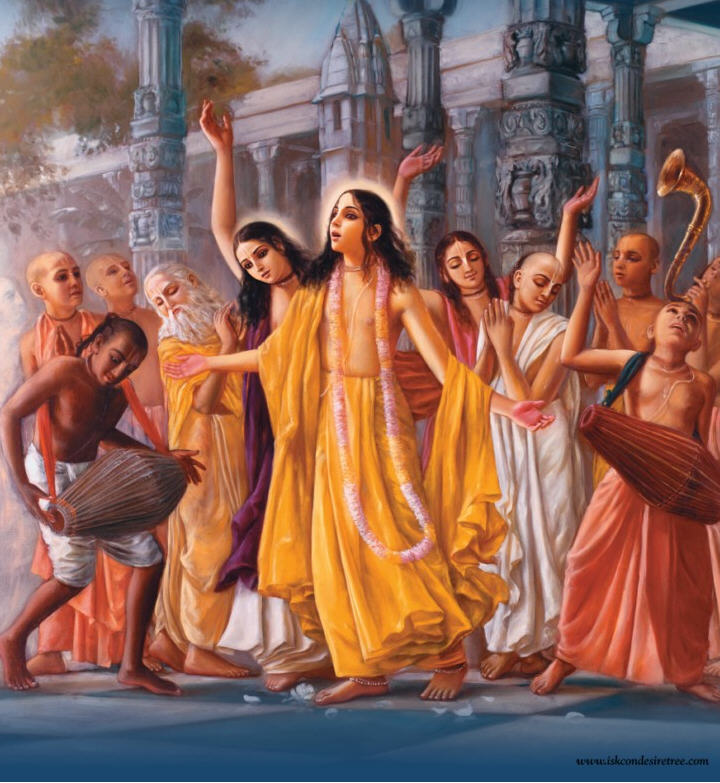
Chaitanya-Bhagavata, by Vrindavana Dasa Thakura, describes the first nights of congregational chanting in Navadvipa, once Sri Chaitanya Mahaprabhu had returned from Gaya and begun the sankirtana movement in earnest. It places Jagadananda Pandita at Srivasa Thakura's courtyard and at Chandrashekhara Acharya's house during those nights. That text names the devotees allowed into those kirtans. They were Nityananda, Gadadhara, Advaita, Srivasa, Vidyanidhi, Murari Gupta, Haridasa, and a short further list that includes Jagadananda. The text says plainly that no one else was permitted to enter while Mahaprabhu danced. English editions of Chaitanya-Bhagavata on its own are not widely available. So this episode is cited here from Sri Chaitanya: His Life & Associates by Srila Bhakti Ballabh Tirtha Maharaja. This is a reliable book by a later author, and it quotes the original verses. From this alone, later writers have reasonably guessed that Jagadananda was born somewhere in Bengal. It is hard to picture him joining such a close, local gathering as an outsider. But it remains a guess, not a recorded fact.
Walking to Puri After Sannyasa #
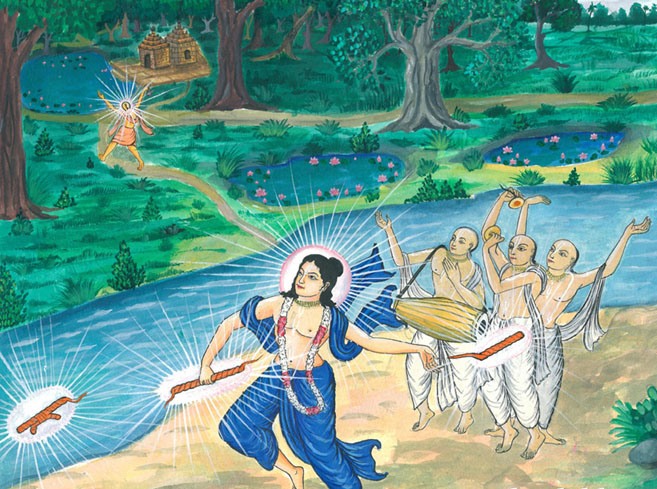
When Sri Chaitanya Mahaprabhu accepted the renounced order in the month of Magha and set out for Jagannatha Puri, Jagadananda was one of the small number who went with Him. Sri Chaitanya-charitamrita's own summary of these years describes how the Lord went alone to see Lord Jagannatha for the first time and fell unconscious in the temple. It records that it was "Nityananda, Jagadananda, Damodara and Mukunda" who came looking for Him and found Him at Sarvabhauma Bhattacharya's house. A separate account in Chaitanya-Bhagavata, also cited here through the same source, gives a slightly different list of companions for the earlier part of the walk itself. It names Nityananda Prabhu, Gadadhara Pandita, Mukunda Datta, Govinda and Brahmananda. This reminds us that on a walking pilgrimage of several weeks, people naturally joined and dropped off along the way. The party was not fixed and unchanging. Both sources agree that Jagadananda was part of it.
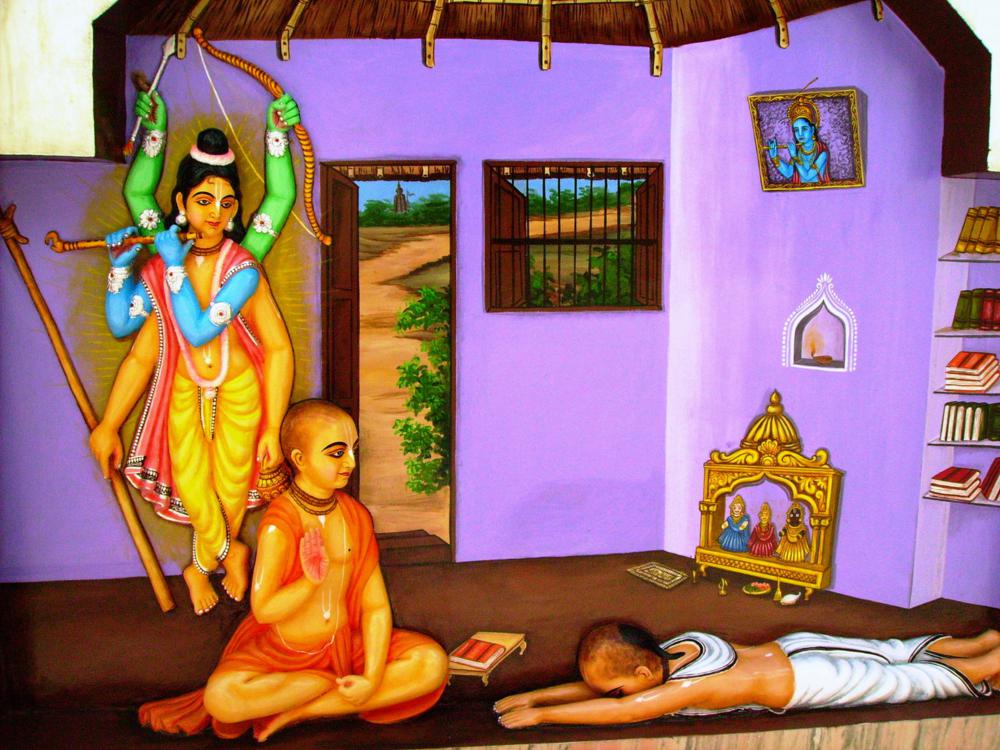
That same walk produced one of the more startling images in the whole tradition. Mahaprabhu had given Jagadananda His own sannyasa staff, the eka-danda, to carry. Jagadananda left it in Nityananda Prabhu's keeping while he went off to beg food. The tradition holds that Nityananda Prabhu is non-different from Balarama Himself. Nityananda Prabhu broke the staff into three pieces. In this way it pointed ahead to the tridanda that Gaudiya Vaishnava sannyasis carry to this day. Jagadananda carried the broken staff back to Mahaprabhu. By Chaitanya-Bhagavata's account, Mahaprabhu became genuinely unhappy at losing His only possession. Then the incident passed, and the party continued on toward Nilachala.
Meeting Sarvabhauma Bhattacharya #
Jagadananda arrived at Sarvabhauma's house and found Mahaprabhu unconscious after His first darshan of Lord Jagannatha. By that same account, this was also Jagadananda's first meeting with Sarvabhauma, the great Vedantist who would soon become one of Mahaprabhu's most celebrated converts. The connection did not end there. Sarvabhauma composed a hundred-verse Sanskrit hymn glorifying Mahaprabhu after a vision of the Lord's six-armed form. He wrote its opening verses on a palm leaf and gave it to Jagadananda to deliver. Mukunda Datta happened to be present when Jagadananda arrived with the leaf and a plate of Jagannatha's prasadam. Mukunda quietly copied the two verses onto a wall before Jagadananda carried them in. That was a good thing, since Mahaprabhu tore up the palm leaf the moment He read a hymn praising Him as God. Because Mukunda had preserved them, the devotees could still read and treasure those two verses, which Sri Chaitanya-charitamrita and the Chaitanya-candrodaya-nataka both record.
A Permanent Place at Puri #
Once Mahaprabhu was settled at Jagannatha Puri, Jagadananda did not return to Bengal to stay. Sri Chaitanya-charitamrita gives a list of the Lord's permanent companions who lived with Him at Puri. It names "Pandita Gosani and other devotees, such as Vakreshvara, Damodara, Shankara and Haridasa Thakura," and right after them "Jagadananda, Bhagavan, Govinda, Kashishvara, Paramananda Puri and Svarupa Damodara" and, finally, Ramananda Raya. All of these were among the Puri residents who stayed with the Lord for the rest of His manifest pastimes. The same text elsewhere groups Jagadananda's own devotional mood with that of Gadadhara Pandita and Svarupa Damodara Goswami. It says that all three relate to Mahaprabhu in the ecstasy of conjugal love, madhura-rasa. This is the most intimate of the moods a devotee can hold toward the Lord. In Jagadananda's case this mood took a very particular form, almost like a mother's care. That is the subject of The Mother's Love for the Lord.
