Srila Jagadananda Pandita
The Life and Soul of the Lord
The complete life, on one page: The main biography and every pastime page, in order, in one place
Introduction
Srila Jagadananda Pandita was one of the small circle of people whom Sri Chaitanya Mahaprabhu kept closest to Him during His years at Jagannatha Puri. Among them he stands out for one very particular reason. He worried about the Lord's body. Other associates were absorbed in Mahaprabhu's moods of spiritual longing. But Jagadananda kept asking simpler questions. Had He eaten? Had He rested? Were His constant austerities wearing Him down? He was bold enough to say so to His face, again and again, for years. Sri Chaitanya-charitamrita calls him prana-rupa, the very life and soul of the Lord. It clearly states that he was an incarnation of Satyabhama, one of Krishna's own queens, appearing again in this pastime. He also left behind Prema-vivarta, a book of Mahaprabhu's pastimes and Gaudiya Vaishnava teaching. Krishnadasa Kaviraja Goswami himself recommended it as a way to understand what love for Krishna actually is.
| Detail | Description |
|---|---|
| Also known as | Jagadananda Pandita, Jaga, Pandita Jagadananda |
| Birthplace | Bengal, though the exact village is disputed; different translations of his own book name either Kumarhatta (present-day Halisahar) or Kanchanpalli, near Navadvipa |
| Identity | Satyabhama, one of Krishna's chief queens (Gaura-ganoddesha-dipika 51; Chaitanya-charitamrita Adi 10.21) |
| Best known for | His outspoken, almost maternal insistence that Sri Chaitanya Mahaprabhu eat and rest properly |
| Literary work | Author of Prema-vivarta, a twenty-chapter Bengali work of pastimes and Gaudiya Vaishnava teaching |
| Closest companions at Puri | Svarupa Damodara Goswami, Govinda, Gadadhara Pandita |
| Disappearance | Not recorded in any source |
Scriptural evidence for the introduction (2)
paṇḍita jagadānanda prabhura prāṇa-rūpa
loke khyāta yeṅho satyabhāmāra svarūpa
Paṇḍita Jagadānanda, the sixth branch of the Caitanya tree, was celebrated as the life and soul of the Lord. He is known to have been an incarnation of Satyabhāmā [one of the chief queens of Lord Kṛṣṇa].
Krishnadasa Kaviraja Goswami names Jagadananda Pandita the life and soul of the Lord and the svarupa of Satyabhama.
केनावान्तरभेदेन भेदं कुर्वन्ति सात्वताः ।
सत्यभामा प्रकाशोऽपि जगदानन्दपण्डितः ॥५१॥
kenāvāntarabhedena bhedaṁ kurvanti sātvatāḥ
satyabhāmā prakāśo'pi jagadānanda-paṇḍitaḥ
The person who appeared in Lord Caitanya's pastimes as Jagadananda Pandita was actually an incarnation of Srimati Satyabhama-devi. What devotee can say otherwise?
Kavi Karnapura's identification of Jagadananda Pandita as a manifestation (prakasha) of Satyabhama, one of Krishna's queens. Sanskrit: diacritic edition of the Gaura-ganoddesha-dipika; English translation as published at bvmlu.org.
Chapter 1
Early Life and Joining Mahaprabhu
An unrecorded birth, a closely guarded circle in Navadvipa, and the walk to Jagannatha Puri
No source can say when or where Srila Jagadananda Pandita was born. Sri Chaitanya-charitamrita and Chaitanya-Bhagavata, the two texts that describe him in the most detail, are simply not interested in his life before he met Sri Chaitanya Mahaprabhu. This is common with the Lord's associates. In the tradition, their life stories begin, for practical purposes, on the day they joined Him. What follows is what the sources actually say about his first years in that circle. We should also be clear about what they do not say. They give no birth year, no confirmed village, and no named diksha-guru. Jagadananda appears in the sources only as a direct personal associate of Mahaprabhu Himself, never as the recorded formal disciple of anyone.
At a Glance #
- Present in Sri Chaitanya Mahaprabhu's tightly guarded sankirtana circle in Navadvipa before the Lord accepted sannyasa
- One of a handful of devotees who accompanied Mahaprabhu on the journey from Bengal to Jagannatha Puri after His sannyasa
- Present when a divine mishap broke Mahaprabhu's own sannyasa staff into three pieces
- Among the first devotees to meet Sarvabhauma Bhattacharya, later Mahaprabhu's great convert from Mayavada philosophy
- Settled permanently at Puri as one of the Lord's closest resident companions
Inside the Closed Circle at Navadvipa #
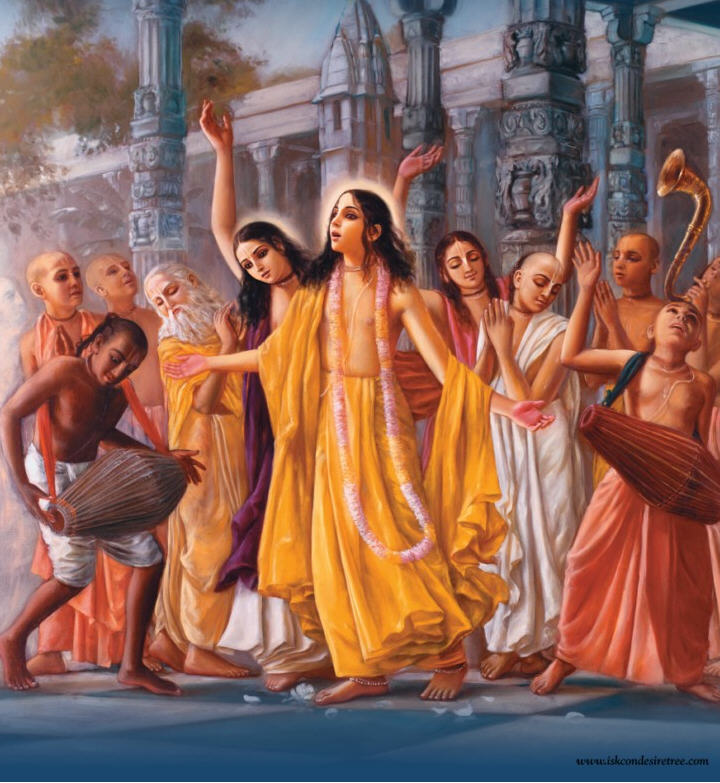
Chaitanya-Bhagavata, by Vrindavana Dasa Thakura, describes the first nights of congregational chanting in Navadvipa, once Sri Chaitanya Mahaprabhu had returned from Gaya and begun the sankirtana movement in earnest. It places Jagadananda Pandita at Srivasa Thakura's courtyard and at Chandrashekhara Acharya's house during those nights. That text names the devotees allowed into those kirtans. They were Nityananda, Gadadhara, Advaita, Srivasa, Vidyanidhi, Murari Gupta, Haridasa, and a short further list that includes Jagadananda. The text says plainly that no one else was permitted to enter while Mahaprabhu danced. English editions of Chaitanya-Bhagavata on its own are not widely available. So this episode is cited here from Sri Chaitanya: His Life & Associates by Srila Bhakti Ballabh Tirtha Maharaja. This is a reliable book by a later author, and it quotes the original verses. From this alone, later writers have reasonably guessed that Jagadananda was born somewhere in Bengal. It is hard to picture him joining such a close, local gathering as an outsider. But it remains a guess, not a recorded fact.
Walking to Puri After Sannyasa #
When Sri Chaitanya Mahaprabhu accepted the renounced order in the month of Magha and set out for Jagannatha Puri, Jagadananda was one of the small number who went with Him. Sri Chaitanya-charitamrita's own summary of these years describes how the Lord went alone to see Lord Jagannatha for the first time and fell unconscious in the temple. It records that it was "Nityananda, Jagadananda, Damodara and Mukunda" who came looking for Him and found Him at Sarvabhauma Bhattacharya's house. A separate account in Chaitanya-Bhagavata, also cited here through the same source, gives a slightly different list of companions for the earlier part of the walk itself. It names Nityananda Prabhu, Gadadhara Pandita, Mukunda Datta, Govinda and Brahmananda. This reminds us that on a walking pilgrimage of several weeks, people naturally joined and dropped off along the way. The party was not fixed and unchanging. Both sources agree that Jagadananda was part of it.
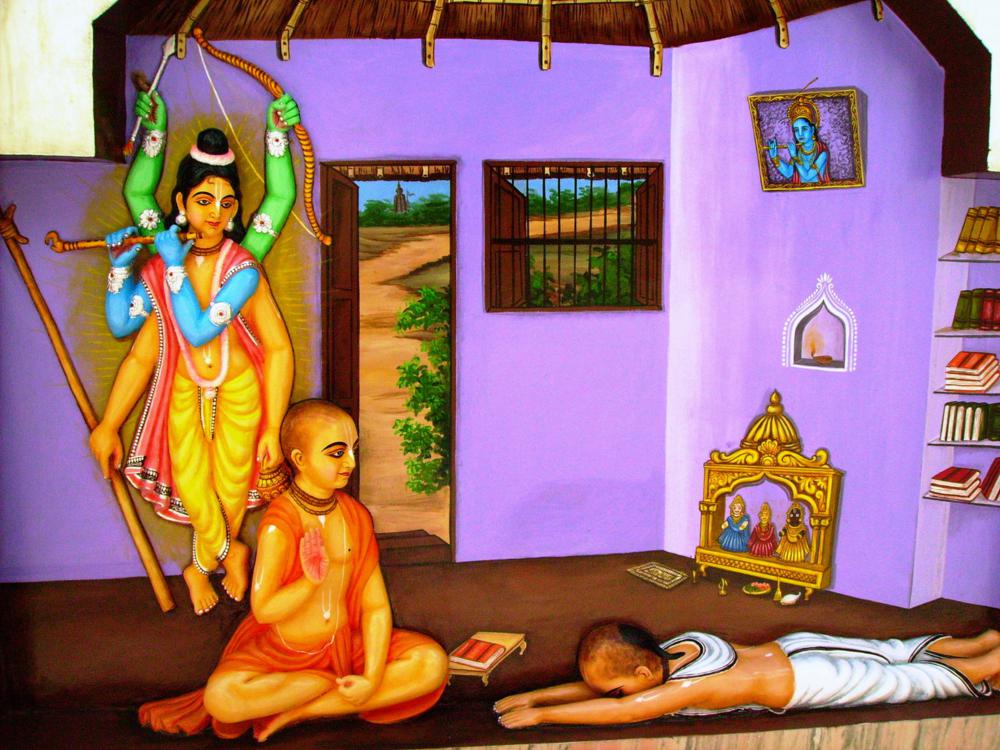
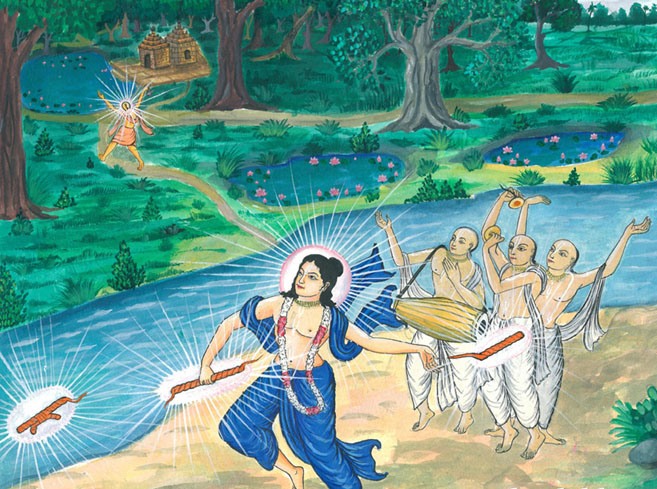
That same walk produced one of the more startling images in the whole tradition. Mahaprabhu had given Jagadananda His own sannyasa staff, the eka-danda, to carry. Jagadananda left it in Nityananda Prabhu's keeping while he went off to beg food. The tradition holds that Nityananda Prabhu is non-different from Balarama Himself. Nityananda Prabhu broke the staff into three pieces. In this way it pointed ahead to the tridanda that Gaudiya Vaishnava sannyasis carry to this day. Jagadananda carried the broken staff back to Mahaprabhu. By Chaitanya-Bhagavata's account, Mahaprabhu became genuinely unhappy at losing His only possession. Then the incident passed, and the party continued on toward Nilachala.
Meeting Sarvabhauma Bhattacharya #
Jagadananda arrived at Sarvabhauma's house and found Mahaprabhu unconscious after His first darshan of Lord Jagannatha. By that same account, this was also Jagadananda's first meeting with Sarvabhauma, the great Vedantist who would soon become one of Mahaprabhu's most celebrated converts. The connection did not end there. Sarvabhauma composed a hundred-verse Sanskrit hymn glorifying Mahaprabhu after a vision of the Lord's six-armed form. He wrote its opening verses on a palm leaf and gave it to Jagadananda to deliver. Mukunda Datta happened to be present when Jagadananda arrived with the leaf and a plate of Jagannatha's prasadam. Mukunda quietly copied the two verses onto a wall before Jagadananda carried them in. That was a good thing, since Mahaprabhu tore up the palm leaf the moment He read a hymn praising Him as God. Because Mukunda had preserved them, the devotees could still read and treasure those two verses, which Sri Chaitanya-charitamrita and the Chaitanya-candrodaya-nataka both record.
A Permanent Place at Puri #
Once Mahaprabhu was settled at Jagannatha Puri, Jagadananda did not return to Bengal to stay. Sri Chaitanya-charitamrita gives a list of the Lord's permanent companions who lived with Him at Puri. It names "Pandita Gosani and other devotees, such as Vakreshvara, Damodara, Shankara and Haridasa Thakura," and right after them "Jagadananda, Bhagavan, Govinda, Kashishvara, Paramananda Puri and Svarupa Damodara" and, finally, Ramananda Raya. All of these were among the Puri residents who stayed with the Lord for the rest of His manifest pastimes. The same text elsewhere groups Jagadananda's own devotional mood with that of Gadadhara Pandita and Svarupa Damodara Goswami. It says that all three relate to Mahaprabhu in the ecstasy of conjugal love, madhura-rasa. This is the most intimate of the moods a devotee can hold toward the Lord. In Jagadananda's case this mood took a very particular form, almost like a mother's care. That is the subject of The Mother's Love for the Lord.
Scriptural evidence for this chapter (6)
nityānanda, jagadānanda, dāmodara, mukunda
pāche āsi' mili' sabe pāila ānanda
Word for word
nityānanda: Nityananda; jagadānanda: Jagadananda; dāmodara: Damodara; mukunda: Mukunda; pāche āsi': coming later; mili': meeting; sabe: all; pāila ānanda: got pleasure.
The Lord had left Nityananda's company and had gone alone to the Jagannatha temple, but later Nityananda, Jagadananda, Damodara and Mukunda came to see Him, and after seeing Him they were very pleased.
Places Jagadananda at Sarvabhauma Bhattacharya's house for Mahaprabhu's first darshan of Lord Jagannatha, right after the Lord's sannyasa staff had been broken on the road.
nityānanda, haridāsa, śrīvāsa, gadādhara
mukunda, jagadānanda, murāri, vakreśvara
Word for word
nityānanda: Lord Nityananda; haridāsa: Haridasa Thakura; śrīvāsa: Srivasa Thakura; gadādhara: Gadadhara Pandita; mukunda: Mukunda; jagadānanda: Jagadananda; murāri: Murari; vakreśvara: Vakreshvara.
All the Vaishnava associates of the Lord were present, including Nityananda Prabhu, Haridasa Thakura, Srivasa Thakura, Gadadhara Pandita, Mukunda, Jagadananda, Murari and Vakreshvara.
Lists Jagadananda among the associates present at Ramakeli when Sri Chaitanya Mahaprabhu first met Rupa and Sanatana Goswami.
purīra vātsalya mukhya, rāmānandera śuddha-sakhya,
govindādyera śuddha-dāsya-rasa
gadādhara, jagadānanda, svarūpera mukhya rasānanda,
ei cāri bhāve prabhu vaśa
Word for word
purīra: of Paramananda Puri; vātsalya mukhya: chiefly paternal affection; rāmānandera: of Ramananda Raya; śuddha-sakhya: pure fraternity; govinda-ādyera: of Govinda and others; śuddha-dāsya-rasa: the pure mellow of service; gadādhara, jagadānanda, svarūpera: of Gadadhara, Jagadananda and Svarupa Damodara; mukhya rasānanda: chiefly tasting conjugal love; ei cāri bhāve: in these four ecstatic moods; prabhu vaśa: the Lord became obliged.
Among His associates, Lord Chaitanya Mahaprabhu enjoyed paternal loving affection from Paramananda Puri, friendly affection with Ramananda Raya, unalloyed service from Govinda and others, and humors of conjugal love with Gadadhara, Jagadananda and Svarupa Damodara.
From the purport: Purport excerpt: "In the presence of His most confidential devotees like Gadadhara Pandita, Jagadananda and Svarupa Damodara, Chaitanya Mahaprabhu enjoyed the ecstatic conditions of Srimati Radharani in Her conjugal relationship with Krishna."
Names Jagadananda's devotional mood specifically as madhura-rasa, conjugal love, shared only with Gadadhara Pandita and Svarupa Damodara Goswami among all of Mahaprabhu's associates.
nityānanda-gosāñi, paṇḍita jagadānanda
dāmodara paṇḍita, āra datta mukunda
ei cāri-jana ācārya dila prabhu sane
jananī prabodha kari' vandila caraṇe
Word for word
nityānanda-gosāñi: Lord Nityananda; paṇḍita jagadānanda: Jagadananda Pandita; dāmodara paṇḍita: Damodara Pandita; āra datta mukunda: and Mukunda Datta; ei cāri-jana: these four persons; ācārya dila prabhu sane: Advaita Acharya sent with the Lord; jananī prabodha kari': pacifying His mother; vandila caraṇe: offered prayers at her feet.
Sri Advaita Acharya sent four persons — Nityananda Gosani, Jagadananda Pandita, Damodara Pandita and Mukunda Datta — to accompany the Lord. After pacifying His mother, Sachimata, Sri Chaitanya Mahaprabhu submitted prayers to her lotus feet.
Shows Advaita Acharya personally choosing Jagadananda as one of only four companions to accompany Mahaprabhu on a visit to His mother Sachi.
Names Jagadananda among the small group allowed into the earliest sankirtana gatherings at Srivasa Thakura's courtyard and Chandrashekhara Acharya's house. No independent English edition of Chaitanya-Bhagavata was consulted directly, so this episode is cited through a reputable secondary account that translates the verses.
Describes Nityananda Prabhu breaking Mahaprabhu's sannyasa staff into three pieces while it was in Jagadananda's keeping, on the walk from Bengal to Puri; cited via the same secondary source as the sankirtana-circle reference above, for the same reason.
Chapter 2
The Mother's Love for the Lord
Sandalwood oil, a broken pot, a forced feast, and a quilt Mahaprabhu refused to sleep on
Sri Chaitanya Mahaprabhu's austerities as a sannyasi at Puri were severe even by the standards of the renounced order. They grew more severe as the years of separation from Krishna deepened. Most of the devotees around Him responded by trying to console His mind. Jagadananda Pandita responded, again and again, by trying to manage His body. He did so with a persistence and a bluntness that no one else in the Lord's circle attempted. Sri Chaitanya-charitamrita directly presents this as coming from his identity as an incarnation of Satyabhama: "Jagadananda Pandita always wanted to see to the comfort of Lord Chaitanya, but since the Lord was a sannyasi He did not accept the luxuries that Jagadananda Pandita offered." The stories below show, verse by verse, what his care for the Lord's comfort actually looked like.
At a Glance #
- Brought scented sandalwood oil from Bengal for Mahaprabhu's head; broke the pot in anger when the Lord refused it
- Fasted for three days until Mahaprabhu personally came to end his fast
- Force-fed the Lord roughly ten times His normal quantity of food out of fear that refusing would restart the fast
- Sewed a quilt and pillow for the Lord's increasingly thin body; was inwardly angry when they were refused
- Often got into what Sri Chaitanya-charitamrita calls "loving quarrels" with the Lord
The Jug of Sandalwood Oil #
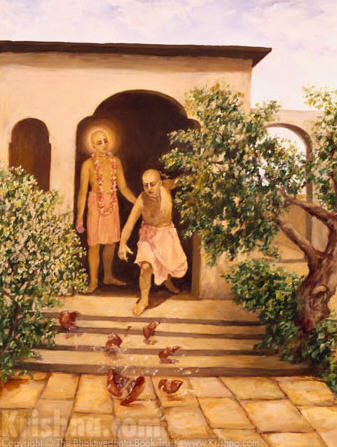
While staying at Shivananda Sena's house in Bengal, Jagadananda had about sixteen seers of fragrant sandalwood oil prepared. He carried the full earthen pot all the way to Puri. There he asked Mahaprabhu's servant Govinda to rub it on the Lord's head, to relieve the headaches brought on by disturbed bile and wind. Mahaprabhu answered at once. A sannyasi had no business with oil, especially scented oil, and Govinda should give it to the Jagannatha temple to burn in the lamps instead. Jagadananda said nothing when Govinda passed on the message. Ten days later, when Govinda raised the matter again, Mahaprabhu grew genuinely irritated: "Why not keep a masseur to massage Me? Have I taken sannyasa for such happiness?" He repeated His refusal. The next morning Jagadananda denied ever bringing any oil at all. He took the jug into the courtyard in front of the Lord and smashed it. Then he bolted his door and lay down without eating.
Three days passed before Mahaprabhu Himself went to Jagadananda's door and asked him, gently, to get up and cook lunch. Jagadananda rose immediately, bathed, and prepared rice, vegetables and sweets on banana leaves. When the food was ready, Mahaprabhu insisted that Jagadananda spread a second leaf and eat beside Him. He sat with His own hands raised and would not touch the meal until Jagadananda, "with great affection and love," agreed to eat first. As He ate, the Lord kept praising the cooking: "Even when you cook in an angry mood, the food is very delicious." Meanwhile Jagadananda, still wanting to make his point, kept serving more and more vegetables. Sri Chaitanya-charitamrita says Mahaprabhu ate about ten times His usual quantity that day. He was afraid that if He refused a single dish, the fast would start again. He stopped only after He had directly asked Jagadananda, twice, to let Him rest. Krishnadasa Kaviraja Goswami closes the episode by comparing the whole exchange to Satyabhama's dealings with Krishna in Srimad-Bhagavatam. He adds that anyone who simply hears about it, "or who reads Jagadananda's book Prema-vivarta, can understand what love is."
A Quilt Against the Plantain Bark #
Some time later, the pain of separation from Krishna had made Mahaprabhu's body so thin that lying on His usual bed of dry plantain bark began to hurt His bones. The devotees around Him could see it. So Jagadananda dyed some cloth red, stuffed it with cotton from a silk-cotton tree, and made it into a quilt and pillow. He asked Govinda to offer them to the Lord, while Svarupa Damodara Goswami worked to talk Mahaprabhu into using them. When the Lord saw the bedding, He became angry at once: "You might as well bring a bedstead here for Me to lie on. Jagadananda wants Me to enjoy material happiness. I am in the renounced order, and therefore I must lie on the floor." He had the bedding put aside and lay back down on the bark. Svarupa Damodara tried once more. He warned that refusing it would cause Jagadananda real unhappiness. But Mahaprabhu held His ground, and Jagadananda was told that the bedding had been completely refused.
Then Svarupa Damodara quietly solved the problem in a different way. With his own nails he shredded dry banana leaves very fine. He stuffed them into two of the Lord's own outer garments to make a simple mattress and pillow. That bedding was humble enough that Mahaprabhu, after much persuading, finally accepted it. Every other devotee was relieved. But Sri Chaitanya-charitamrita says plainly that Jagadananda stayed angry. He hid it outwardly, but inwardly it burned. This same anger, which had not gone away, pushed him soon afterward to ask Mahaprabhu for permission to leave for Vrindavana. It pushed him more than any long-held wish to see holy places, and he asked again and again, very directly. That request, and what came of it, is told in Mission to Vrindavana and Sanatana Goswami.
Why Mahaprabhu Put Up With It #
Mahaprabhu Himself gave the clearest explanation of all this. He gave it not to Jagadananda but to Nityananda Prabhu, when He was explaining why He wanted to tour South India without any companions at all: "Jagadananda wants Me to enjoy bodily sense gratification, and out of fear I do whatever he tells Me. If I sometimes do something against his desire, out of anger he will not talk to Me for three days." This is a remarkable admission. By Gaudiya Vaishnava understanding, He is the Supreme Lord. Yet He describes Himself as being managed, and even made a little afraid, by the sheer force of one devotee's loving insistence. Sri Chaitanya-charitamrita always treats this only as proof of how deep that love ran. Later Gaudiya Vaishnava writers explain it through Jagadananda's identity as an incarnation of Satyabhama (discussed fully in His Identity in Krishna-Lila). In their understanding, this is why he alone among Mahaprabhu's associates was permitted to mother the Lord so openly and so insistently. It was never once called an offense.
Scriptural evidence for this chapter (8)
Quoted in the text above:
- CC Madhya 7.21 Sri Chaitanya-charitamrita
- CC Madhya 7.22 Sri Chaitanya-charitamrita
Further verses:
prītye karite cāhe prabhura lālana-pālana
vairāgya-loka-bhaye prabhu nā māne kakhana
Word for word
prītye: in intimacy or affection; karite cāhe: wanted to do; prabhura: the Lord's; lālana-pālana: maintenance; vairāgya-loka-bhaye: fearing the public in relation to renouncement; prabhu: the Lord; nā māne kakhana: did not accept at any time.
Jagadananda Pandita [as an incarnation of Satyabhama] always wanted to see to the comfort of Lord Chaitanya, but since the Lord was a sannyasi He did not accept the luxuries that Jagadananda Pandita offered.
States in one verse the entire tension found throughout this pastime: Jagadananda's wish to look after the Lord's comfort, and Mahaprabhu's standing refusal of it as a sannyasi.
śuni' prabhu kahe kichu sakrodha vacana
mardaniyā eka rākha karite mardana!
Word for word
śuni': hearing; prabhu kahe: the Lord says; kichu sakrodha vacana: some angry words; mardaniyā eka rākha: keep one masseur; karite mardana: to give massages!
When the Lord heard this, He angrily said, "Why not keep a masseur to massage Me?
Mahaprabhu's exasperated reaction, ten days into Jagadananda's silent campaign to get the sandalwood oil accepted.
eta bali' ghara haite taila-kalasa lañā
prabhura āge āṅgināte phelilā bhāṅgiyā
Word for word
eta bali': saying this; ghara haite: from the room; taila-kalasa lañā: taking the jugful of oil; prabhura āge: in front of Sri Chaitanya Mahaprabhu; āṅgināte: in the courtyard; phelilā bhāṅgiyā: threw it down, breaking it.
After saying this, Jagadananda Pandita took the jug of oil from the room and threw it down before Sri Chaitanya Mahaprabhu in the courtyard and broke it.
The dramatic climax of the sandalwood oil episode: Jagadananda smashing the pot in front of the Lord before beginning his three-day fast.
āgraha kariyā paṇḍita karāilā bhojana
āra dina haite bhojana haila daśa-guṇa
Word for word
āgraha kariyā: with great eagerness; paṇḍita: Jagadananda Pandita; karāilā bhojana: fed; āra dina haite: than on other days; bhojana haila daśa-guṇa: the eating was ten times greater.
Jagadananda Pandita eagerly forced the Lord to eat so much that He ate ten times more than on other days.
The other side of the same episode: once Mahaprabhu agreed to eat, Jagadananda pressed food on Him far beyond His normal quantity.
prabhu kahena, — "khāṭa eka ānaha pāḍite
jagadānanda cāhe āmāya viṣaya bhuñjāite
Word for word
prabhu kahena: Sri Chaitanya Mahaprabhu said; khāṭa eka ānaha pāḍite: bring a bedstead for Me to lie on; jagadānanda cāhe: Jagadananda wants; āmāya viṣaya bhuñjāite: to cause Me to enjoy material happiness.
Sri Chaitanya Mahaprabhu replied, "You might as well bring a bedstead here for Me to lie on. Jagadananda wants Me to enjoy material happiness.
Mahaprabhu's sarcastic first reaction on seeing the quilt and pillow Jagadananda had made for Him.
sannyāsī mānuṣa āmāra bhūmite śayana
āmāre khāṭa-tūli-bālisa mastaka-muṇḍana"
Word for word
sannyāsī mānuṣa: a person in the renounced order; āmāra bhūmite śayana: My lying on the floor; āmāre khāṭa-tūli-bālisa: for Me a bedstead, quilt, pillow; mastaka-muṇḍana: a great shame.
"I am in the renounced order, and therefore I must lie on the floor. For Me to use a bedstead, quilt or pillow would be very shameful."
Mahaprabhu's stated reason for refusing the bedding: a matter of principle for a sannyasi, not a rejection of Jagadananda's love.
Chapter 3
Mission to Vrindavana and Sanatana Goswami
Two months in Vraja, a misunderstood saffron cloth, and a public lesson in Vaishnava etiquette
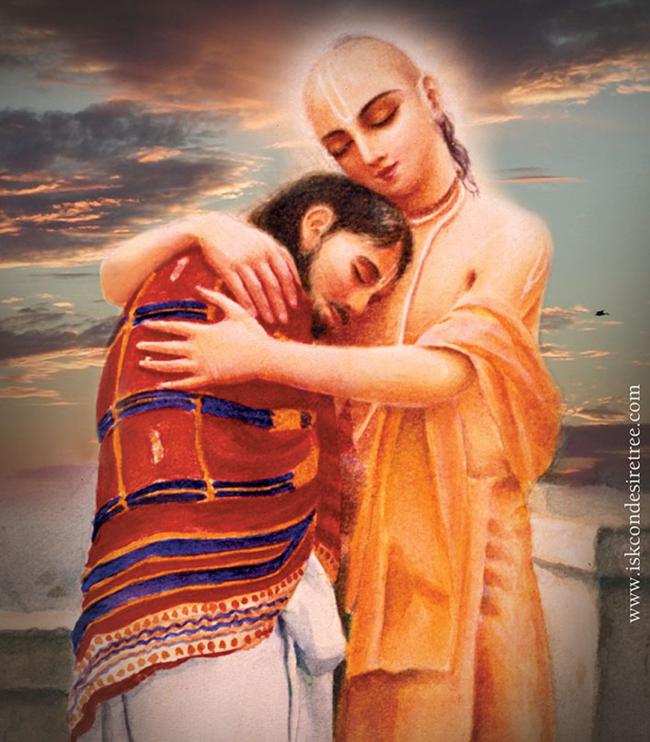
Jagadananda Pandita's bond with Sanatana Goswami led to two of the most memorable episodes in his life. In one, Jagadananda traveled a long way to see Sanatana. In the other, Jagadananda gave Sanatana some advice that Sanatana had not asked for. He gave it with the best intentions, but Sri Chaitanya Mahaprabhu openly corrected him for it. Sri Chaitanya-charitamrita tells both stories in full. Read together, they say as much about Vaishnava etiquette as they do about Jagadananda himself.
Asking, Again and Again, to Go #
Jagadananda had wanted to see Vrindavana for a long time before Mahaprabhu agreed to it. The time when permission finally came was not an accident. It came soon after the disappointment of the refused quilt and pillow, described in The Mother's Love for the Lord. Jagadananda was still privately upset that his bedding had been turned down, and he asked to go to Mathura instead. Mahaprabhu saw through it immediately: "If you are angry with Me when you go to Mathura, you will merely become a beggar and criticize Me." Jagadananda kept asking anyway. He insisted that his wish to see Vrindavana went back much further than any recent disappointment. When the Lord still refused, Jagadananda asked Svarupa Damodara Goswami to speak to the Lord for him. Svarupa Damodara's appeal worked. Mahaprabhu granted permission, embraced Jagadananda, and sent him off with detailed, almost fatherly instructions. He was to travel carefully beyond Varanasi, where bandits target lone Bengalis. He was to stay with Sanatana Goswami and not leave his side. He was to visit all twelve forests of Vraja but not remain there long. Above all, he was not to climb Govardhana Hill to see the Deity of Gopala. Jagadananda was also asked to carry a private message. It said that Mahaprabhu intended to visit Vrindavana again Himself, and that Sanatana should start preparing a place for Him to stay.
Two Months With Sanatana Goswami #
Jagadananda traveled on foot. Along the way he met Tapana Mishra and Chandrashekhara Acharya in Varanasi, and then he reached Mathura and Sanatana Goswami. The two of them toured all twelve forests of Vrindavana together. Then they stayed for a while in Gokula, sharing Sanatana's cave, while Sanatana begged alms door to door. Jagadananda was not used to eating only plain begged wheat, so he did not follow that practice. He cooked rice for himself at a nearby temple instead. One day Jagadananda invited Sanatana to eat. Sanatana arrived wearing a reddish cloth around his head, which another sannyasi, Mukunda Sarasvati, had given him. For a moment Jagadananda thought it was a gift from Mahaprabhu, and he was overcome with emotion. When he learned that it was not, he became so angry that he reached for a cooking pot. He demanded to know how someone so close to the Lord could wear a cloth from anyone else. Sanatana's reply turned the scolding into praise: "My purpose in binding my head with the cloth has now been fulfilled because I have personally seen your uncommon love for Sri Chaitanya Mahaprabhu... I shall give it to a stranger." After two months, the separation from Mahaprabhu became too hard to bear any longer, and the two men parted. Sanatana sent Jagadananda home with sand from the site of Krishna's rasa dance, a stone from Govardhana Hill, a garland of small conchshells, and a bundle of dried, ripe pilu fruits for the Lord.
A Public Correction Over Etiquette #
The second episode happened earlier, during Sanatana Goswami's time at Puri, before the Vrindavana journey described above. At that time Sanatana had long-lasting sores from an old illness. They caused him real distress every time Mahaprabhu embraced him, because he feared that the fluid from the sores touching the Lord's body was itself an offense. Sanatana was troubled and unsure what to do, so he asked Jagadananda for advice. Jagadananda told him plainly to return to Vrindavana once the Ratha-yatra festival was over. When Mahaprabhu learned that Sanatana meant to leave on Jagadananda's advice, He became openly angry with Jagadananda: "Jaga is only a new boy, but he has become so proud that he thinks himself competent to advise a person like you... In affairs of spiritual advancement and even in ordinary dealings, you are on the level of his spiritual master. Yet not knowing his own value, he dares to advise you." Sanatana himself calmed the situation. He fell at the Lord's feet and said he now understood how fortunate Jagadananda was to be scolded in such a close, personal way. He said that his own more formal, respectful treatment from Mahaprabhu was like being given "the bitter juice of nimba and nisinda" next to the nectar Jagadananda received. Once Mahaprabhu had made His point about etiquette, He explained Himself directly: "Please do not think that Jagadananda is more dear to Me than you. However, I cannot tolerate transgressions of the standard etiquette."
Srila Prabhupada returned to this same episode centuries later in a 1973 lecture at Mayapur. He used it to show that even Mahaprabhu's most confidential associates were expected to respect seniority and correct conduct within the Vaishnava community. This episode also helps us understand the warmth of the later cloth episode above. By the time the two of them were laughing together in Sanatana's cave at Gokula, the lesson about etiquette had clearly not harmed their friendship at all.
Scriptural evidence for this chapter (11)
dui-jana vasi' kṛṣṇa-kathā-goṣṭhī kailā
paṇḍitere sanātana duḥkha nivedilā
Word for word
dui-jana vasi': both of them sitting; kṛṣṇa-kathā-goṣṭhī kailā: discussed topics of Krishna; paṇḍitere: unto Jagadananda Pandita; sanātana: Sanatana Gosvami; duḥkha nivedilā: submitted his unhappiness.
When Jagadananda Pandita and Sanatana Gosvami sat together and began to discuss topics about Krishna, Sanatana Gosvami submitted to Jagadananda Pandita the cause of his distress.
Opens the episode in which Sanatana Gosvami, troubled by his bodily illness, turns to Jagadananda for advice: a request that will bring Mahaprabhu's public correction on both of them.
"kālikāra baṭuyā jagā aiche garvī haila
tomā-sabāreha upadeśa karite lāgila
Word for word
kālikāra baṭuyā: a new boy; jagā: Jagadananda Pandita; aiche garvī haila: has become so proud; tomā-sabāreha: persons like you; upadeśa karite lāgila: has begun to advise.
"Jaga [Jagadananda Pandita] is only a new boy, but he has become so proud that he thinks himself competent to advise a person like you.
Mahaprabhu's sharp public rebuke of Jagadananda for advising the senior, learned Sanatana Gosvami: a lesson in Vaishnava etiquette aimed at the whole community, not only at Jagadananda.
jagadānande piyāo ātmīyatā-sudhā-rasa
more piyāo gaurava-stuti-nimba-niśindā-rasa
Word for word
jagadānande: unto Jagadananda Pandita; piyāo: You cause to drink; ātmīyatā-sudhā-rasa: the nectar of affectionate relations; more piyāo: You cause me to drink; gaurava-stuti: honorable prayers; nimba-niśindā-rasa: the juice of nimba fruit and nisindā.
"Sir, You are making Jagadananda drink the nectar of affectionate relationships, whereas by offering me honorable prayers, You are making me drink the bitter juice of nimba and nisindā.
Sanatana Gosvami's own generous reading of the rebuke he had just witnessed, naming exactly how much more intimate Jagadananda's relationship with Mahaprabhu was than his own.
'jagadānanda priya āmāra nahe tomā haite
maryādā-laṅghana āmi nā pāroṅ sahite
Word for word
jagadānanda: Jagadananda Pandita; priya āmāra: dear to Me; nahe tomā haite: is not more than you; maryādā-laṅghana: transgressing the etiquette; āmi nā pāroṅ sahite: I cannot tolerate.
"My dear Sanatana, please do not think that Jagadananda is more dear to Me than you. However, I cannot tolerate transgressions of the standard etiquette.
Mahaprabhu's own resolution of the episode: the correction was about maintaining Vaishnava etiquette, not about ranking His love for one associate above another.
svarūpa-gosāñi āsi' paṇḍite kahilā
śuni' jagadānanda mane mahā-duḥkha pāilā
Word for word
svarūpa-gosāñi āsi': Svarupa Damodara Goswami returning; paṇḍite kahilā: told Jagadananda Pandita; śuni': hearing; jagadānanda: Jagadananda Pandita; mane mahā-duḥkha pāilā: felt great unhappiness within his mind.
When Svarupa Damodara returned and related all these incidents, Jagadananda Pandita felt very unhappy.
The unresolved disappointment over the refused bedding that, a few verses later, pushes Jagadananda to ask for permission to leave for Vrindavana.
eta bali' jagadānande kailā āliṅgana
jagadānanda calilā prabhura vandiyā caraṇa
Word for word
eta bali': saying this; jagadānande kailā āliṅgana: embraced Jagadananda Pandita; jagadānanda calilā: Jagadananda Pandita proceeded; prabhura vandiyā caraṇa: after worshiping the Lord's feet.
After saying this, the Lord embraced Jagadananda Pandita, who then worshiped the Lord's lotus feet and started for Vrindavana.
Mahaprabhu finally sends Jagadananda off to Vrindavana with an embrace, after the detailed travel instructions recorded in the preceding verses.
sanātana paṇḍitera kare samādhāna
mahāvane dena āni' māgi' anna-pāna
Word for word
sanātana: Sanatana Gosvami; paṇḍitera kare samādhāna: gave all kinds of service to Jagadananda Pandita; mahāvane: at Mahavana; dena āni' māgi': brings by begging; anna-pāna: food and drink.
Sanatana Gosvami attended to all of Jagadananda Pandita's needs. He begged in the area of Mahavana and brought Jagadananda all kinds of things to eat and drink.
A small, telling reversal: in Vrindavana it is the senior Sanatana Gosvami who personally serves and feeds Jagadananda.
"tumi mahāprabhura hao pārṣada-pradhāna
tomā-sama mahāprabhura priya nāhi āna
Word for word
tumi: you; mahāprabhura pārṣada-pradhāna: one of the chief associates of Sri Chaitanya Mahaprabhu; tomā-sama: like you; mahāprabhura priya nāhi āna: no one else is dear to the Lord.
"You are one of the chief associates of Sri Chaitanya Mahaprabhu. Indeed, no one is dearer to Him than you.
Jagadananda's own outraged words to Sanatana Gosvami over the saffron cloth, revealing how highly he actually held Sanatana even while scolding him.
rakta-vastra 'vaiṣṇavera' parite nā yuyāya
kona pravāsīre dimu, ki kāya uhāya?
Word for word
rakta-vastra: saffron cloth; vaiṣṇavera parite nā yuyāya: is not fit for a Vaishnava to wear; kona pravāsīre dimu: I shall give it to some outsider; ki kāya uhāya: what business is there with that.
"This saffron cloth is unfit for a Vaishnava to wear; therefore I have no use for it. I shall give it to a stranger."
From the purport: Purport excerpt: "A Vaishnava accepts sannyasa out of humility, not out of pride," per Srila Bhaktisiddhanta Sarasvati Thakura's comment on this verse.
Sanatana Gosvami's graceful reply, turning Jagadananda's anger into an object lesson on Vaishnava humility.
jagadānanda-paṇḍita tabe ājñā māgilā
sanātana prabhure kichu bheṭa-vastu dilā
Word for word
jagadānanda-paṇḍita: Jagadananda Pandita; tabe ājñā māgilā: then asked permission; sanātana: Sanatana Gosvami; prabhure kichu bheṭa-vastu dilā: presented some gifts for Sri Chaitanya Mahaprabhu.
When Sanatana Gosvami granted permission for Jagadananda to return to Jagannatha Puri, he gave Jagadananda some gifts for Lord Chaitanya Mahaprabhu.
The moment of parting after two months together, and the origin of the pilu-fruit gifts Jagadananda carries back to Puri.
prabhura caraṇa vandi' sabāre mililā
mahāprabhu tāṅre dṛḍha āliṅgana kailā
Word for word
prabhura caraṇa vandi': offering prayers to the Lord's lotus feet; sabāre mililā: he met everyone; mahāprabhu tāṅre dṛḍha āliṅgana kailā: Sri Chaitanya Mahaprabhu embraced him very strongly.
After offering prayers at the lotus feet of Sri Chaitanya Mahaprabhu, Jagadananda Pandita greeted everyone. Then the Lord embraced Jagadananda very strongly.
Mahaprabhu's warm welcome on Jagadananda's return from the two-month mission to Vrindavana.
Chapter 4
Writing Prema-vivarta
Twenty chapters moving from childhood memories of Mahaprabhu to the highest Gaudiya Vaishnava teaching
Prema-vivarta is the only book Srila Jagadananda Pandita is known to have written. It is a real work of Gaudiya Vaishnava literature, valuable for its own sake, not just a curiosity attached to a famous name. In Sri Chaitanya-charitamrita, Krishnadasa Kaviraja Goswami praises it directly: "Anyone who hears about the loving exchanges between Jagadananda Pandita and Sri Chaitanya Mahaprabhu, or who reads Jagadananda's book Prema-vivarta, can understand what love is. Moreover, he achieves ecstatic love of Krishna." Bhaktisiddhanta Sarasvati Thakura's own commentary on that verse points out that the Bengali phrase prema-vivarta can be read in two ways at once. It can mean the confused, quarrelling changes that Jagadananda's love went through in his dealings with the Lord. It is also the literal title of the book he wrote about them. Both meanings are almost certainly meant together.
Why and How It Was Written #
Translators of Prema-vivarta say that Jagadananda wrote it at the request of fellow devotees. They give special credit to Svarupa Damodara Goswami for encouraging him to write down his memories for others to read. Jagadananda writes in a very personal way for this kind of literature. By one translation, he writes, "I write whatever comes to my mind about Gauranga's pastimes, whenever it does, even if it is out of sequence," and he describes the act of writing it in almost physical terms: "My mind cries, my heart cries, my eyes cry, and whenever something comes to mind, I write it down." This openness shows in the book's structure. It moves freely between his own memories and formal teaching, without much concern for strict order.
What the Book Actually Contains #
Prema-vivarta has twenty chapters in its standard form, and they fall roughly into three parts. The first several chapters explain core Gaudiya Vaishnava theology. They teach that Radha and Krishna are non-different, and that Sri Chaitanya Mahaprabhu is their combined, non-dual appearance. Then the book turns to Jagadananda's own memories of Mahaprabhu's childhood in Navadvipa. These include schoolyard quarrels, wrestling matches on the banks of the Ganges, and trips into the forests around Nadia with Mahaprabhu and Gadadhara Pandita. They also include pastimes that are recorded nowhere else. One is an account of Mahaprabhu freeing a celestial being who had been trapped for ages in the body of a crocodile in a Navadvipa lake. A long middle section then turns to philosophy in a more usual sense. It covers the nature of the soul, and the difference between genuine renunciation (yukta-vairagya) and its false, joyless imitation (phalgu-vairagya). It explains why birth and caste have nothing to do with real devotion. It also covers the company of saints and the different levels of Vaishnava practitioners, from beginner to perfected soul. The final chapters are almost entirely about the holy name: its power, the ten offenses against it, and how it stands above every other religious practice. In this way, a book that began as a set of personal memories closes with some of the tradition's most direct teaching on chanting.
There is one verse of Prema-vivarta that Srila Prabhupada quotes directly in his own published work. In all likelihood, he took it from this closing section. In his purport to Srimad-Bhagavatam 6.13.8-9, he discusses how the holy name can free even the gravest sinner from reactions built up over many lifetimes. There Prabhupada writes, "Also, in the Prema-vivarta by Jagadananda Pandita it is said: eka krishna-name papira yata papa-ksaya, bahu janme sei papi karite naraya," and then he gives its meaning. As he renders it, by once chanting the Lord's holy name, a person can be freed from more sinful reactions than he could even manage to commit in many lifetimes. It is a small detail, but an important one. Nearly four and a half centuries after the book was written, one of Jagadananda's own verses was still doing exactly the work he wrote the book to do.
An Honest Note on His Birthplace #
The introductions to two different modern English translations of Prema-vivarta disagree about where Jagadananda Pandita actually came from. One, published by The Gaudiya Treasures of Bengal, states that "from this book, we come to know that Srila Jagadananda Pandita had been a resident of Kumarhatta (present-day Halisahar). He belonged to the same village as that of Shivananda Sena and Kavi Karnapura." Another modern edition instead places his early years at Kanchanpalli, a village south of Navadvipa, and adds that he received part of his spiritual education from Shivananda Sena. Sri Chaitanya-charitamrita and the Chaitanya-Bhagavata passages quoted in other sources do not settle the question either way. No source explains why the two translations differ. So both claims are reported here and the question is left open, instead of choosing one as if it were certain.
Scriptural evidence for this chapter (2)
Quoted in the text above:
- CC Antya 12.154 Sri Chaitanya-charitamrita
Further verses:
From the purport: Purport excerpt: "Also, in the Prema-vivarta by Jagadananda Pandita it is said: eka krishna-name papira yata papa-ksaya, bahu janme sei papi karite naraya" — rendered by Srila Prabhupada as meaning one chanting of the holy name can free a person from more sinful reactions than he could commit in many lifetimes.
The one place Srila Prabhupada is known to quote Prema-vivarta directly in his own published books, using it to illustrate the power of the holy name to free even a great sinner from his reactions.
Chapter 5
His Identity in Krishna-Lila
Why Sri Chaitanya-charitamrita itself, and not only later tradition, says he was Satyabhama appearing again
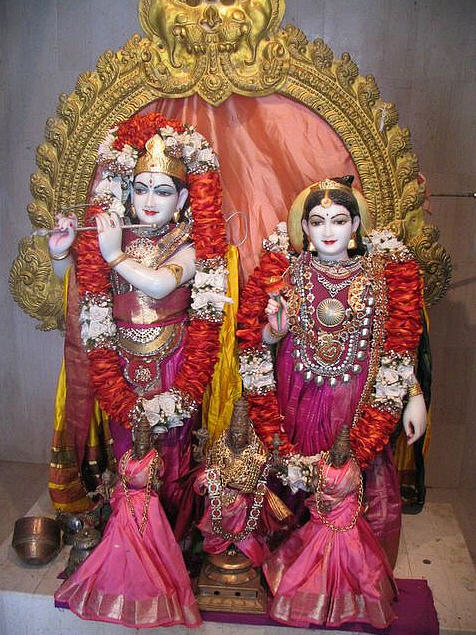
Gaudiya Vaishnavism generally holds that Sri Chaitanya Mahaprabhu's closest associates were not new souls meeting Him for the first time, but eternal companions of Krishna, appearing again to take part in Mahaprabhu's own pastimes. Most of the associates identified this way, Ramananda Raya among them, are traced back to Krishna's cowherd childhood in Vrindavana. Jagadananda Pandita's case is different in one specific way, and this is clearly recorded in the sources. So we should look carefully at exactly what the sources say, and not mix it up with the more familiar Vrindavana pattern.
An Identity Stated in the Text Itself #
Many such identifications rest mainly on Gaura-ganoddesha-dipika, a later work of genealogy by Kavi Karnapura. Jagadananda's case is different. His identity as an incarnation of Satyabhama is stated directly in Sri Chaitanya-charitamrita's own account. It comes in Krishnadasa Kaviraja Goswami's list of the branches of the "Chaitanya tree": "Pandita Jagadananda, the sixth branch of the Caitanya tree, was celebrated as the life and soul of the Lord. He is known to have been an incarnation of Satyabhama [one of the chief queens of Lord Krishna]." The very next verse links the identity directly to his behavior: "They sometimes appeared to fight over trifles, but these quarrels were based on their affection." Gaura-ganoddesha-dipika itself, in its fifty-first verse, states the same identification even more clearly: "Devotees make no inner distinction between Satyabhama and Jagadananda Pandit." Because this identification comes from Sri Chaitanya-charitamrita's main account as well as from Gaura-ganoddesha-dipika, it has more support in the texts than some other identity claims in the tradition.
Dvaraka, Not Vrindavana #
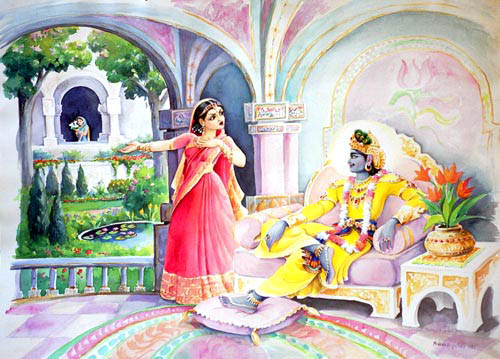
This identity points to the Krishna-lila of Dvaraka, not of Vrindavana. Satyabhama was one of Krishna's principal queens during His household years at Dvaraka, after His childhood in Vrindavana was long over. She is remembered above all for a jealous, possessive, sometimes quarrelsome love for Krishna. Srimad-Bhagavatam describes this love with real affection, not criticism. So Jagadananda's traditional identity is of a different kind from the Vrindavana-gopi identifications given to associates such as Ramananda Raya. Ramananda Raya's identifications as Lalita and Vishakha are drawn from the same Gaura-ganoddesha-dipika. On this reading, Jagadananda's love for Mahaprabhu is not the shy, humble devotion of a gopi hidden in the forest. It is the confident, sometimes demanding love of a queen, who has every right to worry over her Lord's welfare. This matches closely what The Mother's Love for the Lord actually shows him doing.
Vamya-svabhava: Love That Argues #
Sri Chaitanya-charitamrita itself names this particular kind of devotion vamya-svabhava. It is a quarrelsome nature, in which love shows itself through opposition, insistence and open disagreement, not through simple submission. This is the same pattern seen in the sandalwood oil episode and the refused quilt. It is also seen in Sanatana Goswami's own comment that being scolded by Mahaprabhu, as Jagadananda regularly was, was like being given nectar to drink. Sri Chaitanya-charitamrita makes the comparison clear in more than one place. It notes that "Jagadananda Pandita's pure ecstatic love for Sri Chaitanya Mahaprabhu was very deep. It can be compared to the love of Satyabhama, who always quarreled with Lord Krishna," and that he "was accustomed to provoking loving quarrels with the Lord. There was always some disagreement between them." None of this is presented anywhere in the sources as a flaw in his devotion. It is presented as the clearest sign of that devotion. In the tradition's own terms, it proves that Jagadananda's affection for Mahaprabhu ran so deep that he no longer needed the Lord's formal permission to worry about Him out loud.
A Simpler Case Than Most #
Gaura-ganoddesha-dipika identifies dozens of Sri Chaitanya Mahaprabhu's associates this way, and several of the better-known cases are truly complicated or disputed. Ramananda Raya's own Krishna-lila identity is built from two different Arjunas, and there is also an open disagreement over whether he was Lalita or Vishakha. Jagadananda's case is unusual because it is so much simpler. Sri Chaitanya-charitamrita's main narrative and Gaura-ganoddesha-dipika's genealogy agree with each other. They offer only one identity, not several competing ones, and neither text records any rival tradition proposing someone else. Like every claim of this kind, this identification remains a matter of devotional tradition, not recorded history. So this agreement does not make it any easier to prove historically. But it does mean that, for once, there are no different readings here to weigh against each other. We can say with confidence only what the texts themselves say. Sri Chaitanya-charitamrita calls Jagadananda Pandita an incarnation of Satyabhama. It offers this as the explanation for his particular way of loving Mahaprabhu. And no source disputes it.
Scriptural evidence for this chapter (5)
Quoted in the text above:
- CC Ādi 10.21 Sri Chaitanya-charitamrita
- CC Ādi 10.23 Sri Chaitanya-charitamrita
- CC Antya 7.142 Sri Chaitanya-charitamrita
- Verse 51 Gaura-ganoddesha-dipika
Further verses:
bāra-bāra praṇaya kalaha kare prabhu-sane
anyo-'nye khaṭmaṭi cale dui-jane
Word for word
bāra-bāra: again and again; praṇaya kalaha: loving quarrel; kare prabhu-sane: makes with the Lord; anyo-'nye khaṭmaṭi: mutual picking of quarrel; cale dui-jane: goes on between the two.
Jagadananda Pandita was accustomed to provoking loving quarrels with the Lord. There was always some disagreement between them.
Confirms that the quarrelsome dynamic was habitual and mutual, not a single incident.
Chapter 6
Final Days and Legacy
Advaita Acharya's riddle, an unrecorded disappearance, and a book still read today
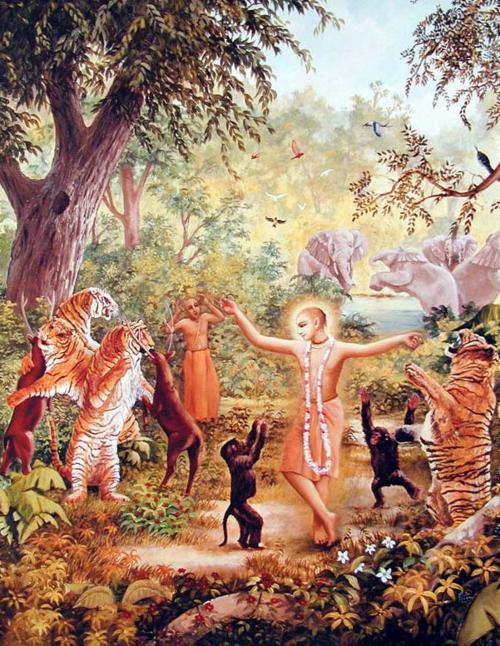
In the sources, Srila Jagadananda Pandita's story does not really come to an end. The record about him simply stops. He remained one of Sri Chaitanya Mahaprabhu's closest companions at Puri through the Lord's later years. The last clearly dated episode involving him is a quiet one. He carried a message between two people who loved each other very much and could no longer see each other often.
The Last Journey to Navadvipa #
His mother, Sachi Devi, missed Him deeply. Out of concern for her, every year Mahaprabhu sent Jagadananda to Navadvipa with prasadam and cloth, and with a set of tender, private words for her: "Tell her for Me, 'Please remember that I come here every day and offer My respects to your lotus feet... I am staying here at Nilachala, Jagannatha Puri, according to your order. As long as I live, I shall not leave this place.'" On what the sources describe as his last such trip, Jagadananda also visited Advaita Acharya. Advaita Acharya gave him a short verse to carry back to Mahaprabhu, deliberately written like a riddle. Sri Chaitanya-charitamrita says it was written "in equivocal language with an import that Sri Chaitanya Mahaprabhu could understand but others could not." On the surface, it spoke of a marketplace where rice was no longer being sold, because everyone had gone mad. When Svarupa Damodara Goswami asked what it meant, Mahaprabhu explained that even He did not fully know what was in Advaita Acharya's mind, only that it was "His order." What is clearly recorded is the effect of the verse. Reading it threw Mahaprabhu into an ecstasy so intense that the devotees feared for His life. Svarupa Damodara had to ask Shankara Pandita to sit with the Lord through the night, to keep Him from injuring His own face against the walls.
What Is Not Known #
No source records when, where or how Jagadananda Pandita left this world. This is true of Sri Chaitanya-charitamrita, of the Chaitanya-Bhagavata passages quoted in other sources, and of Prema-vivarta's own modern translators. Gaudiya History's own biography of him states this plainly. It says that the date and place of his birth are unknown, and so are the date and place of his disappearance. This is not unusual for the period. For several of Mahaprabhu's closest associates, the record is silent in the same way. This is because the tradition's biographers were generally more interested in what a devotee did for the Lord than in the ordinary facts of a life. It would be dishonest to fill that gap with an invented date just to make the account neat. So it is left open here, as the sources leave it.
What Remains #
What does survive is Prema-vivarta itself. It is still read, and in the twenty-first century it is still being translated into English by more than one publisher. Jagadananda also has a reputation inside Gaudiya Vaishnavism that has not faded with time. Srila Prabhupada quoted a verse from the book directly in his purport to Srimad-Bhagavatam, where he discusses the power of the holy name (a detail told fully in Writing Prema-vivarta). He also returned to Jagadananda's own story more than once in his lectures. One of these was a 1973 talk at Mayapur retelling the exchange with Sanatana Goswami over Vaishnava etiquette. More than anything, though, Jagadananda Pandita left behind a particular idea of what love for God can look like. It is not only folded hands and quiet submission. It is also the boldness to break a jug of oil in anger, and to force the Lord to eat a proper meal when, as an ascetic, He did not want to. It is the boldness to keep worrying, out loud and without apology, about whether the Lord he loved was taking care of Himself. Sri Chaitanya-charitamrita always treats that boldness as devotion of the highest kind. In the centuries since, the tradition that still calls him the life and soul of the Lord has treated it the same way.
Still in Print #
Prema-vivarta has not been left to sit unread. Separate English translations have been published in recent years by Gaudiya Darshan, by SCSMath International, and by The Gaudiya Treasures of Bengal, whose translators write that they consider it "immensely valuable to the followers of Sri Chaitanya Mahaprabhu" and hope its teachings will be "eternally celebrated in this world." Bengali editions of the original text are also preserved and freely available through the Internet Archive. The book has no confirmed date of composition, and its author's own birth and death dates are both unrecorded. For such a book, this is a great legacy. A private set of memories and teachings, written down at a friend's request, is still finding new readers roughly four and a half centuries after Jagadananda Pandita set them down.
Scriptural evidence for this chapter (2)
bāulake kahiha, — loka ha-ila bāula
bāulake kahiha, — hāṭe nā vikāya cāula
Word for word
bāulake kahiha: please inform Sri Chaitanya Mahaprabhu, the madman in ecstatic love; loka ha-ila bāula: the people have become mad; hāṭe nā vikāya cāula: rice is no longer sold in the market.
"Please inform Sri Chaitanya Mahaprabhu, who is acting like a madman, that everyone here has become mad like Him. Inform Him also that in the marketplace rice is no longer in demand.
The opening lines of Advaita Acharya's coded verse, carried by Jagadananda on what the sources describe as his last messenger trip to Bengal.
bāulake kahiha, — kāye nāhika āula
bāulake kahiha, — ihā kahiyāche bāula"
Word for word
bāulake kahiha: inform the madman, Sri Chaitanya Mahaprabhu; kāye nāhika āula: there is no interest in worldly business; ihā kahiyāche bāula: this has been spoken by another madman, Advaita Acharya Himself.
"Further tell Him that those now mad in ecstatic love are no longer interested in the material world. Also tell Sri Chaitanya Mahaprabhu that one who has also become a madman in ecstatic love [Advaita Prabhu] has spoken these words."
The verse's closing lines, which threw Mahaprabhu into an ecstasy so intense that the devotees feared for His life.
- Sri Chaitanya-charitamrita, Adi-lila 10.21-23
- Sri Chaitanya-charitamrita, Madhya-lila 1.97-100, 1.219, 1.252-254, 2.78, 3.209-210, 7.21-24
- Sri Chaitanya-charitamrita, Antya-lila 4.130-169, 7.424-457, 12.86-155, 13.1-77, 19.4-22
- Srimad-Bhagavatam 6.13.8-9, purport (quotes a verse of Prema-vivarta)
- Gaudiya History: Jagadananda Pandit - Biography (excerpted from Sri Chaitanya: His Life & Associates by Srila Bhakti Ballabh Tirtha Maharaja)
- Sri Prema-vivarta, translated by Diptiman Gaurahari Dasa and Diptimayi Vishnupriya Devi Dasi (The Gaudiya Treasures of Bengal), Introduction and Table of Contents
- Sri Sri Prema-vivarta - Introduction
- Vanisource: 730621 - Lecture SB 01.10.06 - Mayapur
