Gaudiya Vaishnavism generally holds that Sri Chaitanya Mahaprabhu's closest associates were not new souls entering His pastimes for the first time. They were eternal companions of Krishna in Vrindavana, appearing again in Bengal and Orissa to take part in Mahaprabhu's own pastimes as Krishna in the mood of Radha. Ramananda Raya is counted among the most important of these associates. But the tradition gives more than one answer about his exact identity. This page sets out what the sources actually say, including where they disagree, without picking a single version and presenting it as settled.
Two Arjunas Made One #
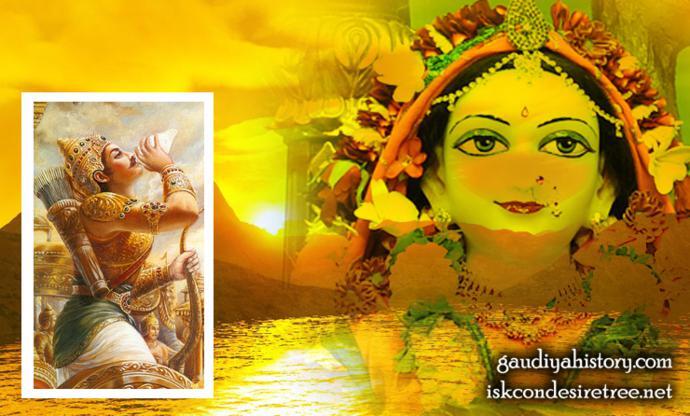
The main source for these identifications is Kavi Karnapura's Gaura-ganoddesha-dipika. This book lists Sri Chaitanya Mahaprabhu's associates and tells who they were in Krishna's own Vrindavana pastimes. Its verses 120 through 124 make an unusual claim about Ramananda Raya. They say that he combines not one but two separate figures named Arjuna. One is a confidential cowherd friend of Krishna in Vrindavana called Arjuna. The other is the more famous Arjuna of the Mahabharata, one of the five Pandava brothers. According to this reading, both of these figures united to become Ramananda Raya. The text supports the Pandava connection by citing a separate passage, said to be from the Padma Purana. This passage describes the Pandava Arjuna as having also once been a gopi named Arjuniya. So this identification is built from two directions at once. That is part of the reason later readers have not always summarized it in the same way.
Lalita or Vishakha #
Besides the Arjuna identification, there is a second, separate question. Which of Radha's closest gopi friends does Ramananda Raya represent? Gaura-ganoddesha-dipika itself notes that some hold he was Lalita-sakhi, while others do not accept this. Srila Bhaktivinoda Thakura, in his own commentary on Sri Chaitanya-charitamrita, took the second view. He wrote about the love that Vishakha had for Radha and Krishna in Vraja, and that Radha and Krishna had for Vishakha. He said that this same love awakened between Sri Chaitanya Mahaprabhu and Ramananda Raya when they met. This points to Vishakha-devi rather than Lalita. Other manuscript sources from Orissa's own devotional literature also favor the Vishakha identification. Among them is a work called Gurbhaktigita, attributed to Achyutananda Dasa. There is no single, universally accepted answer between Lalita and Vishakha. Both readings are current within the tradition, so both are reported here without choosing one.
What Sri Chaitanya Mahaprabhu Said Himself #
Whatever the exact gopi identification may be, the closest thing to a direct statement on the matter comes from Mahaprabhu Himself. Sri Chaitanya-charitamrita records that the Lord embraced Bhavananda Raya and described his five sons. Of the eldest He said: "Ramananda Raya and I are one, although our bodies are different." In his purport to this verse, Srila Prabhupada lays out the Arjuna, Lalita and Vishakha identifications side by side. He does not force a choice between the last two. He also adds the same warning found elsewhere in the tradition. Ramananda Raya's unique closeness to the Lord belongs to him alone, and it was never meant as an example for others to copy. This includes the extraordinary freedom he was given in his service to the temple dancers.
Not a Question of Diksha #
We should be clear about what this identity shows and what it does not show. The primary sources do not describe Ramananda Raya's bond with Sri Chaitanya Mahaprabhu in the language of formal initiation. According to the Bhajana-nirnaya, a record of Gaudiya spiritual lines, Ramananda Raya was already a disciple of Raghavendra Puri before he ever met Sri Chaitanya Mahaprabhu on the Godavari. Through Raghavendra Puri, he was also a grand-disciple of Srila Madhavendra Puri. Afterward, the Lord did not give him a mantra at a formal ceremony. What He gave him was a relationship that the texts describe in far closer terms. They speak of the two being almost one in soul. They speak of a shared "madness" in which the two of them could meet as equals. And they give Ramananda Raya a role as the one who "gave" Mahaprabhu His own deepest realizations of Vrindavana. Even so, on more than one occasion Srila Prabhupada's lectures loosely speak of Ramananda Raya as one of Mahaprabhu's "direct disciples," together with the six Gosvamis. This is a reminder that the tradition does not always draw a hard line between formal initiation and this kind of confidential, eternal service. Because of this uncertainty, and because no initiation ceremony between them is recorded, Sri Chaitanya Mahaprabhu is not treated here as Ramananda Raya's formal diksha-guru.
