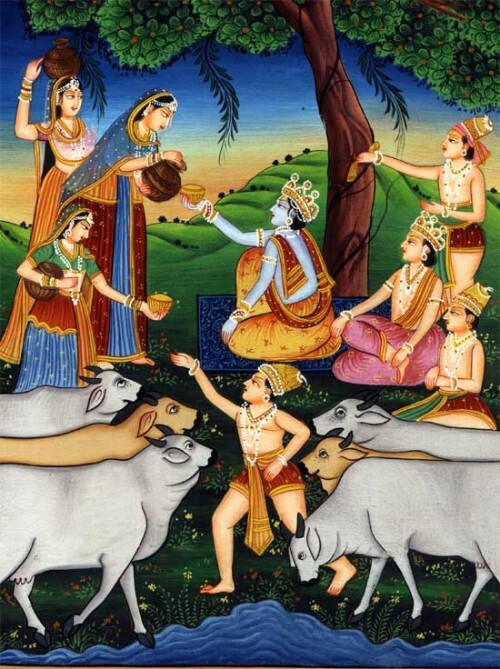
Tradition says that before he was Jagadisha Pandit of Bengal, he was Chandrahasa of Vraja. Almost no one today would recognize this name, except those who study the Gaura-ganoddesha-dipika closely. Yet it is one of the very few facts about his identity on which two independent sources agree completely.
A Dancer Named Chandrahasa #
Gaura-ganoddesha-dipika 143 describes a dancer in Vraja named Chandrahasa, who was expert in tasting rasa. In Krishna's own pastimes he was known mainly for the joy he took in dancing. The verse then states the identification clearly: in Gaura-lila, this same dancer becomes Jagadisha Pandit, and his devotion still shows itself in dancing before the Lord. Srila Prabhupada's purport to Chaitanya-charitamrita Adi-lila 10.70 says the same thing separately, in a single sentence taken from the tradition of Gaudiya commentaries: Jagadisha Pandit was formerly a great dancer in krishna-lila, known as Chandrahasa. Two separate sources agree on this detail. This matters, because very little else about him is confirmed twice over.
Parents, a Disputed Birthplace, and the Move to Mayapur #
The record is less clear about where Jagadisha Pandit was born and who his parents were. The sources disagree, and that disagreement is set down here instead of being explained away. Srila Bhaktisiddhanta Sarasvati Thakura's Anubhasya commentary is quoted in full in Srila Prabhupada's purport to Chaitanya-charitamrita Adi-lila 11.30. It places his family in the village of Yasada-grama, in Nadia district near the Chakadaha railway station. It names his father as Kamalaksa, the son of a Bhatta Narayana. Both parents, the Anubhasya says, were devout worshipers of Lord Vishnu. A separate, later account published by gaudiyahistory.iskcondesiretree.com places his birth far away instead, in the town of Gauhati (also called Pragjyotishpur) in what is now Assam. Neither version can simply be dismissed. They are the two sources that survive, and they disagree.
Both accounts agree on what came after his parents' death. Jagadisha, grieving, left his birthplace with his wife Duhkhini and settled in Sri Mayapur on the bank of the Ganges. He built a home beside that of Jagannatha Mishra, the father of the child who would grow up to be Sri Chaitanya Mahaprabhu. The two families quickly became close. Bhaktisiddhanta Sarasvati's account names Jagadisha's traveling companion as a brother, Mahesha. The later Gaudiya-history retelling instead calls him a brother named Hiranya. Here a third source helps to clear up the confusion. Chaitanya-charitamrita Adi-lila 10.70 itself lists a Hiranya Mahasaya as a separate branch of the family tree, the thirty-second, named immediately after Jagadisha's own entry as the thirty-first branch. But it never calls the two men brothers. A modern retelling of the pastime below is independent of the Gaudiya-history site. It too describes Jagadisha Pandita and Hiranya Pandita as two neighboring brahmanas and inseparable friends of Jagannatha Mishra, not as siblings. That reading, which stays closest to the texts, holds up best. It sees Hiranya as a close neighbor and fellow devotee, not as Jagadisha's blood brother.
The Ekadashi Offering Nimai Refused to Live Without #
The best-recorded single episode from this period is about the infant Nimai, Chaitanya Mahaprabhu in His earliest childhood. As a small child, Nimai would sometimes cry and cry, and no ordinary effort could quiet Him. He would calm down only when the household began congregational chanting of the holy names. On one such Ekadashi day, even the chanting failed. When He was asked what He wanted, the child answered that He was hungry for the food offered that day to the Deity of Vishnu at the house of Jagadisha and Hiranya Pandita. It was a strange request, since eating grains on Ekadashi went against ordinary religious practice, and Mother Sachi became anxious when she heard it.
When Jagannatha Mishra carried the strange request to his neighbors, he found that a large offering had indeed just been made at their home that very day. Jagadisha and Hiranya were astonished that a small child could somehow know this. They needed no persuading and sent the entire offering to Nimai without hesitation. As soon as the plate reached Him, the child stopped crying, and He ate happily while the household sang the holy names around Him. Chaitanya-charitamrita Adi-lila 10.70-71 records the episode briefly. It notes that Lord Chaitanya in His childhood showed Jagadisha and Hiranya His causeless mercy, and that He personally ate what was offered in their two houses. The same pastime is told at greater length in Chaitanya-bhagavata, Adi-khanda. It is a small story, but it shows something important. It is the earliest sign we have that this quiet Vaishnava neighbor's devotion had already caught the attention of God Himself, long before Nimai's public life as Chaitanya Mahaprabhu began. What that devotion grew into, once Nityananda Prabhu entered the picture, is told on Association with Nityananda Prabhu and Chaitanya Mahaprabhu.
