Unlike some acharyas and associates of Chaitanya Mahaprabhu, Jagadisha Pandit left behind no book, no dated samadhi, and no verse of his own composition that has come down to us. What he left instead was a place and a Deity, and a family line that, according to tradition, continued after him.
A Temple Rises at Jashora #
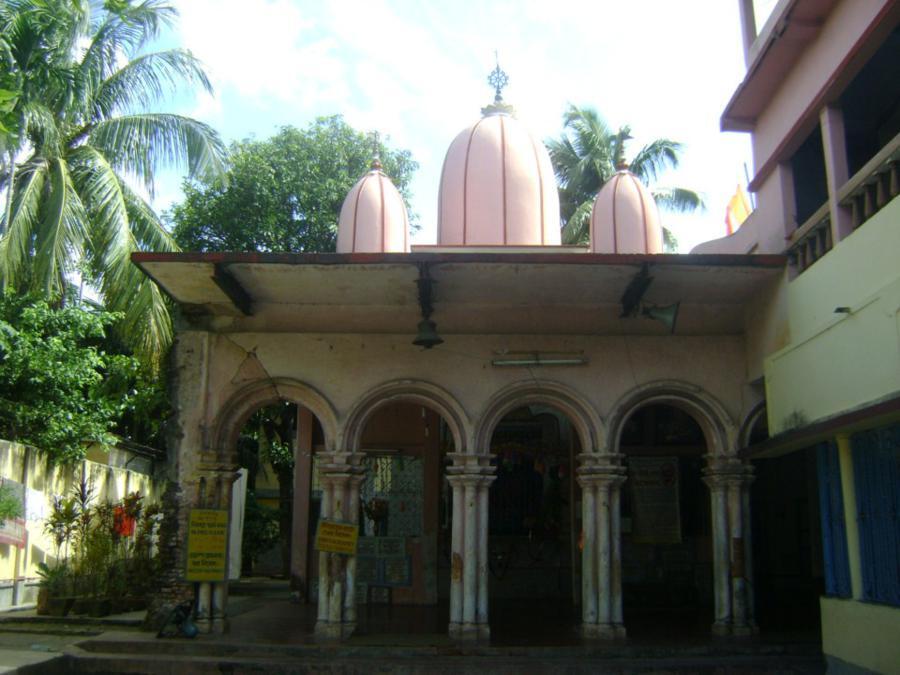
The Jagannatha Deity refused to be carried any further and settled near Chakdaha, in a village the Gaudiya-history tradition calls Jashora. Jagadisha Pandit made his home there for the rest of his recorded life, instead of returning to Mayapur. The Deity was at first kept simply, under a banyan tree by the Ganges. Later, the king of Krishnanagar, Krishnachandra, had a proper temple built on the spot. According to tradition, when Chaitanya Mahaprabhu and Nityananda Prabhu were about to leave Jashora on one of their visits to go on to Puri, Jagadisha's wife Duhkhini wept bitterly at the thought of separation. So the Lord agreed to stay behind in the form of a second Deity, worshiped there ever since as Gaura-Gopala alongside Jagannatha. That temple survives to the present day and is now managed by the Sri Chaitanya Gaudiya Math. In the twentieth century, the same Jagannatha Deity that Jagadisha Pandit once carried on his shoulder from Puri, together with Gaura-Gopala, came under the care of Tridandi Swami Shrimad Bhakti Dayita Madhava Maharaj. Gaudiya-history sources treat this as a continuing sign of the Lord's mercy on Jagadisha's original service.
A Household of Devotion and a Son, Ramabhadra Goswami #
The tradition records that Jagadisha and Duhkhini had a son, Ramabhadra Goswami. But the surviving sources do not go on to describe Ramabhadra's own life or later activities in any detail, and that gap remains unfilled. What is clear is how the Gaudiya tradition remembered the household Jagadisha built. First they were a devout Vaishnava family living beside Jagannatha Mishra in Mayapur. Later they were caretakers of Lord Jagannatha's own Deity at Jashora, on the banks of the Ganges. The Gaudiya tradition remembered this household as a place where Chaitanya Mahaprabhu and Nityananda Prabhu Themselves were pleased to visit and take prasadam.
What the Historical Record Does Not Say #
No source gives a year, or even an approximate decade, for Jagadisha Pandit's birth or his disappearance. This is a real gap, and it is better to admit it than to guess. One later piece of information should be recorded carefully, for what it does and does not show. A 2019 Dandavats notice marked the disappearance of a Madhva-sampradaya sannyasi, Sri Vishwesha Teertha Swamiji. It describes the date of his passing as the disappearance day shared by Srila Jiva Goswami and Sri Jagadisha Pandita. That single reference tells us that at least some ISKCON communities keep an annual observance of Jagadisha Pandit's disappearance day, paired with Jiva Goswami's on the festival calendar. But by itself it does not show which exact lunar date on the traditional calendar is being observed. We could not find any earlier or more detailed source to confirm it further. Those looking for the other associate with an almost identical name should note again that Jagadananda Pandit is a separate person. Jagadananda Pandit was the companion of Chaitanya Mahaprabhu in Puri and the author of the Prema-vivarta. This Jagadisha Pandit lived mostly in Bengal, at Mayapur and Jashora, in the company of Nityananda Prabhu.
