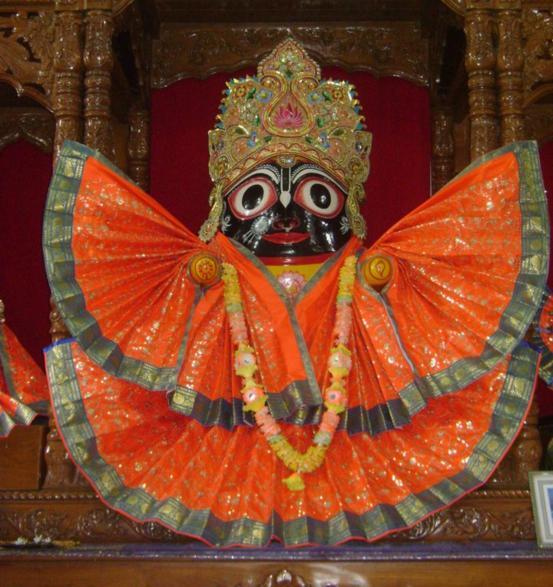
Sri Chaitanya-charitamrita gives two great family trees of associates: the branches of Chaitanya Mahaprabhu's own tree and the branches of Sri Nityananda Prabhu's tree. Most of the associates named there belong to only one list or the other. Jagadisha Pandit is named in both. This double place, more than anything else, marks him out as someone both Lords considered their own.
Named Among the Branches of Two Family Trees #
Chaitanya-charitamrita Adi-lila 10.70 lists Jagadisha Pandit as the thirty-first branch of Chaitanya Mahaprabhu's family tree. In the same verse he is paired with Hiranya Mahasaya, the thirty-second. In the next chapter, in Adi-lila 11.30, Krishnadasa Kaviraja Goswami names him again, this time as the fifteenth branch of Nityananda Prabhu's own tree. He gives the memorable description that devotional love of Krishna showered from him like torrents of rain, purifying the entire universe. Gaudiya-history tradition puts the relationship even more plainly. It says that Nityananda Prabhu was Jagadisha's life and soul, and that He considered Jagadisha one of His own close associates, just as Mahaprabhu Himself had shown Jagadisha mercy since childhood (see Birth, Family, and Early Life). Few of Mahaprabhu's associates are honored with a named place in both trees at once. Jagadisha Pandit is one of them. In a way, this itself shows how the tradition remembered him, even where other facts about his life are few or disputed.
Present at the Chira-dadhi Mahotsava in Panihati #
The Gaudiya-history tradition records one further detail, though it is not confirmed by other independent sources. It places Jagadisha Pandit among those present at Panihati for the Chira-dadhi Mahotsava. This was the famous festival of chipped rice and yogurt that Nityananda Prabhu ordered in that town. It was held by Raghunatha Dasa Goswami on His order, and it is closely tied to Raghunatha Dasa's history. If this is accurate, Jagadisha was at one of the best-known gatherings of Nityananda Prabhu's associates in Bengal, alongside the other associates of Mahaprabhu who shared in that gathering. The tradition is given here as it stands, not as something independently confirmed.
Sent to Puri to Preach Harinama-sankirtana #
Before Mahaprabhu accepted the sannyasa order, He instructed Jagadisha Pandit to travel to Nilachala (Jagannatha Puri) to preach Krishna-bhakti and harinama-sankirtana. This congregational chanting was becoming the main practice of the age. When Jagadisha arrived in Puri, he took darshan of Lord Jagannatha and, tradition says, was overcome with love at the sight of the Deity. On his way back toward Bengal he felt an equally strong pain of separation. This pain of separation, more than anything else, led to what happened next. Lord Jagannatha appeared to Jagadisha in a dream and told him to take His vigraha and personally serve it. At the same time, the account holds, Jagannatha appeared to the king of Orissa. He instructed the king that the next time the wooden Deity was ceremonially replaced (the nava-kalevara rite), the old form being replaced should be given to Jagadisha Pandit. That is the very form now known as the samadhi-stha-vigraha.
Carrying Jagannatha Home to Bengal #
What followed became the episode for which Jagadisha Pandit is best remembered locally. When the Deity was placed in his care, Jagadisha asked Jagannatha how he could possibly carry such a heavy Deity all the way back to Bengal on foot. Jagannatha answered that He would make Himself as light as cork. Jagadisha needed only to cover Him with new cloth and carry Him on a staff, and to settle wherever the Deity was finally set down. Two brahmins took turns carrying the Deity, and Jagadisha reached as far as the village on the Ganges near Chakdaha. Then something unexpected happened. While Jagadisha bathed in the river, the Deity was left for a short time with one of the brahmins, and the Deity suddenly grew too heavy to lift. When Jagadisha returned from his bath, he understood at once that Jagannatha wished to stay exactly there. Once word spread that a Jagannatha Deity from Puri had arrived, thousands of local people came for darshan. Jagadisha did not continue home to Mayapur. He settled there with his wife. Both Nityananda Prabhu and Chaitanya Mahaprabhu are said to have visited the new Deity in that village on two later occasions, holding sankirtan and feasting with the couple. What became of that Deity, and of the household Jagadisha built around it, is told on Disappearance and Legacy.
