Srila Jagadisha Pandit
The Fifteenth Branch of Sri Nityananda Prabhu's Family Tree
The complete life, on one page: The main biography and every pastime page, in order, in one place
Introduction
Srila Jagadisha Pandit is one of the less well-known names in the family tree of Sri Chaitanya Mahaprabhu's associates. Yet Krishnadasa Kaviraja Goswami gave him a place in Sri Chaitanya-charitamrita under both great branches of that tree: the branch of Mahaprabhu Himself and the branch of Sri Nityananda Prabhu. He should not be confused with Jagadananda Pandit. Jagadananda Pandit was a different and better-known associate of Chaitanya Mahaprabhu, who lived with the Lord in Puri and wrote the Prema-vivarta. The two names sound alike, but the classical texts describe two separate people, with different families, different homes and different roles.
| Detail | Description |
|---|---|
| Also known as | Jagadisa Pandita, Jagadish Pandit |
| Identity | Chandrahasa, a dancer of Vraja skilled in rasa (Gaura-ganoddesha-dipika 143; Chaitanya-charitamrita Adi 10.70 purport) |
| Position in the family tree | Thirty-first branch of Chaitanya Mahaprabhu's tree; fifteenth branch of Nityananda Prabhu's tree |
| Home | Mayapur, then Jashora near Chakdaha, Nadia district, Bengal |
| Chief service | Bringing the Deities of Jagannatha and Gaura-Gopala from Puri to Bengal |
| Son | Ramabhadra Goswami |
| Disappearance day | Kept by some ISKCON communities on the same date as Srila Jiva Goswami's |
Scriptural evidence for the introduction (3)
अपरे यज्ञपत्न्यौ श्री जगदीश हिरण्यकौ ।
एकादश्यां ययोरन्नं प्रार्थयित्वाघसत्प्रभुः ॥
apare yajña-patnyau śrī jagadīśa hiraṇyakau
ekādaśyāṁ yayor annaṁ prārthayitvāghasat prabhuḥ
Two other yajna-patnis appeared as Jagadisa and Hiranya. One ekadasi day Lord Caitanya ate grains he had begged from them.
A second Gaura-ganoddesha-dipika verse: two yajna-patnis (wives of the sacrificing brahmanas of Vraja) appeared as Jagadisha and Hiranya, whose grains Sri Chaitanya Mahaprabhu begged and ate on an Ekadashi. Sanskrit: diacritic edition of the Gaura-ganoddesha-dipika; English translation as published at bvmlu.org.
आसीद्व्रजे चन्द्रहासो नर्तको रसकोविदः ।
सोऽयं नृत्यविनोदी श्रीजगदीशाख्यपण्डितः ॥
āsīd vraje candrahāso nartako rasa-kovidaḥ
so’yaṁ nṛtya-vinodī śrī-jagadīśākhya-paṇḍitaḥ
Candrahasa, who in Vrajabhumi had been a dancer expert in transcendental mellows, appeared in Lord Caitanya's pastimes as the dancer Jagadisa Pandita.
From the purport: Jagadīśa Paṇḍita was formerly a great dancer in kṛṣṇa-līlā and was known as Candrahāsa.
Kavi Karnapura identifies the dancing Jagadisha Pandit with Chandrahasa, a dancer of Vraja; Srila Prabhupada repeats this in his purport to CC Adi 10.70. Sanskrit: diacritic edition of the Gaura-ganoddesha-dipika; English translation as published at bvmlu.org.
জগদীশ পণ্ডিত, আর হিরণ্য মহাশয় ।
যারে কৃপা কৈল বাল্যে প্রভু দয়াময় ॥ ৭০ ॥
jagadīśa paṇḍita, āra hiraṇya mahāśaya
yāre kṛpā kaila bālye prabhu dayāmaya
The thirty-first branch was Jagadīśa Paṇḍita, and the thirty-second was Hiraṇya Mahāśaya, unto whom Lord Caitanya in His childhood showed His causeless mercy.
From the purport: Jagadīśa Paṇḍita was formerly a great dancer in kṛṣṇa-līlā and was known as Candrahāsa.
Names Jagadisha Pandit as the thirty-first branch of the Chaitanya tree; Srila Prabhupada's purport gives his Vraja identity as Chandrahasa.
Chapter 1
Birth, Family, and Early Life
A dancer of Vraja takes birth in Bengal and becomes the neighbor of Chaitanya Mahaprabhu's own father.
Tradition says that before he was Jagadisha Pandit of Bengal, he was Chandrahasa of Vraja. Almost no one today would recognize this name, except those who study the Gaura-ganoddesha-dipika closely. Yet it is one of the very few facts about his identity on which two independent sources agree completely.
A Dancer Named Chandrahasa #
Gaura-ganoddesha-dipika 143 describes a dancer in Vraja named Chandrahasa, who was expert in tasting rasa. In Krishna's own pastimes he was known mainly for the joy he took in dancing. The verse then states the identification clearly: in Gaura-lila, this same dancer becomes Jagadisha Pandit, and his devotion still shows itself in dancing before the Lord. Srila Prabhupada's purport to Chaitanya-charitamrita Adi-lila 10.70 says the same thing separately, in a single sentence taken from the tradition of Gaudiya commentaries: Jagadisha Pandit was formerly a great dancer in krishna-lila, known as Chandrahasa. Two separate sources agree on this detail. This matters, because very little else about him is confirmed twice over.
Parents, a Disputed Birthplace, and the Move to Mayapur #
The record is less clear about where Jagadisha Pandit was born and who his parents were. The sources disagree, and that disagreement is set down here instead of being explained away. Srila Bhaktisiddhanta Sarasvati Thakura's Anubhasya commentary is quoted in full in Srila Prabhupada's purport to Chaitanya-charitamrita Adi-lila 11.30. It places his family in the village of Yasada-grama, in Nadia district near the Chakadaha railway station. It names his father as Kamalaksa, the son of a Bhatta Narayana. Both parents, the Anubhasya says, were devout worshipers of Lord Vishnu. A separate, later account published by gaudiyahistory.iskcondesiretree.com places his birth far away instead, in the town of Gauhati (also called Pragjyotishpur) in what is now Assam. Neither version can simply be dismissed. They are the two sources that survive, and they disagree.
Both accounts agree on what came after his parents' death. Jagadisha, grieving, left his birthplace with his wife Duhkhini and settled in Sri Mayapur on the bank of the Ganges. He built a home beside that of Jagannatha Mishra, the father of the child who would grow up to be Sri Chaitanya Mahaprabhu. The two families quickly became close. Bhaktisiddhanta Sarasvati's account names Jagadisha's traveling companion as a brother, Mahesha. The later Gaudiya-history retelling instead calls him a brother named Hiranya. Here a third source helps to clear up the confusion. Chaitanya-charitamrita Adi-lila 10.70 itself lists a Hiranya Mahasaya as a separate branch of the family tree, the thirty-second, named immediately after Jagadisha's own entry as the thirty-first branch. But it never calls the two men brothers. A modern retelling of the pastime below is independent of the Gaudiya-history site. It too describes Jagadisha Pandita and Hiranya Pandita as two neighboring brahmanas and inseparable friends of Jagannatha Mishra, not as siblings. That reading, which stays closest to the texts, holds up best. It sees Hiranya as a close neighbor and fellow devotee, not as Jagadisha's blood brother.
The Ekadashi Offering Nimai Refused to Live Without #
The best-recorded single episode from this period is about the infant Nimai, Chaitanya Mahaprabhu in His earliest childhood. As a small child, Nimai would sometimes cry and cry, and no ordinary effort could quiet Him. He would calm down only when the household began congregational chanting of the holy names. On one such Ekadashi day, even the chanting failed. When He was asked what He wanted, the child answered that He was hungry for the food offered that day to the Deity of Vishnu at the house of Jagadisha and Hiranya Pandita. It was a strange request, since eating grains on Ekadashi went against ordinary religious practice, and Mother Sachi became anxious when she heard it.
When Jagannatha Mishra carried the strange request to his neighbors, he found that a large offering had indeed just been made at their home that very day. Jagadisha and Hiranya were astonished that a small child could somehow know this. They needed no persuading and sent the entire offering to Nimai without hesitation. As soon as the plate reached Him, the child stopped crying, and He ate happily while the household sang the holy names around Him. Chaitanya-charitamrita Adi-lila 10.70-71 records the episode briefly. It notes that Lord Chaitanya in His childhood showed Jagadisha and Hiranya His causeless mercy, and that He personally ate what was offered in their two houses. The same pastime is told at greater length in Chaitanya-bhagavata, Adi-khanda. It is a small story, but it shows something important. It is the earliest sign we have that this quiet Vaishnava neighbor's devotion had already caught the attention of God Himself, long before Nimai's public life as Chaitanya Mahaprabhu began. What that devotion grew into, once Nityananda Prabhu entered the picture, is told on Association with Nityananda Prabhu and Chaitanya Mahaprabhu.
Scriptural evidence for this chapter (3)
jagadisha pandita, ara hiranya mahashaya, yare krpa kaila balye prabhu dayamaya
Word for word
jagadisha pandita: Jagadisha Pandita; ara: and; hiranya: Hiranya; mahashaya: great personality; yare: unto whom; krpa: mercy; kaila: showed; balye: in childhood; prabhu: the Lord; dayamaya: merciful.
The thirty-first branch was Jagadisha Pandita, and the thirty-second was Hiranya Mahasaya, unto whom Lord Chaitanya in His childhood showed His causeless mercy.
From the purport: Purport excerpt: "Jagadisha Pandita was formerly a great dancer in krsna-lila and was known as Candrahasa."
Confirms the Chandrahasa identity from Gaura-ganoddesha-dipika and lists Hiranya as a separate, adjacent branch rather than explicitly Jagadisha's brother.
ei dui-ghare prabhu ekadashi dine, vishnura naivedya magi' khaila apane
Word for word
ei dui-ghare: in these two houses; prabhu: the Lord; ekadashi dine: on the Ekadashi day; vishnura: of Lord Vishnu; naivedya: food offered to Lord Vishnu; magi': begging; khaila: ate; apane: personally.
In their two houses Lord Chaitanya Mahaprabhu begged food on the Ekadashi day and personally ate it.
The verse immediately following Adi 10.70; records the Ekadashi-offering pastime from the infant Nimai's childhood referenced on the birth-and-early-life page.
asid vraje chandrahaso nartako rasa-kovidah so'yam nritya-vinodi shri-jagadishakhyah panditah
In Vraja there was a dancer named Chandrahasa who was very expert in the tasting of rasa. In Chaitanya-lila he became Jagadisha Pandit, who also took great pleasure in dancing for the Lord.
Traditional identification of Jagadisha Pandit's spiritual identity in Krishna's Vraja-lila, cited here as reproduced on gaudiyahistory.iskcondesiretree.com since no independent Sanskrit edition was located.
Chapter 2
Association with Nityananda Prabhu and Chaitanya Mahaprabhu
Named among the branches of both Mahaprabhu's and Nityananda Prabhu's family trees, he is sent to Puri and returns carrying the Lord Jagannatha Deity home to Bengal.
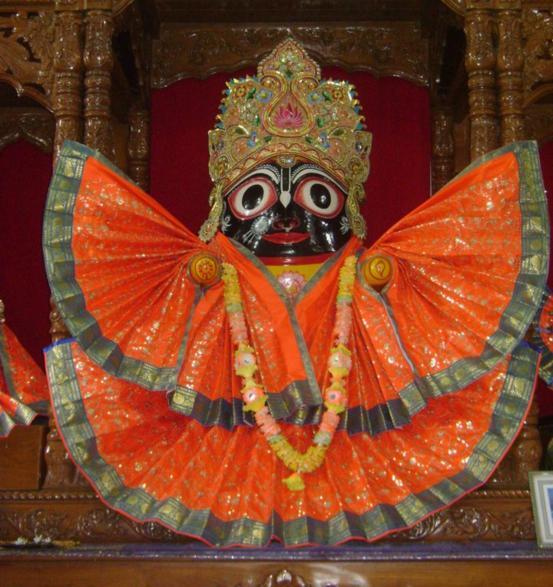
Sri Chaitanya-charitamrita gives two great family trees of associates: the branches of Chaitanya Mahaprabhu's own tree and the branches of Sri Nityananda Prabhu's tree. Most of the associates named there belong to only one list or the other. Jagadisha Pandit is named in both. This double place, more than anything else, marks him out as someone both Lords considered their own.
Named Among the Branches of Two Family Trees #
Chaitanya-charitamrita Adi-lila 10.70 lists Jagadisha Pandit as the thirty-first branch of Chaitanya Mahaprabhu's family tree. In the same verse he is paired with Hiranya Mahasaya, the thirty-second. In the next chapter, in Adi-lila 11.30, Krishnadasa Kaviraja Goswami names him again, this time as the fifteenth branch of Nityananda Prabhu's own tree. He gives the memorable description that devotional love of Krishna showered from him like torrents of rain, purifying the entire universe. Gaudiya-history tradition puts the relationship even more plainly. It says that Nityananda Prabhu was Jagadisha's life and soul, and that He considered Jagadisha one of His own close associates, just as Mahaprabhu Himself had shown Jagadisha mercy since childhood (see Birth, Family, and Early Life). Few of Mahaprabhu's associates are honored with a named place in both trees at once. Jagadisha Pandit is one of them. In a way, this itself shows how the tradition remembered him, even where other facts about his life are few or disputed.
Present at the Chira-dadhi Mahotsava in Panihati #
The Gaudiya-history tradition records one further detail, though it is not confirmed by other independent sources. It places Jagadisha Pandit among those present at Panihati for the Chira-dadhi Mahotsava. This was the famous festival of chipped rice and yogurt that Nityananda Prabhu ordered in that town. It was held by Raghunatha Dasa Goswami on His order, and it is closely tied to Raghunatha Dasa's history. If this is accurate, Jagadisha was at one of the best-known gatherings of Nityananda Prabhu's associates in Bengal, alongside the other associates of Mahaprabhu who shared in that gathering. The tradition is given here as it stands, not as something independently confirmed.
Sent to Puri to Preach Harinama-sankirtana #
Before Mahaprabhu accepted the sannyasa order, He instructed Jagadisha Pandit to travel to Nilachala (Jagannatha Puri) to preach Krishna-bhakti and harinama-sankirtana. This congregational chanting was becoming the main practice of the age. When Jagadisha arrived in Puri, he took darshan of Lord Jagannatha and, tradition says, was overcome with love at the sight of the Deity. On his way back toward Bengal he felt an equally strong pain of separation. This pain of separation, more than anything else, led to what happened next. Lord Jagannatha appeared to Jagadisha in a dream and told him to take His vigraha and personally serve it. At the same time, the account holds, Jagannatha appeared to the king of Orissa. He instructed the king that the next time the wooden Deity was ceremonially replaced (the nava-kalevara rite), the old form being replaced should be given to Jagadisha Pandit. That is the very form now known as the samadhi-stha-vigraha.
Carrying Jagannatha Home to Bengal #
What followed became the episode for which Jagadisha Pandit is best remembered locally. When the Deity was placed in his care, Jagadisha asked Jagannatha how he could possibly carry such a heavy Deity all the way back to Bengal on foot. Jagannatha answered that He would make Himself as light as cork. Jagadisha needed only to cover Him with new cloth and carry Him on a staff, and to settle wherever the Deity was finally set down. Two brahmins took turns carrying the Deity, and Jagadisha reached as far as the village on the Ganges near Chakdaha. Then something unexpected happened. While Jagadisha bathed in the river, the Deity was left for a short time with one of the brahmins, and the Deity suddenly grew too heavy to lift. When Jagadisha returned from his bath, he understood at once that Jagannatha wished to stay exactly there. Once word spread that a Jagannatha Deity from Puri had arrived, thousands of local people came for darshan. Jagadisha did not continue home to Mayapur. He settled there with his wife. Both Nityananda Prabhu and Chaitanya Mahaprabhu are said to have visited the new Deity in that village on two later occasions, holding sankirtan and feasting with the couple. What became of that Deity, and of the household Jagadisha built around it, is told on Disappearance and Legacy.
Scriptural evidence for this chapter (1)
jagadisha pandita haya jagat-pavana, krsna-premamrta varse, yena varsa ghana
Word for word
jagadisha pandita: Jagadisha Pandita; haya: becomes; jagat-pavana: the deliverer of the world; krsna-prema-amrta varse: he always pours torrents of devotional service; yena: like; varsa: rainfall; ghana: heavy.
Jagadisha Pandita, the fifteenth branch of Lord Nityananda's followers, was the deliverer of the entire world. Devotional love of Krishna showered from him like torrents of rain.
From the purport: Purport excerpt: "He belonged to the village of Yasada-grama, in the district of Nadia near the Cakadaha railway station... after their death, Jagadisha, with his wife Duhkhini and brother Mahesa, left his birthplace and came to Sri Mayapur."
Bhaktisiddhanta Sarasvati Thakura's Anubhasya, quoted by Srila Prabhupada, is the source for the Nadia-district family background reported here, set against a differing later tradition.
Chapter 3
Disappearance and Legacy
The Deity he carried from Puri is still worshiped at Jashora, though the year of Jagadisha Pandit's own disappearance is not recorded.
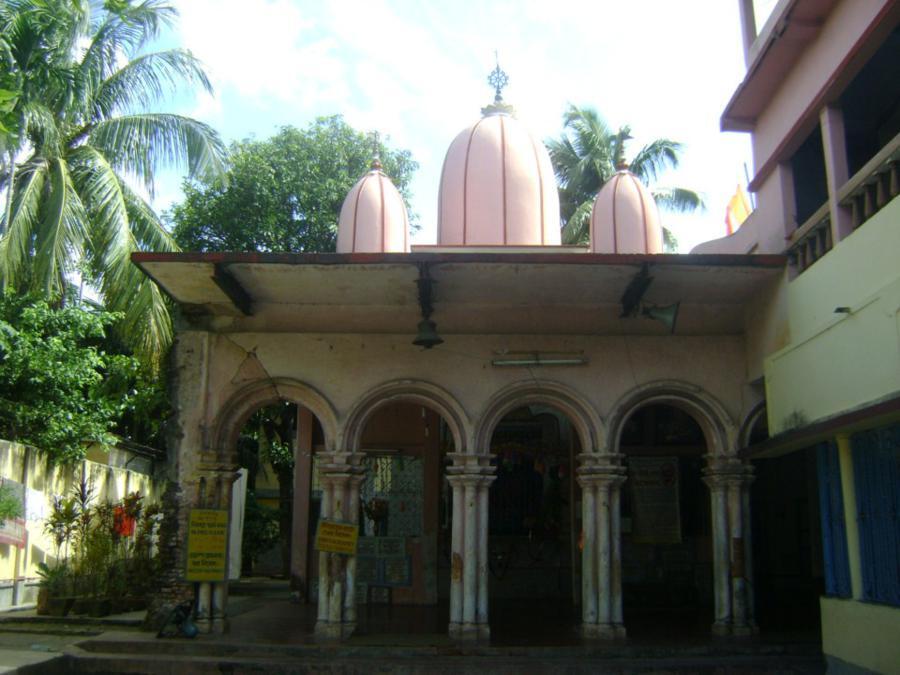
Unlike some acharyas and associates of Chaitanya Mahaprabhu, Jagadisha Pandit left behind no book, no dated samadhi, and no verse of his own composition that has come down to us. What he left instead was a place and a Deity, and a family line that, according to tradition, continued after him.
A Temple Rises at Jashora #
The Jagannatha Deity refused to be carried any further and settled near Chakdaha, in a village the Gaudiya-history tradition calls Jashora. Jagadisha Pandit made his home there for the rest of his recorded life, instead of returning to Mayapur. The Deity was at first kept simply, under a banyan tree by the Ganges. Later, the king of Krishnanagar, Krishnachandra, had a proper temple built on the spot. According to tradition, when Chaitanya Mahaprabhu and Nityananda Prabhu were about to leave Jashora on one of their visits to go on to Puri, Jagadisha's wife Duhkhini wept bitterly at the thought of separation. So the Lord agreed to stay behind in the form of a second Deity, worshiped there ever since as Gaura-Gopala alongside Jagannatha. That temple survives to the present day and is now managed by the Sri Chaitanya Gaudiya Math. In the twentieth century, the same Jagannatha Deity that Jagadisha Pandit once carried on his shoulder from Puri, together with Gaura-Gopala, came under the care of Tridandi Swami Shrimad Bhakti Dayita Madhava Maharaj. Gaudiya-history sources treat this as a continuing sign of the Lord's mercy on Jagadisha's original service.
A Household of Devotion and a Son, Ramabhadra Goswami #
The tradition records that Jagadisha and Duhkhini had a son, Ramabhadra Goswami. But the surviving sources do not go on to describe Ramabhadra's own life or later activities in any detail, and that gap remains unfilled. What is clear is how the Gaudiya tradition remembered the household Jagadisha built. First they were a devout Vaishnava family living beside Jagannatha Mishra in Mayapur. Later they were caretakers of Lord Jagannatha's own Deity at Jashora, on the banks of the Ganges. The Gaudiya tradition remembered this household as a place where Chaitanya Mahaprabhu and Nityananda Prabhu Themselves were pleased to visit and take prasadam.
What the Historical Record Does Not Say #
No source gives a year, or even an approximate decade, for Jagadisha Pandit's birth or his disappearance. This is a real gap, and it is better to admit it than to guess. One later piece of information should be recorded carefully, for what it does and does not show. A 2019 Dandavats notice marked the disappearance of a Madhva-sampradaya sannyasi, Sri Vishwesha Teertha Swamiji. It describes the date of his passing as the disappearance day shared by Srila Jiva Goswami and Sri Jagadisha Pandita. That single reference tells us that at least some ISKCON communities keep an annual observance of Jagadisha Pandit's disappearance day, paired with Jiva Goswami's on the festival calendar. But by itself it does not show which exact lunar date on the traditional calendar is being observed. We could not find any earlier or more detailed source to confirm it further. Those looking for the other associate with an almost identical name should note again that Jagadananda Pandit is a separate person. Jagadananda Pandit was the companion of Chaitanya Mahaprabhu in Puri and the author of the Prema-vivarta. This Jagadisha Pandit lived mostly in Bengal, at Mayapur and Jashora, in the company of Nityananda Prabhu.
Closing
A Dancer of Vraja Remembered in Gaura-ganoddesha-dipika #
The Gaura-ganoddesha-dipika is the traditional list of who each of Mahaprabhu's associates had been in Krishna's own pastimes in Vraja. It gives Jagadisha Pandit a spiritual identity going back further than his birth in Bengal. Verse 143 of that text describes a dancer named Chandrahasa, skilled in rasa, who appears again in Gaura-lila as the dancing, joyful Jagadisha Pandit. Srila Prabhupada's purport to Chaitanya-charitamrita Adi-lila 10.70 repeats the same identification in a single line: Jagadisha Pandit was formerly a great dancer in krishna-lila, known as Chandrahasa. It is a small detail, but it is one of the few places where a specific earlier identity is recorded for him at all. It also fits everything else the record tells us about him. He was a devotee whose bhakti showed itself in movement and celebration, not in writing or debate.
This is verse 143 itself, with its published English translation:
āsīd vraje candrahāso nartako rasa-kovidaḥ
so’yaṁ nṛtya-vinodī śrī-jagadīśākhya-paṇḍitaḥ
"Candrahasa, who in Vrajabhumi had been a dancer expert in transcendental mellows, appeared in Lord Caitanya's pastimes as the dancer Jagadisa Pandita." (Gaura-ganoddesha-dipika 143)
