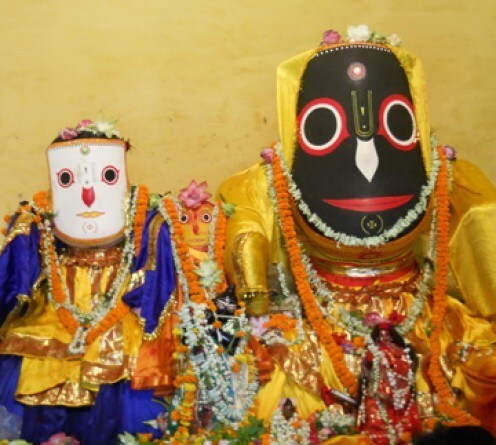
Every source that tells how Kamalakara Pippalai came to Mahesha begins the story with a different devotee entirely. He was an aging man who had renounced the world, named Dhruvananda. Dhruvananda's own story had started years earlier with a broken heart at Jagannatha Puri.
Dhruvananda's Desire #
Dhruvananda had traveled to Puri with one great wish. He wanted to cook for Lord Jagannatha with his own hands and offer that food to the Lord himself. It was a deeply personal devotional wish. Puri's temple authorities would not permit it. According to the account preserved in Bhaktisiddhanta Sarasvati Thakura's Anubhashya to Sri Chaitanya-charitamrita, Dhruvananda was so heartbroken at the refusal that he decided to fast until death. On the third day of that fast, he heard Jagannatha's voice in a dream. The Lord told him to return to Bengal and go to a village called Mahesha, on the bank of the Ganges. There, the Lord said, Dhruvananda's wish would finally be granted. When Dhruvananda reached Mahesha, he found Jagannatha, Balarama and Subhadra themselves floating in the river. He lifted the three Deities out of the water and built a small hut to shelter them. He began worshiping them there alone, and at last he was able to offer Jagannatha food cooked with his own hands.
A Dream Passed On #
Years passed, and Dhruvananda grew old. With no disciple or family to whom he could hand over the Deities' care, he faced the same problem that ends every solitary devotee's service: who continues it after he is gone? The answer, once again, came in a dream. Jagannatha told him of "a great Vaishnava named Kamalakara Pippalai," living in the village of Khalijuli in the Sundarban forest, who had already been instructed, in a dream of his own, to come to Mahesha and take over the Lord's service. Dhruvananda was told simply to hand everything over to this man when he arrived.
The next morning, exactly as promised, Kamalakara Pippalai reached Mahesha. Every account says that he carried the memory of the very same dream. Dhruvananda gave him full charge of Jagannatha, Balarama and Subhadra on the spot. For such an important handing over, it was very quiet. There was no debate, no test of worthiness and no ceremony. There was only trust, from one devotee guided by a dream to another. From that day forward, Kamalakara Pippalai took the title Adhikari, "one who is empowered" to worship the Lord. That title became his family's surname, and his descendants carry it to the present day. The Vaishnavacara-darpana, one of the sources Bhaktisiddhanta Sarasvati draws on, adds that the Pippalai name itself belongs to one of the fifty-five recognized branches of Rarha Brahmins. In this way it places Kamalakara's family clearly within Bengal's brahmana society. At the same time, it describes how he became something far beyond an ordinary brahmana householder.
Building Mahesha from Jungle #
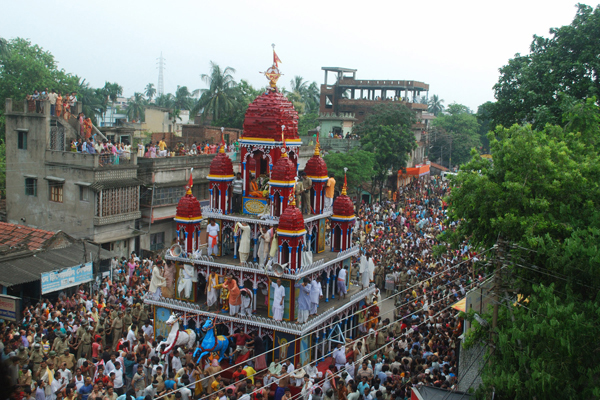
Kamalakara Pippalai did not receive a settled, well-established temple from Dhruvananda. He received a single small hut in what several sources describe as essentially unclaimed jungle along the riverbank. Over the years that followed, he had the land around it cleared and developed. In time, the settlement that grew up around the Deities' worship became a proper village. This is the Mahesha that still exists today, a little over two miles from the Serampore railway station in Hooghly district. The temple he built up there went on to hold one of Bengal's oldest and most important Rath Yatra festivals, and it still holds it today. This is the yearly chariot procession of Jagannatha, Balarama and Subhadra, and it draws hundreds of thousands of pilgrims each year. It is likely that neither Dhruvananda nor Kamalakara Pippalai could have imagined devotion on such a scale, back when there was only that first small hut by the river.
What the Story Asks of a Devotee #
Bhaktisiddhanta Sarasvati Thakura's Anubhashya does not simply tell this story. It draws a lesson from it, and Kamalakara Pippalai's own life shows that lesson directly. The Anubhashya says that a devotee is always eager to serve the Lord. For this reason the Lord gives direction to such a devotee, and never to one who is not already a devotee. Ordinary conditioned souls are absorbed in the pleasures of the senses. When they hear of service to Krishna and the Vaishnavas, they feel only the weight of duty and look for any excuse to avoid it. They do not see such service as wealth, the way a genuine Vaishnava does. Kamalakara Pippalai did the opposite. When he received Jagannatha's instruction, he left home and family at once and went where he was told. He did not do this as a sacrifice made unwillingly. In the Anubhashya's own phrase, he did it naturally and spontaneously. This tradition holds that this is the mark of a heart already absorbed in separation from the Lord, not in the ordinary business of household life. The rest of the story is told on Festivals, Family, and the Adhikari Legacy. It covers the family Kamalakara Pippalai left behind, the family he built in its place at Mahesha, and the festivals of the wider Vaishnava community he kept attending even after settling into this one lifelong service.
