Srila Kamalakara Pippalai
One of Nityananda Prabhu's Twelve Gopalas, Founder of Deity Worship at Mahesha
The complete life, on one page: The main biography and every pastime page, in order, in one place
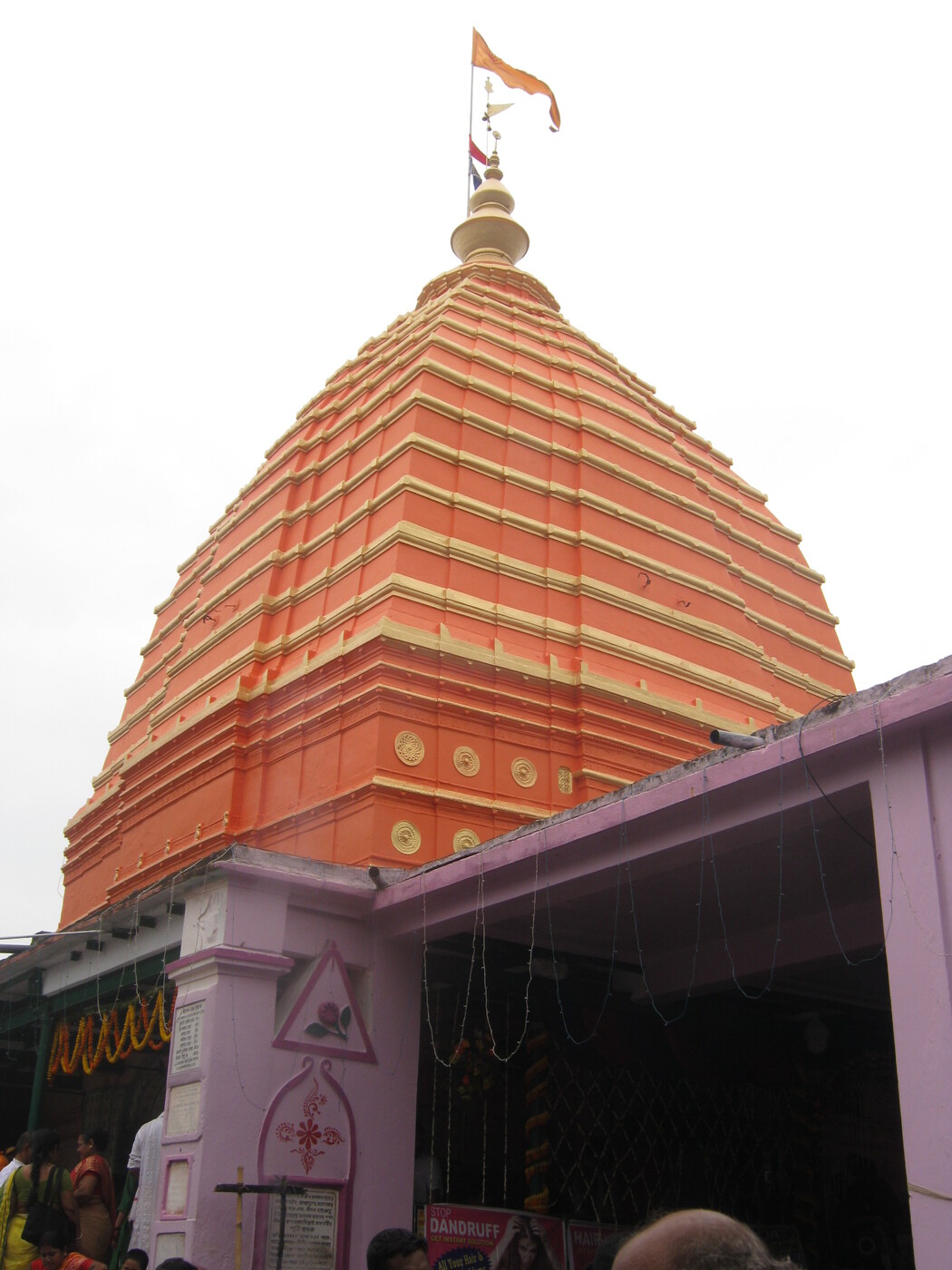
Introduction
Srila Kamalakara Pippalai was one of Sri Nityananda Prabhu's own close associates in sixteenth-century Bengal. He is remembered as one of the twelve gopalas who formed Nityananda's innermost circle of preachers. Sri Chaitanya-charitamrita names him directly and says of him: "His behavior and love of Godhead were uncommon, and thus he is celebrated all over the world." He earned that reputation through one lifelong act of service, not through writing or preaching. He took over the worship of the Jagannatha, Baladeva and Subhadra deities at Mahesha, a village on the Ganges near present-day Serampore in West Bengal. He did this on what he understood to be the Lord's own instruction, given to him in a dream. The temple he built up there still stands. Its Rath Yatra, among the oldest in Bengal, still draws hundreds of thousands of pilgrims every year.
| Detail | Description |
|---|---|
| Traditional birth year | 1492 (Gaudiya Vaishnava Abhidhana); Sri Chaitanya-charitamrita itself gives no date |
| Birthplace | Khalijhuli village, Sundarban region of Bengal |
| Family | Rarha Brahmin family; younger brother Shrinidhipati (Nidhipati) Pippalai |
| Identity | The cowherd boy Mahabala of Vraja, counted the third of the twelve gopalas (Gaura-ganoddesha-dipika 128; Chaitanya-charitamrita Adi 11.24 and purport) |
| Chief service | Took over worship of the Jagannatha, Baladeva and Subhadra deities at Mahesha, Serampore |
| Title | Adhikari, later adopted as the family's surname |
| Disappearance | Chaitra Shukla Trayodashi, 1563, at Vrindavana (family tradition; not independently confirmed) |
Scriptural evidence for the introduction (2)
কমলাকর পিপ্পলাই–অলৌকিক রীত ।
অলৌকিক প্রেম তাঁর ভুবনে বিদিত ২৪
kamalākara pippalāi — alaukika rīta, alaukika prema tāṅra bhuvane vidita
Word for word
kamalākara pippalāi: Kamalākara Pippalāi; alaukika: uncommon; rīta: behavior or pastime; alaukika: uncommon; prema: love of Godhead; tāṅra: his; bhuvane: in the world; vidita: celebrated.
Kamalakara Pippalai is said to have been the third gopala. His behavior and love of Godhead were uncommon, and thus he is celebrated all over the world.
From the purport: Purport excerpt: "In the Gaura-gaṇoddeśa-dīpikā (128) Kamalākara Pippalāi is described as the third gopāla. His former name was Mahābala."
Chaitanya-charitamrita's own verse naming Kamalakara Pippalai; Srila Prabhupada's purport on it, quoting Bhaktisiddhanta Sarasvati Thakura's Anubhashya, is the primary documentary source for almost every biographical detail known about him.
सुबलो यः प्रियश्रेष्ठः स गौरीदासपण्डितः ।
कमलाकरपिप्पलाइनाम्नासीद्यो महाबलः ॥१२८॥
subalo yaḥ priya-śreṣṭhaḥ sa gaurīdāsa-paṇḍitaḥ |
kamalākara-pippalāi-nāmnāsīd yo mahābalaḥ ||128||
Lord Krsna's dearest friend Subala appeared in Lord Caitanya's pastimes as Gauridasa Pandita. The cowherd boy Mahabala appeared in Lord Caitanya's pastimes as Kamalakara Pippalai.
From the purport: In the Gaura-gaṇoddeśa-dīpikā (128) Kamalākara Pippalāi is described as the third gopāla. His former name was Mahābala.
Identifies Kamalakara Pippalai as the cowherd boy Mahabala of Krishna's Vraja pastimes. Sanskrit: diacritic edition of the Gaura-ganoddesha-dipika; English translation as published at bvmlu.org. Purport excerpt: Srila Prabhupada, Chaitanya-charitamrita Adi 11.24 purport, quoting Bhaktisiddhanta Sarasvati Thakura's Anubhashya.
Chapter 1
Mahabala and the Third Gopala
What Sri Chaitanya-charitamrita and its Anubhashya actually say about Kamalakara Pippalai's identity, birth, and family in the Sundarbans.
Sri Chaitanya-charitamrita gives Kamalakara Pippalai only two lines of his own. They come in Krishnadasa Kaviraja Goswami's long list of the "branches" of Nityananda Prabhu: "Kamalakara Pippalai's behavior was extraordinary. It is well-known throughout the world that his love for Krishna is extraordinary." Nearly everything else known about him comes from a single purport Srila Prabhupada wrote on that verse. In it, Srila Prabhupada quotes at length from Srila Bhaktisiddhanta Sarasvati Thakura's own Bengali commentary, the Anubhashya. The verse itself says very little, but the purport is unusually rich. It is the foundation for almost every detail known about his life.
A Name from Krishna's Own Pastimes #
The first thing Bhaktisiddhanta Sarasvati's Anubhashya tells us is who Kamalakara Pippalai was believed to be before he was Kamalakara Pippalai. The Anubhashya cites the Gaura-ganoddesha-dipika (verse 128). This work identifies the Bengali associates of Sri Chaitanya Mahaprabhu with their eternal identities in Krishna's pastimes at Vraja. Citing it, the Anubhashya states that Kamalakara Pippalai is counted as the third of the twelve gopalas. The gopalas were the inner circle of cowherd boys who had been Nityananda Prabhu's own playmates in Vraja. His name in that earlier identity was Mahabala. Many associates of Chaitanya Mahaprabhu and Nityananda Prabhu recorded in Gaudiya Vaishnava literature have this kind of double identity. An ordinary Bengali devotee is understood also to be an eternal associate of Krishna who has appeared again in this world. Among devotees who left behind no writings of their own, Kamalakara Pippalai's case is one of the more clearly recorded examples.
A separate verse later in Chaitanya-charitamrita's Antya-lila lists a short group of names: Ramadasa, Sundarananda, Gadadhara Dasa, Murari, Kamalakara, Sadashiva and Purandara. They are named among devotees gathered in connection with Raghunatha Dasa Goswami. One of that group, Sundarananda Thakura, is described elsewhere as one of Nityananda Prabhu's own close associates. This makes it likely that the "Kamalakara" named with him there is the same Kamalakara Pippalai. The verse itself does not repeat the surname Pippalai. But Srila Prabhupada's purport to Antya-lila 6.63, following the Anubhashya, sends the reader to Adi-lila 11.24 for this Kamalakara. That is the verse on Kamalakara Pippalai.
Born in the Sundarbans #
According to the Anubhashya and the Gaudiya Vaishnava Abhidhana, a later reference work on Gaudiya Vaishnava biography, Kamalakara Pippalai was born around 1492 in Khalijhuli. This village is in the Sundarban region of southern Bengal. The Sundarban is the huge mangrove forest on the coast where the Ganges meets the Bay of Bengal. His family were Rarha Brahmins, one of the recognized branches of Bengal's brahmana community. They are described as a family of some standing, and some accounts describe his father as a man of property. He had a younger brother, Shrinidhipati Pippalai, sometimes recorded as Nidhipati. Shrinidhipati plays his own small but touching part in this story. Later, when Kamalakara had left home for good, Shrinidhipati went looking for him, found him, and tried to bring him back. When his elder brother would not return, Shrinidhipati chose instead to move his whole household to live near him. Shrinidhipati's descendants remain in the Mahesha area to this day, quite separate from the line that descended from Kamalakara Pippalai's own children.
No source explains exactly what made Kamalakara leave his family home in the first place. Nor does any source say what his life was like in the years between that departure and his arrival at Mahesha. Sri Chaitanya-charitamrita and its Anubhashya move directly from his identity as the third gopala to the story of how he came to serve the Jagannatha, Baladeva and Subhadra Deities at Mahesha. They do not dwell on the years in between. That story is the subject of Called to Serve at Mahesh. But we can say more clearly what kind of man the tradition remembers arriving at Mahesha. He was not a scholar, a preacher, or a poet. In Chaitanya-charitamrita's own brief words, he was a Vaishnava whose love for Krishna was so uncommon that it was known "throughout the world," and he was about to spend the rest of his life proving that reputation. He would do it through one unbroken act of service, not through anything he wrote or taught.
A Devotee Without a Book #
Kamalakara Pippalai is remembered in Gaudiya Vaishnava tradition in an unusual way. Many of the devotees who surrounded Chaitanya Mahaprabhu and Nityananda Prabhu are remembered today mainly for something they wrote: a padavali poet's songs, a goswami's Sanskrit works, a chronicler's own eyewitness account. Kamalakara Pippalai left behind no book, no verse, no philosophical work of any kind that has survived under his name. What survives instead is a temple, a tradition of Deity worship, and a family line that has carried both forward for more than four centuries. The tradition values bhakti expressed through service just as much as bhakti expressed through scholarship or verse. So this is a real legacy of its own. In the Bhagavad-gita, Lord Krishna Himself says, "If one offers Me with love and devotion a leaf, a flower, a fruit or water, I will accept it" (Bhagavad-gita 9.26). In his purport, Srila Prabhupada explains, "No other condition, such as becoming a brahmana, a learned scholar, a very rich man or a great philosopher, can induce Krishna to accept some offering. Without the basic principle of bhakti, nothing can induce the Lord to agree to accept anything from anyone." The pages that follow tell Kamalakara Pippalai's legacy in full.
Scriptural evidence for this chapter (2)
Quoted in the text above:
- 9.26 Bhagavad-gita As It Is
Further verses:
rāmadāsa, sundarānanda, dāsa-gadādhara, murāri, kamalākara, sadāśiva, purandara
Word for word
rāmadāsa: Rāmadāsa; sundarānanda: Sundarānanda; dāsa-gadādhara: Gadādhara dāsa; murāri: Murāri; kamalākara: Kamalākara; sadāśiva: Sadāśiva; purandara: Purandara.
Among them were Ramadasa, Sundarananda, Gadadhara dasa, Murari, Kamalakara, Sadashiva and Purandara.
This 'Kamalakara' is not given the Pippalai surname and no purport confirms the identification; he is treated as probably, but not certainly, the same Kamalakara Pippalai, since he appears alongside Sundarananda Thakura, elsewhere identified as one of Nityananda Prabhu's own associates.
Chapter 2
Called to Serve at Mahesh
A dying renunciant's dream, a matching dream of his own, and how Kamalakara Pippalai became the worshiper of Jagannatha at Mahesha.
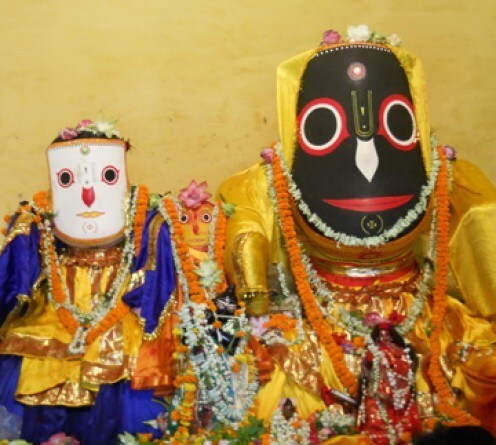
Every source that tells how Kamalakara Pippalai came to Mahesha begins the story with a different devotee entirely. He was an aging man who had renounced the world, named Dhruvananda. Dhruvananda's own story had started years earlier with a broken heart at Jagannatha Puri.
Dhruvananda's Desire #
Dhruvananda had traveled to Puri with one great wish. He wanted to cook for Lord Jagannatha with his own hands and offer that food to the Lord himself. It was a deeply personal devotional wish. Puri's temple authorities would not permit it. According to the account preserved in Bhaktisiddhanta Sarasvati Thakura's Anubhashya to Sri Chaitanya-charitamrita, Dhruvananda was so heartbroken at the refusal that he decided to fast until death. On the third day of that fast, he heard Jagannatha's voice in a dream. The Lord told him to return to Bengal and go to a village called Mahesha, on the bank of the Ganges. There, the Lord said, Dhruvananda's wish would finally be granted. When Dhruvananda reached Mahesha, he found Jagannatha, Balarama and Subhadra themselves floating in the river. He lifted the three Deities out of the water and built a small hut to shelter them. He began worshiping them there alone, and at last he was able to offer Jagannatha food cooked with his own hands.
A Dream Passed On #
Years passed, and Dhruvananda grew old. With no disciple or family to whom he could hand over the Deities' care, he faced the same problem that ends every solitary devotee's service: who continues it after he is gone? The answer, once again, came in a dream. Jagannatha told him of "a great Vaishnava named Kamalakara Pippalai," living in the village of Khalijuli in the Sundarban forest, who had already been instructed, in a dream of his own, to come to Mahesha and take over the Lord's service. Dhruvananda was told simply to hand everything over to this man when he arrived.
The next morning, exactly as promised, Kamalakara Pippalai reached Mahesha. Every account says that he carried the memory of the very same dream. Dhruvananda gave him full charge of Jagannatha, Balarama and Subhadra on the spot. For such an important handing over, it was very quiet. There was no debate, no test of worthiness and no ceremony. There was only trust, from one devotee guided by a dream to another. From that day forward, Kamalakara Pippalai took the title Adhikari, "one who is empowered" to worship the Lord. That title became his family's surname, and his descendants carry it to the present day. The Vaishnavacara-darpana, one of the sources Bhaktisiddhanta Sarasvati draws on, adds that the Pippalai name itself belongs to one of the fifty-five recognized branches of Rarha Brahmins. In this way it places Kamalakara's family clearly within Bengal's brahmana society. At the same time, it describes how he became something far beyond an ordinary brahmana householder.
Building Mahesha from Jungle #
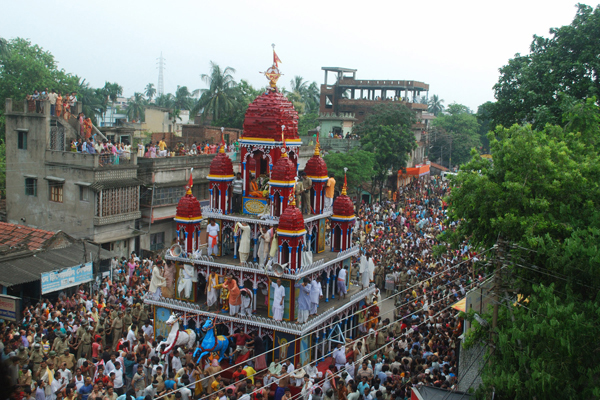
Kamalakara Pippalai did not receive a settled, well-established temple from Dhruvananda. He received a single small hut in what several sources describe as essentially unclaimed jungle along the riverbank. Over the years that followed, he had the land around it cleared and developed. In time, the settlement that grew up around the Deities' worship became a proper village. This is the Mahesha that still exists today, a little over two miles from the Serampore railway station in Hooghly district. The temple he built up there went on to hold one of Bengal's oldest and most important Rath Yatra festivals, and it still holds it today. This is the yearly chariot procession of Jagannatha, Balarama and Subhadra, and it draws hundreds of thousands of pilgrims each year. It is likely that neither Dhruvananda nor Kamalakara Pippalai could have imagined devotion on such a scale, back when there was only that first small hut by the river.
What the Story Asks of a Devotee #
Bhaktisiddhanta Sarasvati Thakura's Anubhashya does not simply tell this story. It draws a lesson from it, and Kamalakara Pippalai's own life shows that lesson directly. The Anubhashya says that a devotee is always eager to serve the Lord. For this reason the Lord gives direction to such a devotee, and never to one who is not already a devotee. Ordinary conditioned souls are absorbed in the pleasures of the senses. When they hear of service to Krishna and the Vaishnavas, they feel only the weight of duty and look for any excuse to avoid it. They do not see such service as wealth, the way a genuine Vaishnava does. Kamalakara Pippalai did the opposite. When he received Jagannatha's instruction, he left home and family at once and went where he was told. He did not do this as a sacrifice made unwillingly. In the Anubhashya's own phrase, he did it naturally and spontaneously. This tradition holds that this is the mark of a heart already absorbed in separation from the Lord, not in the ordinary business of household life. The rest of the story is told on Festivals, Family, and the Adhikari Legacy. It covers the family Kamalakara Pippalai left behind, the family he built in its place at Mahesha, and the festivals of the wider Vaishnava community he kept attending even after settling into this one lifelong service.
Chapter 3
Festivals, Family, and the Adhikari Legacy
Panihati, Kheturi, and a marriage into Nityananda Prabhu's own household, followed by generations of Adhikaris at Mahesha.
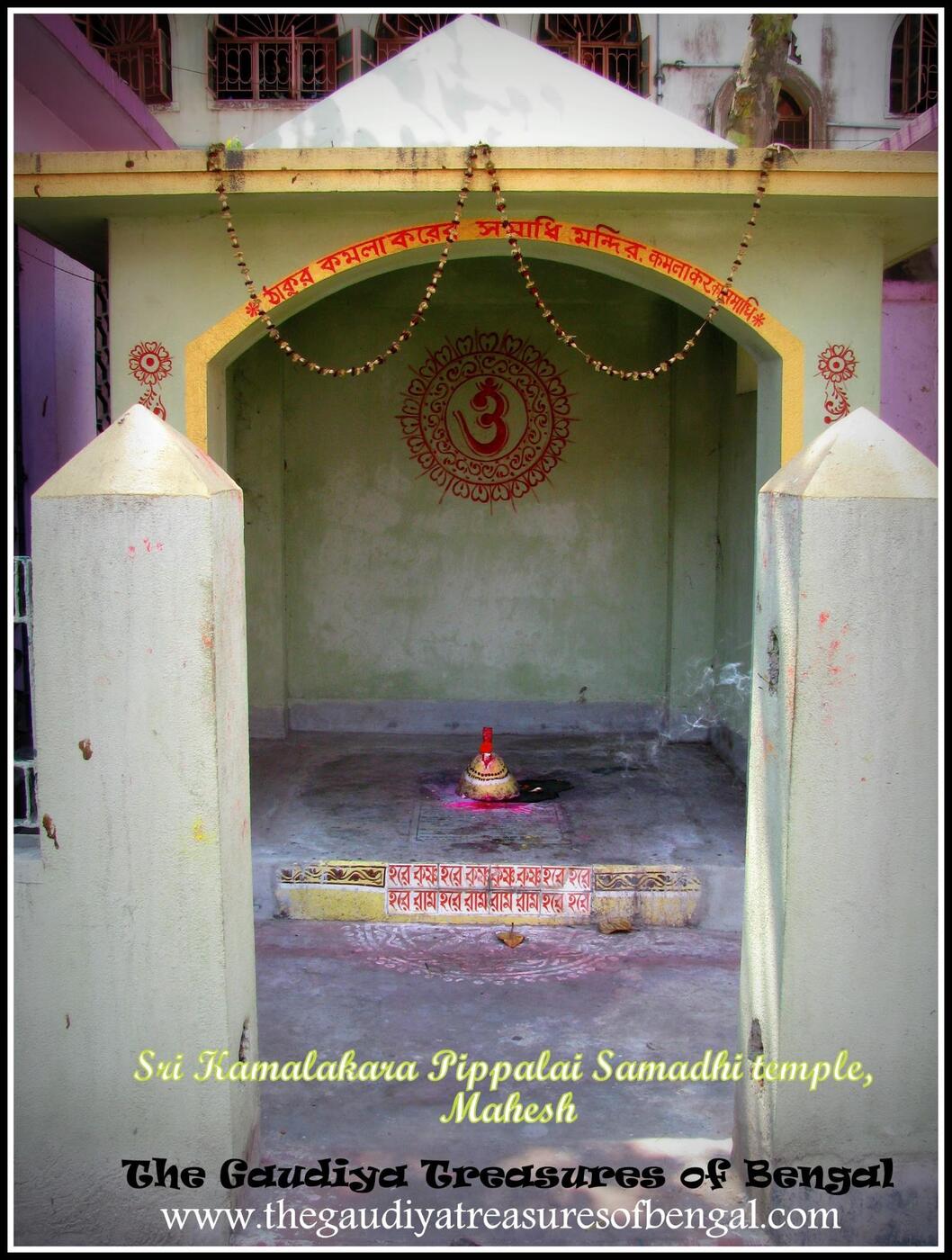
Settling permanently into the service of Jagannatha, Balarama and Subhadra at Mahesha did not mean Kamalakara Pippalai withdrew from the wider community of Sri Chaitanya Mahaprabhu's and Nityananda Prabhu's followers. Vaishnava chronicles place him at several of that community's most important gatherings, and eventually connect his own family directly to Nityananda Prabhu's household.
Panihati, Kheturi, and Katwa #
Kamalakara Pippalai is recorded as present at the Danda-mahotsava held at Panihati. At this festival, acting on Nityananda Prabhu's own order, Raghunatha Dasa Goswami distributed chipped rice and yogurt to the assembled Vaishnavas as a kind of joyful punishment. It is one of the best-loved episodes in the whole Gaudiya Vaishnava tradition. Kamalakara Pippalai is also named among those present at the great festival organized at Kheturi by Narottama Dasa Thakura, and at a further festival at Katwa held in honor of a devotee's disappearance day. Vaishnava history remembers the Kheturi festival as a landmark gathering that brought together devotees from across Bengal. One later compilation, the Vijaya-khanda, is reported to state that Nityananda Prabhu had at some point entrusted Panihati itself to Kamalakara Pippalai's care. This claim rests on that one text alone and cannot be checked against any other source. It is a separate matter from the better-recorded Danda-mahotsava he attended there.
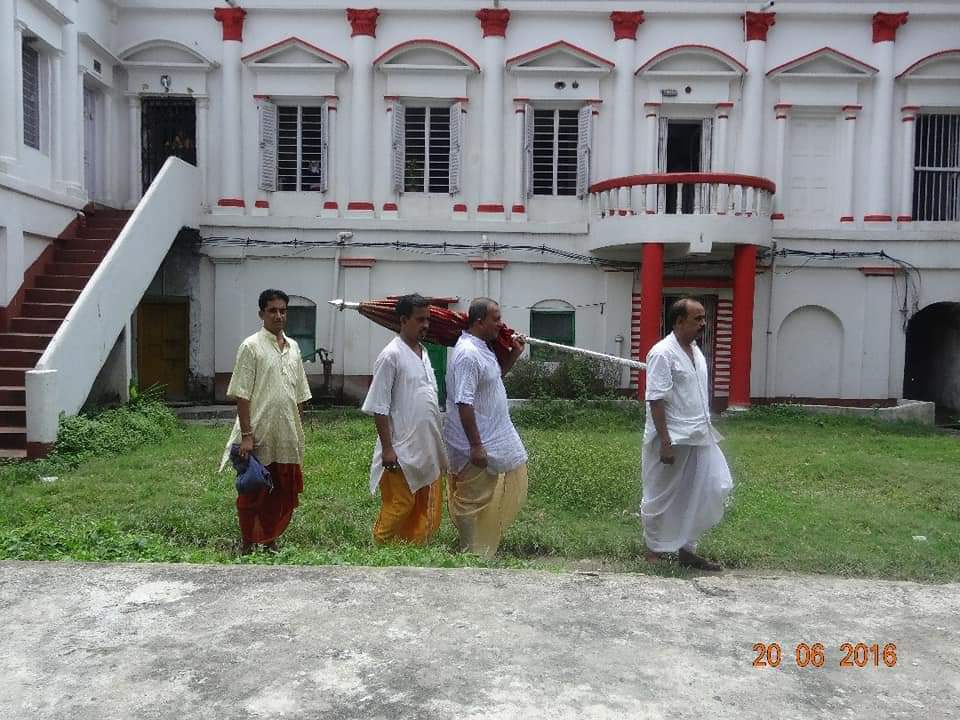
According to the Gaudiya Vaishnava Abhidhana, Kamalakara Pippalai's name also appears in the Bhakti-ratnakara. This is Narahari Chakravarti Thakura's own long chronicle of the generation of Vaishnavas after Chaitanya Mahaprabhu. The passage connects him to Jahnava Mata, Nityananda Prabhu's wife. By this period of Gaudiya Vaishnava history, Jahnava Mata had become a central figure who united the whole devotee community. She presided over major festivals, and both householders and those who had renounced the world respected her. Kamalakara Pippalai was evidently part of her circle. This marks him as someone who remained connected to the wider movement, even while his own service stayed rooted at Mahesha.
A Family Married into Nityananda's Own Line #
Kamalakara Pippalai had a daughter named Vidyunmala. Her marriage became the thread that tied his family permanently to Nityananda Prabhu's own household. But the sources that describe exactly how this happened do not fully agree with one another. The Vaishnavacara-darpana states that Vidyunmala married a learned Brahmin named Yadunandana. A citation from the Nityananda-vamsha-vistara, preserved in the Gaudiya Vaishnava Abhidhana, instead names her husband as Sudhamaya Chattopadhyaya, a devout worshiper of Vishnu and the Vaishnavas living at Mahesha. Both traditions agree about the next generation. A daughter of this marriage was given in marriage to Viracandra Prabhu, Nityananda Prabhu's own son. But even here the sources differ on her name. The Pippalai family's own tradition at Mahesha calls her Radharani. Bhaktisiddhanta Sarasvati Thakura's account names her Narayani, daughter of Yadunatha Acharya and Vidyunmala, and adopted by them. No source settles this difference, so both versions are given here instead of choosing between them. The main fact that both accept is itself well established: a granddaughter of Kamalakara Pippalai married into Nityananda Prabhu's direct family line.
The Adhikaris After Kamalakara #
The Anubhashya commentary on Chaitanya-charitamrita traces Kamalakara Pippalai's descendants across several generations at Mahesha: a son, Chaturbhuja; Chaturbhuja's two sons, Narayana and Jagannatha; Narayana's son, Jagadananda; and Jagadananda's son, Rajivalochana. In Rajivalochana's lifetime, a real shortage of money threatened the temple's worship. The Anubhashya records in exact detail how this was solved. The Nawab of Dacca, Shah Suja, donated 1,185 bighas of land, something close to four hundred acres, in the Bengali year 1060. This corresponds to 1653 in the Christian calendar. Because that land belonged to Jagannatha, the village that grew up on it was named Jagannathpura. It still carries that name today, and it lies a few miles from the Mahesha temple itself. The family that descended from Kamalakara Pippalai has carried the surname Adhikari ever since he first received that title from Dhruvananda. Members of that family still serve as caretakers of the Mahesha Deities today.
A Return to Vrindavana #
According to the Vaishnavacara-darpana, Kamalakara Pippalai eventually left Mahesha after arranging his daughter's marriage. He traveled to Vrindavana, where he spent the rest of his life. His own descendants at Mahesha keep a tradition that he disappeared there on Chaitra Shukla Trayodashi in the Bengali year corresponding to 1563. This date is best treated as family tradition, since no independent source confirms it apart from that family's own memory. But what he left behind is not in dispute. A temple has now stood at Mahesha for centuries. Its Rath Yatra remains one of Bengal's great yearly festivals. Four hundred years later, his family line is still known by the very title Adhikari, "one empowered to serve," which was first given to him through the dream of a dying man who had renounced the world. Kamalakara Pippalai was a Vaishnava from the Sundarbans who asked for nothing more than the chance to serve.
Closing
Descendants, and a Return to Vrindavana #
Kamalakara Pippalai's descendants at Mahesha are recorded across several generations: a son, Chaturbhuja; grandsons Narayana and Jagannatha; and, several generations later, a great-great-grandson, Rajivalochana. In Rajivalochana's time the Nawab of Dacca donated over a thousand bighas of land to support the temple's worship. This land is still known today as Jagannathpura. According to the family's own tradition, Kamalakara Pippalai himself left Mahesha after arranging his daughter's marriage, spent his final years at Vrindavana, and disappeared there on Chaitra Shukla Trayodashi in 1563. No independent source confirms that date. It is best understood as family tradition, not as established fact. But one thing is not in doubt. The service he took up from a dying renunciate, trusting in a dream, has continued through his descendants for more than four centuries. The Adhikari family still conducts worship at Mahesha today, and the temple's Rath Yatra remains one of the best-attended festivals in Bengal.
At a Glance
- Counted as the third of Nityananda Prabhu's twelve gopalas, and identified with the cowherd boy Mahabala from Krishna's Vraja pastimes.
- Took over worship of Jagannatha, Baladeva and Subhadra at Mahesha from the aging Dhruvananda, after both men received matching dreams.
- Adopted the title Adhikari, still carried by his descendants, who continue to serve the Mahesha Deities.
- Present at Panihati's Danda-mahotsava, the Kheturi festival, and a gathering at Katwa; his family later married into Nityananda Prabhu's own household.
- Family tradition holds that he spent his final years at Vrindavana, disappearing there in 1563.
- Sri Chaitanya-charitamrita, Adi-lila 11.24, purport
- Sri Chaitanya-charitamrita, Antya-lila 6.61
- Kamalakara Pippalai - Biography | Gaudiya History
- Dwadash Gopal - Twelve Cowherd Boys, Associates of Lord Nityananda | The Gaudiya Treasures of Bengal
- Sri Jagannatha Temple, Mahesh, Serampore | The Gaudiya Treasures of Bengal
