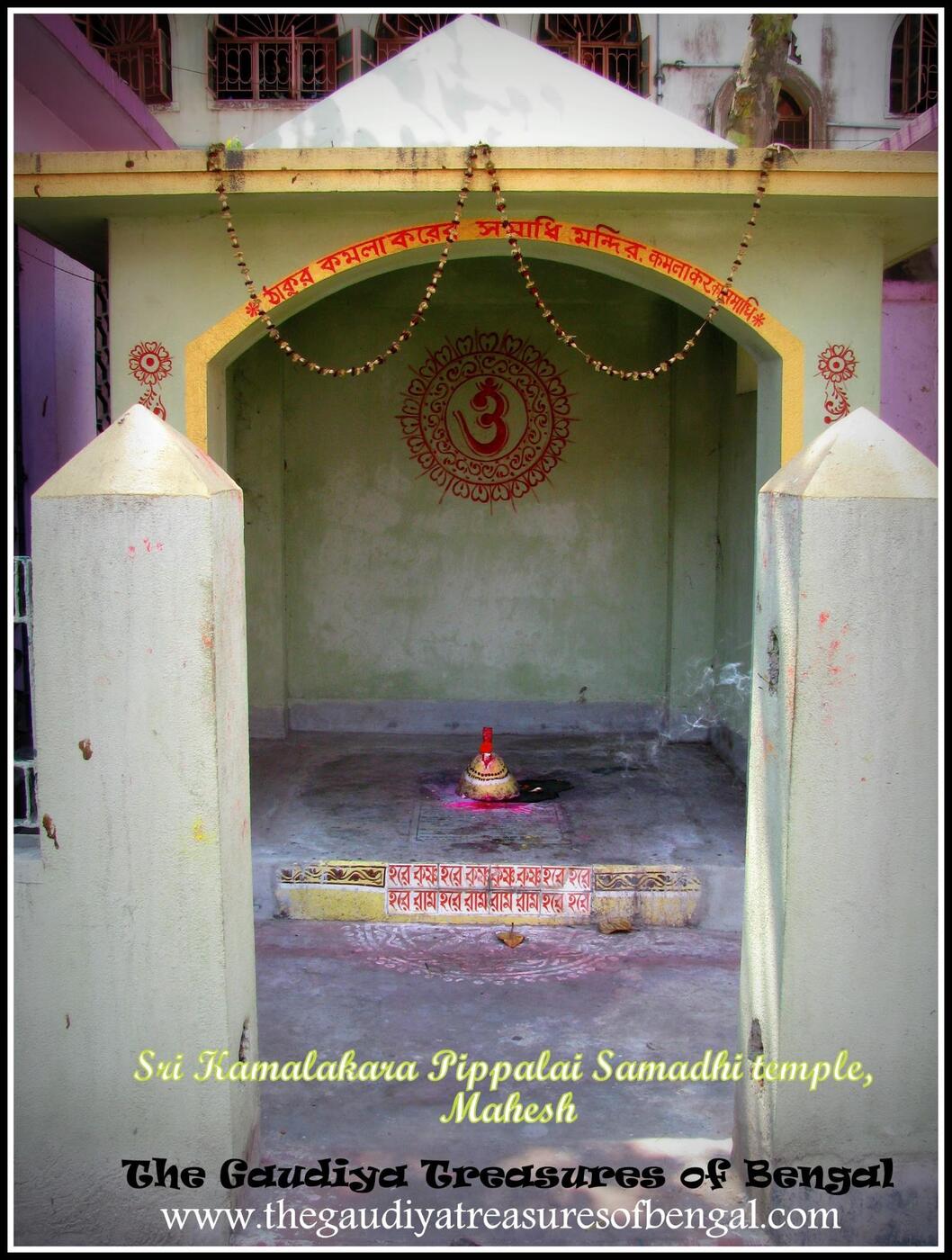
Settling permanently into the service of Jagannatha, Balarama and Subhadra at Mahesha did not mean Kamalakara Pippalai withdrew from the wider community of Sri Chaitanya Mahaprabhu's and Nityananda Prabhu's followers. Vaishnava chronicles place him at several of that community's most important gatherings, and eventually connect his own family directly to Nityananda Prabhu's household.
Panihati, Kheturi, and Katwa #
Kamalakara Pippalai is recorded as present at the Danda-mahotsava held at Panihati. At this festival, acting on Nityananda Prabhu's own order, Raghunatha Dasa Goswami distributed chipped rice and yogurt to the assembled Vaishnavas as a kind of joyful punishment. It is one of the best-loved episodes in the whole Gaudiya Vaishnava tradition. Kamalakara Pippalai is also named among those present at the great festival organized at Kheturi by Narottama Dasa Thakura, and at a further festival at Katwa held in honor of a devotee's disappearance day. Vaishnava history remembers the Kheturi festival as a landmark gathering that brought together devotees from across Bengal. One later compilation, the Vijaya-khanda, is reported to state that Nityananda Prabhu had at some point entrusted Panihati itself to Kamalakara Pippalai's care. This claim rests on that one text alone and cannot be checked against any other source. It is a separate matter from the better-recorded Danda-mahotsava he attended there.
According to the Gaudiya Vaishnava Abhidhana, Kamalakara Pippalai's name also appears in the Bhakti-ratnakara. This is Narahari Chakravarti Thakura's own long chronicle of the generation of Vaishnavas after Chaitanya Mahaprabhu. The passage connects him to Jahnava Mata, Nityananda Prabhu's wife. By this period of Gaudiya Vaishnava history, Jahnava Mata had become a central figure who united the whole devotee community. She presided over major festivals, and both householders and those who had renounced the world respected her. Kamalakara Pippalai was evidently part of her circle. This marks him as someone who remained connected to the wider movement, even while his own service stayed rooted at Mahesha.
A Family Married into Nityananda's Own Line #
Kamalakara Pippalai had a daughter named Vidyunmala. Her marriage became the thread that tied his family permanently to Nityananda Prabhu's own household. But the sources that describe exactly how this happened do not fully agree with one another. The Vaishnavacara-darpana states that Vidyunmala married a learned Brahmin named Yadunandana. A citation from the Nityananda-vamsha-vistara, preserved in the Gaudiya Vaishnava Abhidhana, instead names her husband as Sudhamaya Chattopadhyaya, a devout worshiper of Vishnu and the Vaishnavas living at Mahesha. Both traditions agree about the next generation. A daughter of this marriage was given in marriage to Viracandra Prabhu, Nityananda Prabhu's own son. But even here the sources differ on her name. The Pippalai family's own tradition at Mahesha calls her Radharani. Bhaktisiddhanta Sarasvati Thakura's account names her Narayani, daughter of Yadunatha Acharya and Vidyunmala, and adopted by them. No source settles this difference, so both versions are given here instead of choosing between them. The main fact that both accept is itself well established: a granddaughter of Kamalakara Pippalai married into Nityananda Prabhu's direct family line.
The Adhikaris After Kamalakara #
The Anubhashya commentary on Chaitanya-charitamrita traces Kamalakara Pippalai's descendants across several generations at Mahesha: a son, Chaturbhuja; Chaturbhuja's two sons, Narayana and Jagannatha; Narayana's son, Jagadananda; and Jagadananda's son, Rajivalochana. In Rajivalochana's lifetime, a real shortage of money threatened the temple's worship. The Anubhashya records in exact detail how this was solved. The Nawab of Dacca, Shah Suja, donated 1,185 bighas of land, something close to four hundred acres, in the Bengali year 1060. This corresponds to 1653 in the Christian calendar. Because that land belonged to Jagannatha, the village that grew up on it was named Jagannathpura. It still carries that name today, and it lies a few miles from the Mahesha temple itself. The family that descended from Kamalakara Pippalai has carried the surname Adhikari ever since he first received that title from Dhruvananda. Members of that family still serve as caretakers of the Mahesha Deities today.
A Return to Vrindavana #
According to the Vaishnavacara-darpana, Kamalakara Pippalai eventually left Mahesha after arranging his daughter's marriage. He traveled to Vrindavana, where he spent the rest of his life. His own descendants at Mahesha keep a tradition that he disappeared there on Chaitra Shukla Trayodashi in the Bengali year corresponding to 1563. This date is best treated as family tradition, since no independent source confirms it apart from that family's own memory. But what he left behind is not in dispute. A temple has now stood at Mahesha for centuries. Its Rath Yatra remains one of Bengal's great yearly festivals. Four hundred years later, his family line is still known by the very title Adhikari, "one empowered to serve," which was first given to him through the dream of a dying man who had renounced the world. Kamalakara Pippalai was a Vaishnava from the Sundarbans who asked for nothing more than the chance to serve.
