Chaitanya-charitamrita tells of Kashishvara Pandit's decades of service at Jagannatha Puri. The commentaries on this account also give him a second name. This name shows his place in the eternal life of Vrindavana, before Mahaprabhu's pastimes. That identity, and the Deity worship it later leads to, is the part of Kashishvara's story that reaches farthest from Puri.
Bhrngara, Named in the Gaura-ganoddesha-dipika #
Krishnadasa Kaviraja Goswami's own text describes Kashishvara's guru and his companion Govinda in careful detail. Kashishvara was a brahmachari disciple of Ishvara Puri, always paired with Govinda, "another of his dear disciples." Srila Prabhupada's purport to this verse (Adi 10.138) adds the traditional answer to who these two men were before Mahaprabhu's advent: "In the Gaura-ganoddesha-dipika (137) it is stated that the servants formerly named Bhrngara and Bhangura in Vrindavana became Kashishvara and Govinda in Caitanya Mahaprabhu's pastimes." Gaura-ganoddesha-dipika is the traditional Gaudiya Vaishnava text that names, for each of Mahaprabhu's associates, the matching person in Krishna's own Vraja-lila. According to this book, Kashishvara's place there was as Bhrngara, one of the personal servants attending Krishna in Vrindavana. Govinda, Mahaprabhu's personal attendant in the Puri years, was the servant Bhangura there.
Govinda Gosani, Priest of the Govindaji Deity #
Chaitanya-charitamrita also speaks of a second, different Govinda. He links Kashishvara to Vrindavana as a real place, not only as a match in scripture. Govinda Gosani is described as "a disciple of Kashishvara Gosani," and as "the priest engaged in the service of Lord Govinda in Vrindavana" in one Chaitanya-charitamrita verse. The verse also notes that "there was no servant more dear to the Govinda Deity," and Govinda Gosani was the pujari of the very Deity found in Vrindavana by Sri Rupa Gosvami. This was Sri Govindaji, dug up at Gomatila and installed in the temple Rupa Gosvami built for Him. This much comes directly from Chaitanya-charitamrita's own text, as explained in Bhaktisiddhanta Sarasvati's notes, and we can say it with real confidence. Kashishvara's own disciple ended his life as one of the most trusted priests in Vrindavana. He served the Deity most closely connected with the whole mission of the Six Goswamis there.
Kashishvara's Own Move: What Tradition Adds #
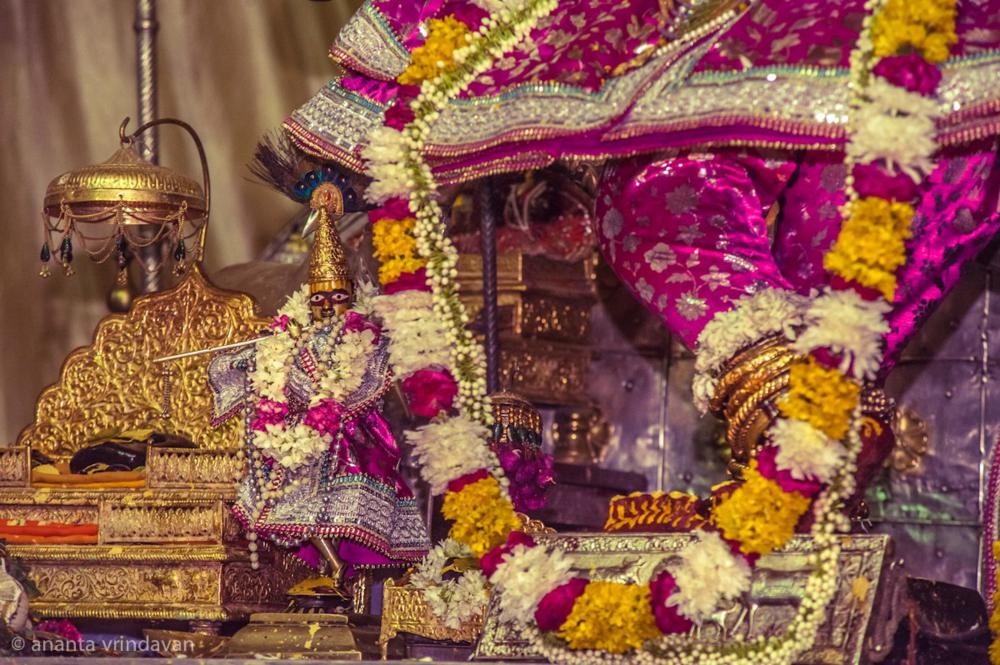
Devotional accounts collected by gaudiyahistory.iskcondesiretree.com go a step further. They hold that when news of Rupa Gosvami's discovery of the Deity reached Puri, Mahaprabhu Himself sent Kashishvara to Vrindavana to join Govinda. Kashishvara was torn at the thought of leaving the Lord's presence, and he said, "My Lord, if I must give up Your association my heart will split in two." In this telling, Mahaprabhu answered by giving him a self-manifest Deity of His own form. The Deity was golden and was playing the flute. It is said to have looked so exactly like Mahaprabhu that it eased Kashishvara's grief. It was installed at Govindaji's right hand and named Gaura-Govinda. The same tradition holds that this Deity later traveled to Jaipur, where Gaura-Govinda and Govindaji are worshiped together to this day. It also holds that a hymn called Shri Sadhana Dipika honors Kashishvara in particular for "power of love and devotion" that "brought Sri Chaitanya to Western India as a Deity."
This part of the story is a devotional tradition. Gaudiya Vaishnava institutions have kept and retold it with real care, but Chaitanya-charitamrita itself does not tell it. The text that names Bhrngara, and that identifies Govinda Gosani as Govindaji's priest, does not go on to describe Kashishvara's own move, his parting words, or the gift of a personal Deity. Those details come only from later devotional retelling. The two accounts do not conflict with each other. The tradition says that Kashishvara, himself a beloved disciple, followed his own disciple to Vrindavana to keep serving beside him. This fits well enough with the facts that Chaitanya-charitamrita does give. But it would claim too much to say that the Gaura-Govinda story is as well supported as the crowd-control episodes, which the Chaitanya-charitamrita itself records verse after verse.
A Family Trace at Vallabhapura #
One more concrete detail has survived. It is the nearest thing we have to outside confirmation for any part of Kashishvara's life beyond Puri. Bhaktisiddhanta Sarasvati Thakura records that Kashishvara was the son of Vasudeva Bhattacharya, of the Chaudhuri family. He also records that Kashishvara's nephew, his sister's son Rudra Pandita, became the first priest of a temple at Vallabhapura, near the Srirampur railway station in Bengal. The temple houses Deities of Radha-Govinda and Gauranga. Bhaktisiddhanta Sarasvati writes that he visited this temple himself and took prasadam there. By his time, later descendants had sold off much of the family's original land that paid for the Deity's daily worship, and the worship had already suffered from this loss. Devotional tradition also places a samadhi for Kashishvara among the sixty-four samadhis of Mahaprabhu's associates at Vrindavana, though no source records this further. So there is a real family in Bengal, a real disciple installed as priest in Vrindavana, and a devotional memory of the guardian, Kashishvara himself, following him there. Kashishvara Pandit's life after Puri is a mixture of what is recorded and what is remembered in devotion, and the two are kept clearly apart here.
