Kashishvara Pandit
The Guardian Who Cleared Mahaprabhu's Path
The complete life, on one page: The main biography and every pastime page, in order, in one place
Introduction
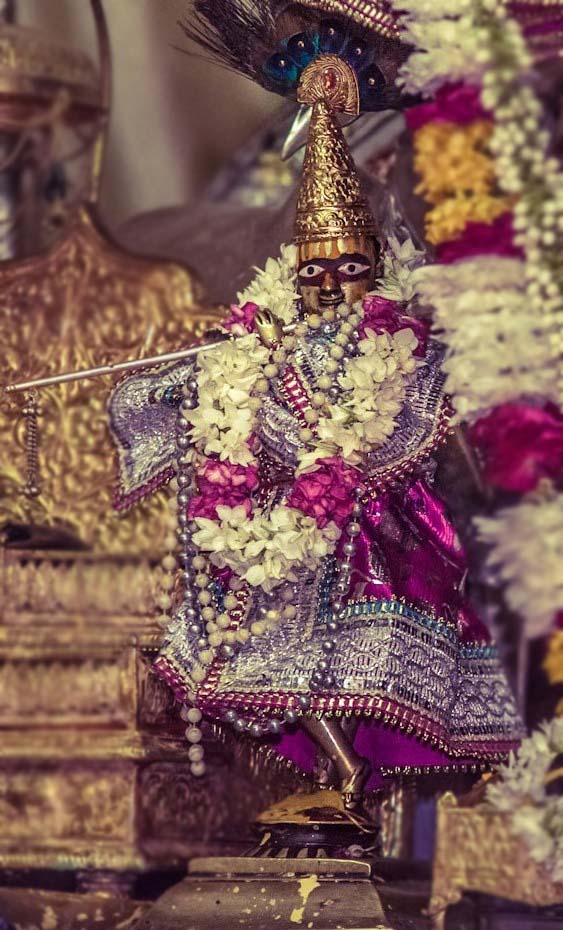
Kashishvara Pandit was one of two disciples that Ishvara Puri, on his deathbed, sent to serve Sri Chaitanya Mahaprabhu at Jagannatha Puri. For the rest of Mahaprabhu's manifest life there, Kashishvara had a role that no one else quite had. Sri Chaitanya-charitamrita describes him walking in front of the Lord through the temple crowds, physically holding people back, and afterward helping serve prasadam to the assembled devotees. The text names him eighteenth among the many devotees it lists at Nilachala (Jagannatha Puri). It pairs him again and again with Govinda, a fellow disciple of Ishvara Puri. It keeps mentioning the two of them from Mahaprabhu's early Puri years all the way through the Antya-lila, the account of the Lord's last twelve years. Almost nothing of his life outside that service survives. There is no birth year, no year of disappearance, and only one detailed biographical note, from Srila Bhaktisiddhanta Sarasvati Thakura. But what is recorded is specific and consistent, and it is repeated in many verses. Kashishvara Pandit was Sri Chaitanya Mahaprabhu's physical protector.
| Detail | Description |
|---|---|
| Guru | Ishvara Puri, who was also Sri Chaitanya Mahaprabhu's own diksha-guru |
| Status | Brahmachari; by that guru relationship, a direct Godbrother of Mahaprabhu Himself |
| Field of service | Jagannatha Puri, in Mahaprabhu's household and at the Jagannatha temple |
| Constant companion | Govinda, another dear disciple of Ishvara Puri and Mahaprabhu's personal attendant |
| Best-documented role | Clearing crowds ahead of Mahaprabhu on the way to see Lord Jagannatha; distributing prasadam after kirtana |
| Family detail | Son of Vasudeva Bhattacharya of the Chaudhuri family (a different Vasudeva Bhattacharya from Sarvabhauma Bhattacharya, who was also born with that name); connected to a temple at Vallabhapura, near Srirampur, Bengal |
| Identity | Bhrngara, a servant of Krishna in Vraja (Gaura-ganoddesha-dipika 137; Chaitanya-charitamrita Adi 10.138 purport) |
Scriptural evidence for the introduction (7)
isvara-purira sisya — brahmacari kasisvara
sri-govinda nama tanra priya anucara
Word for word
isvara-purira sisya: disciple of Ishvara Puri; brahmacari kasisvara: Brahmachari Kashishvara; sri-govinda: Sri Govinda; nama: name; tanra: his; priya: very dear; anucara: follower.
Brahmachari Kashishvara was a disciple of Ishvara Puri, and Sri Govinda was another of his dear disciples.
From the purport: In the Gaura-gaṇoddeśa-dīpikā (137) it is stated that the servants formerly named Bhṛṅgāra and Bhaṅgura in Vṛndāvana became Kāśīśvara and Govinda in Caitanya Mahāprabhu’s pastimes.
The line naming Kashishvara as Ishvara Puri's disciple and Govinda as his own dear follower, opening the pair's story in the Adi-lila catalog of devotees.
tanra siddhi-kale donhe tanra ajna pana
nilacale prabhu-sthane milila asiya
Word for word
tanra siddhi-kale: at the time of Ishvara Puri's passing away; donhe: the two of them; tanra ajna: his order; pana: getting; nilacale: at Jagannatha Puri; prabhu-sthane: at the place of Lord Chaitanya Mahaprabhu; milila asiya: met, coming there.
In the list of prominent devotees at Nilachala [Jagannatha Puri], Kashishvara was the eighteenth and Govinda the nineteenth. They both came to see Chaitanya Mahaprabhu at Jagannatha Puri, being thus ordered by Ishvara Puri at the time of his passing away.
States that both men came to Puri on their dying guru's own order, and gives their place in Chaitanya-charitamrita's ranked list of devotees at Nilachala.
gurura sambandhe manya kaila dunhakare
tanra ajna mani' seva dilena donhare
Word for word
gurura sambandhe: in relationship with His spiritual master; manya kaila: offered honor; dunhakare: to both of them; tanra ajna mani': accepting his order; seva dilena donhare: gave the two of them service.
Both Kashishvara and Govinda were Godbrothers of Sri Chaitanya Mahaprabhu, and thus the Lord duly honored them as soon as they arrived. But because Ishvara Puri had ordered them to give Chaitanya Mahaprabhu personal service, the Lord accepted their service.
Explains Mahaprabhu's initial reluctance to accept service from His own Godbrothers, and why He agreed regardless.
anga-seva govindere dilena isvara
jagannatha dekhite calena age kasisvara
Word for word
anga-seva: bodily service; govindere: unto Govinda; dilena isvara: the Lord gave; jagannatha dekhite: to see Lord Jagannatha; calena: walks; age: in front; kasisvara: Kashishvara.
Govinda cared for the body of Sri Chaitanya Mahaprabhu, whereas Kashishvara went in front of the Lord when He went to see Jagannatha in the temple.
The verse that fixes the lasting division of duties between the two companions.
kasisvara asibena saba tirtha dekhiya
prabhu-ajnaya muni ainu toma-pade dhana
Word for word
kasisvara asibena: Kashishvara will come; saba tirtha dekhiya: after visiting all the holy places; prabhu-ajnaya: under the order of my spiritual master; muni ainu toma-pade dhana: I have hastily come to Your lotus feet.
"Kashishvara will also come here after visiting all the holy places. However, following the orders of my spiritual master, I have hastily come to be present at Your lotus feet."
Govinda explaining to Mahaprabhu, on his own arrival at Puri, that Kashishvara was still finishing a pilgrimage and would follow separately.
kasisvara gosani aila ara dine
sammana kariya prabhu rakhila nija sthane
Word for word
kasisvara gosani: Kashishvara Gosani; aila: came; ara dine: the next day; sammana kariya: giving all respect; prabhu rakhila nija sthane: the Lord kept him in His own place.
The next day, Kashishvara Gosani also came and remained with Sri Chaitanya Mahaprabhu, who received him with great respect.
Records Kashishvara's own arrival at Puri, a day after Govinda, as promised.
पुरा वृन्दावने चेटौ स्थितौ भृङ्गरभङ्गुरौ ।
श्रीकाशीश्वर गोविन्दौ तौ जातौ प्रभुसेवकौ ॥
purā vṛndāvane ceṭau sthitau bhṛṅgara-bhaṅgurau
śrī-kāśīśvara govindau tau jātau prabhu-sevakau
Bhrngara and Bhangura, who had been Lord Krsna's servants in Vrndavana, later appeared as Sri Kasisvara and Sri Govinda, the servants of Lord Caitanya Mahaprabhu.
Kavi Karnapura names the Vraja servants Bhrngara and Bhangura as Kashishvara and Govinda, the two servants of Sri Chaitanya Mahaprabhu; Srila Prabhupada repeats this in his purport to Chaitanya-charitamrita Adi 10.138. Sanskrit: diacritic edition of the Gaura-ganoddesha-dipika; English translation as published at bvmlu.org.
Chapter 1
Guardian of the Sankirtana Crowds
How a brahmachari sent by his dying guru became Sri Chaitanya Mahaprabhu's lifelong physical protector at Jagannatha Puri.
Sri Chaitanya-charitamrita does not describe Kashishvara Pandit's guardianship of Mahaprabhu as a single event. Instead, the text builds up the picture verse by verse, across years and chapters. The same short phrase, "Kashishvara-Govinda," comes again and again in lists of the devotees who stood nearest Sri Chaitanya Mahaprabhu at Jagannatha Puri. In the end, the pair reads less like two names and more like the name of a single duty.
The clearest single description of the job itself comes during the annual cleansing of the Gundica temple, the ritual that opened each year's Ratha-yatra season. Krishnadasa Kaviraja Goswami records that when Mahaprabhu went to visit the temple, "Kashishvara walked in front, checking the crowds of people, and Govinda walked in the rear, bringing the sannyasi's pitcher filled with water." It is a small, homely picture of one man clearing a path and another carrying water. But it shows exactly how their arrangement had settled since Ishvara Puri first ordered them to Puri. Govinda's duty was bodily care, close and constant. Kashishvara's duty was the crowd itself, which he kept at a physical distance from the Lord's body by his own strength.
The Second Circle #
During the Ratha-yatra festival itself, that job grew much larger. Puri filled with pilgrims for the occasion, and the kirtana that Mahaprabhu led before Lord Jagannatha's cart drew crowds no single man could hold back alone. Chaitanya-charitamrita describes the devotees organizing themselves into rings around the Lord as He danced. There was an inner circle right around Him. Beyond it the devotees formed a second ring, joining hands to keep the wider crowd from pressing in. "All the devotees headed by Kashishvara and Govinda linked hands," the text says, "and formed a second circle around the Lord." The words "headed by" matter. This was not simply Kashishvara taking his usual place near Mahaprabhu. It was Kashishvara organizing other devotees into a working barrier. Such a role would need both physical strength and some recognized authority among the assembled Vaishnavas to put them into position.
Srila Bhaktisiddhanta Sarasvati Thakura wrote a note on Kashishvara that is preserved in his Anubhasya commentary and quoted in Srila Prabhupada's purport to Chaitanya-charitamrita. The note ties the two roles together, temple-crowd control and Ratha-yatra circle-forming. It treats them as a single trait of his character, not as two separate duties: "Kashishvara Gosani was a very strong man, and therefore when Lord Chaitanya visited the temple of Jagannatha, he used to protect the Lord from the crowds. Another of his duties was to distribute prasadam to the devotees after kirtana." That second duty should not be passed over, because it is easy to miss beside the drama of crowd control. After the kirtana ended and the devotees sat down together, Kashishvara helped serve the meal. He is sometimes named in this service alongside Govinda, Swarupa Damodara, Jagadananda Pandita and Shankara. He moved down the rows of seated Vaishnavas, serving out Lord Jagannatha's prasadam. Chaitanya-charitamrita records this happening repeatedly in the Antya-lila, the account of Mahaprabhu's final twelve years at Puri. This means Kashishvara was still doing it late in life. The same hands that held back a festival crowd also served rice to the devotees who had just been part of it.
A Fixture of Every List #
When we read through Chaitanya-charitamrita's many devotee-lists, one thing stands out. Kashishvara's name appears steadily across the whole span of Mahaprabhu's Puri residence, not in one short burst. He is named among those who stayed with the Lord at Nilachala early on, alongside Paramananda Puri, Swarupa Damodara, Jagadananda Pandita and Damodara Pandita. He is named among the devotees who set out partway with Mahaprabhu when He began His journey toward Vrindavana. These included Haridasa Thakura, Vakreshvara Pandita, Gopinatha Acharya and others. Then the Lord reduced His party to a single companion for the forest crossing. And he is named again in the Antya-lila, among the Puri brahmanas who took turns inviting Mahaprabhu to their own homes for meals cooked there, not bought as temple prasadam. These are three different moments and three different kinds of scene, with the same name in all of them. This is about as close as Chaitanya-charitamrita comes to describing a man's entire working life in one continuous thread.
In fact, this steady service is the whole of what can truly be said about Kashishvara Pandit's years at Puri. There was no single dramatic turning point. There were decades of the same demanding, physical, mostly humble service. It was repeated at every festival and, it seems, recorded every time it happened. There was, however, one occasion when the arrangement failed. For once, Kashishvara and Govinda were not in position, and Chaitanya-charitamrita treats the consequences as important enough to explain in detail. That episode is told separately, on The Day the Circle Broke.
Scriptural evidence for this chapter (6)
kasisvara gosanira sisya — govinda gosani
govindera priya-sevaka tanra sama nani
Word for word
kasisvara gosanira: of Kashishvara Gosvami; sisya: disciple; govinda gosani: Govinda Gosani; govindera priya-sevaka: most confidential servitor of Govinda; tanra sama nani: none is equal to him.
Govinda Gosani, the priest engaged in the service of Lord Govinda in Vrindavana, was a disciple of Kashishvara Gosani. There was no servant more dear to the Govinda Deity.
From the purport: "Kasisvara Gosani was a very strong man, and therefore when Lord Caitanya visited the temple of Jagannatha, he used to protect the Lord from the crowds. Another of his duties was to distribute prasadam to the devotees after kirtana."
Srila Bhaktisiddhanta Sarasvati Thakura's Anubhasya, quoted in Srila Prabhupada's purport, is the single fullest surviving character sketch of Kashishvara and the direct source for his role as crowd-guard and prasadam-server.
age kasisvara yaya loka nivariya
pache govinda yaya jala-karanga lana
Word for word
age: in front; kasisvara yaya: Kashishvara goes; loka nivariya: checking the crowd; pache: at the end; govinda yaya: Govinda goes; jala-karanga lana: bringing the water pitcher.
When Sri Chaitanya Mahaprabhu went to visit the temple, Kashishvara walked in front, checking the crowds of people, and Govinda walked in the rear, bringing the sannyasi's pitcher filled with water.
The single clearest description of the two men's daily working arrangement during the Gundica-temple visits before Ratha-yatra.
kasisvara govindadi yata bhakta-gana
hatahati kari' haila dvitiya avarana
Word for word
kasisvara: Kashishvara; govinda-adi: headed by Govinda; yata bhakta-gana: all the devotees; hatahati kari': linking hand to hand; haila dvitiya avarana: became a second covering circle.
All the devotees headed by Kashishvara and Govinda linked hands and formed a second circle around the Lord.
Describes Kashishvara organizing other devotees into a human barrier during the Ratha-yatra kirtana, not merely standing near Mahaprabhu himself.
puri-gosani, jagadananda, svarupa-damodara
damodara-pandita, ara govinda, kasisvara
ei-saba-sange prabhu vaise nilacale
jagannatha-darasana nitya kare pratah-kale
Word for word
puri-gosani: Paramananda Puri; jagadananda: Jagadananda; svarupa-damodara: Svarupa Damodara; damodara-pandita: Damodara Pandita; ara govinda, kasisvara: and Govinda, Kashishvara; ei-saba-sange: with all of them; prabhu vaise nilacale: the Lord stays at Nilachala.
Sri Chaitanya Mahaprabhu remained at Jagannatha Puri, Nilachala, with Paramananda Puri, Jagadananda, Svarupa Damodara, Damodara Pandita, Govinda and Kashishvara. It was Sri Chaitanya Mahaprabhu's daily practice to see Lord Jagannatha in the morning.
Places Kashishvara among the small inner circle who stayed with Mahaprabhu at Nilachala year-round.
prabhu-sange puri-gosani, svarupa-damodara
jagadananda, mukunda, govinda, kasisvara
haridasa-thakura, ara pandita-vakresvara
gopinathacarya, ara pandita-damodara
ramai, nandai, ara bahu bhakta-gana
pradhana kahilun, sabara ke kare ganana
Word for word
prabhu-sange: with Sri Chaitanya Mahaprabhu; puri-gosani: Paramananda Puri Gosvami; svarupa-damodara, jagadananda, mukunda, govinda, kasisvara: Svarupa Damodara, Jagadananda, Mukunda, Govinda, Kashishvara; pradhana kahilun: I have mentioned only the chief devotees.
Paramananda Puri Gosvami, Svarupa Damodara, Jagadananda, Mukunda, Govinda, Kashishvara, Haridasa Thakura, Vakresvara Pandita, Gopinatha Acharya, Damodara Pandita, Ramai, Nandai and many other devotees accompanied the Lord. I have mentioned only the chief devotees. No one can describe the total number.
Names Kashishvara among the devotees who set out with Mahaprabhu at the start of His journey toward Vrindavana, before the Lord reduced His party for the forest crossing.
gopinathacarya, jagadananda, kasisvara
bhagavan, ramabhadracarya, sankara, vakresvara
madhye madhye ghara-bhate kare nimantrana
anyera nimantrane prasade kaudi dui-pana
Word for word
gopinatha-acarya: Gopinatha Acharya; jagadananda: Jagadananda Pandita; kasisvara: Kashishvara; bhagavan: Bhagavan; ramabhadra-acarya, sankara, vakresvara: Ramabhadra Acharya, Shankara, Vakresvara; ghara-bhate kare nimantrana: invite for food cooked at home.
Gopinatha Acharya, Jagadananda, Kashishvara, Bhagavan, Ramabhadra Acharya, Shankara and Vakresvara, who were all brahmanas, extended invitations to Sri Chaitanya Mahaprabhu and offered Him food cooked at home, whereas other devotees would pay two panas of small conchshells to purchase Jagannatha's prasadam and then invite the Lord.
Shows Kashishvara still a fixture at Puri in the Antya-lila, the account of Mahaprabhu's final twelve years.
Chapter 2
The Day the Circle Broke
The one Ratha-yatra when Kashishvara's usual post stood empty, and King Prataparudra caught the falling Lord instead.
For most of every Ratha-yatra festival, the arrangement worked exactly as intended: Kashishvara and Govinda, with other devotees linking hands around them, kept the crowd at a safe distance while Sri Chaitanya Mahaprabhu danced in front of Lord Jagannatha's cart. Sri Chaitanya-charitamrita records one occasion, though, when the system broke down at exactly the wrong moment. It used the failure to tell one of the more delicate stories in the whole Ratha-yatra narrative, about King Prataparudra of Orissa.
The Lord Falls #
Mahaprabhu's dancing before the cart was, by every account, not a performance. It was an ecstasy that overtook His body again and again. Krishnadasa Kaviraja Goswami writes that even Lord Jagannatha and Lord Balarama, watching from the cart, would sometimes stop its movement altogether just to observe Him: "anyone who was able to see Them stop and watch the dancing," he adds, "bore witness to Their pastimes." In the middle of this dancing and wandering, Mahaprabhu was so deep in trance that He was no longer aware of where He was moving. Then He fell, directly in front of King Prataparudra.
The king was there in disguise. Devotional accounts describe how, out of devotion, he had taken up the humble service of a sweeper, clearing the road ahead of Lord Jagannatha's cart. Chaitanya-charitamrita confirms that this service pleased Mahaprabhu deeply once He learned of it. When the Lord collapsed toward him, Prataparudra caught Him and "picked the Lord up with great respect," in Krishnadasa Kaviraja's words. The ecstasy did not come to a natural end. It was the shock of seeing the king's face that brought Mahaprabhu back to His external senses.
The Lord's Self-Rebuke #
What followed was not gratitude but distress. When Mahaprabhu recognized whose arms He had fallen into, He condemned Himself on the spot: "Oh, how pitiful it is that I have touched a person who is interested in mundane affairs!" The line sounds harsh out of context. But it reflects a strict standard that Mahaprabhu held and applied to Himself first. This was a sannyasi's careful distance from kings, ministers and anyone whose position centered on worldly power. He kept this distance even from devout rulers. He was concerned that easy mixing with royalty could damage the example set by a sannyasi. By this point in the Chaitanya-charitamrita narrative, Prataparudra was a sincerely devoted Vaishnava king. But that made no difference to Mahaprabhu's immediate response. The touch itself, however innocent, was enough to bring on the self-rebuke.
Where Kashishvara Was #
At exactly this point, Chaitanya-charitamrita explains why no one prevented the fall in the first place, and it names Kashishvara directly in doing so: "Not even Lord Nityananda Prabhu, Kashishvara or Govinda took care of Lord Chaitanya Mahaprabhu when He fell down. Nityananda was in great ecstasy, and Kashishvara and Govinda were elsewhere." This verse matters a great deal in the story. Elsewhere in the text, these three are exactly the men whose job it was to stay close enough to Mahaprabhu's body to catch this kind of fall. Nityananda Prabhu was His oldest and closest companion. Kashishvara and Govinda had their long-established roles as crowd-guard and body-attendant. But this time, for once, none of the three was in position to catch Him. Nityananda was himself lost in ecstatic dancing nearby. Kashishvara and Govinda happened, at that moment, to be elsewhere in the crowd. The text offers this as the specific reason why the King, and no one else, was the one who caught the falling Lord.
Seen in this way, the verse is not really a criticism of Kashishvara. It shows instead how reliable his usual presence was. Chaitanya-charitamrita does not record this as a lapse in duty needing correction. Nor does it show Mahaprabhu troubled by his guardians' absence. He is troubled only by the person He happened to fall toward while they were away. The moment stands out because it is the one time in the entire text that Kashishvara is mentioned for not being at his protective post. Everywhere else, across decades of festivals and daily temple visits, he is exactly where the job required him to be.
What the Episode Preserves #
King Prataparudra's disguised service as a sweeper is itself part of a longer story, about the king's persistent, humble attempts to be allowed to meet Mahaprabhu. Seen together with that service, the fall becomes a small turning point in a larger story about devotion counting for more than rank. But it is also, quietly, a turning point in Kashishvara's own story. This is the single moment that Chaitanya-charitamrita chooses to mark by his absence. Without saying so directly, it tells us exactly how present he was expected to be at every other moment of every other year. A guardian usually goes unnoticed in the record of the person he guards. Only the one time he is missing makes his constant presence visible at all.
Scriptural evidence for this chapter (3)
Quoted in the text above:
- Madhya 13.183 Sri Chaitanya-charitamrita
Further verses:
ei-mata prabhu nrtya karite bhramite
prataparudrera age lagila padite
Word for word
ei-mata: in this way; prabhu nrtya karite bhramite: the Lord dancing and wandering; prataparudrera age: in front of King Prataparudra; lagila padite: began to fall down.
When Lord Sri Chaitanya Mahaprabhu was dancing and wandering in this way, He fell down in front of Maharaja Prataparudra.
The moment of the fall itself, during the ecstatic dancing before Lord Jagannatha's Ratha-yatra cart.
raja dekhi' mahaprabhu karena dhik-kara
chi, chi, visayira sparsa ha-ila amara
Word for word
raja dekhi': seeing the King; mahaprabhu karena dhik-kara: Mahaprabhu condemns Himself; chi chi: how pitiable it is; visayira sparsa ha-ila amara: I have touched a person interested in mundane affairs.
After seeing the King, Sri Chaitanya Mahaprabhu condemned Himself, saying, "Oh, how pitiful it is that I have touched a person who is interested in mundane affairs!"
Mahaprabhu's own self-rebuke on regaining external consciousness in King Prataparudra's arms.
Chapter 3
Bhrngara of Vrindavana
Kashishvara's identity from Krishna's Vraja pastimes, his disciple Govinda's life as priest of the Govindaji Deity, and the devotional tradition of the Gaura-Govinda Deity that reached Jaipur.
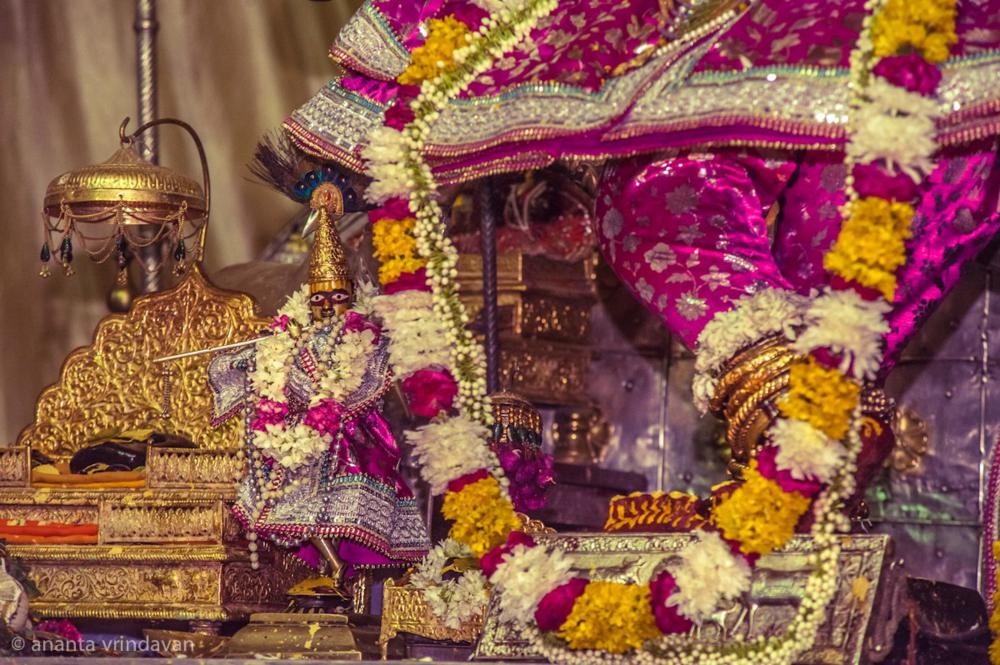
Chaitanya-charitamrita tells of Kashishvara Pandit's decades of service at Jagannatha Puri. The commentaries on this account also give him a second name. This name shows his place in the eternal life of Vrindavana, before Mahaprabhu's pastimes. That identity, and the Deity worship it later leads to, is the part of Kashishvara's story that reaches farthest from Puri.
Bhrngara, Named in the Gaura-ganoddesha-dipika #
Krishnadasa Kaviraja Goswami's own text describes Kashishvara's guru and his companion Govinda in careful detail. Kashishvara was a brahmachari disciple of Ishvara Puri, always paired with Govinda, "another of his dear disciples." Srila Prabhupada's purport to this verse (Adi 10.138) adds the traditional answer to who these two men were before Mahaprabhu's advent: "In the Gaura-ganoddesha-dipika (137) it is stated that the servants formerly named Bhrngara and Bhangura in Vrindavana became Kashishvara and Govinda in Caitanya Mahaprabhu's pastimes." Gaura-ganoddesha-dipika is the traditional Gaudiya Vaishnava text that names, for each of Mahaprabhu's associates, the matching person in Krishna's own Vraja-lila. According to this book, Kashishvara's place there was as Bhrngara, one of the personal servants attending Krishna in Vrindavana. Govinda, Mahaprabhu's personal attendant in the Puri years, was the servant Bhangura there.
Govinda Gosani, Priest of the Govindaji Deity #
Chaitanya-charitamrita also speaks of a second, different Govinda. He links Kashishvara to Vrindavana as a real place, not only as a match in scripture. Govinda Gosani is described as "a disciple of Kashishvara Gosani," and as "the priest engaged in the service of Lord Govinda in Vrindavana" in one Chaitanya-charitamrita verse. The verse also notes that "there was no servant more dear to the Govinda Deity," and Govinda Gosani was the pujari of the very Deity found in Vrindavana by Sri Rupa Gosvami. This was Sri Govindaji, dug up at Gomatila and installed in the temple Rupa Gosvami built for Him. This much comes directly from Chaitanya-charitamrita's own text, as explained in Bhaktisiddhanta Sarasvati's notes, and we can say it with real confidence. Kashishvara's own disciple ended his life as one of the most trusted priests in Vrindavana. He served the Deity most closely connected with the whole mission of the Six Goswamis there.
Kashishvara's Own Move: What Tradition Adds #
Devotional accounts collected by gaudiyahistory.iskcondesiretree.com go a step further. They hold that when news of Rupa Gosvami's discovery of the Deity reached Puri, Mahaprabhu Himself sent Kashishvara to Vrindavana to join Govinda. Kashishvara was torn at the thought of leaving the Lord's presence, and he said, "My Lord, if I must give up Your association my heart will split in two." In this telling, Mahaprabhu answered by giving him a self-manifest Deity of His own form. The Deity was golden and was playing the flute. It is said to have looked so exactly like Mahaprabhu that it eased Kashishvara's grief. It was installed at Govindaji's right hand and named Gaura-Govinda. The same tradition holds that this Deity later traveled to Jaipur, where Gaura-Govinda and Govindaji are worshiped together to this day. It also holds that a hymn called Shri Sadhana Dipika honors Kashishvara in particular for "power of love and devotion" that "brought Sri Chaitanya to Western India as a Deity."
This part of the story is a devotional tradition. Gaudiya Vaishnava institutions have kept and retold it with real care, but Chaitanya-charitamrita itself does not tell it. The text that names Bhrngara, and that identifies Govinda Gosani as Govindaji's priest, does not go on to describe Kashishvara's own move, his parting words, or the gift of a personal Deity. Those details come only from later devotional retelling. The two accounts do not conflict with each other. The tradition says that Kashishvara, himself a beloved disciple, followed his own disciple to Vrindavana to keep serving beside him. This fits well enough with the facts that Chaitanya-charitamrita does give. But it would claim too much to say that the Gaura-Govinda story is as well supported as the crowd-control episodes, which the Chaitanya-charitamrita itself records verse after verse.
A Family Trace at Vallabhapura #
One more concrete detail has survived. It is the nearest thing we have to outside confirmation for any part of Kashishvara's life beyond Puri. Bhaktisiddhanta Sarasvati Thakura records that Kashishvara was the son of Vasudeva Bhattacharya, of the Chaudhuri family. He also records that Kashishvara's nephew, his sister's son Rudra Pandita, became the first priest of a temple at Vallabhapura, near the Srirampur railway station in Bengal. The temple houses Deities of Radha-Govinda and Gauranga. Bhaktisiddhanta Sarasvati writes that he visited this temple himself and took prasadam there. By his time, later descendants had sold off much of the family's original land that paid for the Deity's daily worship, and the worship had already suffered from this loss. Devotional tradition also places a samadhi for Kashishvara among the sixty-four samadhis of Mahaprabhu's associates at Vrindavana, though no source records this further. So there is a real family in Bengal, a real disciple installed as priest in Vrindavana, and a devotional memory of the guardian, Kashishvara himself, following him there. Kashishvara Pandit's life after Puri is a mixture of what is recorded and what is remembered in devotion, and the two are kept clearly apart here.
Scriptural evidence for this chapter (2)
kasisvara gosanira sisya — govinda gosani
govindera priya-sevaka tanra sama nani
Word for word
kasisvara gosanira: of Kashishvara Gosvami; sisya: disciple; govinda gosani: Govinda Gosani; govindera priya-sevaka: most confidential servitor of Govinda; tanra sama nani: none is equal to him.
Govinda Gosani, the priest engaged in the service of Lord Govinda in Vrindavana, was a disciple of Kashishvara Gosani. There was no servant more dear to the Govinda Deity.
The textual basis for Govinda's later role as priest of the Govindaji Deity in Vrindavana, and for his standing as Kashishvara's own disciple.
isvara-purira sisya — brahmacari kasisvara
sri-govinda nama tanra priya anucara
Word for word
isvara-purira sisya: disciple of Ishvara Puri; brahmacari kasisvara: Brahmachari Kashishvara; sri-govinda: Sri Govinda; tanra priya anucara: his dear follower.
Brahmachari Kashishvara was a disciple of Ishvara Puri, and Sri Govinda was another of his dear disciples.
From the purport: "It is said in the Gaura-ganoddesa-dipika (137) that the servants formerly named Bhrngara and Bhangura in Vrindavana became Kasisvara and Govinda in Caitanya Mahaprabhu's pastimes."
The Gaura-ganoddesha-dipika identification of Kashishvara's and Govinda's places in Krishna's own Vraja-lila, as preserved in Srila Prabhupada's purport.
Closing
A Dying Guru's Command #
Chaitanya-charitamrita opens Kashishvara's story with a death. Ishvara Puri was the sannyasi who had given Mahaprabhu His own diksha at Gaya. By the time of Mahaprabhu's Puri years, he was no longer living. Krishnadasa Kaviraja Goswami records that at the moment of his passing away, Ishvara Puri gave a direct order to two of his own disciples. They were the brahmachari Kashishvara and a devotee named Govinda. Chaitanya-charitamrita calls this Govinda another dear disciple of Ishvara Puri, so he was Kashishvara's Godbrother. He should not be confused with Govinda Gosani, Kashishvara's own disciple in Vrindavana. Both men were told to go to Nilachala and place themselves in Sri Chaitanya Mahaprabhu's personal service. They obeyed as soon as their guru died, and arrived separately at Puri. Chaitanya-charitamrita even preserves the detail that Govinda arrived first. Govinda explained that Kashishvara was still finishing a tour of holy places and would follow. Kashishvara did follow, "the next day," and was received by Mahaprabhu "with great respect."
But that respect also came with real hesitation. After all, Kashishvara and Govinda were Mahaprabhu's own Godbrothers. They were fellow disciples of the same guru, standing in the disciplic line beside Him, not below Him. Chaitanya-charitamrita states plainly that the Lord honored them the moment they arrived. But He was reluctant to accept personal service from men who held that status. Mahaprabhu agreed to be served by them at all only because Ishvara Puri himself had ordered it. This small detail tells us something. These two men would go on to spend the rest of their lives guarding His body. Yet even with them, Chaitanya Mahaprabhu never simply took the relationship for granted.
Once the arrangement was settled, the two men's duties were clearly divided, and they stayed that way for years. Govinda took charge of Mahaprabhu's personal bodily care, which meant staying close to Him all the time. Kashishvara took the outside duty. Whenever the Lord went to see Jagannatha in the temple, Kashishvara walked ahead of Him, physically holding back the crowds that gathered wherever He passed. Govinda followed behind, carrying the sannyasi's water pitcher. From that point Chaitanya-charitamrita treats the two almost as a single name, "Kashishvara-Govinda," which comes again and again in lists of the devotees who stayed nearest to the Lord at Puri. They are named at the cleansing of the Gundica temple, at the annual Ratha-yatra, and in the ordinary daily routine of Mahaprabhu's last years. Even then, Kashishvara is still named among the Puri brahmanas who invited Him to their homes for meals.
- Sri Chaitanya-charitamrita, Adi-lila, Chapter 8 ("Sri Ishvara Puri"), verse 66 with purport
- Sri Chaitanya-charitamrita, Adi-lila, Chapter 10 ("The Branches of the Chaitanya Tree"), verses 138-141
- Sri Chaitanya-charitamrita, Madhya-lila, Chapter 10, verses 134 and 185
- Sri Chaitanya-charitamrita, Madhya-lila, Chapter 12 ("Cleansing the Gundica Temple"), verse 207
- Sri Chaitanya-charitamrita, Madhya-lila, Chapter 13 ("Mahaprabhu Visits King Prataparudra"), verses 89 and 180-183
- Sri Chaitanya-charitamrita, Madhya-lila, Chapters 15-16, on the Lord's residence at Nilachala and departure toward Vrindavana
- Sri Chaitanya-charitamrita, Antya-lila, Chapter 10, verses 154-155
- Kashishvara Pandit — biography page, Gaudiya Vaishnava Biographies
- Kashishvara Pandit — Biography (second page, on the Vrindavana Deity)
