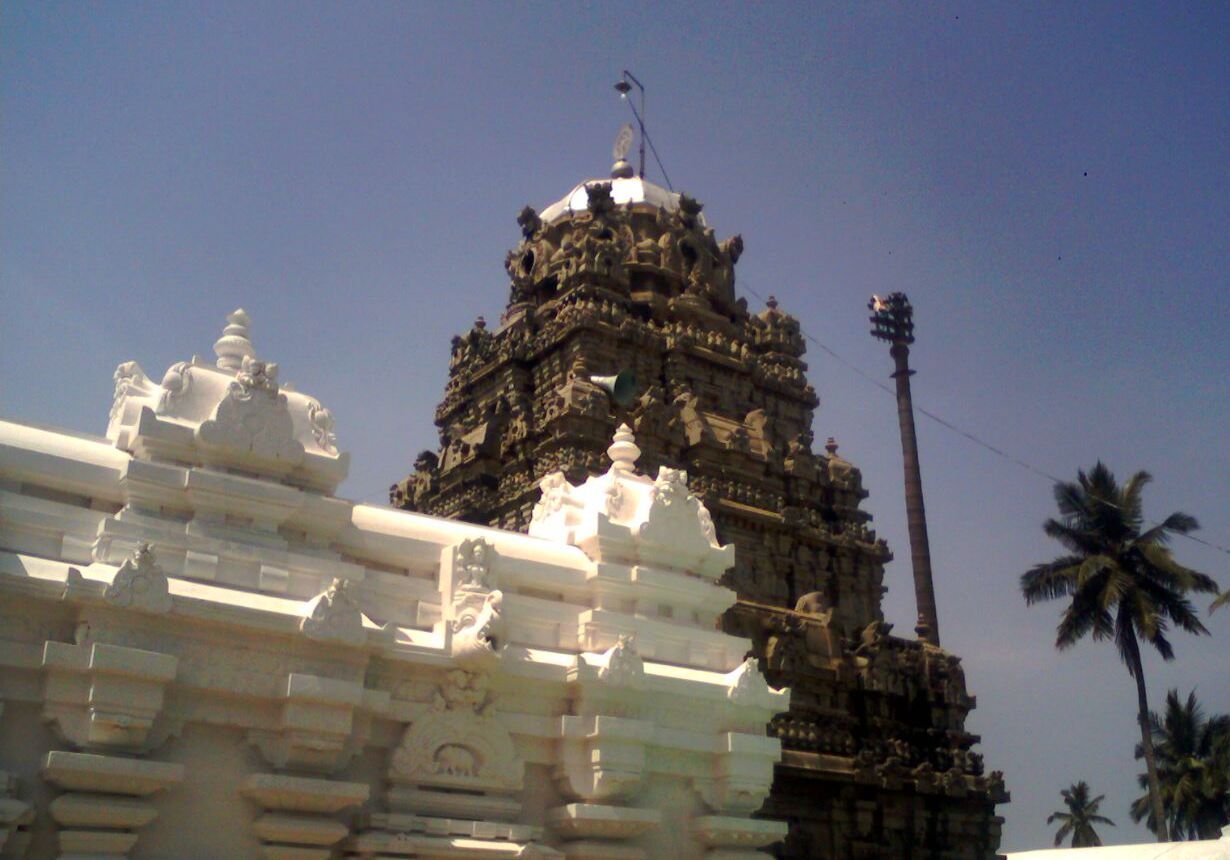
The Temple of the Tortoise Incarnation #
By the time Sri Chaitanya Mahaprabhu reached Kurma-kshetra, His South India tour had already been running for some weeks, and its pattern was set: He walked chanting, embraced whoever chanted back, and moved on. Kurma-kshetra is identified with the temple town now called Srikurmam. It is on the Andhra coast, in what is today Srikakulam district. It is the site of an old Vaishnava temple built around a Deity of Kurma, the tortoise incarnation of Vishnu, and the place takes its name from Kurma. Krishnadasa Kaviraja Goswami describes the Lord going first to the temple itself and offering obeisances to the Deity. Then He fell into such intense ecstatic love that He danced, wept and laughed before the astonished villagers. News of it spread. People came from the surrounding villages simply to look at Him. The Chaitanya-charitamrita says that everyone who saw Him became a devotee on the spot. They chanted "Krishna" and "Hari" and raised their arms in the same ecstasy.
Krishnadasa Kaviraja adds one more detail before the Lord's mood settled. When His external consciousness returned, the temple priest of the Kurma Deity came forward with offerings of his own. He treated the ecstatic sannyasi as an honored guest of the shrine itself. After the temple, the ecstasy, the crowds and the priest, the story moves from the whole town to one particular house.
A Vedic Brahmana Named Kurma #
"In one village there was a Vedic brahmana named Kurma," Krishnadasa Kaviraja writes. With that single sentence, a man who has no other biography enters the Chaitanya-charitamrita by name. He invited Mahaprabhu to his home with what the text calls great faith and devotion, and the Lord accepted. He seems to have accepted every such invitation on this part of the tour. The very next verses of the chapter say that He did the same at every house where He took alms during the whole journey. The whole journey, village by village, is told on the South India tour. This page stays inside the one house Kurma opened to Him.
Feet-Washing and a Family's Prasadam #
What Kurma did next follows a custom of hospitality as old as the Vedic household itself. But the Chaitanya-charitamrita records it in close, homely detail. He brought the Lord into his home and washed His feet. Then he and every member of his family drank that water together. This was an act of reverence toward a sannyasi guest, and in the family's eyes it was also reverence toward Krishna Himself. He fed Mahaprabhu, offering all kinds of food with what the text again calls great affection and respect. When the meal was finished, the entire family shared what the Lord had left on His plate as prasadam. Nothing in the account suggests Kurma expected anything in return for this. From everything the text shows, he was an ordinary brahmana householder doing what hospitality to a holy guest required of him. The only difference was that the guest was the Lord Himself.
"My Family, Birth and Riches Have All Been Glorified" #
Before Mahaprabhu could rise from the meal, Kurma spoke a prayer. Krishnadasa Kaviraja preserves it almost verse for verse. Kurma said that the same lotus feet on which Lord Brahma meditates had come to rest in his own house, not because of any merit of his own. He said that there was no way to measure how fortunate this made him. And he said that on this one day his family, his birth and his wealth had all been made worthwhile. It is a brahmana's plain, open-hearted gratitude, spoken with no idea of what was coming next. Kurma was now about to make a request of his own. The Lord would refuse that request, and would answer instead with an instruction that outlasted every other detail of the afternoon. That exchange is told in full on Become a Guru in This Land.
