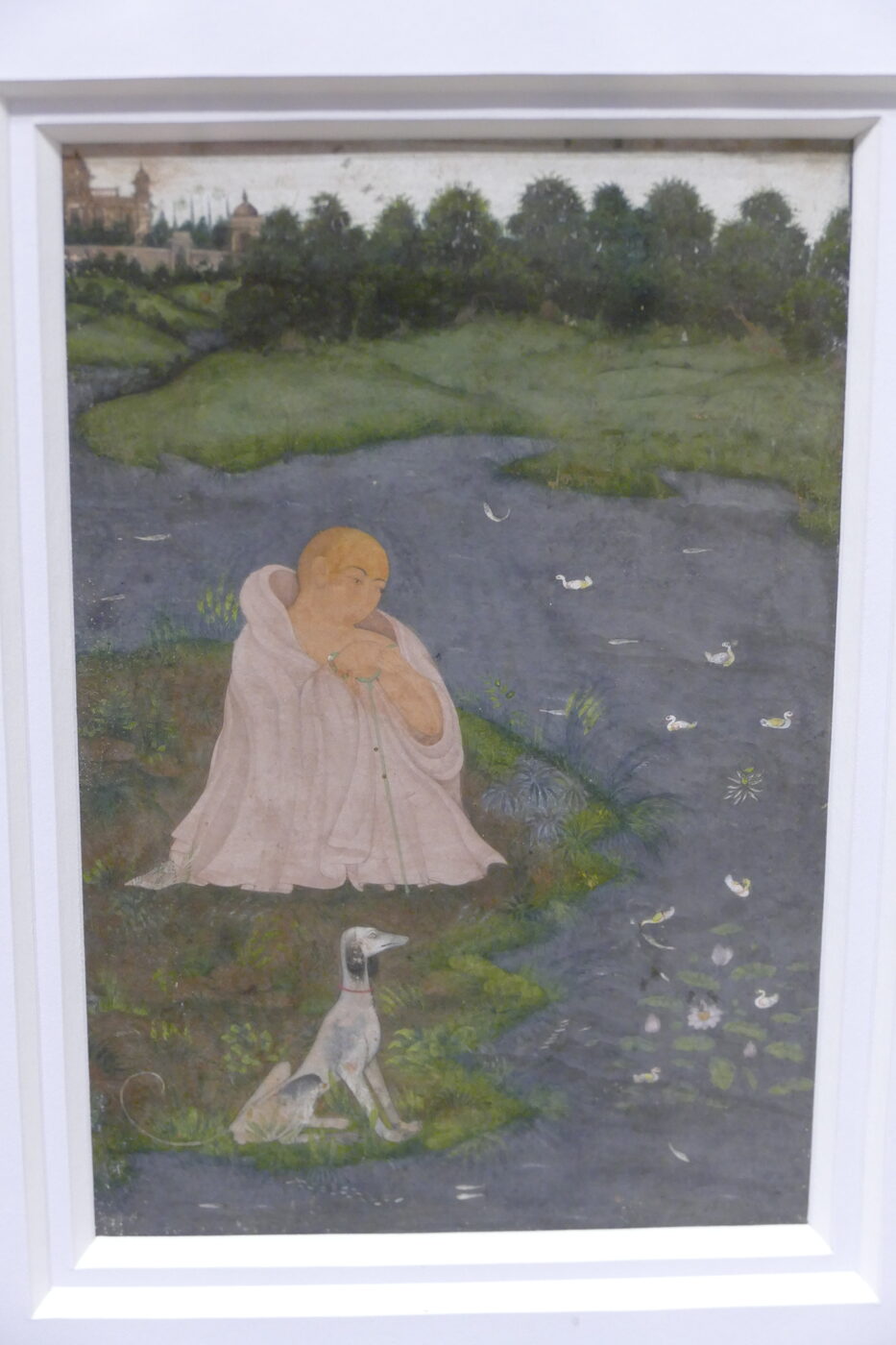
When Sri Chaitanya Mahaprabhu accepted sannyasa at Katwa, He had intended to walk straight to Vrindavana. But His devotees turned Him toward Jagannatha Puri instead. His life as a wandering sannyasi actually began there, in the first months of 1510. Krishnadasa Kaviraja gives the dates carefully. The Lord took sannyasa in the month of Magha and reached Puri in Phalguna, where He saw the Dola-yatra festival. He converted the great logician Sarvabhauma Bhattacharya in Chaitra, and at the beginning of Vaishakha He announced that He was leaving on a tour of the south. The reason He gave was that He wished to search for His elder brother Vishvarupa, who had taken sannyasa years earlier and vanished into the south. But the biographies note plainly that He already knew Vishvarupa had passed away. They say that the search was only an outward reason for a preaching journey.
| Stage of the Journey | What Happened There |
|---|---|
| Kurma-kshetra | The brahmana Kurma told to stay home and preach; Vasudeva cured of leprosy |
| Jiyada-Nrisimha and the Godavari | The meeting with Ramananda Raya at Vidyanagara |
| Rangakshetra (Srirangam) | Four months of Chaturmasya with Venkata Bhatta; the illiterate brahmana's Gita |
| Rishabha Hill to Cape Comorin | Paramananda Puri, southern Mathura, the Kurma Purana from Rameshvaram |
| Adi-keshava on the Payasvini | The lost chapter of the Brahma-samhita recovered |
| Pandarpur, then the Krishna-venva river | News of Vishvarupa; Krishna-karnamrita copied |
| Udupi | The head of the Tattvavadi school questioned |
Krishnadasa the Servant and Sarvabhauma's Request #
He wanted to travel alone, and said so, but the devotees would not agree. Nityananda Prabhu argued that a man whose two hands are always busy chanting and counting the holy names cannot also carry a waterpot and a change of cloth. He also argued that when the Lord fell unconscious in ecstasy on the road, there would be nobody to look after His belongings. The compromise was a simple, quiet brahmana named Krishnadasa. He would carry the waterpot and the garments and, as Nityananda put it, would not say a word. Sarvabhauma Bhattacharya sent four sets of cloth after Him and made one more request. He asked the Lord to be sure to meet a government officer named Ramananda Raya on the banks of the Godavari. He also asked Him not to turn Ramananda Raya away because he came from a family that the brahmanas of Bengal would have called low. The devotees walked with Him as far as Alalanatha, and the Bhattacharya fainted at the roadside as He left. Krishnadasa Kaviraja records plainly that the Lord did not turn round.
Preaching Village by Village #
The method of the tour was fixed in the first few days, and it never changed. He walked chanting Krishna's names aloud, and asked every person He passed to chant "Hari! Hari!" Those who did so followed Him for a while, and when He judged the moment right He embraced them and sent them home. The Chaitanya-charitamrita describes what happened next. Each person He had embraced went back to his own village chanting, laughing, weeping and dancing, and asked everyone he met to chant. Those villagers in turn became devotees. Visitors came from neighbouring villages simply to look at this changed man, and they were changed in the same way. And so, village by village, the practice spread far ahead of the Lord's own footsteps. The biographer sums up that hundreds of thousands of people in the south became Vaishnavas without ever meeting Him. He also notes frankly that Chaitanya Mahaprabhu had not shown this power to empower others in Nabadwip, but He showed it in the south.
The Brahmana Kurma and the Order to Preach #
At Kurma-kshetra, the temple of the tortoise incarnation on the Andhra coast, He was received by a Vedic brahmana named Kurma who washed His feet, fed Him, and then begged to be allowed to abandon his household and follow Him. The Lord refused, and His answer has become one of the most quoted sentences in the whole tradition: stay at home, chant Krishna's name always, teach everyone you meet what Krishna teaches in the Bhagavad-gita and the Srimad-Bhagavatam, and in that way become a spiritual master and deliver this country. Krishnadasa Kaviraja states clearly that this was not a one-time instruction but the pattern of the whole tour. He says that wherever the Lord took a meal, He gave His host the same instruction before moving on. Gaudiya Vaishnavism has always sent householders out to preach on the strength of this instruction.
The Healing of Vasudeva the Leper #
In the same village lived a brahmana named Vasudeva. His leprosy was so advanced that his body was full of worms. The biographies record one thing that shows what kind of man he was: when a worm dropped from him, he would pick it up and put it back rather than let it die. He heard that the Lord had come, and the next morning he went to Kurma's house. He found that the Lord had already left, and he collapsed in the road. Chaitanya Mahaprabhu turned back and embraced him. The accounts say that the disease and the distress left him together and that his body became beautiful. They say his first reaction was to worry that he would now become proud. For this, again, the Lord's remedy was constant chanting and constant preaching. From this episode He received one of His less familiar names, Vasudevamrita-prada, "He who gave nectar to Vasudeva."
Jiyada-Nrisimha and the Meeting with Ramananda Raya #
Continuing south He visited the temple of Jiyada-Nrisimha and then came to the Godavari. There the sight of the river reminded Him of the Yamuna, and the woods along its bank reminded Him of Vrindavana. At the bathing place near Vidyanagara, He met Ramananda Raya, who was then governor of the Godavari region on behalf of the king of Odisha. The conversations that followed over several evenings are the theological centre of the entire Chaitanya-charitamrita. They are told in full on their own page. The most important meeting of the tour happened only a few weeks after it began. Afterwards the Lord ordered Ramananda Raya to resign his post and come to Puri.
Chaturmasya at Rangakshetra with Venkata Bhatta #
From the Godavari the route ran through a great many temple towns, including Mallikarjuna, Ahovala-Nrisimha, Siddhavata, Tirupati and Tirumala, Kanchi and Vriddhakola. At the start of his account, Krishnadasa Kaviraja admits that he cannot record them in order and will simply list what he can. At Rangakshetra, the great Srirangam temple on an island in the Kaveri, a Sri Vaishnava brahmana of the Ramanuja line named Venkata Bhatta invited the Lord to his home. Venkata Bhatta pointed out that the four months of Chaturmasya had begun, so a wandering sannyasi was required to stay in one place. The Lord stayed the whole four months.
The Illiterate Brahmana Who Read the Gita #
It is at Srirangam, too, that the tour produced its most charming episode: an illiterate brahmana who read the whole Bhagavad-gita aloud every day, mispronouncing it so badly that people laughed at him, and who wept as he read. Asked which passage moved him, he answered that he did not understand a word, but that while he read he saw Krishna sitting on the chariot with the reins in His hands, and could not look away. The Lord embraced him and told him he had understood the Gita correctly.
The Goddess of Fortune and the Rasa Dance #
With His host Venkata Bhatta the Lord had a long argument, and He deliberately tried to provoke him. He teased him by asking why the goddess of fortune, who had performed austerities to enter the rasa dance, was never admitted to it, while ordinary cowherd girls were. Venkata Bhatta's entire tradition held Narayana to be the supreme form of God, and he could not answer. At last the Lord told him that the joking had a purpose. He led him to the conclusion that Krishna in Vrindavana is the original and complete form of the Divine.
The Boy Who Became Gopala Bhatta Goswami #
The household included a boy who served the Lord throughout those four months. Krishnadasa Kaviraja does not name him. The reason is given elsewhere in the Chaitanya-charitamrita. Before beginning his book, the author sought the blessings of the surviving Goswamis. This Goswami gave his blessing on condition that his own name should never appear in it. The boy was Gopala Bhatta, later Gopala Bhatta Goswami of Vrindavana, one of the Six Goswamis. He installed the Radharamana Deity, and he is the compiler behind the Hari-bhakti-vilasa.
From Rishabha Hill to Cape Comorin #
Beyond Srirangam the Lord went on to Rishabha Hill. There He met the elderly sannyasi Paramananda Puri, a godbrother of His own guru, and persuaded him to come to Puri. Next He went to southern Mathura, the modern Madurai. There a brahmana devoted to Ramachandra was starving himself to death, out of grief that Sita had been touched by Ravana. The Lord consoled him by explaining that Ravana had abducted only an illusory form. This was later confirmed to the brahmana from an old palm-leaf manuscript of the Kurma Purana, which the Lord tracked down at Rameshvaram and carried back to him. Finally, past Kanyakumari, the Lord went to Cape Comorin at the very tip of the peninsula.
Krishnadasa and the Bhattatharis #
On the way back up the western side, the Lord came to a settlement of Bhattatharis in Mallara-desa. There His servant Krishnadasa was lured away and had to be brought back by force. In the end this incident cost Krishnadasa his place in the Lord's service.
Recovering the Brahma-samhita at Adi-keshava #
In the temple of Adi-keshava, on the banks of the Payasvini in the far south, the tour produced its most lasting concrete result. There, among a group of advanced devotees who were discussing spiritual subjects, the Lord found a manuscript chapter of the Brahma-samhita. At that time the text was practically lost. Krishnadasa Kaviraja praises it without reserve. He says there is no scripture equal to it on the final conclusion, and that it is essential among all Vaishnava literatures. The Lord had it copied and carried it with Him.
Krishna-karnamrita and the News of Vishvarupa #
Some months later, at Pandarpur in the Maratha country, He learned from Sri Ranga Puri that the sannyasi Sankararanya, who had attained perfection in that town, was in fact His own elder brother Vishvarupa. Next, on the bank of the Krishna-venva river, He came upon a community of brahmanas who read daily from a book of devotional poetry called Krishna-karnamrita, by Bilvamangala Thakura. He had that copied too. The two manuscripts came back to Odisha with Him, and the biographer calls them the two jewels He brought home. The first thing He did on reaching Vidyanagara again was to hand both to Ramananda Raya, who copied them.
Debating the Philosophers of the South #
The Chaitanya-charitamrita sums up the debates of the tour in only a handful of verses. The chapter's opening verse says that the people of the south were as strong as elephants, but were held in the jaws of the crocodiles of Buddhist, Jain and Mayavada philosophy. The narrative that follows names the opponents whom He met and answered using their own ways of reasoning, before establishing devotion. They were logicians of the Nyaya school, followers of Jaimini's Mimamsa, Sankhya philosophers, yogis of Patanjali's system and the impersonalist followers of Shankaracharya.
The Buddhist Teacher and the Impure Offering #
One Buddhist episode is told at length. A learned teacher came to argue the nine principles of his school, and he was defeated. Then the Buddhists made a plot. They brought the Lord a plate of untouchable food and presented it as if it were sacred offered food. The plot failed. A very large bird appeared, carried the plate away in its beak and dropped it on the chief teacher's head. The metal edge cut him, and he fell unconscious. It ended with the teacher's own disciples reviving him by chanting the names of Krishna into his ear, until he chanted them himself.
Questioning the Tattvavadis at Udupi #
At Udupi, the seat of Madhvacharya and the Tattvavadi tradition, the Lord questioned the head of the school. He did it so respectfully that at first the man did not realise he was being examined. Then the Lord took apart the Tattvavadi position that the perfection of life is to dedicate one's varnashrama duty to Krishna in order to obtain liberation. His reason was that pure devotees reject liberation itself.
What the Tour Left Behind #
The tour lasted roughly two years, and the Lord returned to Puri by much the same road, so the villages He had converted saw Him a second time. Its results were far greater than its length would suggest. Two lost books came back with Him, and they became foundation texts of a school that did not yet exist. A boy in a Srirangam household became one of its six great theologians. A governor on the Godavari became His most confidential associate. And an instruction given casually to a village brahmana over lunch became the lasting order under which the movement has brought in new devotees ever since. From the South India tour, Gaudiya Vaishnavas learn that Chaitanya Mahaprabhu did not treat the chanting of the holy name as a simple folk practice for people who could not read, while keeping argument only for scholars. He did both, in the same journey, with the same calm mind. And, as the biographer puts it, He left behind whole provinces where the only sound to be heard on the road was the name of Krishna.
