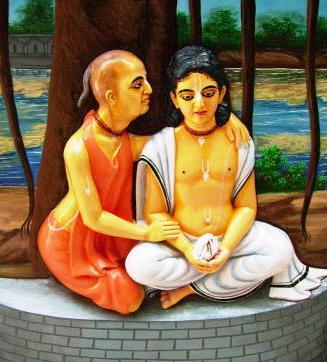
Sources broadly agree that Lochana Dasa Thakura was born in the village of Kograma (also spelled Kogram), close to the Ajaya River in what is today Bardhaman (Burdwan) district, West Bengal. The village is roughly ten miles north of the present-day Guskara railway station. Most sources give his birth year as 1523. At least one older account gives 1520 instead, and describes him as appearing thirty-four years after Sri Chaitanya Mahaprabhu's own birth. This difference between sources is left open here, not settled. His birth tithi is recorded by some traditions as the first day of the waxing moon in the Bengali month of Paush.
| Detail | Description |
|---|---|
| Birthplace | Kograma, near the Ajaya River, Bardhaman district |
| Father | Kamalakara Dasa |
| Mother | Sadananda Devi |
| Family lineage | Vaidya (hereditary Bengali physicians) |
| Birth year | 1523 (one older source gives 1520) |
An Only Son Raised by His Grandfather #
Lochana Dasa Thakura's father, Kamalakara Dasa, and mother, Sadananda Devi, belonged to a vaidya family, the traditional caste of Bengali ayurvedic physicians. He was their only child. According to his own account in the closing verses of Sri Chaitanya-mangala, he was devoted to the holy name from a very young age. He writes that it was only by his parents' mercy that he was later able to sing the glories of Gauranga at all. He was sent to be raised and educated in his maternal grandfather's household, a common arrangement in Bengali families of the period. It was there that his formal education was completed. Even as a child, tradition holds, he was drawn to the company of the Vaishnavas who passed through or lived near his village. At that time rural Bengal still had a fresh, living memory of the devotees inspired by Chaitanya Mahaprabhu's sankirtana movement. They were not yet a matter of old report.
An Early Marriage and a Renounced Heart #
Following the custom of the time, Lochana Dasa Thakura was married while still quite young to a woman from a nearby village. Different sources give the village as Kakutiya or Amedpura-Kakua. This difference is left open here instead of guessing between them. Even after entering household life, he showed little interest in the ordinary comforts and duties of a householder. He preferred to spend his time with other devotees discussing Krishna-katha, talk of Krishna's pastimes and of Chaitanya Mahaprabhu's own. This pull toward renunciation inside a married life only grew stronger once he came into contact with the Vaishnava who would become his spiritual master, Narahari Sarkara Thakura of Srikhanda. This meeting was important enough to reshape the rest of his life. It is described in full on Discipleship Under Narahari Sarkara Thakura.
A Devotee Even at Home #
One incident from this period of his life is preserved in more than one account of his biography. By then Lochana Dasa had gone to live at Srikhanda to be near his guru. His wife's family worried that he had almost abandoned married life, so they brought their complaint to Narahari Sarkara Thakura himself. Narahari heard them out and ordered his disciple to go and visit his in-laws. Lochana Dasa did not want to leave his guru's company, but he obeyed. He arrived in the village after a long absence and found he could no longer remember the way to his in-laws' house. So he stopped to ask directions from a young woman he passed on the road, addressing her respectfully as "Ma," mother. Only when he reached the house did he learn that the woman he had just called his mother was, in fact, his own wife. From that day on, tradition says, he continued to see her in the same way, as a mother, not as a wife in the ordinary sense. The couple spent the rest of their lives absorbed in discussing the pastimes of Chaitanya Mahaprabhu, not in the affairs of the household. After five centuries of retelling, readers may judge the exact details of the story differently. But it is preserved consistently as an example of how complete his renunciation was, even within a grihastha life. It also leads into the deeper turn his life took at Srikhanda under Narahari Sarkara Thakura's direct guidance.
