No source gives a year, or even an approximate period, for Lochana Dasa Thakura's disappearance. This is a real gap in the record, and it cannot honestly be filled. But multiple independent sources do agree on where his samadhi is. It lies in the Chaunsath Samadhi, or 64 Samadhis, area of Vrindavan. This is a garden near the Radha-Damodara and Radha-Govinda temples, where the nama- and puspa-samadhis of some of the most confidential associates of Chaitanya Mahaprabhu are preserved. Other Gaudiya Vaishnava figures with samadhis in the same area include Svarupa Damodara Goswami and Raghunatha Dasa Goswami. So, in the tradition's own view, Lochana Dasa Thakura rests among highly honoured devotees.
| Detail | Description |
|---|---|
| Disappearance year | Not recorded in any source |
| Samadhi location | Chaunsath Samadhi (64 Samadhis) area, Vrindavan |
| Other samadhis in same area | Svarupa Damodara Goswami, Raghunatha Dasa Goswami |
| Book still printed and sung | Sri Chaitanya-mangala; padavali songs in ongoing kirtana use |
A Garden of Confidential Associates #
The 64 Samadhis garden itself has its own history. The first samadhis established there, near Vrindavan's Radha-Govinda temple, were those of Raghunatha Bhatta Goswami, Kashishvara Pandit Goswami, and Subuddhi Raya. Over the generations that followed, the temple's caretakers added further samadhis. In time the site came to be recognized as a resting place for sixty-four of Chaitanya Mahaprabhu's most confidential associates. Lochana Dasa Thakura's own samadhi stands among them, even without a recorded date attached to it. This itself shows how highly the Gaudiya Vaishnava tradition ranked him.
Present Until His Guru's Final Days #
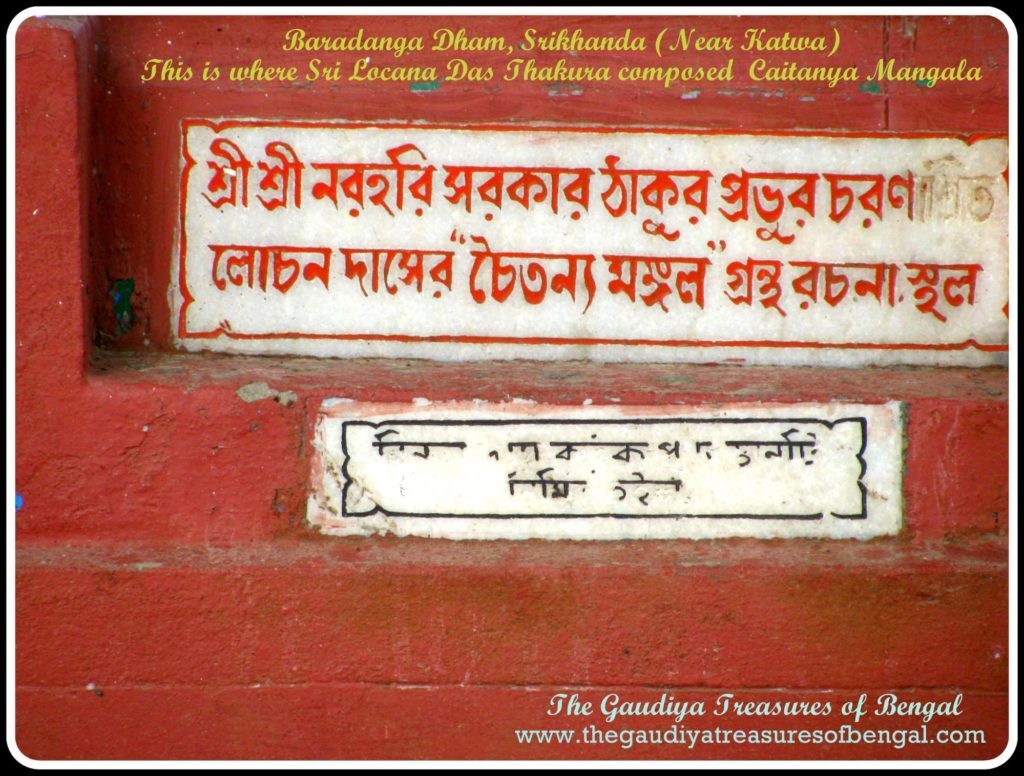
The records of Lochana Dasa Thakura's later years tell us less about his own end than about his guru's. According to the Bhakti-ratnakara, he was present at Narahari Sarkara Thakura's disappearance festival. There he took on the task of greeting the gathered devotees and offering them sandalwood paste and garlands. He was a poet able to compose an entire biography of Chaitanya Mahaprabhu, yet at his own guru's final gathering he served as a simple attendant. For all his skill as a writer, Lochana Dasa Thakura's own writing returns again and again to one idea: he is Narahari Sarkara Thakura's servant first and a poet second. This small act of hospitality at his guru's disappearance festival fits that same view of himself, right to the very end of the record we have of him.
What Outlasted the Uncertain Dates #
Whatever the uncertainty around his own final years, Lochana Dasa Thakura's literary legacy is not in doubt. Sri Chaitanya-mangala, printed and distributed by Bhaktisiddhanta Sarasvati Thakura, continued to circulate in Gaudiya Vaishnava circles well into the twentieth century. For generations wandering musicians carried its verses across rural Bengal, in much the way reciters carried the Ramayana and Mahabharata. His padavali songs have done, if anything, even better. Several are still among the regular songs of Gaudiya Vaishnava kirtana today, and the Vaishnava Song Book still preserves a dozen of them. One of these is the very Parama Karuna that Srila Prabhupada once sang and explained line by line in a Los Angeles temple room. He described its author as "a great devotee and acharya of the Gaudiya-sampradaya."
A Place in the Wider Parampara #
Lochana Dasa Thakura's life, directly or through his writing, touched the lives of several other acharyas of the Gaudiya Vaishnava tradition. His guru Narahari Sarkara Thakura connects him to the wider circle of Srikhanda Vaishnavas. He carefully handled the naming of his own book beside Vrindavana Dasa Thakura's Chaitanya-bhagavata (see Writing Sri Chaitanya-mangala), and this ties him to the earliest generation of Chaitanya biographers. His songs are still sung in temples that trace their teaching back through Bhaktisiddhanta Sarasvati Thakura and Srila Prabhupada to Chaitanya Mahaprabhu Himself. In this way his voice is still alive in Gaudiya Vaishnava worship, five centuries after he first sat down at Baradanga to write. The record of his final days is thin. But the fact that his book and songs have continued all this time is the clearest evidence of the place Gaudiya Vaishnava tradition has given him.
