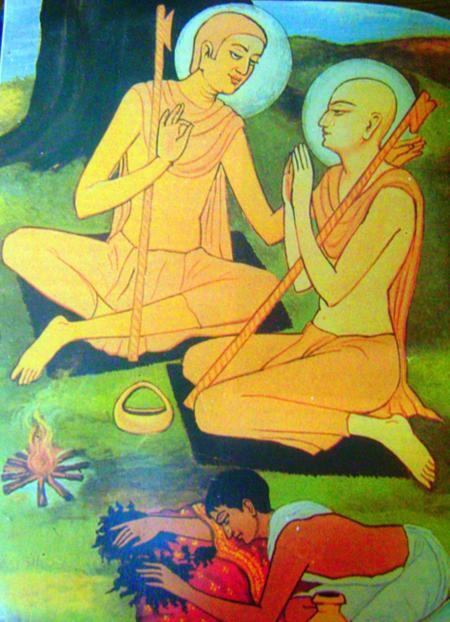
By his own account, in the Sutra-khanda that opens Sri Chaitanya-mangala, Lochana Dasa Thakura did not invent the events of Chaitanya Mahaprabhu's life from scratch. He explains that Murari Gupta had already written an account in Sanskrit verse. Murari Gupta was a physician who lived in Nadia and had personally witnessed many of the Lord's early pastimes. This account reached Lochana Dasa Thakura secondhand. Damodara Pandita had heard it from Murari Gupta directly, and he later recited it to Lochana Dasa Thakura. Lochana Dasa Thakura memorized what he heard. Moved by devotion, he retold it in the Panchali metre of eastern Bengali folk poetry, so that people who could not follow Sanskrit could still enter into Chaitanya Mahaprabhu's pastimes. Tradition places the actual writing at Baradanga, near Srikhanda. There, it is said, Lochana Dasa Thakura sat beneath a great tree beside his guru's bhajana-kutira. That tree and the surrounding site are still shown to visitors at Baradanga today.
| Detail | Description |
|---|---|
| Source material | Murari Gupta's Sanskrit account, transmitted through Damodara Pandita |
| Verse form | Panchali, the folk-poetry metre of eastern Bengal |
| Completed | 1537 |
| Structure | Four khandas: Sutra (2 chapters), Adi (7), Madhyama (12), Shesha (3) |
| Place of composition | Baradanga, Srikhanda, near Katwa |
A Book in Four Parts #
Sri Chaitanya-mangala runs to more than twenty chapters across four sections. The Sutra-khanda opens with an invocation glorifying Chaitanya Mahaprabhu and His associates. It offers Lochana Dasa Thakura's obeisances to his guru Narahari Sarkara Thakura and gives a preview of what is to follow. The Adi-khanda covers the Lord's appearance and childhood in Navadvipa. The Madhyama-khanda, the largest section, covers His youth, marriage, and the events leading to His acceptance of sannyasa. The Shesha-khanda closes the account. The book is remembered for several episodes. One of them is a description of Sri Gaurasundara's final, tender conversation with Vishnupriya Devi on the night before He accepted the renounced order of sannyasa. This book tells that scene at greater length than some other early biographies of the Lord.
A Meeting to Settle Two Names #
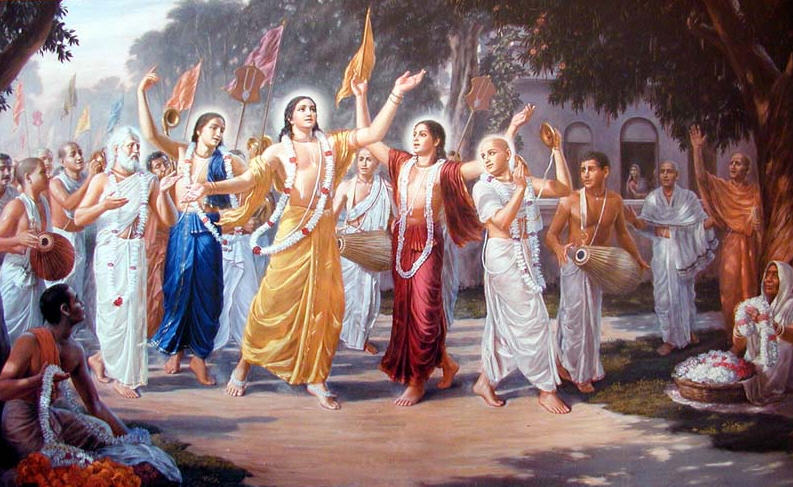
By the time Lochana Dasa Thakura had finished his manuscript, Vrindavana Dasa Thakura had already written his own life of Chaitanya Mahaprabhu. By tradition's account, he had given it the very same title, Chaitanya-mangala. Narahari Sarkara Thakura is said to have asked his disciple to seek Vrindavana Dasa Thakura's blessing before making his own book public. Gaudiya Vaishnava tradition recounts that the two met at Denur, where Vrindavana Dasa Thakura had done his own writing. Vrindavana Dasa Thakura is said to have read Lochana Dasa Thakura's work with real appreciation. Tradition holds that after this, his own composition came to be known instead as Chaitanya-bhagavata, and the name Chaitanya-mangala was left to Lochana Dasa Thakura's book. But other accounts credit Krishnadasa Kaviraja Goswami with suggesting the new name. They point to his own verse in Sri Chaitanya-caritamrita comparing Vrindavana Dasa Thakura to Vyasadeva: "As Vyasadeva compiled the pastimes of Krishna in Srimad-Bhagavatam, Thakura Vrindavana dasa has depicted the pastimes of Chaitanya." Exactly who proposed the change, and how the meeting went, cannot be settled with confidence. The story rests on later devotional biographies, not on Sri Chaitanya-caritamrita itself, which does not describe the episode at all. What can be said with more confidence is that Lochana Dasa Thakura's own text pays its own tribute to Vrindavana Dasa Thakura. It opens with a verse of respect for him and for how his "Bhagavata's songs have enchanted the entire universe."
Rasa Against Description #
Gaudiya Vaishnava tradition has long placed Sri Chaitanya-mangala and Chaitanya-bhagavata side by side, not in competition. In his Vaishnava Abhidhana, the nineteenth-century Vaishnava historian Haridasa Dasa described Chaitanya-mangala as a rasatmika text, full of devotional feeling. He contrasted it with Chaitanya-bhagavata, which he called a varnanatmika text, full of description. He added that in places Lochana Dasa Thakura's poetic expression is even finer than Vrindavana Dasa Thakura's own. Generations later, the Bengali dictionary-maker Ashutosh Deb, in his dictionary, counted Lochana Dasa Thakura among the first Bengali poets to write in moric metres (metres counted by the length of syllables). He also counted him among the earliest Bengali writers of history. Sri Chaitanya-mangala was later printed and circulated by Bhaktisiddhanta Sarasvati Thakura. For centuries wandering Gaudiya Vaishnava singers have carried its verses from village to village across Bengal, much as reciters of the Ramayana and Mahabharata have long done with those epics.
