Srila Lochana Dasa Thakura
Author of Sri Chaitanya-mangala and Poet of the Srikhanda Vaishnavas
The complete life, on one page: The main biography and every pastime page, in order, in one place
Introduction
Srila Lochana Dasa Thakura was a Bengali poet-saint of the generation after Sri Chaitanya Mahaprabhu's own direct associates. He is remembered above all for two things. He wrote Sri Chaitanya-mangala, one of the earliest full biographical poems on the life of Chaitanya Mahaprabhu. He also composed many Bengali padavali songs that Gaudiya Vaishnavas, including Srila Prabhupada himself, have sung ever since. He belonged to the circle of Vaishnavas at Srikhanda gathered around his guru, Narahari Sarkara Thakura. We know his life mainly from his own writing and from later devotional biographies, not from Sri Chaitanya-charitamrita itself. That book does not tell his life story at length.
| Detail | Description |
|---|---|
| Birth | 1523, in a family of vaidya (physician) lineage (some sources give 1520) |
| Birthplace | Kograma, near the Ajaya River, Katwa, Bardhaman district, Bengal |
| Parents | Kamalakara Dasa (father) and Sadananda Devi (mother) |
| Guru | Narahari Sarkara Thakura, at Srikhanda |
| Major work | Sri Chaitanya-mangala, completed 1537 |
| Other works | Prarthana, Durlabha-sara, Dhamali, and Bengali verse translations of Ramananda Raya's Jagannatha-vallabha-nataka and the Rasa-panchadhyaya |
| Disappearance | Year not recorded; samadhi in the 64 Samadhis area, Vrindavan |
Chapter 1
Birth and Early Life
A physician's only son from a Bengal river village grows attached to the sankirtana of Chaitanya Mahaprabhu.
Sources broadly agree that Lochana Dasa Thakura was born in the village of Kograma (also spelled Kogram), close to the Ajaya River in what is today Bardhaman (Burdwan) district, West Bengal. The village is roughly ten miles north of the present-day Guskara railway station. Most sources give his birth year as 1523. At least one older account gives 1520 instead, and describes him as appearing thirty-four years after Sri Chaitanya Mahaprabhu's own birth. This difference between sources is left open here, not settled. His birth tithi is recorded by some traditions as the first day of the waxing moon in the Bengali month of Paush.
| Detail | Description |
|---|---|
| Birthplace | Kograma, near the Ajaya River, Bardhaman district |
| Father | Kamalakara Dasa |
| Mother | Sadananda Devi |
| Family lineage | Vaidya (hereditary Bengali physicians) |
| Birth year | 1523 (one older source gives 1520) |
An Only Son Raised by His Grandfather #
Lochana Dasa Thakura's father, Kamalakara Dasa, and mother, Sadananda Devi, belonged to a vaidya family, the traditional caste of Bengali ayurvedic physicians. He was their only child. According to his own account in the closing verses of Sri Chaitanya-mangala, he was devoted to the holy name from a very young age. He writes that it was only by his parents' mercy that he was later able to sing the glories of Gauranga at all. He was sent to be raised and educated in his maternal grandfather's household, a common arrangement in Bengali families of the period. It was there that his formal education was completed. Even as a child, tradition holds, he was drawn to the company of the Vaishnavas who passed through or lived near his village. At that time rural Bengal still had a fresh, living memory of the devotees inspired by Chaitanya Mahaprabhu's sankirtana movement. They were not yet a matter of old report.
An Early Marriage and a Renounced Heart #
Following the custom of the time, Lochana Dasa Thakura was married while still quite young to a woman from a nearby village. Different sources give the village as Kakutiya or Amedpura-Kakua. This difference is left open here instead of guessing between them. Even after entering household life, he showed little interest in the ordinary comforts and duties of a householder. He preferred to spend his time with other devotees discussing Krishna-katha, talk of Krishna's pastimes and of Chaitanya Mahaprabhu's own. This pull toward renunciation inside a married life only grew stronger once he came into contact with the Vaishnava who would become his spiritual master, Narahari Sarkara Thakura of Srikhanda. This meeting was important enough to reshape the rest of his life. It is described in full on Discipleship Under Narahari Sarkara Thakura.
A Devotee Even at Home #
One incident from this period of his life is preserved in more than one account of his biography. By then Lochana Dasa had gone to live at Srikhanda to be near his guru. His wife's family worried that he had almost abandoned married life, so they brought their complaint to Narahari Sarkara Thakura himself. Narahari heard them out and ordered his disciple to go and visit his in-laws. Lochana Dasa did not want to leave his guru's company, but he obeyed. He arrived in the village after a long absence and found he could no longer remember the way to his in-laws' house. So he stopped to ask directions from a young woman he passed on the road, addressing her respectfully as "Ma," mother. Only when he reached the house did he learn that the woman he had just called his mother was, in fact, his own wife. From that day on, tradition says, he continued to see her in the same way, as a mother, not as a wife in the ordinary sense. The couple spent the rest of their lives absorbed in discussing the pastimes of Chaitanya Mahaprabhu, not in the affairs of the household. After five centuries of retelling, readers may judge the exact details of the story differently. But it is preserved consistently as an example of how complete his renunciation was, even within a grihastha life. It also leads into the deeper turn his life took at Srikhanda under Narahari Sarkara Thakura's direct guidance.
Chapter 2
Discipleship Under Narahari Sarkara Thakura
At Srikhanda, Lochana Dasa Thakura takes shelter of Narahari Sarkara Thakura and receives the order that shapes his life's work.
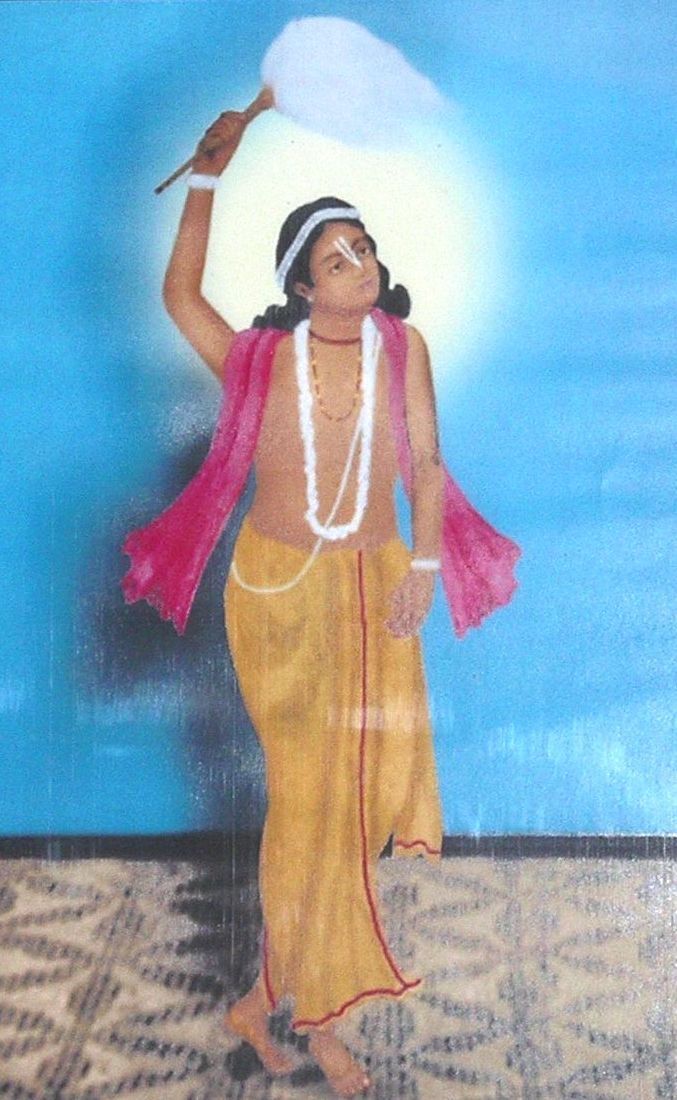
Lochana Dasa Thakura's guru was Narahari Sarkara Thakura, one of the personal associates of Sri Chaitanya Mahaprabhu. He was among the senior Vaishnavas settled at Srikhanda, a village near Katwa in Bardhaman district. Sri Chaitanya-caritamrita describes the great branches of Chaitanya Mahaprabhu's tree of mercy. There it names Narahari Sarkara Thakura directly, along with the Srikhanda householder-devotees Mukunda Dasa and his son Raghunandana Thakura. In his purport on that passage, Srila Prabhupada states that "Locana dasa Thakura, the celebrated author of Sri Chaitanya-mangala, was his disciple." Narahari Sarkara Thakura's own service to Chaitanya Mahaprabhu is traditionally remembered as fanning the Lord with a camara, a yak-tail whisk, during kirtana. This small, humble service set the pattern for how he, in turn, dealt with his own disciples.
| Detail | Description |
|---|---|
| Guru | Narahari Sarkara Thakura |
| Place of discipleship | Srikhanda, near Katwa |
| Fellow Srikhanda Vaishnavas | Mukunda Dasa, Raghunandana Thakura |
| Textual confirmation | Sri Caitanya-caritamrita, Adi-lila 10.78-79, purport |
Taking Shelter at Srikhanda #
Drawn by his growing attachment to the sankirtana movement described on Birth and Early Life, Lochana Dasa Thakura received initiation from Narahari Sarkara Thakura and then went to live at his ashram in Srikhanda. In the opening invocation of Sri Chaitanya-mangala, he addresses his guru directly and again and again. "My lord and master is Narahari Dasa. I prostrate myself in humility to him," he writes in one verse, and in another, "Other than him, I have no friend in the three worlds." These are not just polite words. All through the Sutra-khanda he returns again and again to the point that only Narahari's mercy makes his work possible at all. He even writes that he considers himself utterly unfit to attempt such a composition without his guru's grace behind it.
Learning Kirtana, Receiving an Order #
At Srikhanda, Lochana Dasa Thakura learned the art of kirtana directly from his guru. In time, Narahari Sarkara Thakura instructed him to compose a Bengali account of Chaitanya Mahaprabhu's life and pastimes. Lochana Dasa Thakura took this order so seriously that he spent years fulfilling it. Tradition holds that Narahari Sarkara Thakura had long wished for such a book to exist in Bengali. He wanted ordinary people, not just Sanskrit scholars, to enter into the deep, confidential sweetness of Chaitanya Mahaprabhu's pastimes. Tradition also holds that from this point on, Lochana Dasa Thakura's whole life's purpose was to fulfill that wish. The resulting work, Sri Chaitanya-mangala, and the way he went about writing it are described in full on Writing Sri Chaitanya-mangala.
A Wider Circle of Srikhanda Vaishnavas #
Narahari Sarkara Thakura was not the only notable devotee at Srikhanda. Sri Chaitanya-caritamrita's list of great branches also names Mukunda Dasa. The Gaura-ganoddesha-dipika identifies him as an incarnation of the gopi Vrindadevi. The list also names his son Raghunandana Thakura, who is remembered for his personal Deity worship of Chaitanya Mahaprabhu. Another Srikhanda resident named in the same passage, Chiranjiva, had two sons. One of them, Govinda Dasa Kaviraja, became a famous Vaishnava poet himself. The names are easily confused, so note that this same Chaitanya-caritamrita passage also names a separate devotee called Sulocana as a distinct branch of the tree. Sulocana is a different person from Lochana Dasa Thakura. Srila Prabhupada's purport to the same passage names Lochana Dasa Thakura as Narahari Sarkara Thakura's disciple and the author of Sri Chaitanya-mangala. Being trained in this village so full of devotion, among householder Vaishnavas who were truly great poets and devotees, seems to have made Lochana Dasa Thakura himself serious about both kirtana and composition.
Present at His Guru's Final Festival #
According to the Bhakti-ratnakara, Lochana Dasa Thakura was present at Narahari Sarkara Thakura's own disappearance festival. There he took on the humble task of greeting the assembled guests and giving them sandalwood paste and garlands. This detail is small, but it shows that he kept serving his guru faithfully even after Narahari Sarkara Thakura's own life on earth had ended. Narahari Sarkara Thakura also left behind his own devotional writings, including the Bhakti-chandrika-patala and Sri Krishna-bhajanamrita. Lochana Dasa Thakura's deep respect for him never grew less throughout his life. In Sri Chaitanya-mangala he admits that his highest hope, greater even than fame for his own composition, is simply to remain at Narahari's lotus feet and continue serving him. He expressed this devotion to a single guru very plainly in his own verse. This is one reason later Gaudiya Vaishnava tradition remembers Lochana Dasa Thakura as much for the way he lived as a disciple as for how much he wrote.
Scriptural evidence for this chapter (1)
khaṇḍavāsī mukunda-dāsa, śrī-raghunandana
narahari-dāsa, cirañjīva, sulocana
ei saba mahāśākhā — caitanya-kṛpādhāma
prema-phala-phula kare yāhāṅ tāhāṅ dāna
Word for word
khaṇḍa-vāsī mukunda-dāsa: Mukunda dāsa, a resident of Śrīkhaṇḍa; śrī-raghunandana: Raghunandana; narahari-dāsa: Narahari dāsa; cirañjīva: Cirañjīva; sulocana: Sulocana; ei saba: all of them; mahā-śākhā: great branches; caitanya-kṛpā-dhāma: of Lord Sri Caitanya Mahaprabhu, the reservoir of mercy; prema-phala-phula: the fruit and flower of love of God; dāna: distribution
Sri Khandavasi Mukunda and his son Raghunandana were the thirty-ninth branch of the tree, Narahari was the fortieth, Chiranjiva the forty-first, and Sulocana the forty-second. They were all big branches of the all-merciful tree of Chaitanya Mahaprabhu, distributing the fruits and flowers of love of Godhead everywhere.
From the purport: Purport excerpt: "Narahari dasa Sarakara was a very famous devotee... Locana dasa Thakura, the celebrated author of Sri Caitanya-mangala, was his disciple."
This purport is the direct scriptural confirmation, in Srila Prabhupada's words, that Lochana Dasa Thakura was Narahari Sarkara Thakura's disciple; the verse itself separately names an unrelated Srikhanda devotee called Sulocana, distinct from Lochana Dasa Thakura despite the similar name.
Chapter 3
Writing Sri Chaitanya-mangala
Working from Damodara Pandita's memory of Murari Gupta's Sanskrit account, Lochana Dasa Thakura composes one of the earliest full biographies of Chaitanya Mahaprabhu.
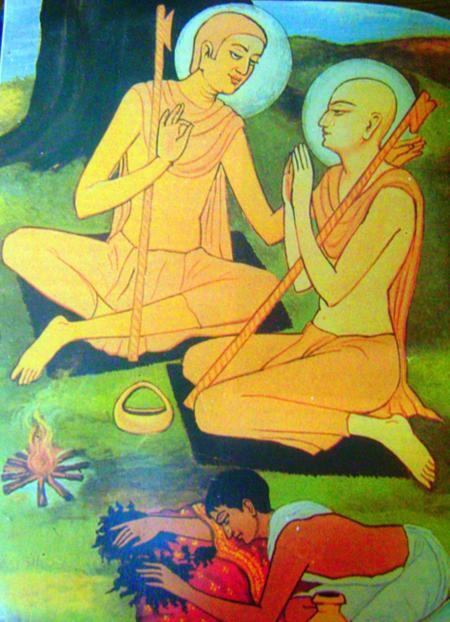
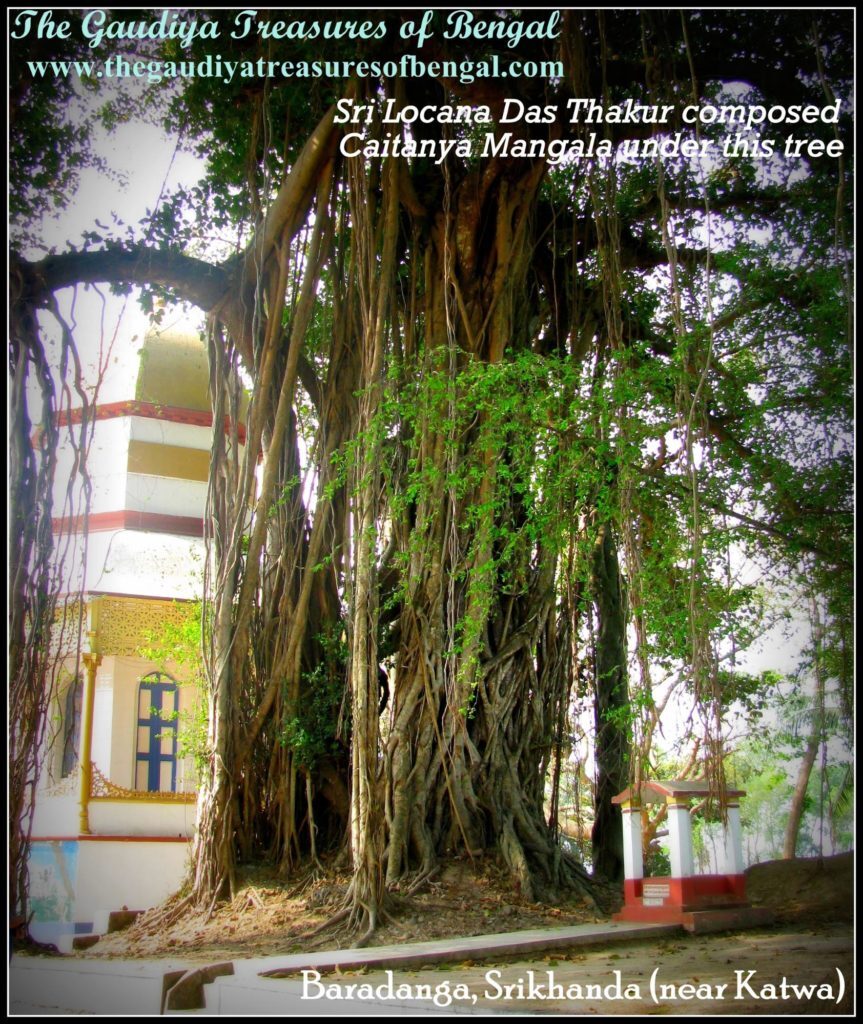
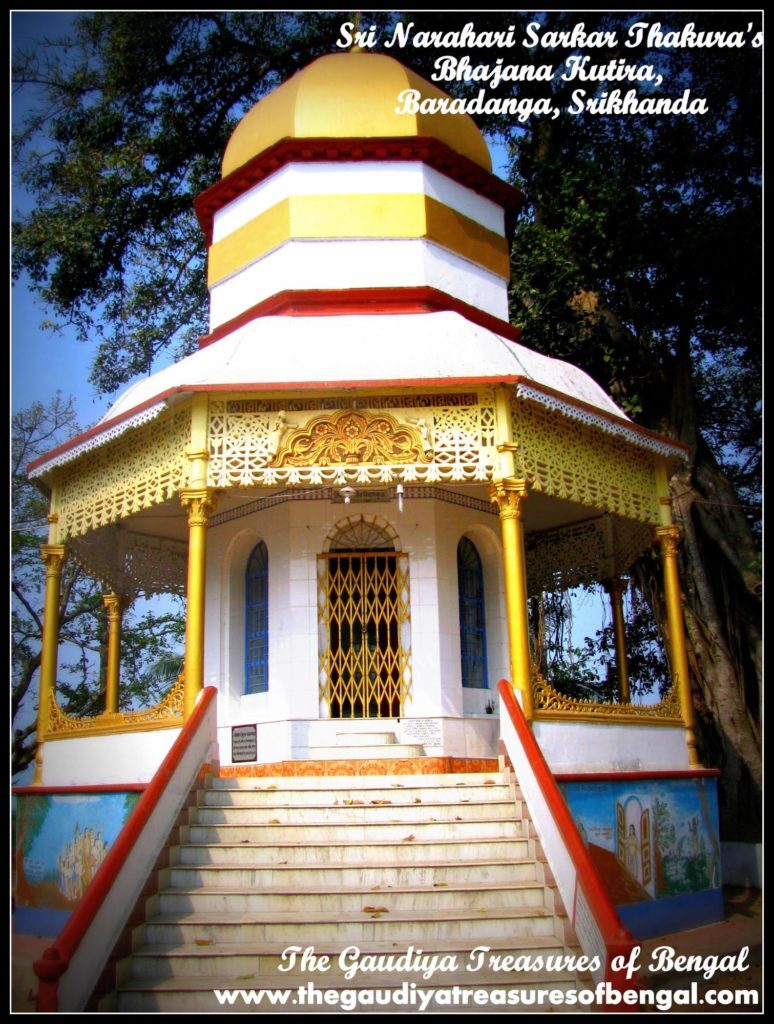
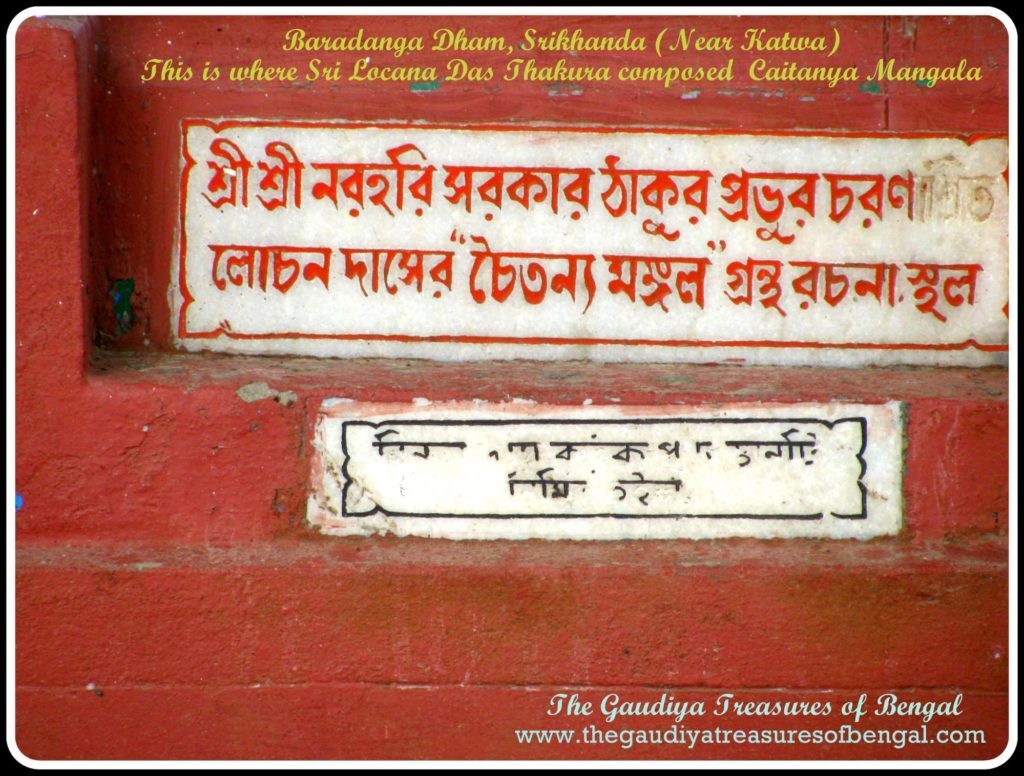
By his own account, in the Sutra-khanda that opens Sri Chaitanya-mangala, Lochana Dasa Thakura did not invent the events of Chaitanya Mahaprabhu's life from scratch. He explains that Murari Gupta had already written an account in Sanskrit verse. Murari Gupta was a physician who lived in Nadia and had personally witnessed many of the Lord's early pastimes. This account reached Lochana Dasa Thakura secondhand. Damodara Pandita had heard it from Murari Gupta directly, and he later recited it to Lochana Dasa Thakura. Lochana Dasa Thakura memorized what he heard. Moved by devotion, he retold it in the Panchali metre of eastern Bengali folk poetry, so that people who could not follow Sanskrit could still enter into Chaitanya Mahaprabhu's pastimes. Tradition places the actual writing at Baradanga, near Srikhanda. There, it is said, Lochana Dasa Thakura sat beneath a great tree beside his guru's bhajana-kutira. That tree and the surrounding site are still shown to visitors at Baradanga today.
| Detail | Description |
|---|---|
| Source material | Murari Gupta's Sanskrit account, transmitted through Damodara Pandita |
| Verse form | Panchali, the folk-poetry metre of eastern Bengal |
| Completed | 1537 |
| Structure | Four khandas: Sutra (2 chapters), Adi (7), Madhyama (12), Shesha (3) |
| Place of composition | Baradanga, Srikhanda, near Katwa |
A Book in Four Parts #
Sri Chaitanya-mangala runs to more than twenty chapters across four sections. The Sutra-khanda opens with an invocation glorifying Chaitanya Mahaprabhu and His associates. It offers Lochana Dasa Thakura's obeisances to his guru Narahari Sarkara Thakura and gives a preview of what is to follow. The Adi-khanda covers the Lord's appearance and childhood in Navadvipa. The Madhyama-khanda, the largest section, covers His youth, marriage, and the events leading to His acceptance of sannyasa. The Shesha-khanda closes the account. The book is remembered for several episodes. One of them is a description of Sri Gaurasundara's final, tender conversation with Vishnupriya Devi on the night before He accepted the renounced order of sannyasa. This book tells that scene at greater length than some other early biographies of the Lord.
A Meeting to Settle Two Names #
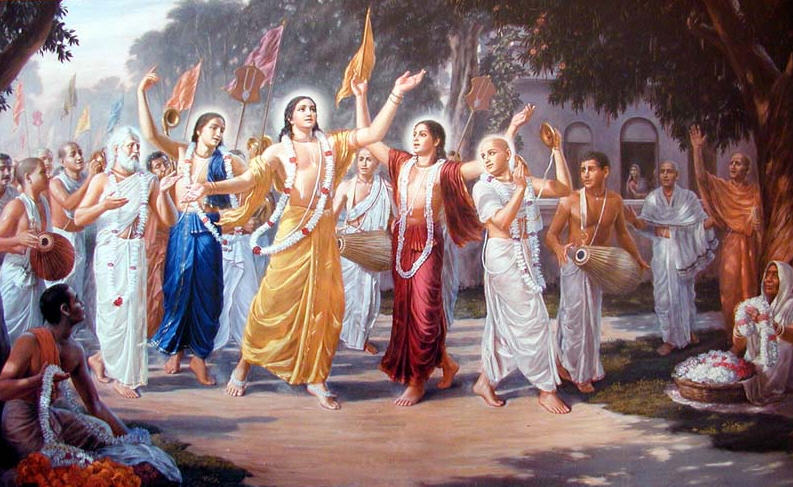
By the time Lochana Dasa Thakura had finished his manuscript, Vrindavana Dasa Thakura had already written his own life of Chaitanya Mahaprabhu. By tradition's account, he had given it the very same title, Chaitanya-mangala. Narahari Sarkara Thakura is said to have asked his disciple to seek Vrindavana Dasa Thakura's blessing before making his own book public. Gaudiya Vaishnava tradition recounts that the two met at Denur, where Vrindavana Dasa Thakura had done his own writing. Vrindavana Dasa Thakura is said to have read Lochana Dasa Thakura's work with real appreciation. Tradition holds that after this, his own composition came to be known instead as Chaitanya-bhagavata, and the name Chaitanya-mangala was left to Lochana Dasa Thakura's book. But other accounts credit Krishnadasa Kaviraja Goswami with suggesting the new name. They point to his own verse in Sri Chaitanya-caritamrita comparing Vrindavana Dasa Thakura to Vyasadeva: "As Vyasadeva compiled the pastimes of Krishna in Srimad-Bhagavatam, Thakura Vrindavana dasa has depicted the pastimes of Chaitanya." Exactly who proposed the change, and how the meeting went, cannot be settled with confidence. The story rests on later devotional biographies, not on Sri Chaitanya-caritamrita itself, which does not describe the episode at all. What can be said with more confidence is that Lochana Dasa Thakura's own text pays its own tribute to Vrindavana Dasa Thakura. It opens with a verse of respect for him and for how his "Bhagavata's songs have enchanted the entire universe."
Rasa Against Description #
Gaudiya Vaishnava tradition has long placed Sri Chaitanya-mangala and Chaitanya-bhagavata side by side, not in competition. In his Vaishnava Abhidhana, the nineteenth-century Vaishnava historian Haridasa Dasa described Chaitanya-mangala as a rasatmika text, full of devotional feeling. He contrasted it with Chaitanya-bhagavata, which he called a varnanatmika text, full of description. He added that in places Lochana Dasa Thakura's poetic expression is even finer than Vrindavana Dasa Thakura's own. Generations later, the Bengali dictionary-maker Ashutosh Deb, in his dictionary, counted Lochana Dasa Thakura among the first Bengali poets to write in moric metres (metres counted by the length of syllables). He also counted him among the earliest Bengali writers of history. Sri Chaitanya-mangala was later printed and circulated by Bhaktisiddhanta Sarasvati Thakura. For centuries wandering Gaudiya Vaishnava singers have carried its verses from village to village across Bengal, much as reciters of the Ramayana and Mahabharata have long done with those epics.
Scriptural evidence for this chapter (1)
kṛṣṇa-līlā bhāgavate kahe veda-vyāsa
caitanya-līlāra vyāsa — vṛndāvana-dāsa
Word for word
kṛṣṇa-līlā: the pastimes of Lord Krishna; bhāgavate: in the book Srimad-Bhagavatam; kahe: tells; veda-vyāsa: Vyasadeva, the editor of the Vedic literatures; caitanya-līlāra: of the pastimes of Lord Chaitanya; vyāsa: compiler; vṛndāvana-dāsa: is Vrindavana dasa
As Vyasadeva has compiled all the pastimes of Lord Krishna in Srimad-Bhagavatam, Thakura Vrindavana dasa has depicted the pastimes of Lord Chaitanya.
Cited here because this verse is the traditional basis for the belief that Vrindavana Dasa Thakura's own Chaitanya-mangala came to be called Chaitanya-bhagavata to distinguish it from Lochana Dasa Thakura's identically-titled work; who exactly proposed the renaming is not something Sri Caitanya-caritamrita itself states.
Chapter 4
Devotional Songs and Padavali
Beyond his one great book, Lochana Dasa Thakura left many Bengali kirtana songs. Srila Prabhupada himself sang one of them and explained it in a purport.
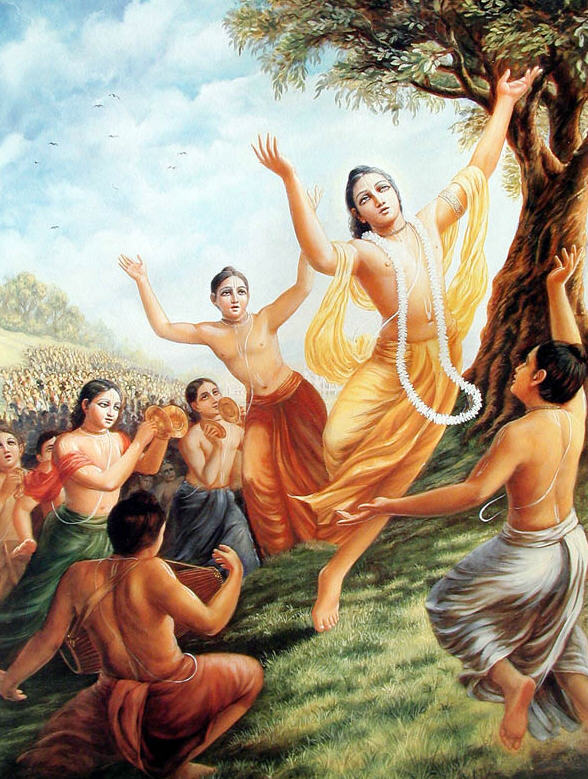
Alongside Sri Chaitanya-mangala, Lochana Dasa Thakura composed many separate devotional songs, or padavali, in Bengali. By his own admission, he wrote these songs partly because of a worry about his own great book. Sri Chaitanya-mangala concentrates its praise on his guru Narahari Sarkara Thakura's closeness to Chaitanya Mahaprabhu. It does not speak at equal length about Nityananda Prabhu's glories. Lochana Dasa Thakura worried that this might look like neglect. So he wrote a set of songs especially to glorify Nityananda Prabhu and make up for it. Two of these are Nitai Gunamani ("Nitai is the jewel of virtue") and Akrodha Paramananda ("Free from anger, the embodiment of supreme joy"). They describe Nityananda Prabhu wandering from door to door, giving the holy names to the fallen without asking who deserved them. Both are still sung in kirtana by Gaudiya Vaishnavas today.
| Detail | Description |
|---|---|
| Best-known songs | Parama Karuna, Nitai Gunamani, Akrodha Paramananda |
| Subjects | Chaitanya Mahaprabhu, Nityananda Prabhu, Gauridasa Pandit |
| Other credited works | Prarthana, Durlabha-sara, Dhamali |
| Translations attributed to him | Ramananda Raya's Jagannatha-vallabha-nataka; the Rasa-panchadhyaya, in Bengali verse |
| In the Vaishnava Song Book | 12 songs catalogued under Locana Dasa Thakura in the /songs/ collection |
Parama Karuna and Srila Prabhupada's Purport #
Of all Lochana Dasa Thakura's songs, Parama Karuna, Pahu Dui Jana ("Supremely merciful are these two Lords, Nitai and Gauracandra") appears to have held a special place for Srila Prabhupada. In a recorded talk given in Los Angeles on 4 January 1969, Prabhupada sang the song in full and then went through it line by line. He introduced it simply: "This is a song by Locana dasa Thakura, a great devotee and acharya of the Gaudiya-sampradaya." He explained each line in turn. Nitai and Gauracandra, he said, are the most merciful of all incarnations, because they distribute love of God through the simple, joyful process of chanting and dancing, not through demanding philosophical study. He also explained that in the song's final verses, Lochana Dasa Thakura looks at himself. Lochana Dasa Thakura admits that he is caught in sense gratification, and that he fears Yamaraja's punishment for failing to take shelter of Nitai-Gauracandra's mercy. Prabhupada gave an entire recorded class to a single six-verse Bengali song. This itself shows how highly he regarded Lochana Dasa Thakura's devotional poetry.
A Teaching on Raganuga Bhakti #
Beyond songs of simple glorification, at least one of Lochana Dasa Thakura's compositions carries a specific teaching point. It concerns the raganuga bhakta, a devotee following the spontaneous devotional moods of Vraja, not the regulated path of vaidhi-bhakti. The song teaches that such a devotee should take shelter of Gadadhara Pandit in order to attain prema-bhakti for Radha and Govinda. In this song Gadadhara Pandit is addressed by the epithet Vrindavanishvari, queen of Vrindavana. This song stands alongside his songs of praise for Chaitanya Mahaprabhu, Nityananda Prabhu, and Gauridasa Pandit. Together they show that Lochana Dasa Thakura's padavali did not only express devotion. Sometimes they also taught points of Gaudiya Vaishnava theology, quietly, in verses that could be sung, not in prose argument.
His Songs in the Vaishnava Song Book #
The Vaishnava Song Book preserves a dozen compositions catalogued under the name Locana Dasa Thakura. They include Nitai Guna Mani, Bhaja Bhaja Hari, Akrodha Paramananda, and Parama Karuna Pahu Dui Jana, among others. Several of them are the songs described above, and they are still sung in Gaudiya Vaishnava kirtana five centuries after they were written. Visitors who wish to read or hear these compositions in full can find them in the songs section.
Other Writings #
Beyond his devotional songs and Sri Chaitanya-mangala, tradition credits Lochana Dasa Thakura with several other works. They are Prarthana, a further collection of prayers; Durlabha-sara; and Dhamali. Tradition also credits him with Bengali verse translations of Ramananda Raya's Sanskrit drama Jagannatha-vallabha-nataka and of the Rasa-panchadhyaya, the five chapters of Srimad-Bhagavatam describing Krishna's rasa dance. Together with Sri Chaitanya-mangala, all this work makes Lochana Dasa Thakura one of the more productive writers of the generation that followed Chaitanya Mahaprabhu's own associates. In Srila Prabhupada's own estimate, he deserves to be counted alongside Narottama Dasa Thakura and Bhaktivinoda Thakura among the great song-composers of the Gaudiya Vaishnava line.
Scriptural evidence for this chapter (2)
parama koruṇa, pahū dui jana
nitāi gauracandra
saba avatāra-sāra śiromaṇi
kevala ānanda-kanda
Word for word
parama koruṇa: supremely merciful; pahū dui jana: two lords; nitāi gauracandra: Nitai and Gauracandra; saba avatāra-sāra śiromaṇi: the essence and crest-jewel of all incarnations; kevala ānanda-kanda: the very root of joy
Lord Nitai and Lord Gauracandra are supremely merciful. They are the essence of all incarnations. The specific significance of these incarnations is that They introduced a process of chanting and dancing that is simply joyful.
From the purport: Purport excerpt: "This is a song by Locana dasa Thakura, a great devotee and acharya of the Gaudiya-sampradaya."
Srila Prabhupada sang this entire song and gave a line-by-line purport to it in a 1969 Los Angeles talk, making it the single richest piece of Prabhupada commentary found on any Lochana Dasa Thakura composition.
nitāi guṇamaṇi āmāra nitāi guṇamaṇi
aniyā premera bānyā bhāsāla abanī
Nitai is the jewel of virtue, my Nitai is the jewel of virtue. He brought the deluge of love of God and flooded the world.
One of Lochana Dasa Thakura's best-known independent songs glorifying Nityananda Prabhu, still sung in Gaudiya Vaishnava kirtana and catalogued in the /songs/ archive.
Chapter 5
Disappearance and Legacy
No source records the year Lochana Dasa Thakura departed this world, but his book and his songs are still with us.
No source gives a year, or even an approximate period, for Lochana Dasa Thakura's disappearance. This is a real gap in the record, and it cannot honestly be filled. But multiple independent sources do agree on where his samadhi is. It lies in the Chaunsath Samadhi, or 64 Samadhis, area of Vrindavan. This is a garden near the Radha-Damodara and Radha-Govinda temples, where the nama- and puspa-samadhis of some of the most confidential associates of Chaitanya Mahaprabhu are preserved. Other Gaudiya Vaishnava figures with samadhis in the same area include Svarupa Damodara Goswami and Raghunatha Dasa Goswami. So, in the tradition's own view, Lochana Dasa Thakura rests among highly honoured devotees.
| Detail | Description |
|---|---|
| Disappearance year | Not recorded in any source |
| Samadhi location | Chaunsath Samadhi (64 Samadhis) area, Vrindavan |
| Other samadhis in same area | Svarupa Damodara Goswami, Raghunatha Dasa Goswami |
| Book still printed and sung | Sri Chaitanya-mangala; padavali songs in ongoing kirtana use |
A Garden of Confidential Associates #
The 64 Samadhis garden itself has its own history. The first samadhis established there, near Vrindavan's Radha-Govinda temple, were those of Raghunatha Bhatta Goswami, Kashishvara Pandit Goswami, and Subuddhi Raya. Over the generations that followed, the temple's caretakers added further samadhis. In time the site came to be recognized as a resting place for sixty-four of Chaitanya Mahaprabhu's most confidential associates. Lochana Dasa Thakura's own samadhi stands among them, even without a recorded date attached to it. This itself shows how highly the Gaudiya Vaishnava tradition ranked him.
Present Until His Guru's Final Days #
The records of Lochana Dasa Thakura's later years tell us less about his own end than about his guru's. According to the Bhakti-ratnakara, he was present at Narahari Sarkara Thakura's disappearance festival. There he took on the task of greeting the gathered devotees and offering them sandalwood paste and garlands. He was a poet able to compose an entire biography of Chaitanya Mahaprabhu, yet at his own guru's final gathering he served as a simple attendant. For all his skill as a writer, Lochana Dasa Thakura's own writing returns again and again to one idea: he is Narahari Sarkara Thakura's servant first and a poet second. This small act of hospitality at his guru's disappearance festival fits that same view of himself, right to the very end of the record we have of him.
What Outlasted the Uncertain Dates #
Whatever the uncertainty around his own final years, Lochana Dasa Thakura's literary legacy is not in doubt. Sri Chaitanya-mangala, printed and distributed by Bhaktisiddhanta Sarasvati Thakura, continued to circulate in Gaudiya Vaishnava circles well into the twentieth century. For generations wandering musicians carried its verses across rural Bengal, in much the way reciters carried the Ramayana and Mahabharata. His padavali songs have done, if anything, even better. Several are still among the regular songs of Gaudiya Vaishnava kirtana today, and the Vaishnava Song Book still preserves a dozen of them. One of these is the very Parama Karuna that Srila Prabhupada once sang and explained line by line in a Los Angeles temple room. He described its author as "a great devotee and acharya of the Gaudiya-sampradaya."
A Place in the Wider Parampara #
Lochana Dasa Thakura's life, directly or through his writing, touched the lives of several other acharyas of the Gaudiya Vaishnava tradition. His guru Narahari Sarkara Thakura connects him to the wider circle of Srikhanda Vaishnavas. He carefully handled the naming of his own book beside Vrindavana Dasa Thakura's Chaitanya-bhagavata (see Writing Sri Chaitanya-mangala), and this ties him to the earliest generation of Chaitanya biographers. His songs are still sung in temples that trace their teaching back through Bhaktisiddhanta Sarasvati Thakura and Srila Prabhupada to Chaitanya Mahaprabhu Himself. In this way his voice is still alive in Gaudiya Vaishnava worship, five centuries after he first sat down at Baradanga to write. The record of his final days is thin. But the fact that his book and songs have continued all this time is the clearest evidence of the place Gaudiya Vaishnava tradition has given him.
Closing
Songs in the Vaishnava Song Book #
The Vaishnava Song Book carries 12 songs attributed to Srila Lochana Dasa Thakura: see the full author page here.
- Lochana Dasa Thakura - Biography | Gaudiya History
- Lochana Dasa Thakura - Biography (continued) | Gaudiya History
- Lochana Dasa Thakura | Gaudiya History
- Sri Lochana Dasa Thakura - Vrindavan Chandrodaya Mandir
- Sri Caitanya-caritamrita, Adi-lila 10.78-79, purport
- Lochan das Thakura - Biography | Sripat Baradanga - The Gaudiya Treasures of Bengal
- Bhajan and Purport to Parama Koruna, Los Angeles, 4 January 1969
- Lochana Dasa Thakura Disappearance - Ramai Swami
